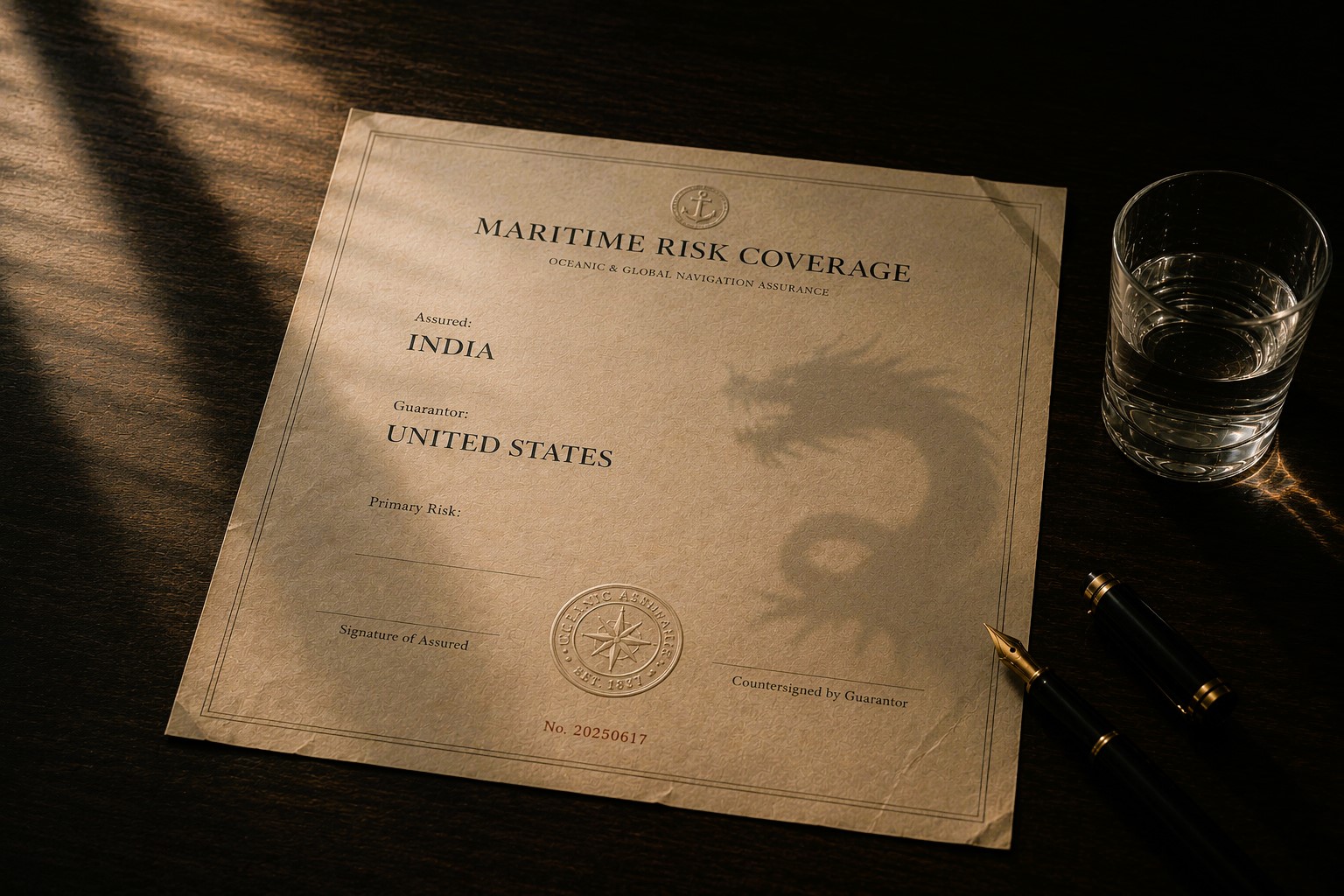

Behind the public disagreements between India and the United States lies a reality that directly affects shipping, trade and geoeconomics. For New Delhi, the main issue is neither President Donald Trump’s tariffs nor the occasional disputes with Washington. It is the control of Indo-Pacific sea lanes and the growing power of China.
A maritime economy dependent on open sea lanes
India is fundamentally a maritime economy. Approximately 95% of its foreign trade is transported by sea, while its energy security depends on maritime imports of oil and LNG from the Persian Gulf. The Strait of Hormuz, the Gulf of Aden, the Arabian Sea and the Indian Ocean constitute vital arteries for the country’s economic growth.
It is precisely in this geography that the world’s most significant strategic competition is unfolding today. China is no longer confined to the South China Sea. Through the network of ports, infrastructure projects and investments it has developed under the Belt and Road Initiative, Beijing is gradually expanding its presence across critical locations in the Indian Ocean, creating a sphere of influence that causes growing concern in New Delhi.
China’s expanding footprint in the Indian Ocean
For Indian strategic planners, this issue is far from theoretical. China’s presence at Pakistan’s Gwadar Port, as well as its investments in Sri Lanka, Bangladesh and other coastal infrastructure projects throughout the region, are viewed as part of a broader strategy aimed at restricting India’s room for manoeuvre within its natural geopolitical environment.
Within this context, the relationship with the United States acquires critical importance. Despite tensions caused by American tariffs, pressure regarding imports of Russian oil and Trump’s interventions in India–Pakistan affairs, Prime Minister Narendra Modi’s government shows no willingness to challenge the country’s strategic orientation. The reason is simple: only the United States currently possesses the naval, economic and military power capable of serving as a counterbalance to China.
The strategic logic behind the partnership
India’s real concern stems from the continuously widening power gap with China. The Chinese economy is now approximately five times larger than India’s, while Beijing is systematically converting this economic advantage into military capabilities. China operates three aircraft carriers, advanced fifth-generation fighter aircraft, a powerful defence industry and the world’s largest shipbuilding base. In contrast, India remains significantly dependent on imported military systems and foreign technology.
These developments are particularly important for global shipping. The Indo-Pacific hosts the world’s most critical maritime trade corridors. A substantial share of global container traffic, energy shipments and raw material flows passes through this region. The balance of power between China, India and the United States directly affects freedom of navigation, supply chain security and the overall cost of international trade.
Why alternative partners cannot replace Washington
In theory, India could seek alternative strategic partners. Russia remains an important supplier of military equipment, but its increasingly close relationship with China and the consequences of the war in Ukraine have reduced its value as a geopolitical counterweight. At the same time, countries such as Japan and Australia are strengthening cooperation with India through the Quad framework, but their capabilities are insufficient on their own to balance Chinese power.
Even a potential rapprochement with Beijing appears extremely difficult. Border disputes in the Himalayas, repeated clashes in recent years and the close strategic partnership between China and Pakistan have created an environment of deep mutual distrust. India understands that any temporary improvement in bilateral relations does not eliminate the long-term competition for influence across Asia and the Indian Ocean.
What it means for shipping and supply chains
The central conclusion of this analysis is that the India–United States partnership is no longer based on political sympathies or personal relations between leaders. It is based on a shared strategic necessity: maintaining a balance of power in the Indo-Pacific that prevents China from achieving overwhelming dominance over the world’s most important maritime trade routes.
For international shipping, the maritime economy and global supply chains, this development represents one of the most significant geostrategic realities of the coming decade.
George S. Skordilis is Editor-in-Chief of geo-trends.eu.