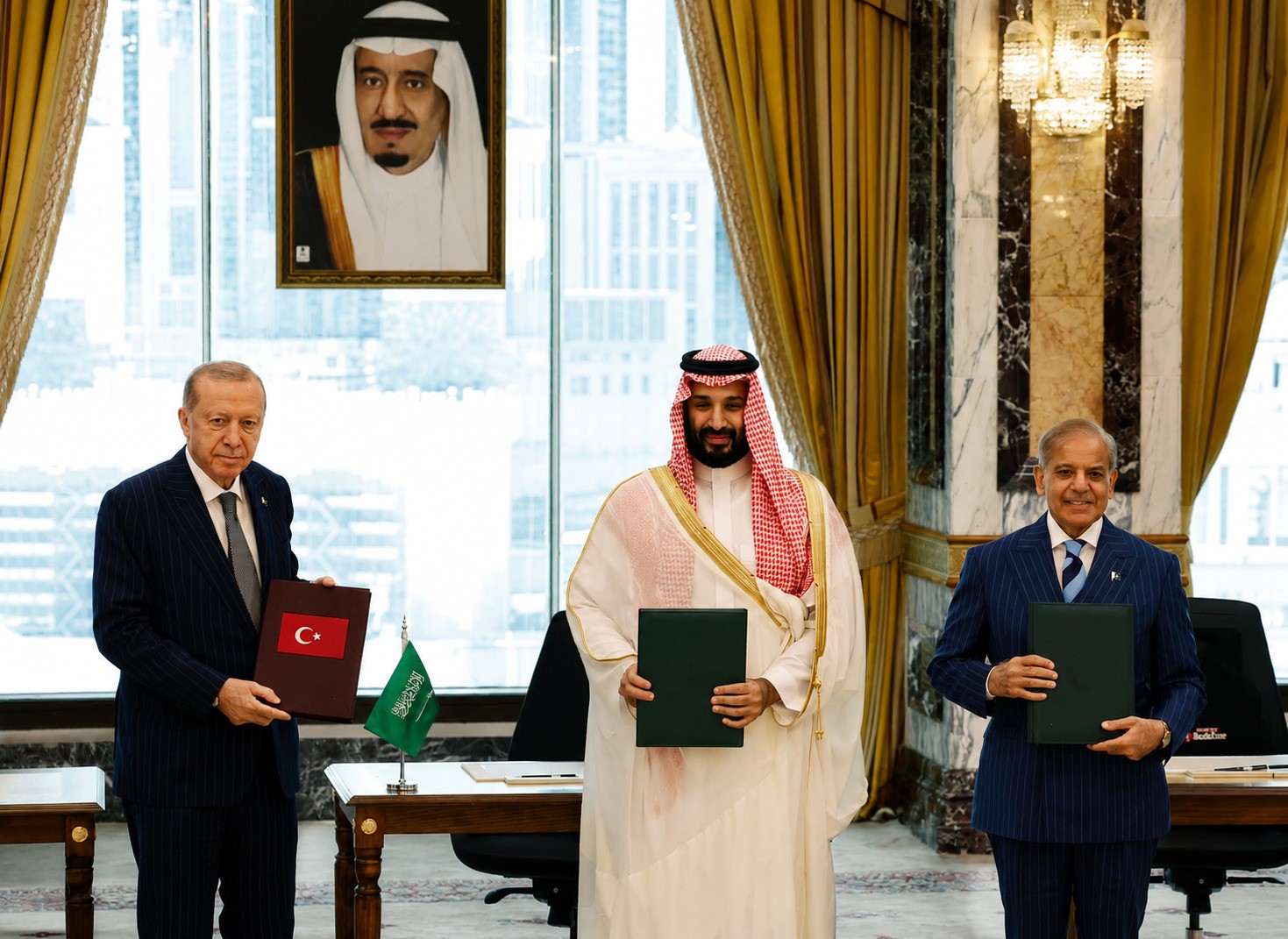

In June, we mapped the emerging Sunni security alignment as a consultation mechanism without a charter: frequent meetings, no communiqués, studied silence. That phase has ended. On 7 August 2026, Crown Prince Mohammed bin Salman, President Recep Tayyip Erdoğan and Prime Minister Shehbaz Sharif signed the Mecca Joint Defence Agreement, building on the September 2025 Saudi-Pakistani treaty by extending its collective-defence framework to Türkiye. Its central clause reads like Article 5: an armed attack on one signatory counts as an attack on all three, though the joint statement stayed silent on what each party actually owes the others.
Meanwhile, on the opposite shore, Athens, Nicosia and Jerusalem have spent a decade building their own alignment, and the past eight months have hardened it into something operational. Two blocs now share one sea. Between them sits Egypt, courted by both and committed to neither. Above them hangs a NATO that increasingly resembles a listed building: protected, admired, and structurally unsound.
What the Mecca Pact actually builds
Six days after the signing, the Turkish defence ministry laid out the machinery: standing committees of defence ministers, foreign ministers and chiefs of staff; joint land, air and naval exercises; cooperation on air defence, unmanned systems, electronic warfare and artificial intelligence. Reuters separately reported the political and military coordination mechanisms and deeper defence-industry cooperation, for readers who prefer wire-service sobriety. Moreover, the defence-industrial track aims at joint development and production rather than shopping lists. Foreign Minister Hakan Fidan has even compared the clause to NATO’s Article 5, and a permanent secretariat is expected in Saudi Arabia. In this region, that counts as reckless institutional ambition.
The arithmetic explains the attention. Together the three states field roughly 1.4 million active personnel, 3,400 aircraft, 6,000 tanks and more than 340 naval assets, per the 2026 Global Firepower Index. The grouping combines the world’s swing oil producer, NATO’s second-largest army and the only nuclear arsenal in the Muslim world. Furthermore, Pakistan already keeps around 8,000 troops, fighter jets, drones and an air-defence system on Saudi soil, so the treaty formalises a presence rather than promising one. In short, the Mecca Pact is a hedge with teeth.
Furthermore, the motive remains the one we identified in June. Iranian strikes on Saudi territory during the 2026 war demonstrated, once again, that American protection arrives selectively. Riyadh therefore bought insurance elsewhere. Türkiye gains capital and markets for its defence industry, while Pakistan gains Saudi economic backing and regional standing. Nobody needed to mention Israel in the text, and pointedly, nobody did.
The Hellenic triangle answers in kind
Athens, Nicosia and Jerusalem did not wait for Mecca. At their tenth trilateral summit in Jerusalem on 22 December 2025, the three leaders signed agreements on maritime security and energy interconnection. Days later, their armed forces signed the Joint Action Plan for 2026 in Nicosia, alongside a bilateral Greece–Israel military cooperation programme.
The content is operational rather than ceremonial. Israeli fighters return to the Iniochos exercise, Greece joins Noble Dina, and Israel transfers air-defence know-how drawn from its laser-based Iron Beam programme. In addition, local reporting has floated a joint rapid-response force of roughly 2,500 personnel. Underneath sits a multibillion-euro procurement relationship: PULS rocket artillery, the Achilles Shield air-defence project and the 3+1 framework with Washington.
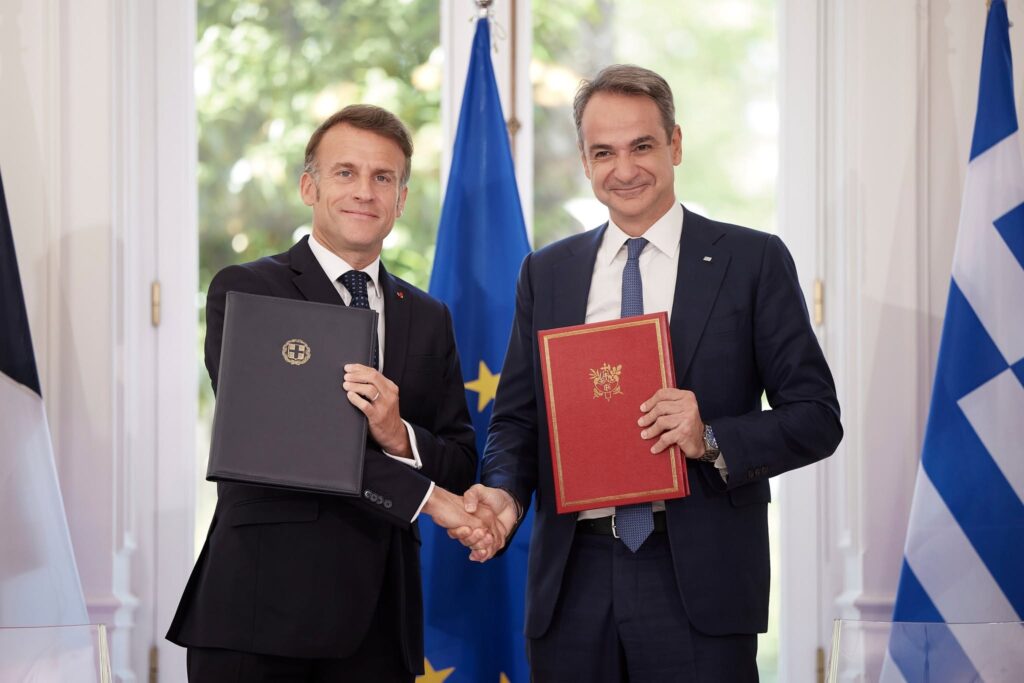 © Greek Prime Minister’s Office
Nor does the triangle stand alone. Greece’s 2021 treaty with France pledges immediate military assistance if a third country attacks either party, even an ally. Moreover, in April 2026 Macron renewed the pact in Athens for another five years, calling the assistance clause “inviolable,” a month after naming Greece among the European allies in talks to host French nuclear-armed aircraft. The Hellenic bloc therefore holds its own extra-NATO guarantees, a mirror of what Riyadh sought in Islamabad. Symmetry of this kind rarely happens by accident. Grace 1
Two hedges, one Turkish problem
Reading the map as two alliances aimed at each other is tempting, and premature. Both blocs answer the same question: what happens when the American umbrella fails to open? Indeed, RUSI’s Burcu Ozcelik reads the pact as deterrence against Israel and a counterweight to Iran, not a prelude to confrontation with Tehran. However, hedges built for one contingency have a habit of facing another. The fault line between these two runs through a single capital, Ankara. Türkiye supplies the Mecca Pact with strategic reach, yet it simultaneously ranks as the principal security concern of Athens, Nicosia and, increasingly, Jerusalem. Consequently, Israeli analysts expect the pact to deepen ties between Israel, India and the Hellenic states.
Even so, three restraints complicate the collision scenario. First, nothing in the text commits Saudi Arabia or Pakistan to Turkish positions on the Aegean or Cyprus; the drafters, like NATO’s, left the nature of assistance to consultation. Second, memberships overlap: a Hellenic Patriot battery has protected Saudi territory since 2021, and Riyadh’s channel to Jerusalem stays open. Third, Athens itself reads the agreement coolly, projecting confidence in its own web of relationships rather than indulging encirclement talk.
The more realistic near-term picture is compartmentalised coexistence under strain: two Article-5-adjacent systems in one sea, with no mechanism connecting them. That arrangement stays stable only while nobody tests it. Moreover, the stress points announce themselves: a Turkish-Israeli incident in Syria, a survey crisis in the Cypriot EEZ, or rhetoric of the sort Pakistan’s defence minister supplied within a day of the signing, when he called for a united military front against Israel.
The contest for Cairo
Egypt formed the fourth pillar of the quadrilateral we described in June, yet its signature is conspicuously absent from the Mecca document. The public choreography suggests an open door. Fidan called Cairo a natural partner, flew to Egypt on 13-14 August, and Foreign Minister Badr Abdelatty confirmed that Egypt studies accession “very seriously.” The private choreography looks murkier, however. Middle East Eye reports, citing three Saudi sources, that Riyadh itself blocked Egyptian membership for now. Apparently even new alliances come with waiting lists.
Cairo’s calculus cuts across both blocs. On one side sit Gulf money, reconciliation with Ankara and the appeal of an Arab-Islamic framework that respects Egyptian mass and Suez geography. On the other side sit the Camp David treaty, the American aid relationship, delimited maritime zones with Greece and Cyprus, and the energy architecture (the GREGY interconnector, the East Mediterranean Gas Forum) that ties Egypt’s export future to the European shore. Accordingly, Chatham House’s Karim Elgendy argues that Egypt can sign only if the text protects the Washington relationship, spares existing treaties and preserves Cairo’s freedom to choose its wars.
The likeliest outcome, then, is that Egypt joins nothing outright and monetises everything. Its optimal position is exactly where it stands: courted by Ankara, subsidised by Riyadh, armed by Washington, energy-linked to Athens and at peace with Jerusalem. So the real question is not who wins Cairo, but which bloc’s failure forces Cairo off the fence. A Mecca Pact that hardens into an anti-Israel front would force a choice Egypt does not want; equally, a Hellenic bloc that lets Egyptian-Israeli relations rot over Gaza would do the same. Whoever avoids forcing that choice keeps Egypt half-inside their architecture, which, for a state of Egypt’s weight, beats a signature.
NATO, the absent underwriter
None of this makes sense without the Atlantic backdrop. The 2026 war did to NATO’s cohesion what it did to Gulf confidence in Washington. European allies collectively refused the American request for naval support in the Strait of Hormuz, and Trump answered by calling the alliance a “paper tiger.” Meanwhile, force reductions in Europe proceeded, including a cancelled armoured brigade rotation of more than 4,000 troops, even as the July summit in Ankara tried to dress retrenchment as burden-sharing.
Furthermore, a growing body of scholarship points in the same direction: not dissolution, but transformation into a multi-speed, functionally fragmented structure whose members insure themselves through side arrangements. Macron said it plainly in Athens: the doubt over Article 5 came from the American president, not from the Europeans. Seen from that angle, the two Eastern Mediterranean blocs are not anomalies within the NATO order. They are its successor logic, arriving early.
Consider the arrangement NATO now contains. Türkiye, a member, holds an Article-5-style guarantee outside the alliance through the Mecca Pact. Greece, a member, holds a mutual-assistance clause with France and a place in an emerging French nuclear-deterrence arrangement, also outside alliance structures. The Greek-Turkish dyad, which NATO spent seventy years containing inside one command structure, now sits embedded in two rival external frameworks, precisely because neither capital believes the internal one will function when needed. Real deterrence commitments have migrated from Brussels to Mecca, Paris and Nicosia. The buildings in Brussels remain lovely.
The price of the next signature
Three trajectories follow. In the first, the blocs compartmentalise: overlapping Saudi-Greek, Saudi-Israeli and Egyptian ties absorb the shocks, and the Eastern Mediterranean settles into managed bipolarity. In the second, a trigger in Syria or the Cypriot EEZ aligns the fault lines, Egypt must finally choose, and the two hedges become what their critics already call them. In the third, and least discussed, the Mecca Pact and the Hellenic triangle become building blocks of a post-American regional concert, with Riyadh and Cairo as the hinges.
Our June analysis closed by noting that the alignment’s arc looked clear while its tensile strength remained untested. Two months on, the arc has become a treaty, and the test has moved west, into the sea where the two architectures meet. Nobody will collect the next signature that matters in Mecca or Jerusalem. Cairo will grant it, or withhold it, at a price of its own choosing.
image sources
- geo-trends.eu_Mecca Pact_: Greek Prime Minister’s Office