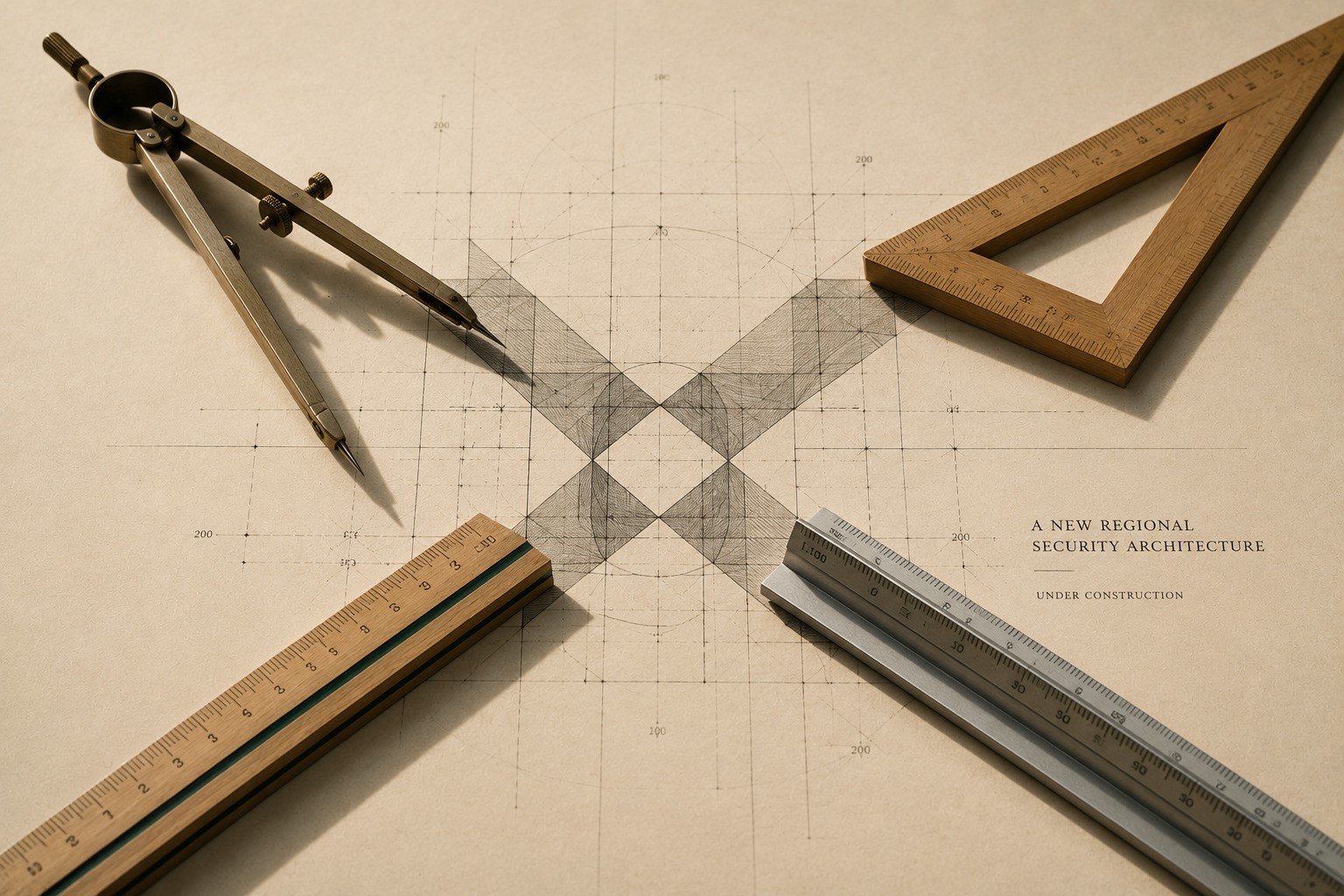

For decades, Washington tried to construct a Sunni security bloc across the Middle East. It spent political capital, hosted summits and drafted frameworks with names that sounded impressive in press releases. Every single attempt collapsed under the weight of competing national interests, Saudi-Qatari feuds and the basic unwillingness of Arab states to place their armies under someone else’s command. Then, in a nine-month window between September 2025 and June 2026, a war nobody formally declared produced what thirty years of diplomacy could not.
The irony is structural, not coincidental. The Strategic Mutual Defence Agreement between Saudi Arabia and Pakistan, signed on 17 September 2025, was already in its final drafting stages before the Israeli strikes on Doha brought it to the surface. The war did not create the architecture. It accelerated it, stripped away the diplomatic cover and made the underlying logic visible to anyone paying attention.
What is emerging is a Sunni security alignment built on four pillars: Saudi financial and religious weight, Turkish military-industrial capability and NATO membership, Pakistani nuclear deterrence and mediation credibility, and Egyptian geographic depth via the Suez Canal. It met three times at foreign minister level in thirty-one days between March and April 2026 in Riyadh, Islamabad and Antalya. It produced no communiqué. That silence is not a sign of weakness. It is a studied choice by states that have learned, at considerable cost, that declarations invite vetoes.
What the SMDA actually means
The Saudi–Pakistan Strategic Mutual Defence Agreement contains a clause that its drafters borrowed almost verbatim from the NATO Treaty: an attack on one party is an attack on both. Pakistani Defence Minister Khawaja Asif initially stated this extended to Pakistan’s nuclear umbrella, a claim he subsequently retracted under diplomatic pressure, though a senior Saudi official told Reuters the agreement “encompasses all military means” without explicitly excluding nuclear sharing. The Bulletin of the Atomic Scientists assessed that language as “formally ambiguous,” which in nuclear diplomacy is not imprecision. It is policy.
Riyadh’s motivation is straightforward. Saudi Arabia has no formal mutual defence treaty with the United States. It has bases, bilateral agreements and decades of weapons purchases, but no Article 5 equivalent. The Trump administration’s own record reinforced the point: after the 2019 Abqaiq attacks, Trump publicly stated the U.S. had no obligation to defend the Kingdom. The SMDA fills that gap, not cleanly, but credibly enough to serve as deterrence signalling.
The Sunni security bloc taking shape around this agreement is not a replacement for the American security umbrella. It is a hedge against the moment that umbrella fails to open. Given what Gulf states observed between February and June 2026, that calculation is harder to argue with than it once was.
The quartet’s geometry
The IISS, in a May 2026 analysis, described the four-nation grouping as a “fluid consultation and coordination mechanism” that has moved from reactive crisis response to institutionalised consultation. That is precise language from an institution not known for overstatement. Three foreign minister sessions in a month, followed by a bilateral Turkish-Saudi Coordination Council meeting in Ankara on 6 May, constitute a pace of engagement with no recent parallel in any of the four states’ alliance histories.
The significance of the emerging alignment lies not in the aggregate power of its members but in their complementarity. Each member contributes a function the others cannot easily replace.
Saudi Arabia provides the political centre of gravity. Without Riyadh’s financial weight, diplomatic influence and convening power, the framework would struggle to acquire either momentum or regional relevance.
Türkiye provides strategic reach. It connects the grouping simultaneously to NATO structures, regional military theatres and diplomatic channels that remain closed to many Arab states.
Pakistan provides deterrence and mediation. Its military relationship with Saudi Arabia, nuclear ambiguity and ability to communicate across rival geopolitical camps make it uniquely positioned to reduce escalation while preserving leverage.
Egypt provides strategic depth and Arab legitimacy. Control of the Suez Canal gives Cairo enduring geographic relevance, while its political weight prevents the alignment from being perceived as a narrowly Gulf-centred project.
Taken individually, none of these functions is sufficient to sustain a new regional security architecture. Taken together, they begin to form something more consequential than a coalition of capabilities. They form a coalition of functions. The emerging alignment derives its strength not from what its members share, but from what each contributes that the others lack. What this Sunni security bloc does not yet have is a permanent secretariat, a fixed meeting schedule or a unified command structure. Sessions rotate between capitals and are consistently held on the sidelines of broader diplomatic events, which provides plausible deniability and avoids the institutional formality that would require a charter. Whether that changes depends on the sixty-day Memorandum of Understanding (M0U) clock, Israeli military behaviour in Lebanon and Syria, and whether Saudi Arabia can sustain its current ambiguity between Washington dependence and strategic autonomy.
The MoU and the American retreat
The Islamabad Memorandum of Understanding, signed digitally on 15 June 2026 and formally sealed at a signing ceremony in Bürgenstock, Switzerland on 19 June, contains a provision that redraws the regional map more decisively than any battle damage assessment: the United States commits not to deploy additional forces in the region pending the final deal. Combine that with the gradual lifting of sanctions, the release of frozen Iranian assets and the sixty-day negotiation clock, and the picture that emerges is of an American administration that entered a war with maximum force and is exiting with minimum strategic gain.
The Gulf states registered this immediately. Confidence in Washington as a security guarantor has diminished, as the Atlantic Council noted the day the MoU was announced, though Gulf states remain dependent on American hard-security projection from bases on their territory. That dependency and that diminished confidence now coexist permanently. It is an uncomfortable combination, and it is precisely the combination that makes the Sunni security bloc not a luxury but a structural necessity.
Israel is absent from the MoU entirely. It is not a signatory, not a guarantor, not a named party to the ceasefire framework. The agreement calls for “termination of military operations on all fronts, including in Lebanon,” a provision that Netanyahu’s government was still working to circumvent through escalation even as the text was being finalised. For Arab states watching this in real time, the conclusion was not subtle: Washington signed a deal that constrains American options but leaves Israeli operational freedom intact in territories that are not Iran.
From Anti-Iran architecture to broader strategic calculus
Israel’s exclusion from the MoU is not merely a legal technicality. It is the moment that forces Arab states to answer a question they had carefully avoided for three years: if the United States is both their security patron and the co-author of military campaigns that destabilise their neighbourhood, what exactly are they buying with that relationship? The emergence of the Sunni security bloc as a consultation mechanism is, in part, the answer taking institutional form.
The Arab states involved in building this alignment do not view Iran benignly. Many consider it a serious and enduring security challenge, and nothing in the MoU changes that assessment. But that assessment now sits alongside a parallel view, increasingly explicit in the analytical literature: Israel’s pursuit of regional paramountcy, and Washington’s demonstrated readiness to enable it, has introduced an additional destabilising variable into the regional system, one that the older anti-Iran framework was never designed to address.
The ISPI analyst Eleonora Ardemagni offered the most direct formulation available in the open literature: the potential expansion of the SMDA to Türkiye “would be primarily related to Israel’s containment.” Not Iran’s. That does not mean Iran has ceased to be a concern. It means the strategic agenda of this Sunni security bloc has expanded to include a second variable that did not appear on the original spreadsheet.
Israel and the arithmetic of isolation
The Center for American Progress, not a publication given to inflammatory framing, described the February 28 strikes as having “disrupted a fragile regional equilibrium that Arab governments had spent years trying to preserve.” Arab states had pursued limited de-escalation with Tehran not out of affection, but because they were trying to prevent their region from becoming the primary battlefield between Iran, Israel and the United States. That strategy failed on 28 February. The Sunni security bloc is, among other things, the institutional response to that failure.
Israeli political figures understand their new position and have responded with the kind of public outrage that illuminates the problem rather than resolving it. When the MoU was announced, journalists close to Netanyahu called Trump a “loser” and questioned American loyalty. A state that considers itself the indispensable regional partner does not respond to a peace deal with fury. It responds with fury when it recognises that the deal was reached without it, around it and, in certain provisions, in direct tension with its operational plans.
The arithmetic is not complicated. Four states representing over 1.7 million active military personnel, two G20 economies, one nuclear power and one NATO member are meeting with increasing regularity and decreasing transparency. Their agenda, as the Egyptian foreign minister stated at Antalya on 18 April 2026, is “hammering out a security deal.” Whether that deal ever acquires the formal architecture of an alliance or remains a fluid coordination mechanism is, at this moment, an open question. Whether this becomes a formal alliance remains uncertain. Whether a Sunni security alignment is emerging does not.
The sixty-day MoU clock began ticking on 15 June. Whether the post-war regional order gets written in Washington and Tel Aviv, or in Riyadh, Islamabad, Ankara and Cairo as well, depends on what happens in that window. The arc of the alignment is clear. Its tensile strength remains untested.