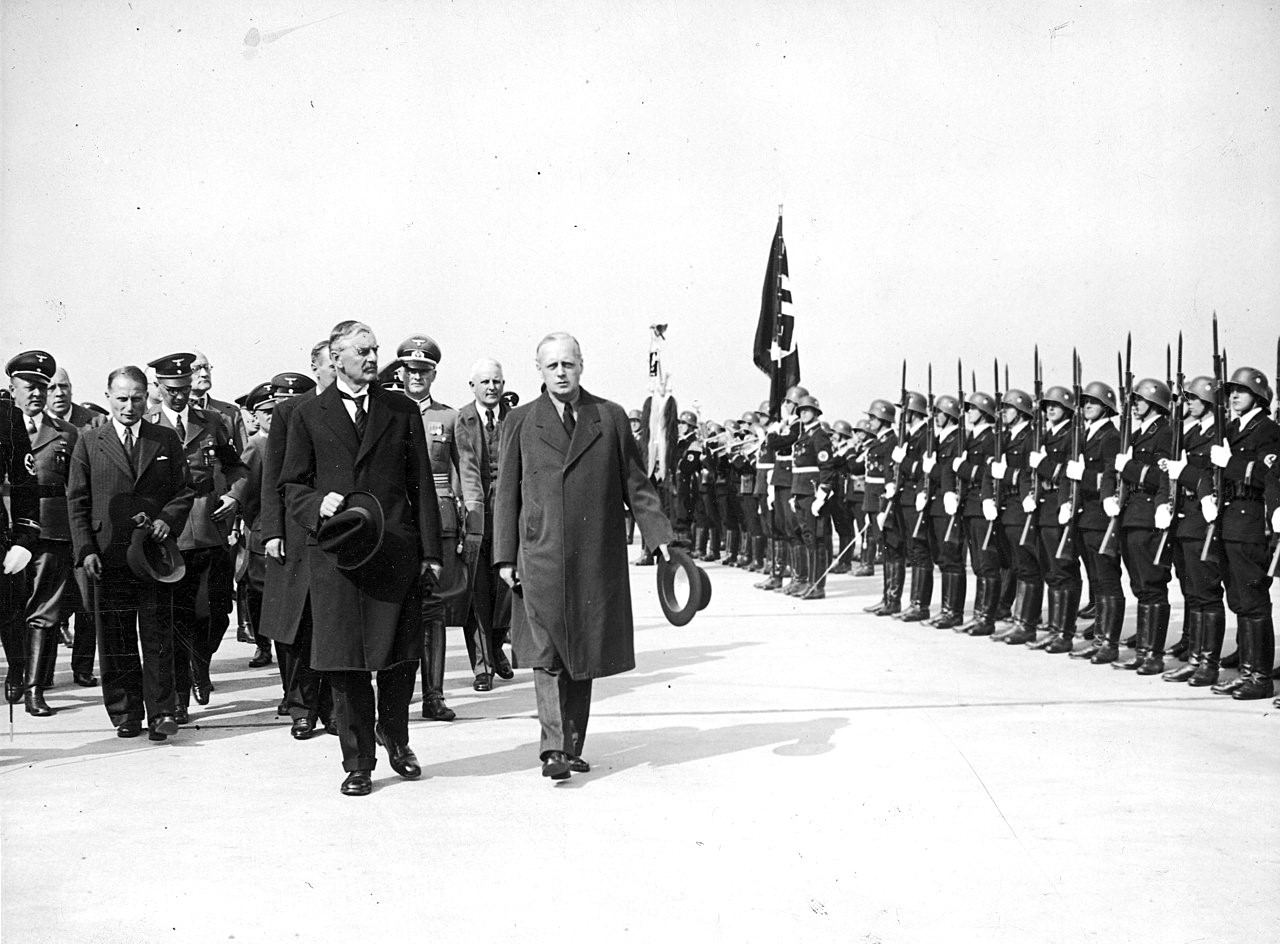

When prominent analysts compare the 2025 Riyadh meeting between American and Russian officials to the 1938 Munich Agreement, the analogy is not just misleading but a fundamental analytical failure. History does not operate as a loop, endlessly repeating itself. Instead, it evolves through specific social, economic, and political conditions.
The idea that Donald Trump in 2025 mirrors Neville Chamberlain in 1938 oversimplifies history and ignores the unique complexities of both moments in time.
The Munich Agreement: A product of its time
The 1938 Munich Agreement was an attempt by Britain and France to appease Adolf Hitler by allowing Nazi Germany to annex the Sudetenland, a German-speaking region of Czechoslovakia, in hopes of preventing a larger war. Neville Chamberlain, the British Prime Minister, returned from Munich proclaiming “peace for our time,” only to see Hitler violate the agreement months later. This event has since become a shorthand for diplomatic failure and the dangers of appeasement.
However, the context of 1938 was unique. Europe was still reeling from the trauma of World War I, and the fear of another devastating war loomed large. The global economy was fragile, and the rise of fascism was fueled by widespread economic despair and political instability. Chamberlain’s actions, while flawed, were shaped by the belief that avoiding war was paramount, even at the cost of sacrificing smaller nations.
Economic and political structures: Then vs. now
The world economy in 1938 was vastly different from that of 2025. The Great Depression had shattered financial systems, mass unemployment had fueled extremist movements, and the gold standard had restricted monetary flexibility. By contrast, today’s global economy, while volatile, is deeply interconnected. Russia, unlike Nazi Germany, operates within globalized trade networks and faces economic constraints that did not exist in 1938.
Politically, the 1930s were marked by unstable democracies, aggressive expansionist ideologies, and the collapse of the League of Nations. In 2025, despite challenges, institutions like the United Nations, NATO, and the G20 continue to shape diplomatic interactions. The idea that Munich 1938 offers a direct lesson for contemporary diplomacy ignores how the mechanisms of international relations have evolved.
Trump vs. Chamberlain: Diverging motives and constraints
A direct comparison between Chamberlain and Trump fails to account for the different motivations behind their respective diplomatic engagements. Chamberlain, representing a Britain still recovering from World War I, sought to maintain peace at almost any cost, even if it meant conceding to Hitler’s demands. His belief was that buying time could prevent an immediate military catastrophe.
Trump, on the other hand, approaches diplomacy through a transactional lens. His engagement with Russia in 2025 is not driven by fear of global war in the same way Chamberlain’s was. Instead, Trump’s motives are shaped by domestic political considerations, economic factors, and a desire to project strength through negotiation rather than military confrontation. Unlike Chamberlain, who operated in a unipolar European context, Trump engages with Russia within a complex multipolar world where China, the European Union, and other global powers play significant roles.
Additionally, the presence of nuclear deterrence fundamentally alters the stakes of diplomacy. Whereas Chamberlain’s concessions emboldened Hitler’s expansionist ambitions, Trump’s interactions with Russia occur within an environment where direct military aggression carries unprecedented global risks. Thus, equating Trump’s diplomatic choices to appeasement oversimplifies the unique pressures and constraints he faces.
Appeasement as a misunderstood concept
The Munich analogy assumes that diplomacy equates to appeasement and that any attempt to negotiate with an adversary is a sign of weakness. This simplistic view disregards the reality that diplomatic engagement can serve multiple strategic purposes.
The 1962 Cuban Missile Crisis, for example, was resolved through negotiation rather than confrontation. Likewise, major Cold War summits between the US and USSR did not imply surrender but were essential in managing tensions.
Rhetoric vs. reality in foreign policy
Using “Munich 1938” as a reference point is not just analytically weak—it distorts policy decisions. If every negotiation with a rival is framed as appeasement, leaders face pressure to adopt rigid, maximalist stances that may lead to escalation rather than resolution.
The reality of 2025 is that diplomatic engagement with Russia, even under controversial circumstances, cannot be equated with capitulation.
The real meaning of history’s legacy
Some supporters of the repetition thesis often reference Karl Marx’s well-known statement in The Eighteenth Brumaire of Louis Bonaparte: “Hegel remarks somewhere that all great world-historic facts and personages appear, so to speak, twice. He forgot to add: the first time as tragedy, the second time as farce.”
However, the idea that history simply repeats itself is a simplistic approach that ignores the dynamic nature of historical evolution. Marx emphasized that the past influences the present through inherited structures, decisions, and ideologies. The persistence of historical stereotypes—such as the claim that appeasement always leads to disaster—reflects an outdated perception of time. The Munich Agreement of 1938 has become a symbol of diplomatic failure, but using it as a blanket analogy undermines serious analysis.
The need for historical precision
Analogies are powerful tools, but when used irresponsibly, they obscure more than they reveal. The Munich Agreement remains a significant historical event, but its overuse as a geopolitical reference point limits serious discussion. Instead of looking for past events to copy-paste onto the present, analysts must engage with history in a way that recognizes both continuity and change.
The 2025 Riyadh meeting is not Munich 1938, and treating it as such is a fundamental misreading of both history and current geopolitics.