
Steve Bannon, former White House Chief Strategist during Donald Trump’s presidency, said that the major geopolitical and economic confrontations of the coming decades will be directly linked to the control of sea routes and the protection of freedom of navigation. He made the remarks at the 11th Delphi Economic Forum, which is taking place from April 22 to April 25.
Bannon took part online in a discussion with Matthew Boyle, head of the Breitbart News Network’s Washington bureau, and commented on the main open fronts of American foreign, trade, and strategic policy. His intervention focused on U.S.–China rivalry, the importance of ports, global supply chains, Europe’s role in defense, and the policy of trade tariffs promoted by the American president.
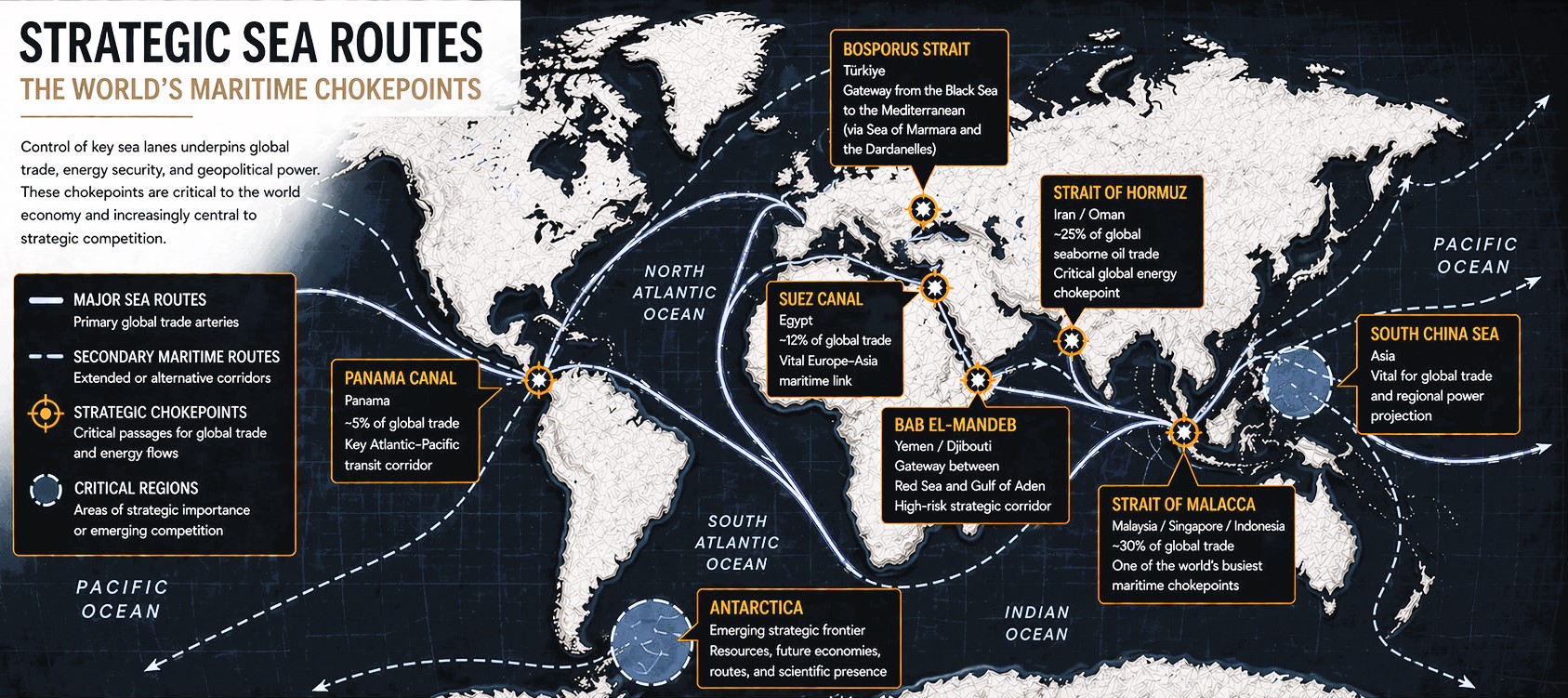
Speaking about sea lanes, he argued that freedom of navigation will be a central issue in international politics and strategic power relations. As he said, the competition for control over ports and maritime passages is already visible, with the rivalry between the United States and China standing at the center of it. In this context, he placed special emphasis on the role of Greece, saying that the Greeks have a strong shipping presence and attach great importance to the safety and smooth operation of maritime transport.
According to Bannon, the critical geographic zones of the coming years will not be limited to one single point. He referred in particular to the Red Sea, Antarctica, Panama, the Strait of Hormuz, and the Gulf of Oman, arguing that an important part of the global balance of power will be decided in these regions. In his view, the battles that will be fought over maritime supply chains will be among the most important of the coming decades, as they are directly connected to trade, energy, industrial production, and the military presence of major powers.
In the same context, he returned to the importance of Greek shipping, saying that Greece will be a critical factor in this new reality. This reference was part of his broader argument about the strategic value of maritime transport at a time of growing geo-economic competition.
When asked about NATO and European security, Bannon repeated his well-known criticism of American involvement in the war in Ukraine and argued that responsibility for Europe’s security should fall mainly on the European states themselves. He also referred to a recent incident involving an Iranian drone in Cyprus, saying that the British response was limited because, as he stated, only one ship was sent. Through this example, he sought to underline what he described as the limits of today’s European defense readiness.
He also placed particular emphasis on trade tariffs, presenting them as a tool for the reindustrialization of the United States. As he said, the core of Trump’s policy is the return of production to American soil, with the aim of restoring the country’s central role as an industrial power. In his view, such a development would not work only in favor of the United States, but could also affect the international economic system as a whole.
In the same discussion, Bannon described Chinese economic practice as a competing model, calling China a “predatory capitalist,” while arguing that Trump’s approach is based on cooperation between nations guided by mutual interests. For his part, Matthew Boyle said that the American president does not hesitate to take large-scale initiatives, adding that the scope of his plan will be judged in practice in the period ahead.
* George S. Skordilis is Editor-in-Chief of geo-trends.eu.