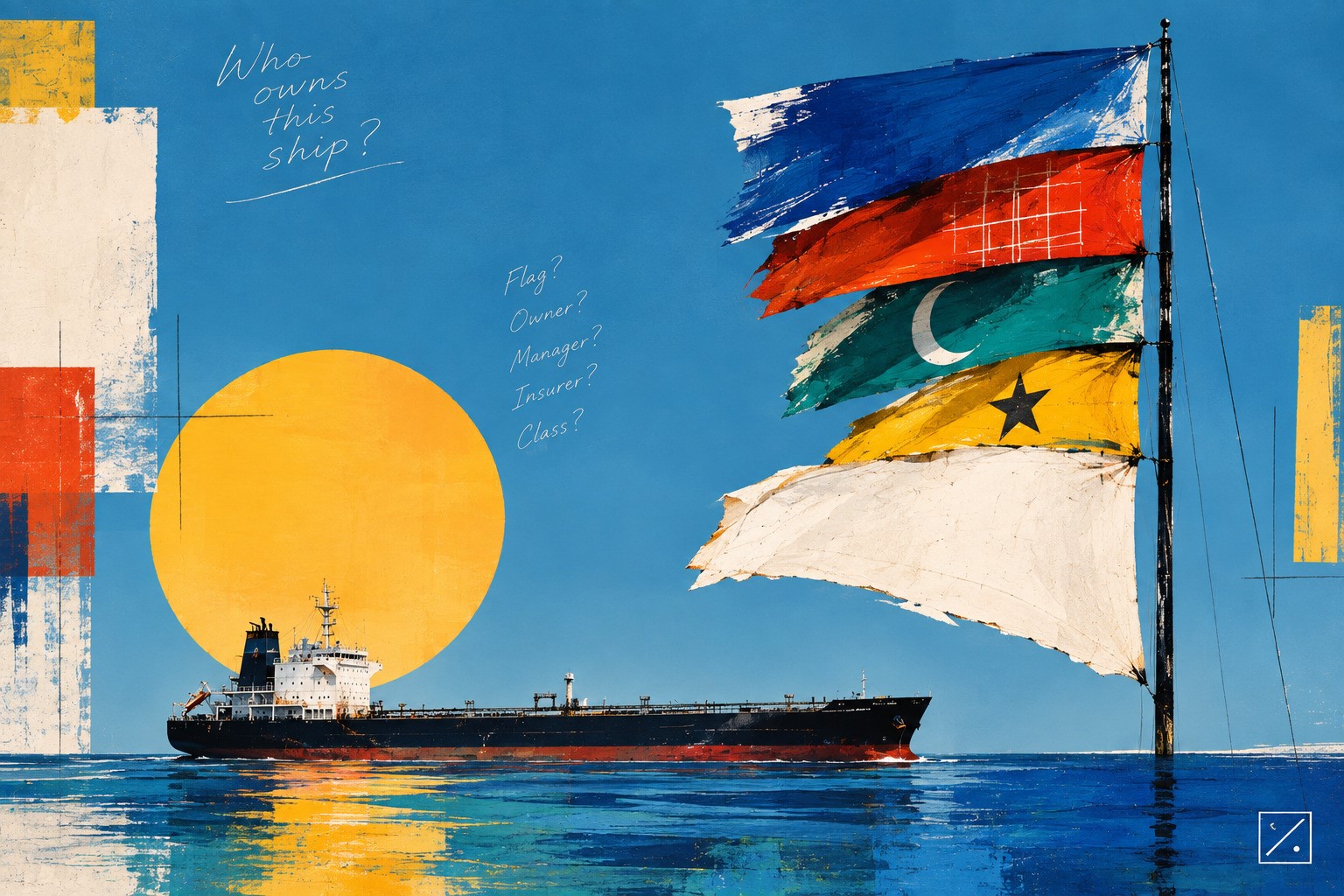

The imposition of sanctions on Russia, Iran and Venezuela did not eliminate the oil trade. It did something more complicated: it helped create a parallel maritime ecosystem in which the vessel’s flag has evolved from a marker of legal identity into one of the principal instruments for obscuring it.
Windward’s analysis paints a particularly troubling picture: 1,942 tankers and gas carriers were classified, as of August 9, 2025, as part of the shadow fleet. Of these, 884 were under Western sanctions and 929 were classified as high risk. Among vessels above 20,000 dwt that had already been sanctioned, 57% of total dwt either carried a false flag or appeared with an unknown flag in the IMO and Equasis databases.
That figure may be the most revealing of all. This is no longer simply an attempt to change flag after sanctions have been imposed. It points to a system of “flag shopping” in which a vessel can successively change flags, use temporary registrations or even display through AIS a flag different from the one under which it is legally registered.
The distinction matters. Sanctions enforcement traditionally assumes that a vessel can ultimately be traced back to a recognizable legal identity. Flag hopping attacks that assumption itself.
From flags of convenience to phantom flags: when registration loses its meaning
A flag of convenience is not illegal. The problem begins when the flag displayed by a vessel does not correspond to an actual and lawful registration.
According to the IMO definition, a vessel is carrying a false flag when the competent administration of the country confirms that it is not legally registered there. Windward identified at least 12 fraudulent registries, including Guyana, Malawi, Guinea, Curaçao, Benin, St. Maarten, Eswatini, Aruba, Timor-Leste, Mali, Angola and, later, Mozambique.
In several cases, the operating model is deceptively simple: private companies present themselves as allegedly authorized managers of national ship registries and issue certificates that create the appearance of lawful registration. The result is a vessel that appears on paper to be flying the “flag of a state” without possessing the corresponding legal basis.
And this is where a critical weakness in the international maritime system emerges. Much of its control architecture depends on documents, declared information and AIS signals. When these are falsified — or simply cease to correspond to reality — a gap opens between the actual identity of the vessel and the identity it presents to the outside world.
Windward describes fraudulent ship registries as precisely such a mechanism: vessels can appear to be legally registered while, in practice, lacking the corresponding legal authorization.
The problem, therefore, is not merely that the wrong flag appears on a screen. The deeper problem is that one of shipping’s fundamental mechanisms of accountability can be made unreliable.
The hunt for the next flag: sanctions trigger a maritime migration
The imposition of sanctions has created a reverse dynamic. The more registries remove sanctioned vessels, the greater the pressure becomes on smaller, more permissive or more vulnerable registries willing to absorb them.
Windward records that many vessels have used at least four different flags within 24 months, while some have passed through more than one fraudulent registry in just one year.
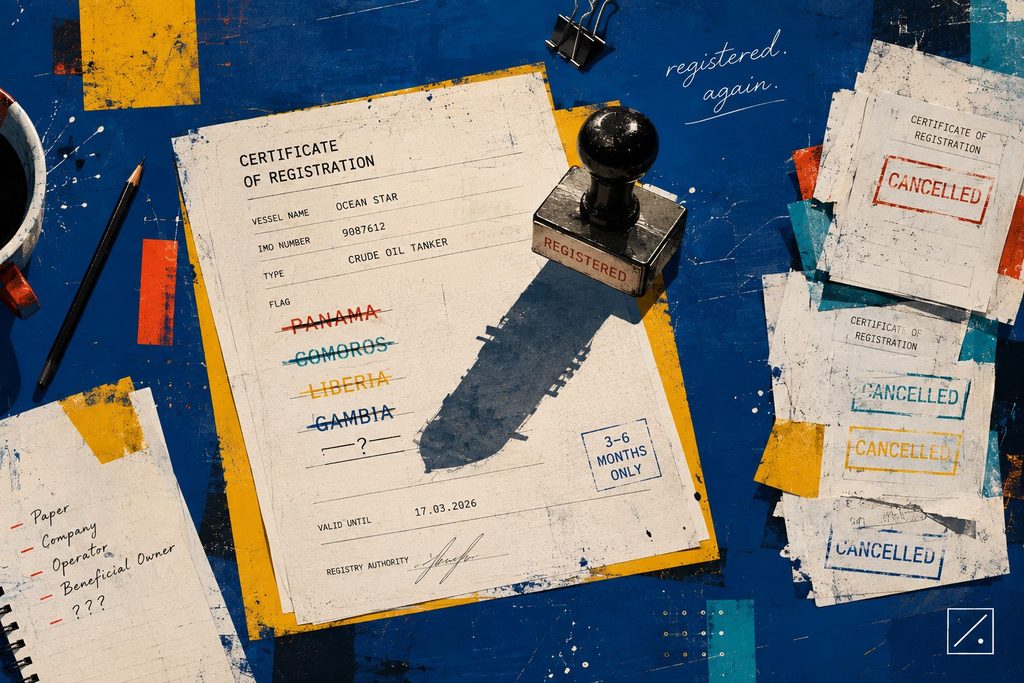
One of the main loopholes is temporary registration. Some open registries allow temporary registration for three to six months, with limited initial due diligence while the required documentation is being completed. A vessel can then change flag before the inspection process is finished.
This practice is not merely a bureaucratic trick. It has direct implications for safety. Vessels operating under false flags may lack valid insurance coverage as well as seaworthiness and safety certificates issued by recognized organizations. A vessel continuing to carry cargo can therefore find itself operating inside a kind of legal vacuum.
That is the structural consequence of flag hopping: regulatory pressure may continue to follow the ship, but legal responsibility becomes progressively harder to locate.
Sanctions are redrawing the geography of ship registries
This development is directly linked to the intensification of Western sanctions. Between January 2024 and August 10, 2025, the EU had imposed sanctions on more than 440 vessels, the United Kingdom on almost 430 and the United States on approximately 600, of which more than 170 had been sanctioned since February 2025.
The market’s response was largely predictable: reflagging.
Following an executive order in October 2024, the Panama Maritime Authority began removing from its registry vessels appearing on international sanctions lists. In the first five months of 2025 alone, approximately 200 vessels were removed.
The vessels forced to find a new flag moved mainly towards Comoros and Gambia, while others turned directly to fraudulent registries.
This is particularly significant because regulatory pressure does not necessarily eliminate the vessel from the market. It can simply move it into another part of the maritime chain — frequently one that is less transparent, less accountable and potentially more difficult to supervise.
In that sense, sanctions can produce a shifting of risk rather than its elimination.
The vessel remains. The cargo remains. The commercial incentive remains. What changes is the legal and regulatory environment surrounding them.
Gambia: how quickly the shadow fleet can redraw a registry
The case of Gambia provides a striking example of how rapidly the geography of the shadow fleet can change.
In August 2025, Windward identified 111 vessels transmitting the flag of Gambia. Of these, 33 tankers and gas carriers had already been sanctioned by the U.S., EU or UK. Another 34 were considered high risk.
The first shadow-fleet tanker appeared on the Gambia registry in May 2024. It was a 1999-built Aframax that had previously passed through the registries of the Cook Islands, Gabon and Panama.
Within just 12 months, the total gross tonnage of the Gambia registry increased by 1,038%. The number of vessels increased from 43 to 99. Until the second quarter of 2024, the registry had mainly consisted of small coastal vessels, fishing vessels and tugs.
The transformation came after the Gambia Maritime Authority informed the IMO, in October 2024, that a Cyprus-based company, Gambia International Ship Registry, was operating an international registry on behalf of the country. The company was owned by MDIR Services Ltd, which six months earlier had undertaken to establish and manage the registry.
The expansion was extraordinary: 626% in a single quarter through the end of December 2024, followed by a further 50% in the first quarter of 2025.
These numbers illustrate something larger than the growth of a single registry. They show how quickly sanctioned or high-risk tonnage can migrate when pressure closes one regulatory door and another remains open.
Beyond sanctions: the risk migrates from compliance to safety
The real stakes are broader than sanctions enforcement.
A vessel that changes flag to evade sanctions can simultaneously generate problems involving insurance, class, technical oversight, responsibility for the crew and environmental protection.
The picture becomes more troubling in areas where large numbers of shadow-fleet tankers are concentrated. Off eastern Malaysia, near the Riau archipelago, Windward has recorded up to 80 tankers anchored simultaneously, with approximately 40% carrying false flags. Ship-to-ship transfers also take place in the area, while GNSS manipulation has been recorded.
At this point, the issue ceases to be merely one of sanctions enforcement.
With ageing tankers, uncertain insurance status and vessel-identification problems, the possibility of an accident becomes a question of maritime safety and environmental liability. Windward describes the area as an epicenter of illegal and deceptive maritime activity.
And this changes the nature of the debate. Sanctions evasion may be the mechanism that pushes vessels towards opacity, but the consequences do not stop at sanctions. They travel with the ship — into busy sea lanes, anchorage zones, ship-to-ship transfer areas and ultimately the wider maritime environment.
How large Is the false-flag fleet? Even the databases disagree
The exact number is difficult to determine — and that uncertainty is itself part of the problem.
Windward’s analysis recorded 332 falsely flagged vessels in August 2025, compared with 201 reported by the IMO Secretariat in January — an increase of 65%. Of the 332, 229 were tankers, including gas carriers.
Equasis recorded 183 oil and chemical tankers using the 11 fraudulent registries, while another 40 vessels had legitimate open registries but were found to be falsely transmitting those specific flags.
Windward, for its part, identified at least 350 tankers and gas carriers transmitting the flags of fraudulent registries — a figure 53% higher than the IMO data.
The discrepancy matters.
If the institutions and databases designed to identify vessels cannot produce the same picture of the fleet, then opacity is no longer confined to individual ships. It begins to affect the system’s ability to measure the phenomenon itself.
The scale of the problem, therefore, is probably greater than official databases currently capture.
The next front: the vessels that have not yet been sanctioned
Perhaps the most consequential finding concerns vessels that have not yet been sanctioned.
Of the 929 high-risk tankers in the shadow fleet, 394 were above 20,000 dwt and did not fly the flag of Russia, Venezuela or Cuba. Windward found that 33% of these were transmitting the flag of Panama, 18% Curaçao, 8% Hong Kong and 5% Marshall Islands. In total, the 394 vessels displayed 39 different flags.
Even more revealing is that 98% of the vessels that were eventually placed under sanctions had previously been classified as high risk by Windward.
This points to something strategically important: there is a time window between the detection of suspicious behaviour and the official imposition of sanctions.
And it is precisely within this window that flag hopping appears to operate.
The enforcement challenge is therefore partly temporal. By the time a vessel moves from being identified as high risk to formally sanctioned, its registry, declared identity or ownership structure may already have changed.
The new shipping game: when the flag stops answering the question “Who is responsible?”
The picture that emerges is of a system in which the flag no longer always constitutes a reliable indicator of a vessel’s actual legal identity.
Vessels under pressure do not necessarily disappear. They migrate from registry to registry, change names and ownership structures, use temporary registrations or false flags and continue carrying cargoes.
Windward concludes that the spread of fraudulent registries and flag hopping now constitutes a systemic risk for international shipping.
But the deeper issue extends beyond the number of sanctioned ships or fraudulent registries.
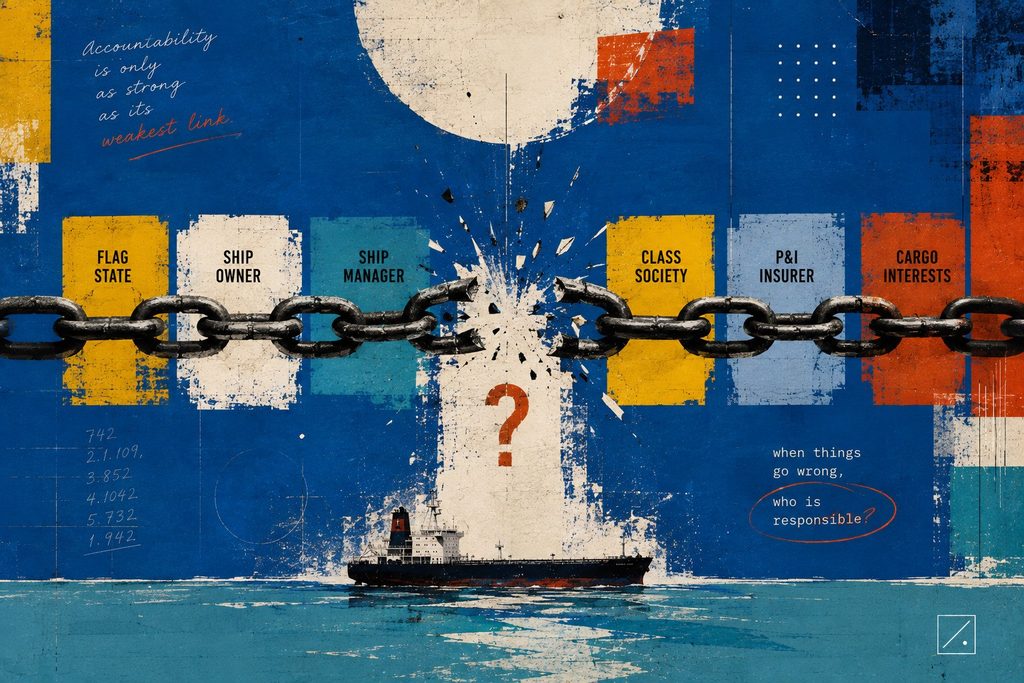
International shipping has operated for decades on a foundational principle: someone must ultimately be responsible for every vessel.
A flag state. A shipowner. A manager. An insurer. A classification society.
The shadow fleet is attempting to break precisely this chain.
That is what transforms the phenomenon from a sanctions-enforcement problem into a challenge to the institutional architecture of shipping itself.
When the flag is false, the certificate may be forged, AIS may transmit a different identity and the vessel may have changed four flags within two years, the question is no longer simply:
“Who is carrying the oil?”
The more consequential question is:
Who bears responsibility when something goes wrong?
That may ultimately be the shadow fleet’s most dangerous innovation. It does not need to make the ship disappear. It only needs to make responsibility difficult enough to locate.
And in a shipping market where an ageing tanker can continue sailing even after being sanctioned, the answer is anything but self-evident.