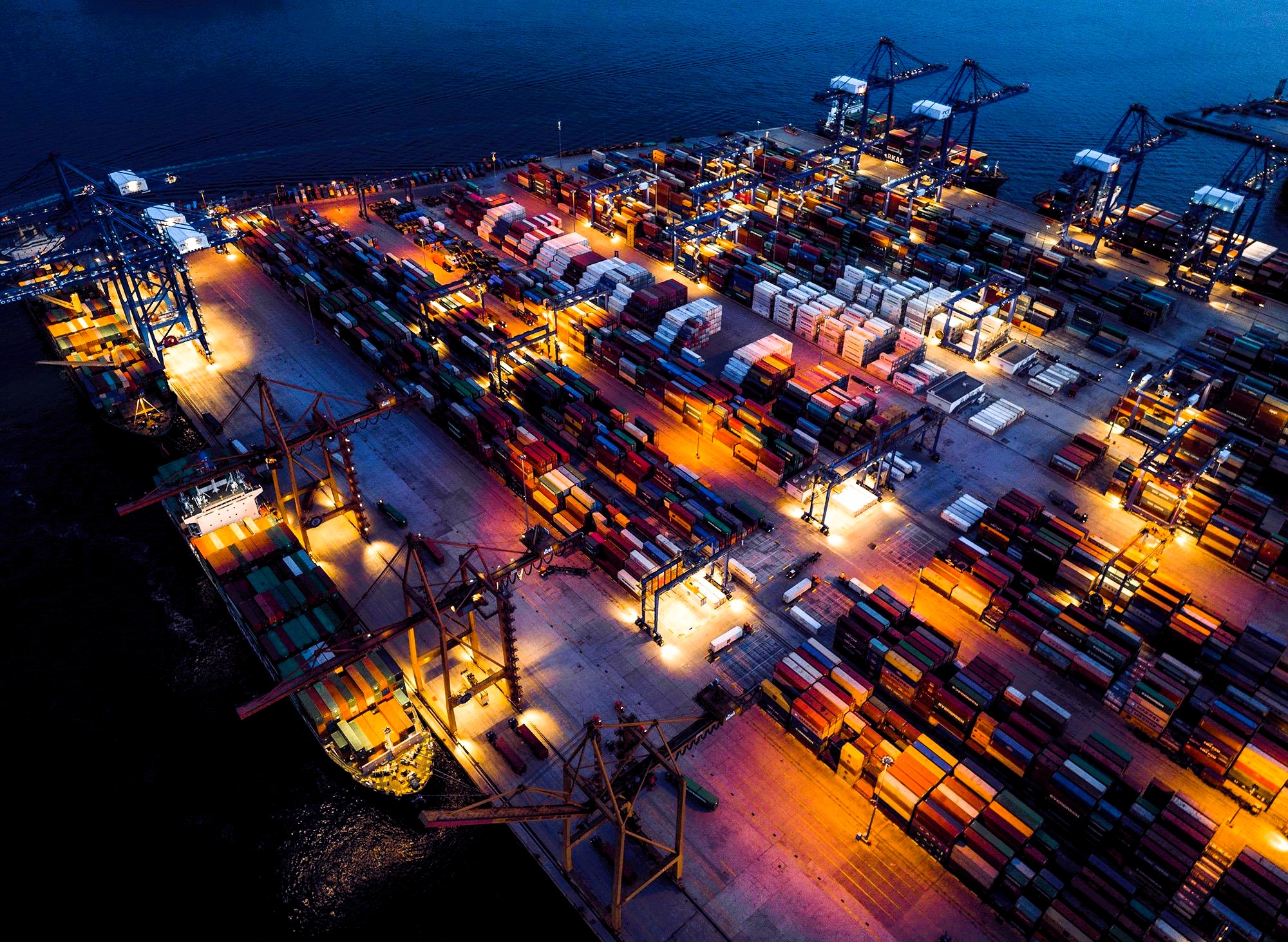

How “European” is TEN-T, really? The Orient/East-Med (OEM) TEN-T corridor is presented as one of the most emblematic projects of European transport policy. A single 6,480-km artery linking the North and Baltic Seas with the Mediterranean, crossing eight countries and connecting ports, railways, and key logistics hubs into one common flow system. In theory, it is the essence of European integration: free movement, multimodal transport, common standards, and stronger cross-border infrastructure. In practice, however, as the OEM corridor moves towards the European South, the question becomes harder to avoid.
How “European” is a project that carries an EU label but whose key links are shaped by Chinese capital and by a strategy that is not designed in Brussels?
The OEM corridor runs through Germany, Czechia, Slovakia, Austria, Hungary, Romania, Bulgaria, and Greece, forming a clear north–south axis that connects Europe’s hinterland with the sea. Its logic is simple: faster cargo movement, lower costs, and a more efficient link between central markets and Europe’s gateways.
But the corridor is not just a line on a map. It is a mechanism that redistributes flows and power. And this is exactly where politics enters the picture: who controls the gateways, who sets the operational terms, and who holds influence over the points where cargo is concentrated and redistributed.
The key role of Piraeus Port
At the southern end of the OEM corridor, Piraeus has become one of those points.
COSCO does not simply “participate” there. COSCO has been controlling the Port of Piraeus since 2016, and its expansion has turned Piraeus into a major Mediterranean hub, able to function as a main gateway for cargo bound for the European market.
This dynamic is not abstract. With 5.15 million TEUs in 2019, Piraeus strengthened its position as one of the strongest hubs in the Mediterranean and, at the same time, as the southern connector of a European corridor that leads directly into the heart of the continent.
In simple terms, the OEM corridor does not just “end” in Greece. It ends at a gateway where Chinese control is not peripheral but structural to the way the system works.
This shifts the discussion from infrastructure to strategy. TEN-T is an EU framework, but the real economic value of a corridor is not found in regulations. It is found in how the corridor is filled with cargo, which networks feed it, and which hubs gain the strongest leverage over supply chains.
In the OEM case, the objective of strengthening multimodal connections between Central Europe and the Aegean or the Black Sea often turns into a “fast lane” for goods entering Europe from Asia.
It is not accidental that the corridor is described as critical for moving Chinese products into Europe through the narrative of the “Maritime Silk Road.” In other words, Europe’s goal of faster and cheaper transport is, in practice, aligned with a trade model that supports the penetration of Asian flows into the European market through hubs where China has built strong influence.
Rail infrastructure and the Balkan bottleneck
The second major area where the OEM corridor takes on a more “hybrid” character is rail infrastructure in the Balkans. The corridor cannot function with ports alone.
It needs rail lines that work, borders that do not slow traffic down, networks that can handle large freight trains, and full compatibility with European standards. This is where large investments appear, including upgraded and high-speed rail projects such as the Belgrade–Budapest connection, a line that is often financed and built by Chinese entities.
The point is not only that capital is being injected. The point is that, in key parts of the corridor, implementation is not relying solely on EU tools but also on external players who view the European transport network as a space for geo-economic positioning.
A corridor that is European—but not neutral
The picture is therefore clear. The OEM corridor is European in design but less “European-neutral” in how it operates.
Piraeus acts as the southern gateway of a network that was designed to unite the continent, yet at the same time it serves as an entry point for goods that follow a route from Asia into Central Europe, aiming to shorten transit times.
At the same time, rail links in the Balkans, which should be Europe’s own “nervous system,” are reinforced in some sections through Chinese financing and construction.
This does not automatically mean the corridor is “not European.” But it does mean it is European only to the extent that Europe controls its critical nodes and sets the real rules of the flow.
Technical gaps and strategic consequences
And here we face another very European problem: even with the right framework, the corridor’s performance still suffers from long-standing weaknesses.
Bottlenecks remain, especially where cross-border rail traffic loses speed and interoperability breaks down, while border procedures cancel out the advantages of a supposedly unified network.
The implementation of ERTMS, the European Rail Traffic Management System that should solve compatibility issues and improve efficiency, remains a challenge in several sections. In addition, compliance with the 740-metre freight train length standard, which is crucial for economies of scale, is not guaranteed everywhere along the OEM corridor.
So, while the corridor is described as strategic and faster, technical and administrative gaps still reduce its real effectiveness.
A hybrid outcome
The result is a contradiction that cannot be covered with slogans. Europe is building a single transport system, but it does not move at the same speed everywhere, leaving gaps that others can fill.
The OEM corridor, as a concept, serves European connectivity. But as a real supply chain route, it often operates as a channel that strengthens imported flows with a centre of gravity in Asia, using European infrastructure and, at key points, Chinese-controlled or Chinese-supported platforms.
With Piraeus under COSCO control since 2016 and with Balkan rail links becoming areas of Chinese investment presence, the European narrative becomes more complex. A hybrid model where Europe’s connectivity strategy overlaps with China’s plan for commercial access.
Measuring Europeanness by control
If the question is “how European is TEN-T,” the answer cannot be purely negative or purely celebratory.
It is European as an institution and as a policy goal. But it is not insulated from global power. Corridors are not just infrastructure. They are tools that shape trade routes, market access, and influence over flows.
And the OEM corridor, precisely because it is so strategic, shows that European transport policy can no longer be judged only by projects and kilometres. It must be judged by who controls the key nodes and who holds real leverage over the supply chain.
If Piraeus remains the southern gateway of this corridor under COSCO control, and if key rail upgrades in the region are built through Chinese-backed schemes, the OEM corridor will remain both European and something less than fully European.
A corridor with an EU label, but a China geo-economic signature.
George S. Skordilis is Editor-in-Chief of geo-trends.eu.