
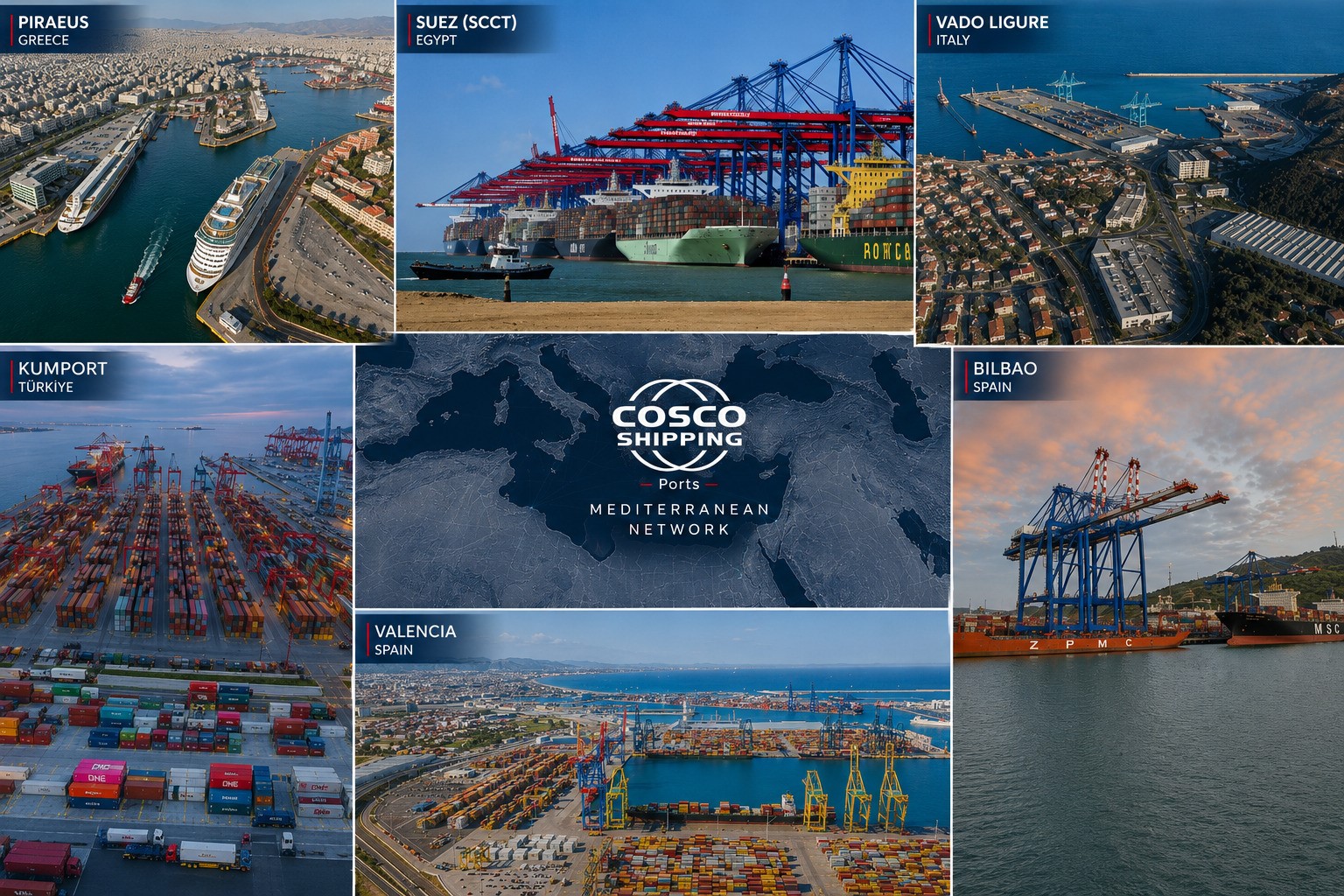

The strategy of COSCO SHIPPING Ports in the Mediterranean can no longer be analysed as a series of independent investments scattered across different ports. Increasingly, it resembles an interconnected network of hubs with distinct roles, geographical positions and levels of COSCO ownership, spanning almost the entire maritime corridor from the Suez Canal and the Eastern Mediterranean to the Iberian Peninsula.
At the end of 2025, COSCO SHIPPING Ports operated or held interests in 387 berths across 40 ports worldwide, 238 of which were container berths. The network had total designed capacity of around 149.4 million TEU, with overseas terminals accounting for 55.6 million TEU.
The company itself describes its strategy in three words: globalisation, synergy and control. The objective is to build a global terminal network capable of generating synergies with COSCO SHIPPING and the Ocean Alliance while increasing the company’s operational influence in the ports where it invests.
In the Mediterranean, however, those three words acquire a broader significance. Geography is only the first layer. The strategic value of the network increasingly lies in the coexistence of different gateways, transshipment hubs and hinterland connections — and in the fact that they do not all need to perform in the same way, or at the same time, for the portfolio to succeed.
From Piraeus to Gibraltar: building a Mediterranean port system
The core of the Mediterranean portfolio includes Piraeus, the Valencia and Bilbao terminals, the Suez Canal Container Terminal in Egypt, Kumport in Türkiye and the Vado terminals in Italy.
COSCO’s exposure, however, is not uniform. COSCO SHIPPING Ports controls 100% of Piraeus Container Terminal, with designed capacity of 6.2 million TEU. In Valencia, it holds 51%; in Bilbao, 39.51%; in the Suez Canal Container Terminal, 20%; in Kumport, 26%; and in the Vado Reefer and Vado Container terminals, 40% each.
These differences matter. COSCO’s Mediterranean position is not built around a single ownership model but around varying degrees of control and exposure across ports serving different functions within the container system.
In Spain, COSCO entered the market in 2017 by acquiring 51% of Noatum Port Holdings for €203.49 million. The package included the Valencia and Bilbao terminals, as well as rail facilities in Madrid and Zaragoza. COSCO said at the time that Valencia served simultaneously as a gateway to Iberia, Madrid’s natural port and a Western Mediterranean transshipment hub.
In Italy, the investment in Vado involved the purchase of 40% of APM Terminals Vado Holding for €53 million, with the aim of gaining access to the markets of Northern Italy, Switzerland and Southern Germany.
The Mediterranean chessboard was therefore never composed of interchangeable squares. Each investment offered COSCO something different: transshipment capacity, hinterland penetration, geographic reach, operational influence or access to major European consumption and industrial markets.
The Red Sea shock: COSCO’s network under stress
The Red Sea crisis provided perhaps the clearest demonstration of how that portfolio can behave under pressure.
In 2024, Piraeus lost 7.8% of the traffic handled at Piers II and III, falling from 4.59 million TEU to 4.23 million TEU. COSCO explicitly attributed the decline to the continuing impact of the Red Sea crisis.
What followed in the same annual report was particularly significant. COSCO said that its Spanish companies and Zeebrugge attracted some of the routes and cargo previously handled through Piraeus.
The Spanish terminals increased their volumes by 16.8% to 3.67 million TEU, while Zeebrugge increased by 55.3%.
This is more than a story of one port losing cargo while others gained it. It illustrates a fundamental characteristic of a geographically diversified terminal portfolio: disruption does not necessarily disappear from the system; it can redistribute value within it.
COSCO could not simply command cargo to migrate between terminals. Liner schedules, alliance decisions, customers, voyage economics and the changing geography of services remained decisive. But the group already possessed assets positioned to capture part of the traffic displaced by the disruption.
That distinction is central to understanding the Mediterranean strategy.
Piraeus in 2025: losing TEU, defending value
In 2025, PCT’s container traffic fell for a second consecutive year, declining by 6% to 3.977 million TEU. Between 2023 and 2025, the loss therefore exceeded 600,000 TEU. The company mainly attributed the 2025 decline to weaker demand in the Mediterranean.
But stopping at TEU figures would produce an incomplete — and potentially misleading — conclusion.
Despite the lower volume, Piraeus revenues increased by 16.7% to $357.7 million, mainly due to higher storage revenues and price increases. Terminal profit rose from $29 million to $40.75 million, an increase of around 40%.
This is one of the most important findings of the comparison: Piraeus was a loser in terms of volume, but not necessarily in financial terms.
Operating costs also increased by 16% to $284.5 million, due to higher labour costs and concession fees. Yet the increase in revenues was sufficient to produce a significant improvement in the result.
The divergence matters because ports are too often ranked through a single metric. Throughput measures scale and traffic capture; it does not, by itself, measure the economic value extracted from that traffic.
The question of “who is winning?” therefore requires at least two answers: TEU and money. In a network as diverse as COSCO’s, it may ultimately require a third: strategic utility.
Beyond the surge: the deeper strength of COSCO’s Spanish terminals
After the sharp increase in 2024, the Spanish terminals continued to grow in 2025, although at a clearly slower rate.
Container traffic reached 3.752 million TEU, up 2.2%. Revenues increased by 8.6% to $366.97 million, while operating costs rose by 10.4% to $303.46 million.
Spain therefore appears to have retained part of the traffic it gained during the reorganisation of shipping routes, although it is no longer expanding at the exceptional rate recorded during the first year of the crisis.
It also possesses an advantage that distinguishes it from a pure transshipment hub: Valencia and Bilbao have genuine hinterlands and rail connections. This was a central part of COSCO’s investment logic as early as 2017.
That makes the Spanish position structurally different. Cargo captured during disruption can potentially be anchored by inland connectivity rather than depending exclusively on the permanence of a particular transshipment pattern.
Spain’s position, however, is not without risk. The growing strength of Tanger Med, directly opposite the Iberian Peninsula, means that competition for transshipment cargo at the western entrance to the Mediterranean is becoming increasingly intense.
The Western Mediterranean is therefore not simply another growth zone in COSCO’s portfolio. It is also an increasingly contested gateway.
Suez in 2025: the portfolio’s biggest volume winner
The figures for the Suez Canal Container Terminal are striking.
The terminal handled 5.57 million TEU in 2025, up 41.3% from 2024. COSCO holds a 20% stake in a facility with designed capacity of 5 million TEU.
Actual throughput therefore exceeded even the nominal designed capacity reported by COSCO.
The financial picture was also positive, with COSCO’s share of profit from the Suez Canal Container Terminal increasing by $8.38 million in 2025.
At first sight, the result may appear paradoxical given the Red Sea crisis. Yet that apparent contradiction reveals precisely why port performance cannot be inferred mechanically from headline Suez Canal transit numbers.
Port Said and the Suez Canal Container Terminal do not depend solely on aggregate canal transits. Individual liner services, the transshipment mix and changes in regional networks also shape terminal throughput.
A maritime chokepoint can suffer disruption while an individual terminal within its wider geography gains traffic. The network does not respond to crisis as a single, uniform organism.
Kumport’s rise: why Piraeus does not tell the Eastern Mediterranean story
The picture in Türkiye is equally revealing.
Kumport handled 1.543 million TEU in 2025, up 22.7%. COSCO holds a 26% stake, and the facility has designed capacity of around 2.1 million TEU.
Its performance demonstrates why the Eastern Mediterranean should not be classified as a “lost region” simply because Piraeus declined.
On the contrary, Kumport shows that Türkiye continues to generate strong regional demand and transshipment potential, while providing access both to the Turkish market and to flows towards the Black Sea.
Within the same broad Eastern Mediterranean geography, therefore, two very different stories were unfolding simultaneously: Piraeus -6%; Kumport +22.7%.
That divergence is important. It suggests that the competitive map is becoming more granular. Regional labels such as “Eastern Mediterranean” can conceal as much as they reveal when individual ports are exposed to different cargo bases, hinterlands and liner-service dynamics.
Vado’s uneven advance: container growth meets a reefer retreat
In Italy, the picture is more complex.
Vado Container Terminal increased by an impressive 80.3% to 575,568 TEU in 2025. At the same time, the Vado Reefer Terminal declined by 37.9% to 38,206 TEU.
COSCO holds 40% in both terminals. Despite their sharply different performances, Vado’s contribution to group profitability improved: its share of profit increased by around $2.88 million.
Vado therefore demonstrates why an investment should not be assessed through a single cargo segment. Container activity can grow rapidly while reefer activity contracts sharply.
The result also reinforces the broader pattern emerging across COSCO’s Mediterranean portfolio: even within the same port complex, performance can fragment.
The 2026 map sharpens: Suez and Kumport extend their momentum
The first available 2026 figures reinforce the differences across the network.
In the January–May period, Piraeus handled 1.628 million TEU, down 2.8% from 2025. Spain was up 3.3% at 1.580 million TEU.
By contrast, the Suez Canal Container Terminal had reached 2.506 million TEU, up 26.7%, while Kumport was up 16.8% at around 699,000 TEU.
Vado Container Terminal recorded a 12.8% decline over the same period, showing that its explosive growth in 2025 is not continuing in a straight line.
Overall, however, COSCO’s overseas terminals show particularly strong performance. In the first five months of 2026, throughput outside China increased by 18.7%, compared with an overall network increase of 8.6%.
The divergence has therefore persisted into 2026. The winners change, the growth rates change and individual terminals can reverse direction. The portfolio remains the constant.
COSCO’s real advantage lies in the network
This is perhaps the most important conclusion.
In 2025, COSCO SHIPPING Ports’ total throughput increased by 6.2% to almost 153 million TEU. Overseas terminals performed even better, increasing by 11.5% to 38.16 million TEU.
The port operator’s total revenues increased by 11% to $1.669 billion.
Piraeus’ decline, therefore, does not represent a decline of COSCO’s international network. Quite the opposite. During the same period in which Piraeus was losing volume, Suez, Kumport, Vado Container Terminal, Spain and other overseas hubs were growing.
Nor does this mean that COSCO can simply move cargo from one port to another at will. Decisions depend on alliances, trade flows, customers, hinterlands, freight rates, available services and the economics of individual routes.
The strategic advantage lies elsewhere: COSCO does not need every square on its Mediterranean chessboard to win simultaneously.
A network can absorb divergence. One terminal can lose throughput while another captures displaced services. A port can surrender TEU while improving profitability. A gateway can benefit from its hinterland while a transshipment hub depends more heavily on changing liner patterns. Even terminals inside the same port complex can move in opposite directions.
That is why the Mediterranean map should no longer be read simply as a ranking of ports.
The more consequential question is whether COSCO has assembled enough differently positioned assets to remain exposed to container flows even as those flows are repeatedly rerouted by crisis, competition and changing trade geography.
The evidence from 2024, 2025 and the opening months of 2026 suggests that this is precisely where the portfolio is beginning to demonstrate its value.
COSCO’s Mediterranean advantage may not be dominance of any single port. It may be the ability of the network to keep producing winners when the geography of container shipping changes.
George S. Skordilis is Editor-in-Chief of geo-trends.eu.