
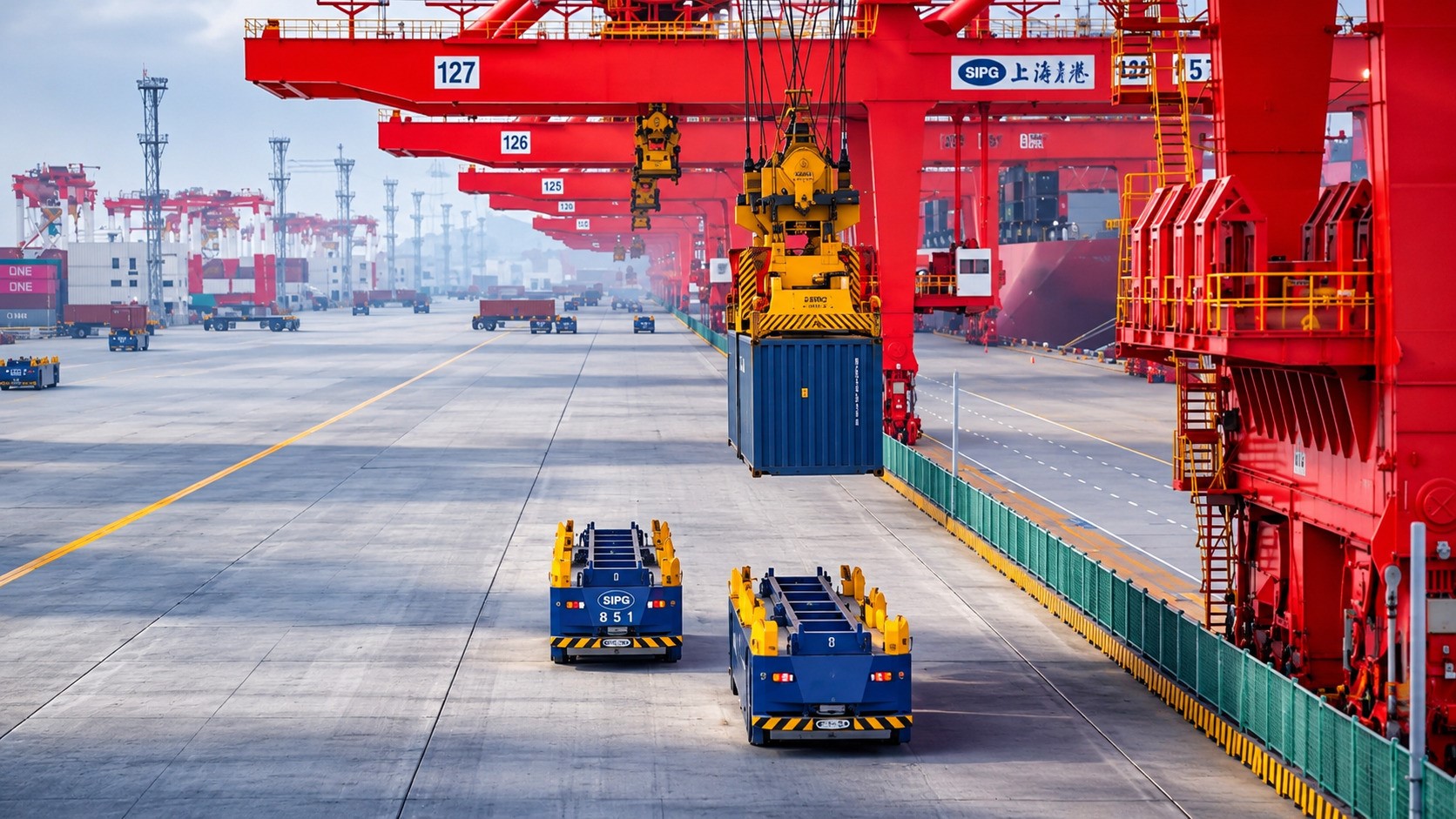

Shanghai has spent years automating the physical movement of containers. Now, a new Shanghai port AI initiative aims to coordinate the decisions governing how cargo moves between ships, terminals, trucks and railways.
The ambition is to move beyond the automation of individual tasks towards intelligent coordination across an entire logistics network.
On November 7, Shanghai International Port Group (SIPG), working with academic and technology partners, unveiled an AI testing initiative intended to bring intelligent applications closer to operational deployment.
According to the Shanghai Municipal Transportation Commission, much of the testing facility’s infrastructure has already been completed, with 54 business AI agents brought under management.
The initiative reflects a broader challenge facing major container hubs: how to improve performance when delays, capacity constraints and operational decisions increasingly extend beyond terminal boundaries.
Nine months, three typhoons and a record September
Shanghai handled 55.06 million twenty-foot equivalent units (TEU) in 2025, up 6.9% year on year, retaining its position as the world’s busiest container port for the 16th consecutive year, according to municipal government figures.
Growth continued in 2026, although at a slower pace.
According to Chinese Ministry of Transport data compiled by CEIC, Shanghai handled 42.83 million TEUs during January–September 2026, approximately 3.1% more than in the corresponding period of 2025.
The nine-month figure concealed considerable volatility.
August throughput fell 14.7% year on year to approximately 4.284 million TEU, following successive typhoon-related disruptions. The comparison was also unusually demanding: August 2025 had exceeded 5 million TEU, establishing a high statistical base.
September then reached a monthly record of 5.135 million TEU as operators worked to restore cargo flows and clear backlogs.
As The Maritime Executive reported, three typhoons disrupted port operations during the summer, affecting vessel movements and contributing to congestion.
The figures illustrate the operational pressures confronting a port of Shanghai’s scale.
Delayed arrivals affect berth allocation, crane deployment, container storage and inland collection schedules. Disruptions can spread from terminals to shipping lines, trucking companies, railway operators and cargo owners.
AI could help operators anticipate these interdependencies, identify emerging bottlenecks and coordinate responses before delays multiply.
The commercial objective is better utilisation of existing capacity, more predictable cargo movements and lower avoidable costs.
Yangshan demonstrates the value of integrated automation
Shanghai’s AI ambitions build on an extensive technological foundation.
Yangshan Deep-Water Port handled approximately 28.71 million TEU in 2025, accounting for slightly more than half of Shanghai’s container throughput.
Its Phase IV terminal, operating since 2017, is among the world’s largest automated container facilities.
The terminal uses 29 quay cranes, 121 rail-mounted gantry cranes and 155 automated guided vehicles, coordinated through an integrated control system incorporating digital-twin technology.
According to figures attributed to SIPG and reported in Shanghai’s assessment of the terminal, automation has improved overall operational efficiency by approximately 30% compared with conventional operations. Phase IV handled more than 8 million TEU in 2025.
Coordination has also produced gains beyond the automated terminal.
At Yangshan, a synchronised vessel-handling arrangement involving three ships and tidal windows has reduced average turnaround times by approximately two hours per call.
According to Pudong government reporting, the improvement has released handling capacity equivalent to approximately 1.08 million TEU.
This achievement belongs to Yangshan’s maritime service operations and should not be attributed to the new AI initiative.
Nevertheless, it demonstrates how better coordination can release capacity without a corresponding expansion of physical infrastructure.
Shanghai’s next challenge is to extend such gains across activities managed by different organisations and technological systems.
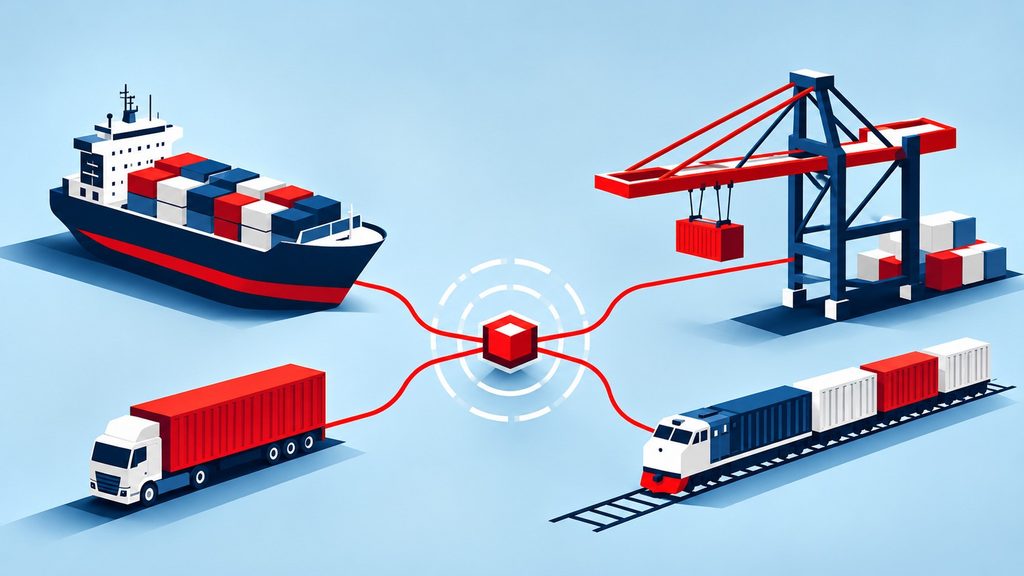
Shanghai port AI must prove its value beyond the terminal gates
The new testing facility concentrates on three operational areas: port cargo handling, container collection and distribution, and multimodal transport coordination.
Its infrastructure combines computing resources, specialised data corpora, AI models and a platform for managing intelligent software agents.
The 54 agents currently under management demonstrate the breadth of development activity, not that all have been successfully deployed in live port operations.
The commercial test is whether these applications can process reliable information, interact with existing systems and support consistent decisions under changing operational conditions.
That requires cooperation between organisations with different commercial interests, software platforms and operating procedures.
Shipping lines, terminal operators, trucking companies and railway providers do not necessarily share common data architectures or priorities.
Shanghai’s wider transport AI action plan also includes a trusted data-sharing environment and measures addressing algorithm security and data governance. These belong to the broader programme rather than the testing facility’s own technical infrastructure.
Their importance extends beyond Shanghai.
Intelligent coordination depends on timely information about vessel arrivals, terminal capacity, container availability and inland transport movements. It also requires cybersecurity protections, clear operational responsibilities and reliable human oversight.
For shipping companies and logistics providers, the relevant performance indicators will be vessel turnaround, container dwell times, equipment utilisation, inland transport reliability and operating costs.
The number of AI agents developed is less important than the measurable improvements they deliver.

From operational efficiency to technological autonomy
Shanghai’s programme has implications beyond port productivity.
The municipal transport initiative seeks to develop intelligent applications that can be replicated and expanded beyond Shanghai.
Separately, an AI professional committee established within a wider international sustainable transport innovation framework will examine international standards, exchange governance practices and promote technological innovations internationally.
These objectives are distinct.
A replicable operating model does not guarantee adoption by other ports. Participation in international standards research does not establish an ability to determine those standards.
Yet the initiative highlights an increasingly important dimension of maritime competition: control over the digital systems used to coordinate cargo movements.
Advanced logistics platforms depend on data access, software interfaces, algorithms, cybersecurity arrangements and technical interoperability.
As these systems become embedded in daily operations, technology procurement decisions can carry long-term commercial and strategic consequences.
Ports must consider whether operational data remain accessible, whether systems can communicate with competing technologies and how easily suppliers can be replaced.
The issue connects with the wider debate explored by GeoTrends in AI and the Battle for Shipping’s Knowledge: technological competitiveness increasingly involves control over information and the systems used to interpret it.
Shanghai has substantial advantages in developing integrated logistics applications.
Its container volumes, automated infrastructure and connections with the Yangtze River Delta provide a demanding environment for testing intelligent coordination at scale.
But ports operate under different regulatory, commercial and technological conditions. Systems developed for Shanghai may require significant adaptation elsewhere.
For competing hubs, the question is therefore not simply whether to adopt similar technologies, but how to improve coordination while preserving interoperability and technological choice.
Shanghai’s 2030 targets put AI in perspective
The initiative forms part of a broader strategy combining infrastructure expansion, automation and multimodal transport development.
Under Shanghai’s 15th Five-Year Plan for the International Shipping Center, annual container throughput is expected to exceed 58 million TEU by 2030.
Sea-rail intermodal transport is targeted to reach approximately 2 million TEU, while automated container handling is expected to increase to 15 million TEU annually.
Major infrastructure investments, including the Xiaoyangshan North Operation Area, remain central to these ambitions.
AI is not intended to replace berths, railway connections or handling equipment. Its potential contribution is to improve the way those assets operate together.
For Shanghai, success will depend on whether intelligent coordination can improve throughput reliability and reduce costs across the logistics network.
For the wider port industry, the initiative raises a larger question: will future competitive advantage depend increasingly on coordinating operational decisions rather than simply expanding terminal capacity?
Shanghai has spent years automating container handling. It now wants AI to coordinate decisions across the logistics chain, while signalling an interest in international standards work. Whether that ambition delivers measurable efficiency gains or technologies adopted beyond Shanghai remains an open question.
George S. Skordilis is Editor-in-Chief of geo-trends.eu.