
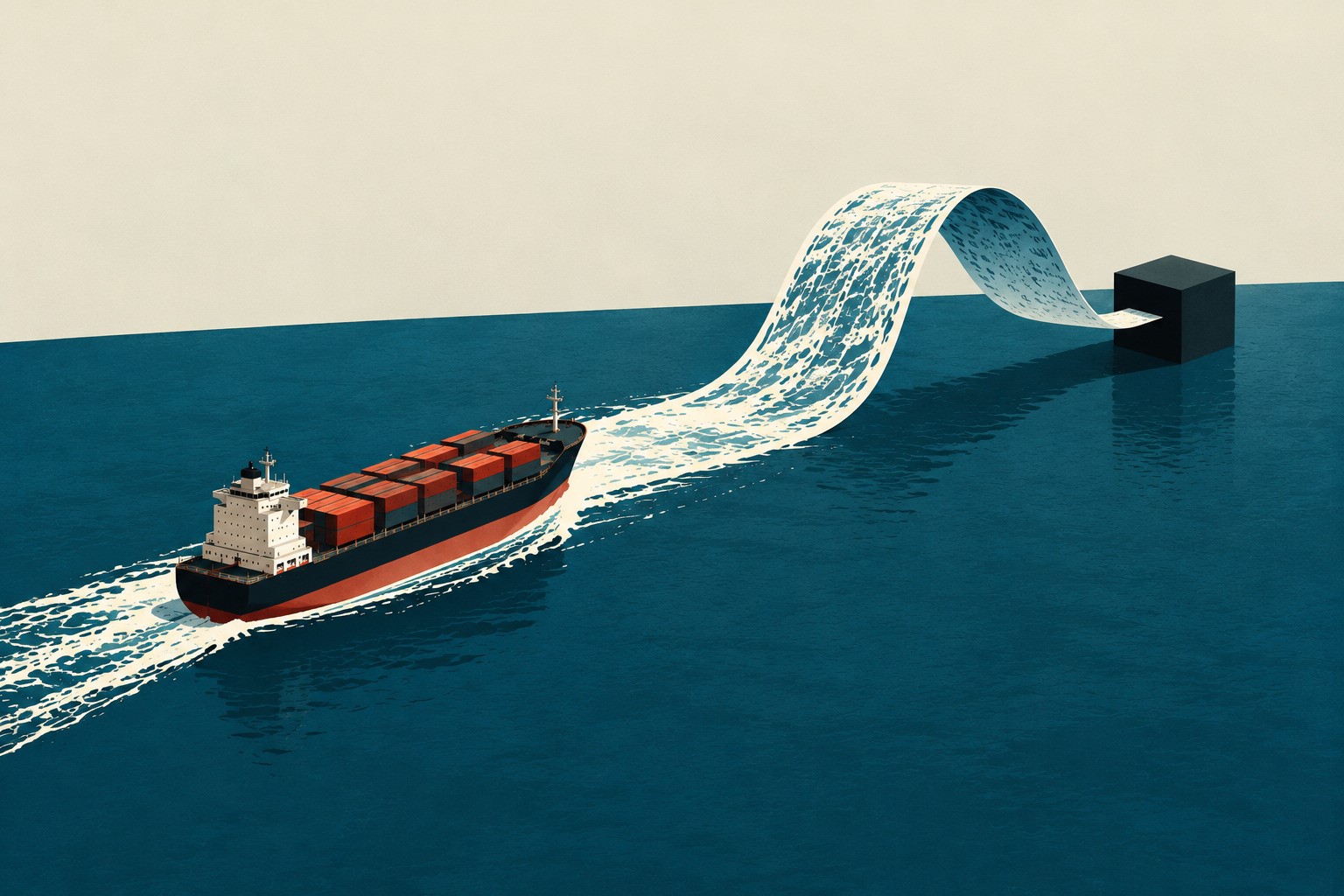

For decades, one of shipping’s most important competitive advantages has been its ability to manage uncertainty. Experience, operational knowledge, and the capacity to make decisions in an exceptionally complex environment were assets that competitors could not easily replicate. Today, artificial intelligence is beginning to challenge not only how shipping companies operate, but potentially the very foundations of their competitive strength.
In a recent article published by Seatrade Maritime, Nakul Malhotra highlights a historic shift. For the first time, the maritime industry is adopting a new technology alongside other sectors of the economy, abandoning its traditional practice of waiting for innovations to be tested and refined ashore.
It is an astute observation. What deserves further examination, however, is whether this technological convergence will also lead to a more profound restructuring of economic relationships within the maritime industry.
When corporate knowledge becomes someone else’s business
Until now, a shipping company’s expertise has largely remained an internal asset. Decisions concerning fleet management, maintenance, chartering opportunities, and responses to operational crises have relied on information and experience accumulated over decades.
Artificial intelligence creates the possibility of transforming this knowledge into digitally processable and reproducible content.
And this raises a crucial question: Who will ultimately control the knowledge generated through the combined use of a shipping company’s data and the algorithms of a technology platform?
The issue is far from theoretical. As more functions migrate to external digital environments, dependence on the providers managing those environments increases. Even when ownership of the data contractually remains with the shipping company, its ability to exploit that data may depend on technological infrastructure and commercial terms beyond its control.
An investment intended to improve efficiency could therefore create a new form of corporate dependency.
The competitive advantage that AI could erase
This development is particularly significant for Greek-owned shipping. Its international competitiveness was not built exclusively on fleet size or access to capital. It was also founded on flexibility, rapid decision-making, and the ability of shipowners to assess risks and opportunities more effectively than their competitors.
If, however, an increasing number of companies begin using similar artificial intelligence systems, drawing on comparable datasets and producing similar recommendations, part of this differentiation may gradually disappear.
Paradoxically, the very technology promising competitive advantage could lead to greater uniformity in business decisions.
This does not mean algorithms will replace shipowners, managers, or masters. It does mean, however, that the value of human judgment will shift. It will lie less in access to information and more in the ability to evaluate, challenge, and effectively use it.
Will AI empower smaller shipowners or strengthen the giants?
There is also a second, equally important dimension. Artificial intelligence could reshape the relationship between large and smaller shipping companies.
On the one hand, it offers smaller operators access to analytical capabilities that, until recently, required substantial investment and large teams of specialists. On the other, major shipping groups possess more extensive datasets, greater financial resources, and easier access to specialised technological infrastructure.
Which of these two trends ultimately prevails will influence the future structure of competition.
Technological autonomy is the next strategic battleground
Consequently, the objective should not simply be the faster digitalisation of shipping. It should be the development of a strategy for technological autonomy, supported by clear rules governing the use of corporate data, system transparency, and the ability to change technology providers without losing critical knowledge.
Malhotra is right to argue that shipping no longer has the luxury of waiting for other industries to test new technologies first. The real challenge, however, lies one step further.
Shipping must not only learn how to use artificial intelligence. It must ensure that, in doing so, it does not surrender control over the knowledge upon which its success was built to third parties.
Because in the next phase of international maritime competition, power will not be measured solely in ships, tonnage, and available capital. It will also be measured by who controls the data, who shapes the algorithms, and ultimately, who retains the independence to make their own decisions.
George S. Skordilis is Editor-in-Chief of geo-trends.eu.