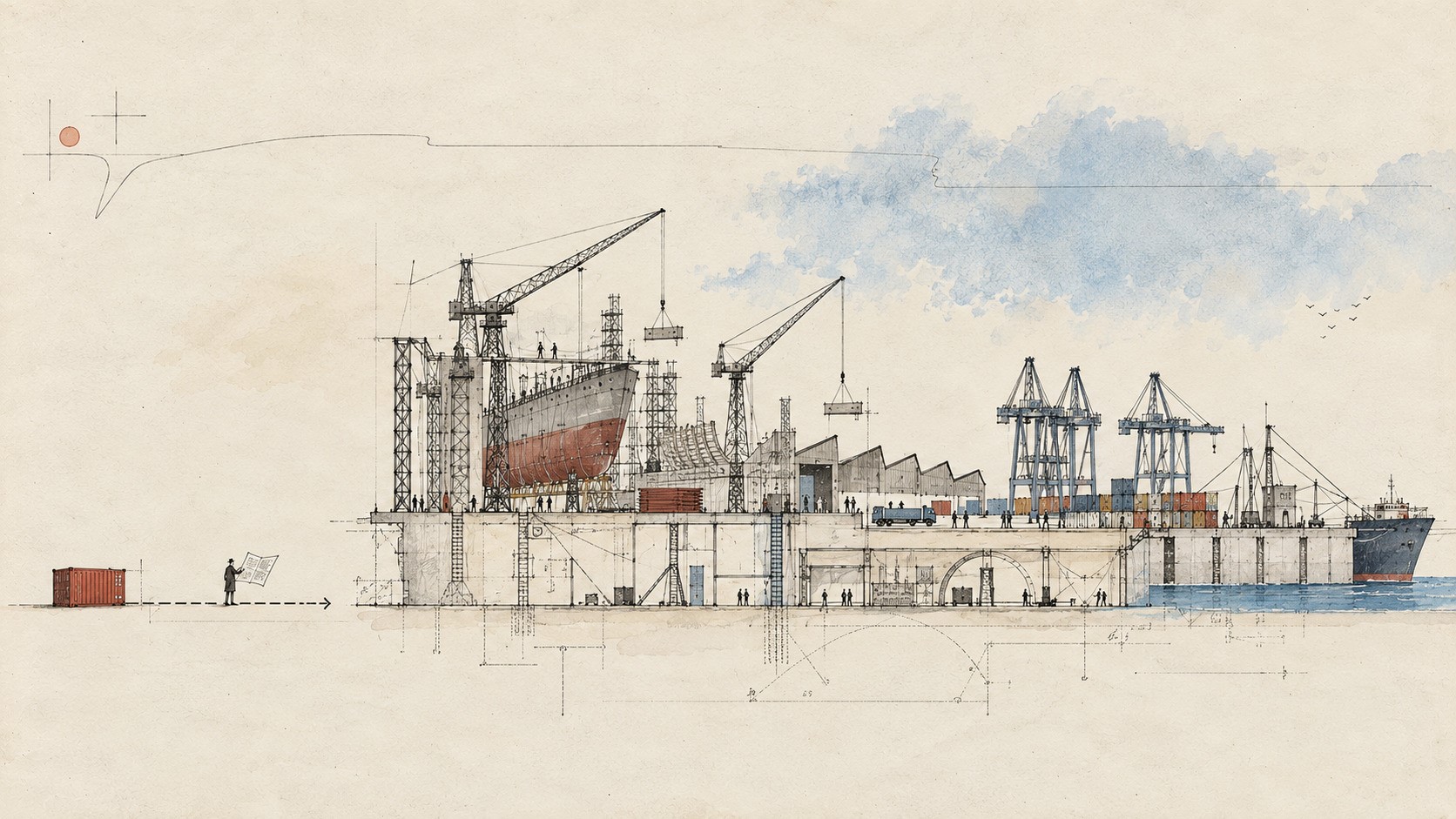

“Everything will follow the cargo.” U.S. Senator Mark Kelly’s remark goes to the heart of the strategic challenge now confronting Washington.
The United States is not simply trying to build more ships. It is attempting something considerably more ambitious: to reconstruct the maritime foundations of American economic and geopolitical power.
That means bringing the U.S. flag back into international trade, rebuilding domestic shipbuilding capacity, expanding the pool of American seafarers, modernising ports and logistics infrastructure, and securing a stronger U.S. presence across strategically important maritime nodes beyond American shores.
In effect, Washington is seeking to build a new American maritime ecosystem capable of competing with the vast network of ships, shipyards, ports, terminals, industrial capacity and logistics infrastructure that China has developed over the past several decades.
But there is a fundamental constraint.
Maritime power ultimately depends on cargo.
Without sufficient and predictable trade flows, shipyards have no sustainable orderbook, merchant vessels have no commercial purpose, and ports risk becoming strategic assets without the economic activity required to sustain them.
That is increasingly becoming the central question surrounding America’s maritime revival: whether the United States can generate the commercial flows required to make its maritime capacity durable.
Beyond shipbuilding: rebuilding an entire maritime system
The U.S. strategy has already moved far beyond a conventional industrial policy designed merely to support domestic shipyards.
America’s Maritime Action Plan, unveiled in February 2026, treats shipbuilding, ship repair, supplier networks, merchant shipping, ports, logistics and maritime labour as components of a single strategic system.
This represents an important shift in American thinking.
Shipbuilding capacity cannot be expanded in isolation. It requires ports, cargo-handling infrastructure, industrial supply chains, skilled labour and — critically — long-term demand capable of supporting investment.
Washington is therefore confronting a basic economic reality: it cannot build a large merchant fleet first and search for cargo afterwards.
It must develop ships and cargo flows simultaneously.
Ports are becoming geopolitical infrastructure
This is also why ports are moving towards the centre of U.S. maritime strategy.
Inside the United States, the U.S Maritime Administration (MARAD) announced nearly $489 million in funding in March for port, shipyard and related infrastructure, with objectives including faster cargo handling, stronger supply chains and the modernisation of maritime facilities.
But the emerging U.S. strategy extends far beyond American territory.
The U.S. International Development Finance Corporation (DFC) is increasingly deploying financial instruments to support critical infrastructure, transport networks and supply chains overseas.
The logic is both economic and geopolitical.
Ports are no longer viewed simply as commercial infrastructure. They are strategic nodes connecting trade, energy, industry, logistics and, potentially, military mobility.
The competition with China therefore increasingly extends from shipyards to terminals, logistics corridors and maritime infrastructure across the world.
Greece provides a revealing example.
The DFC provided $125 million to support the redevelopment of the Elefsis Shipyards, presenting the investment as strategically important to U.S. interests and explicitly placing it within the wider context of Chinese influence in Piraeus.
The significance goes beyond a single shipyard.
Geography matters. Ports, shipyards, energy terminals and logistics hubs together form corridors through which commodities, manufactured goods, energy and strategic supplies move.
Control, access and influence over those corridors can translate into economic leverage and geopolitical reach.
But infrastructure alone does not create maritime power.
A port acquires lasting economic and strategic relevance when cargo moves through it. Geography creates strategic possibility; throughput converts it into power.
The China problem: an integrated maritime economy, not merely a larger fleet
This is where the structural asymmetry between American ambitions and Chinese maritime power becomes most visible.
China does not simply possess the world’s largest shipbuilding industry.
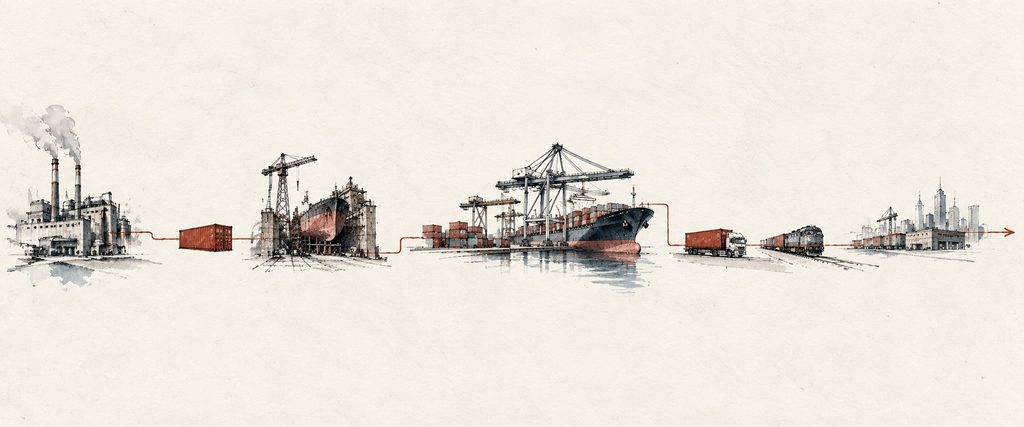
It combines industrial production, exports, shipping companies, merchant fleets, container terminals, logistics networks and access to ports across multiple regions of the world.
The factory, the container, the ship, the terminal and the trade route are parts of the same economic architecture.
This gives Beijing an advantage that cannot be replicated simply by subsidising new vessels or reopening shipyards.
China already possesses the enormous trade volumes that sustain its maritime system.
The United States, by contrast, is attempting to reconstruct significant parts of that system while simultaneously creating the commercial foundations required to support it.
That is a much more difficult undertaking.
Industry’s warning to Washington: capacity follows the demand signal
This was one of the clearest messages to emerge from the recent Hudson Institute policy forum in Washington.
Larry Ryder of Hanwha Defense USA argued that shipbuilding capacity is not necessarily the only — or even the immediate — constraint facing the US maritime revival.
The deeper issue is the strength of the demand signal.
Companies will invest in shipyards, production capacity and new vessels only if they have sufficient confidence that those assets will have sustained commercial demand.
Havoc AI highlighted a similar problem. The company has focused primarily on defence applications because commercial demand for its systems has not yet reached sufficient scale.
The strategic question, therefore, is no longer simply whether America can build ships.
It is also what those ships will carry, which trade routes they will serve and who will pay for their operation.
From 80 ships to 250 new vessels
The scale of the ambition is illustrated by the SHIPS for America Act.
Supporters of the initiative note that only around 80 U.S.-flagged vessels currently operate in international trade, compared with approximately 5,500 vessels associated with China.
The Strategic Commercial Fleet Program envisages adding 250 U.S.-flagged oceangoing vessels over the next decade.
Building those ships, however, is only half the equation.
Washington must also create an economic environment capable of keeping them commercially active.
And that is where the U.S. government is beginning to intervene directly in the cargo equation.
Washington is not only building ships — it is trying to build demand
The Maritime Action Plan explicitly acknowledges this challenge.
It proposes stronger requirements for government and commercial cargoes to move aboard U.S.-flagged vessels and examines the creation of a United States Maritime Preference Requirement.
The principle is strategically significant.
As additional American vessels enter service, major exporting economies could gradually be required to transport a share of their containerised exports to the United States aboard eligible U.S.-flagged ships.
Existing cargo-preference provisions covering federal government cargoes could also be strengthened.
This marks an important evolution in U.S. maritime policy.
Washington is no longer considering only how to subsidise the supply of maritime capacity.
It is also exploring how state policy can generate the demand required to sustain that capacity.
In geopolitical terms, this amounts to an attempt to reconnect American trade policy, industrial policy and maritime strategy.
Ship – port – cargo: the architecture of maritime power
The emerging American strategy can therefore be understood through three interconnected elements: ships, ports and cargo.
The United States needs shipyards to restore industrial capacity.
It needs a merchant fleet to carry goods under the American flag.
It needs ports and terminals, both at home and overseas, to anchor supply chains and strategic trade corridors.
It needs technology and automation to reduce costs and mitigate shortages of maritime labour.
And it needs alliances, investment and infrastructure partnerships abroad to build a wider maritime network capable of competing with China’s global presence.
But one element ultimately determines whether the entire architecture works.
Cargo.
A government can finance a shipyard.
It can subsidise a merchant vessel.
It can invest in a strategically located port thousands of miles from American shores.
But unless there is a predictable flow of goods connecting the shipyard, the vessel, the port and the market, what has been created is infrastructure — not maritime power.
That may prove to be the defining test of America’s return to the sea.
The geopolitical contest with China will not be decided simply by who builds more ships or controls more terminals.
It will increasingly be shaped by who controls, attracts and ultimately carries the cargo flows that connect the global economy.
George S. Skordilis is Editor-in-Chief of geo-trends.eu.