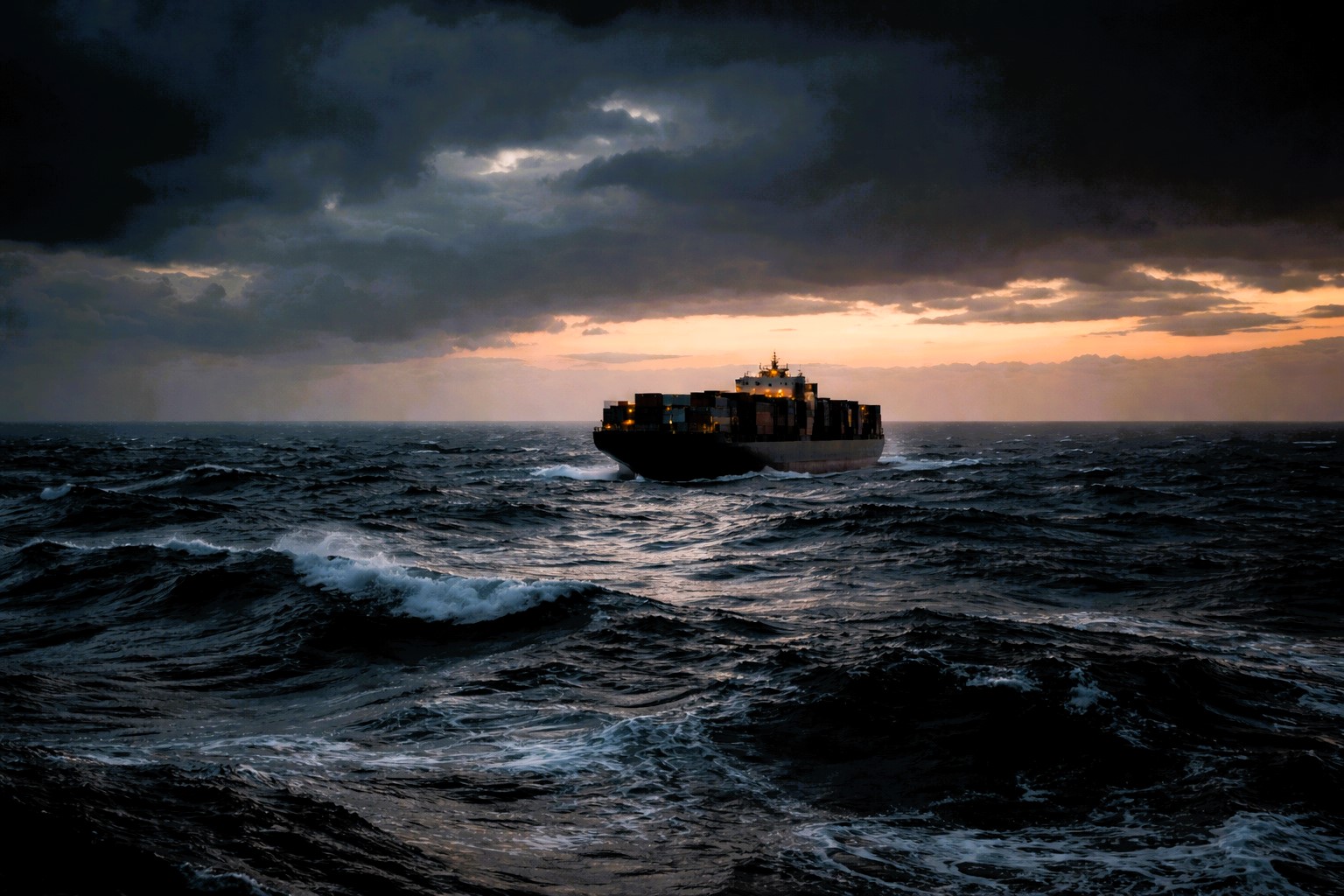

The latest attacks on commercial vessels in the Strait of Hormuz have dispelled, once again, the illusion that the crisis had subsided simply because officials declared the waterway open. A strait may remain open in legal terms and yet become unstable in every practical sense. For maritime trade, that distinction is no longer theoretical. It has become decisive.
This is the deeper meaning of the new tension around Hormuz. The issue is not limited to Iran, nor even to the immediate military risk surrounding one of the world’s most sensitive passages. What is at stake is something broader: the gradual erosion of a principle that underpinned the global economy for decades, namely the assumption that freedom of navigation existed as a durable and almost natural condition. That assumption no longer holds.
The illusion of reliability
For a long time, global shipping was organized around a form of strategic confidence. The main maritime corridors were not free of tension, but they were treated as fundamentally reliable. The Suez Canal linked Asia to Europe. The Strait of Hormuz ensured the outward flow of Gulf energy. The Panama Canal served as a stable hinge between oceans. Even when crises emerged, they were generally understood as limited disruptions within a system whose basic geometry remained intact.
Over the past few years, that geometry has been progressively undone. The pandemic offered the first major shock. It revealed that a system praised for its speed and efficiency had become highly vulnerable. Port congestion, crew change paralysis, container dislocation, and inland transport bottlenecks showed that the architecture of global logistics was less resilient than it appeared. What had been mistaken for strength was often only optimization carried to the point of fragility.
Chokepoints and systemic exposure
Then came the Ever Given in the Suez Canal in 2021. The episode lasted only a few days, yet its significance was lasting. It demonstrated with brutal clarity that a single incident in a single chokepoint could disrupt trade on a global scale. Behind the image of a stranded ship lay a more troubling truth: world commerce had become dangerously dependent on an extremely narrow set of maritime passages.
The war in the Black Sea deepened that realization. Here, the problem was no longer logistical but geopolitical in the most direct sense. Shipping routes were redrawn under the pressure of war. Grain exports became a diplomatic and strategic issue. Insurance premiums rose. Commercial navigation found itself once again exposed to military realities that the post-Cold War era had encouraged many to treat as secondary.
Climate pressure and strategic routes
The drought affecting the Panama Canal added yet another dimension. It showed that the vulnerability of maritime circulation was not only political and military, but also climatic. The great routes of world trade were not merely exposed to conflict; they were also exposed to environmental stress. A passage can remain peaceful and still cease to function normally.
The Red Sea crisis completed the picture. As attacks on merchant shipping multiplied, major operators rerouted around the Cape of Good Hope. The consequences were immediate: longer voyages, higher costs, weaker schedule reliability, and a deeper sense that strategic waterways could no longer be treated as neutral infrastructure. They had become contested spaces.
From legal openness to operational uncertainty
Hormuz must be read in that same sequence. It is not an isolated episode. It belongs to a chain of disruptions that, taken together, mark the end of an era. The world’s principal sea lanes have not all been closed, but they have ceased to be unquestioned.
This is the point at which legal certainty and commercial reality begin to diverge. A maritime route may remain open under international law while becoming increasingly unpredictable in operational terms. Navigation is still possible, but it is encumbered by security alerts, war-risk premiums, sanctions exposure, compliance burdens, crew safety concerns, and political volatility. The route survives. Confidence does not.
The end of a silent assumption
To speak, then, of the end of free navigation is not to suggest that ships can no longer sail. It is to recognize that freedom of navigation has ceased to function as a cheap and silent premise of global commerce. It has become a condition that must be protected, negotiated, insured, and paid for.
The implications go well beyond the shipping industry. When maritime circulation becomes more uncertain, the effects extend across energy markets, food supply chains, industrial production, and inflation. The sea remains the essential medium of globalization, but it no longer offers the same predictability. What was once treated as a stable background to world trade has become one of its principal vulnerabilities.
A new maritime era
This is, ultimately, the historical shift now taking shape. For decades, the openness of the sea was not merely a legal principle; it was a political and economic habit. Today, that habit is breaking down. States intervene more directly. Strategic rivalries weigh more heavily on trade routes. Climate pressures compound geopolitical ones. The maritime world is entering an age in which circulation remains possible, but no longer self-evident.
That is why the phrase “The end of free navigation” is not an overstatement. It describes the passage from one order to another: from a world in which maritime openness could be assumed to one in which it must constantly be defended against war, coercion, disruption, and scarcity.
The ships are still moving. But the age of innocence at sea is over.
* George S. Skordilis is Editor-in-Chief of geo-trends.eu.