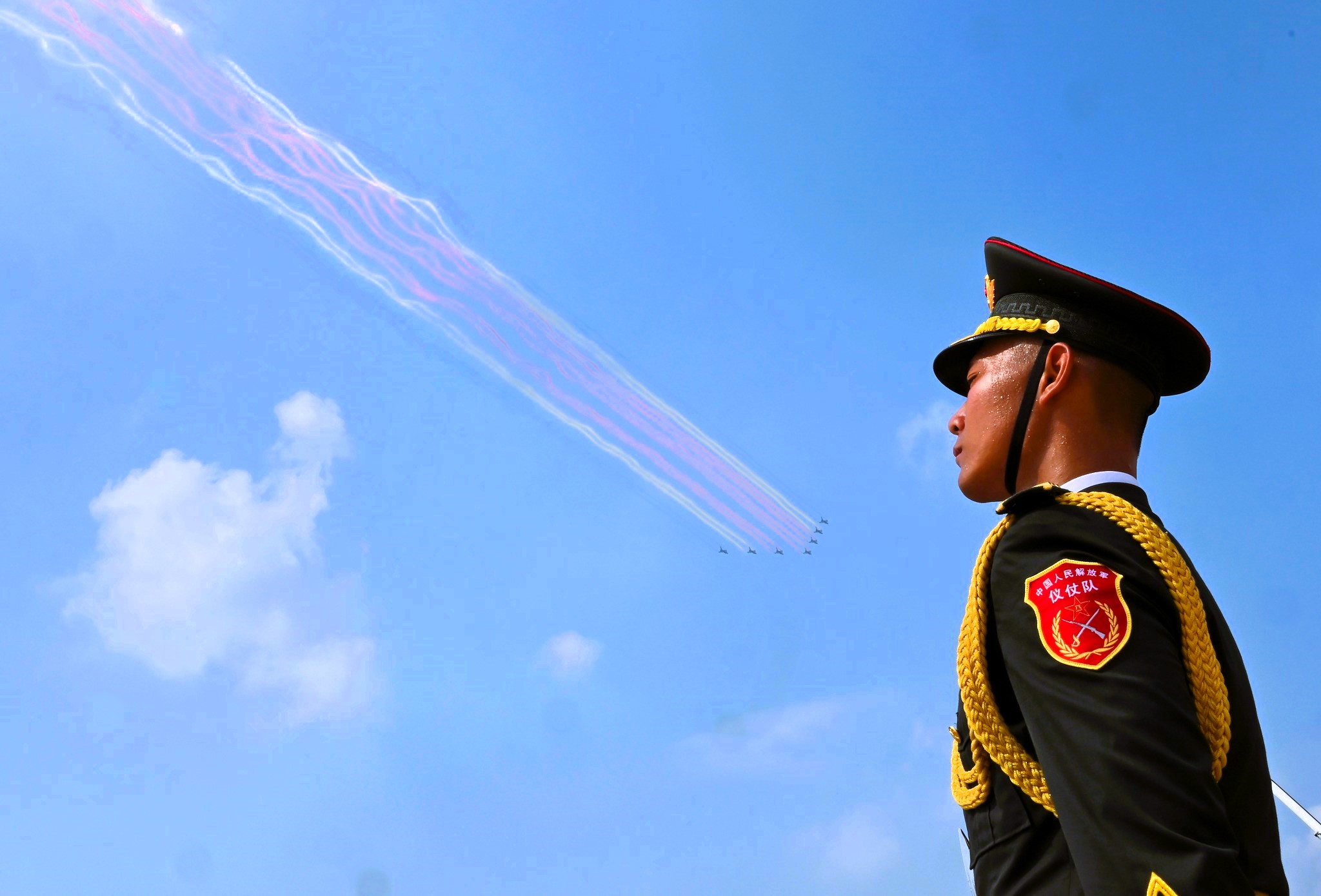

China is rapidly developing its military capabilities, transforming the People’s Liberation Army (PLA) into an increasingly sophisticated and capable force. The manner in which China continues to develop its military power, how it conceives of the use of force, and how it seeks to employ military means to achieve broader political and strategic objectives will significantly shape global security and international politics in the coming decades. This article draws directly on the Swedish Defence Research Agency’s (FOI) foundational report “Studying China’s Military Power—Analytical Framework and Methods,” authored by Oscar Almén and Christopher Weidacher Hsiung (eds.), Johan Englund, Frida Lampinen, and Per Olsson.
The report develops an analytical framework for assessing military power in general, with specific application to China, and discusses methodological approaches as well as the state of research on the PLA. This article applies the FOI framework to China, offering insights into the drivers of the PLA’s evolution and the broader implications for global security.
Understanding military power: An analytical framework
To comprehend military power, it is essential to define its scope. In the context of this analysis, military power is defined as the ability to influence international relations through the use or threat of military force to achieve strategic objectives. This definition highlights not only the material dimension of military strength but also a state’s intent and capacity to use it effectively.
The FOI report develops an analytical framework consisting of three interconnected analytical components for studying and evaluating military power, with a specific application to China. These components are:
- Resources: This refers to the material assets a state possesses. These include not only the number of soldiers, weapons, and equipment but also their quality, technology, and production capacity. For instance, the development of advanced weapon systems, such as stealth fighter jets or modern warships, is a direct indicator of available resources.
- Perceptual inputs: This concerns how a state perceives the utility of military power as a tool for achieving strategic goals. This includes national strategy, military doctrine, training, and the ideology that shapes decisions regarding the use of force. Understanding China’s perceptions of the use of its military power is critical for predicting its future actions.
- Conditional factors: These include variables that shape, positively or negatively, how effectively a state can convert its existing capabilities and resources into military power. These factors can be geopolitical, economic, social, or even cultural. For example, the ability to conduct joint operations or a lack of combat experience can affect actual military strength, regardless of the resources available.
This framework is designed to be flexible and adaptable to different conflict scenarios and contexts, offering a structured, open-ended tool for conducting holistic assessments of military power. Its application to China allows for a more comprehensive understanding of its military evolution and its potential implications.
The PLA’s military modernization: Progress and challenges
China’s military modernization is one of the most significant geopolitical phenomena of recent decades. The PLA has transformed from a force once considered outdated and underfunded into a modern military with cutting-edge equipment. This transformation is not merely a quantitative increase but a qualitative upgrade that affects all branches of the armed forces.
One of the most prominent examples of this rapid development is the expansion of China’s surface navy. The People’s Liberation Army Navy (PLAN) has become the world’s largest navy by number of ships, with a continuous addition of modern frigates, destroyers, and aircraft carriers. The construction and deployment of stealth fighter aircraft, such as the J-20, is another characteristic example of China’s technological progress in the military domain.
Despite this impressive progress, China still faces significant challenges and lags behind the United States. The report notes that China’s military spending is approximately one-third of that of the U.S., and the PLA still falls short in key areas such as combat aircraft, command and control (C2) systems, aircraft carriers, and nuclear-powered submarines.
Furthermore, the PLA’s lack of combat experience and its limited capabilities in conducting joint operations are critical weaknesses identified in the literature. While China has invested heavily in training and exercises, the true test of battle remains an unknown factor.
However, China has steadily closed its military spending and technological gaps with the West over the past two decades. Although questions remain about the precise performance details of Chinese military equipment, China is developing increasingly advanced designs with a greater degree of indigenous innovation. This suggests a growing ability for China to independently produce and develop military technology, reducing its reliance on foreign sources.
From FOI’s Studying China’s Military Power—Analytical Framework and Methods (2025): PLA forces and capabilities
“In 2024, the PLAGF had 965,000 active personnel, all of which were contracted. In 2024, the PLAGF had 4,700 main battle tanks (MBTs), 2,450 light tanks, 8,050 infantry fighting vehicles (IFVs), 3,600 armoured personnel carriers (APCs), 4,140 artillery pieces, 1,330 multiple launch rocket systems (MLRSs), and 320 attack helicopters in active service. Overall, the PLAGF contains a mix of modern, ageing and obsolete equipment. However, the trend has been a steady pace of upgrades, replacements and new capabilities.
The PLAN is organised into three fleets: the North Sea Fleet, the East Sea Fleet, and the South Sea Fleet, placed under the Northern, Eastern, and Southern Military Theatre Commands, respectively. As of 2024: the North Sea Fleet had 1 aircraft carrier, 4 large destroyers, 12 destroyers, 11 frigates, 10 corvettes, 4 tactical nuclear submarines (SSNs), 15 tactical conventional submarines (SSKs), 18 patrol vessels, 9 mine warfare vessels, and 7 landing ships in its inventory. The East Sea Fleet had 16 destroyers, 19 frigates, 19 corvettes, 30 patrol vessels, 9 mine warfare vessels, 1 landing helicopter dock (LHD), 3 amphibious transport docks (LPDs), 22 landing ships, and 16 SSK. The South Sea Fleet had 1 aircraft carrier, 4 large destroyers, 14 destroyers, 15 frigates, 21 corvettes, 30 patrol vessels, 13 mine warfare vessels, 1 LHD, 5 LPD, 21 landing ships, 6 strategic nuclear submarines (SSBNs), 2 SSNs, and 15 SSKs.
In 2024, the PLAAF had 403,000 active personnel, all of whom were contracted. In 2024, the PLAAF and PLANAF together had over 2,100 combat aircraft, close to 200 bombers, nearly 100 ISR and AEW&C aircraft, over 1,000 trainers, and 144 tankers and transport aircraft, as well as 55 helicopters.
The PLA Rocket Force (PLARF) is responsible for China’s land-based conventional and nuclear missiles. China’s nuclear arsenal has been expanding for some time, from about 200 warheads a decade ago to over 500 in 2023, according to the U.S. Department of Defence. China has a large fleet of missile-carrying vehicles and an increasing number of strategic submarines; in 2021, it was revealed that China had begun building new silo fields capable of storing intercontinental ballistic missiles. Nuclear missiles have also become more advanced and diverse, with a growing share being capable of carrying Multiple Independently Targetable Re-entry Vehicles (MIRV). This includes China’s newest intercontinental ballistic missile (ICBM), the DF-41, which has an estimated range of 12,000 kilometres, covering most of the continental USA.”
(FOI-R–5760–SE, 2025, pp. 65–80)
China’s defense industry and technological development
China’s defense industry is a central and critical resource for achieving the PLA’s development goals by 2050. A well-functioning, capable, innovative, and self-sufficient defense-industrial base (DIB) is essential for the sustained enhancement of the country’s military power. Significant efforts are underway to develop military Artificial Intelligence (AI) and autonomous technologies, aiming to achieve “intelligentized warfare,” although the full deployment of these capabilities is likely still several years away.
Despite China’s advanced industrial capabilities, complete self-sufficiency remains a long-term goal. However, the party-state’s commitment to improving the technological capacity of the defense sector creates favorable conditions for the PLA’s progress, provided it is not disrupted by major crises. Success, however, depends on a sustained level of financial support, progressive leadership, and improved incentive structures within the defense market.
Research on China’s military power faces significant challenges, primarily due to the difficulty of accessing diverse sources and data, as well as other challenges associated with researching a sensitive topic in an authoritarian environment. Despite the Chinese government’s efforts to censor and restrict access to information, numerous sources are still available that can contribute to a better understanding of China’s military power. The report advocates for a broad approach to studying military power and using different combinations of research methods depending on the issue under examination.
Methodological approaches and future studies
The study of China’s military power requires a careful and multifaceted methodological approach. As mentioned, access to information can be limited, necessitating the use of various sources and methods. The FOI report underscores the importance of understanding not only material capabilities but also the ideational frameworks and strategic thinking that guide the use of China’s military resources. This includes analyzing official documents, statements, military publications, and leveraging open-source intelligence (OSINT).
The FOI report series, of which this report is the first, aims to complement the predominantly U.S.-centric field of research on China’s military. Research from countries outside the United States, such as in Europe or East Asia, can offer different perspectives and experiences regarding China’s military power. Furthermore, this series aims to build Swedish expertise on the Chinese military, an issue of growing importance for Sweden.
Continuous monitoring and analysis of China’s military power are vital for understanding global geopolitical developments. The application of a comprehensive analytical framework, combined with the use of diverse methodological approaches, will contribute to providing well-founded insights and informing policy decisions.