
On 13 May, Hapag-Lloyd delivered the cleanest illustration of what Q1 2026 container shipping really looks like. Revenue dropped to €4.2 billion from €5.0 billion a year earlier. EBITDA collapsed from €1.0 billion to €422 million. The company moved from a €446 million profit to a €219 million loss in twelve months, and CEO Rolf Habben Jansen used the word “unsatisfactory” with the particular German discipline that suggests considerably stronger language was contemplated and rejected.
The Liner Shipping segment carried the entire decline. Terminal & Infrastructure actually grew, with revenue rising from €104 million to €144 million and EBIT improving slightly. So the story is not that Hapag-Lloyd lost its operational footing. The story is that ocean freight, which is what Hapag-Lloyd primarily sells, has stopped paying what it used to.
And then there is the Middle East. Habben Jansen put a number on it that the industry will now have to live with: €50 to €60 million per week in additional cost from the Hormuz disruption, with the company attempting to recover part of that through surcharges. For a single quarter, those figures imply gross exposure of roughly €650 to €780 million. Even after partial recovery, the residual burden is measured in hundreds of millions rather than temporary volatility. It is not weather. It is not seasonality. It is a permanent feature of the operating environment until Tehran decides otherwise.
Maersk and the volume illusion
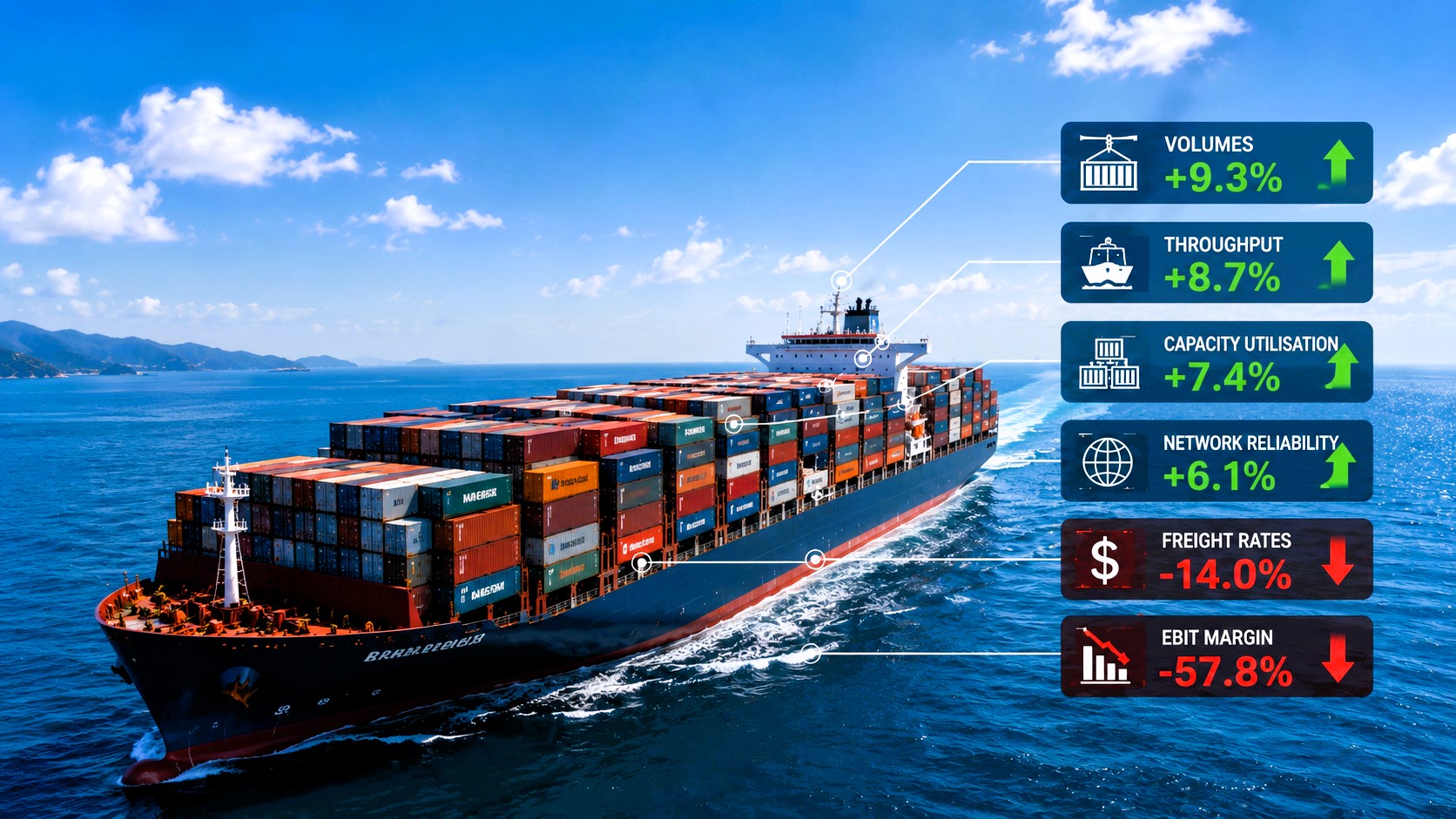
If Hapag-Lloyd showed how bad the quarter can look on the surface, Maersk showed how misleading the headline can be. Ocean volumes rose 9.3%. Logistics & Services revenue grew 8.7%. Terminal volumes added 4.3%. By the metric that still governs liner profitability, freight rates, it was awful. Loaded rates fell 14% to $2,081 per FFE, and Ocean EBIT swung from a $743 million profit to a $192 million loss.
The Maersk result is therefore the most diagnostic in the sector. Demand exists. Customers are shipping. Asia is exporting at pace, driven by China. Yet group revenue still fell 2.6% year-on-year, because every extra box was sold at a discount. Vincent Clerc described his diversified network as a “true gamechanger” for cost containment, which is the polite corporate formulation for the observation that Ocean alone no longer carries the quarter.
This is the central insight of Q1 2026 container shipping. The cyclical recovery argument depends on the assumption that rising volumes drag rates upward. They did not. Industry overcapacity, with new vessel deliveries continuing to enter the market, has decoupled the two. Carriers are now hauling more cargo into a freight rate environment that actively punishes them for doing so.
COSCO confirms it in Mandarin
Across the Pacific, COSCO Shipping Holdings reported revenue of RMB 51.8 billion and net profit attributable to shareholders of RMB 5.88 billion, which sounds healthy until placed against last year. Net income fell roughly 50% year-on-year. The freight-rate compression mirrored Maersk almost exactly, with earnings per share dropping from RMB 0.74 to RMB 0.38. The Chinese scale advantage, in other words, did not insulate the company from the same compression hitting Hamburg and Copenhagen.
Taiwan’s carriers tell the same story with smaller numbers. Evergreen, Yang Ming and Wan Hai are all operating in a weaker transpacific pricing environment, with Pacific routes under particular pressure. The Taiwanese trio rode the 2024 Red Sea diversions to remarkable profits. In 2026, they are absorbing the cost of bunker prices and rerouting without the offsetting rate spike that made 2024 historically unusual.
Korea’s HMM completes the picture from East Asia. Operating profit and net profit remain positive, but both have compressed materially from pandemic-era levels. The era of extraordinary spreads, which began with the pandemic and was extended by the Red Sea crisis, is now closing across every Asian liner balance sheet. This is not a regional question anymore. It is a sector-wide phenomenon.
The Strait of Hormuz becomes an earnings variable
For three years, the maritime industry treated the Red Sea and now the Hormuz disruption as a geopolitical headline. The Q1 2026 container shipping numbers force a different reading. These are no longer external shocks. They are recurring operating costs, quantified by CFOs and disclosed in earnings releases. For the first time since the pandemic era unwound, geopolitical disruption is no longer producing extraordinary freight upside. It is producing ordinary operating drag. The conflict that escalated on 28 February 2026 severely disrupted traffic through the Strait of Hormuz, which remained at near-standstill conditions at the end of the quarter according to Maersk’s own quarterly disclosure.
The financial signature is consistent. Maersk’s Ocean unit cost fell 7% through network discipline, even as Hormuz disrupted supply chains. Hapag-Lloyd is carrying €50 to €60 million in additional weekly costs. Bunker prices accelerated alongside the Gulf crisis, with Brent crude moving materially higher through March and April. Every major carrier is now embedding a Hormuz factor into guidance and surcharge structures, which means the disruption has moved from contingency planning into the permanent cost base.
The strategic reading is uncomfortable. Even if Hormuz reopens tomorrow, the contractual rate structures, the rerouting investments and the surcharge frameworks built around the disruption will not unwind cleanly. Maersk’s wide full-year guidance, with EBITDA between $4.5 billion and $7.0 billion, explicitly cites two unknowns: vessel oversupply and the timing of any Red Sea and Hormuz reopening. That guidance range tells you the industry no longer pretends to know what normal looks like.
Why the Hapag-Lloyd × ZIM merger is the structural answer
On 16 February 2026, Hapag-Lloyd signed an agreement to acquire ZIM for $35.00 per share in cash, a transaction value of approximately $4.2 billion. The combined entity will operate over 400 vessels, capacity exceeding 3 million TEU and annual cargo volume above 18 million TEU, securing Hapag-Lloyd’s position as the world’s fifth-largest carrier.⁶ Read in isolation, this looks like a routine consolidation deal in a cyclical industry. Read against the Q1 results, however, it is something more revealing.
ZIM will publish its Q1 2026 numbers on 20 May, before U.S. markets open, and has confirmed it will not host a conference call because of the pending merger. The decision is procedurally routine and strategically revealing. It suggests that the pending transaction has already displaced quarterly performance as the market’s primary reference point for valuation. The $35 per share, fixed in February, has displaced operational results as the relevant number. That is what a consolidating industry looks like before consolidation completes.
The merger logic is now legible across every release this quarter. Margin compression has arrived. Geopolitical cost is permanent. New vessel deliveries continue. In that environment, the fifth-largest carrier acquires the tenth, and the gap between the integrated majors and the standalone mid-sized players widens further. ONE, HMM, Wan Hai and the Taiwan trio now find themselves in a market where scale, network density and terminal exposure are the only durable insulators. Mid-tier independence is becoming structurally expensive.
There remains one absentee. CMA CGM has not yet published its Q1 2026 figures, with its full-year 2025 results released in early March showing a 2% revenue decline to $54.4 billion and EBITDA falling to $10.6 billion. The French group is private, so its publication schedule is its own affair. When the numbers eventually arrive, they will fit the pattern. They will not change it.
Q1 2026 container shipping was not a quarter of collapse. It was a quarter of disclosure. The volumes are real, the demand is genuine and the customers are still shipping. What has vanished is the pricing power that, for four extraordinary years, made the industry one of the most profitable in global trade. The Hormuz factor has converted a geopolitical headline into a permanent operating cost, and the Hapag-Lloyd × ZIM transaction confirms that the major players have read the same data and reached the same conclusion.
The question for the rest of 2026 is therefore not whether rates recover. It is which mid-sized carriers, watching the merger logic play out between Hamburg and Haifa, conclude that going it alone is no longer a viable proposition. Q1 2026 container shipping has handed them the answer in writing.
The cycle is not turning. The structure is.