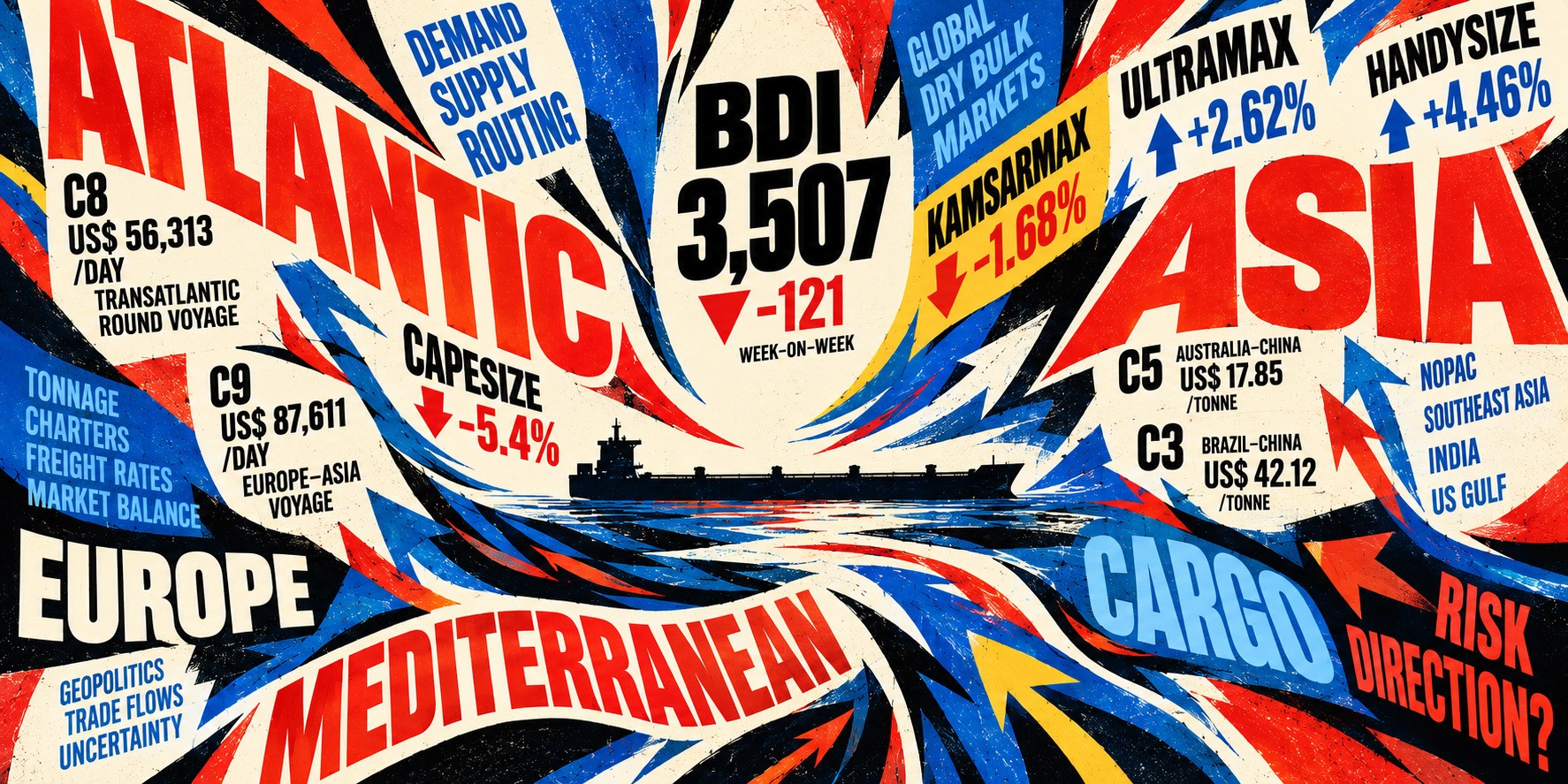

The dry bulk market spent the week treading water, with most vessel segments broadly holding within familiar ranges. Although the weekly moves remained in single digits, the larger sizes slipped into negative territory, while Supramaxes and Handies recorded marginal gains.
The divergence was limited, but it was telling. Capesizes fell by 5.4%, Kamsarmaxes by 1.68%, while Ultramaxes and Handies advanced by 2.62% and 4.46%, respectively, compared with the previous week.
Against this backdrop, the Baltic Dry Index (BDI) shed 121 points week-on-week, closing at 3,507 points on Friday, 11 September.
The headline, therefore, is not one of dramatic change but of a market searching for direction. Beneath the relatively restrained headline figures, however, regional balances between tonnage and cargo continued to shift. A closer look at each vessel segment and trading basin reveals where the pressure is building — and where the foundations remain comparatively firm.
Capesize — A tale of two oceans
Asia: midweek recovery, fragile finish
The week opened on a softer footing in Asia, before the market regained some ground around midweek, supported by activity from the major miners on the key Australia–China C5 route.
That recovery, however, proved somewhat fragile, with modest downward corrections emerging towards the end of the week. The C5 Australia–China index closed Friday at US$17.85 per tonne.
The picture was therefore one of resilience rather than conviction: sufficient demand to steady the market, but not enough to establish a sustained upward trajectory.
Atlantic: a quiet South, a divided North
In the Atlantic, and particularly in the South, the market remained subdued, with a limited number of cargoes appearing on both sides of the basin.
The North presented a more nuanced picture. Transatlantic business broadly held its ground, underpinned by a relatively tight prompt tonnage position, while voyages towards Asia came under pressure.
By Friday, the Brazil–China C3 index stood at US$42.12 per tonne. Rates for Europe–Asia C9 voyages closed at US$87,611 per day, while transatlantic round voyages on C8 stood at US$56,313 per day.
The Capesize market, in short, remained caught between relatively supportive tonnage fundamentals in parts of the Atlantic and softer demand on key Asian-bound routes.
Kamsarmax — The Atlantic loses its edge
Atlantic: more ships, fewer fresh cargoes
The Atlantic closed the week with a discernible sense of fatigue, both in the North and South.
In the North, the imbalance between vessel supply and cargo demand became increasingly apparent. Tonnage was accumulating faster than fresh cargoes were entering the market, placing gradual pressure on owners’ ideas.
In the South, meanwhile, geopolitical developments continued to inject considerable nervousness into the market. Indicatively, rates for ECSA–Far East voyages stood at US$33,000–35,000 per day, basis delivery West Africa. Europe–Asia voyages were assessed at US$29,500–31,500 per day, basis delivery Europe, while transatlantic round voyages traded at US$20,000–22,000 per day, basis delivery Gibraltar.
The market is therefore being shaped by two very different forces: conventional tonnage–cargo fundamentals in the North, and geopolitical risk in the South.
Asia: demand holds, but the gap widens
Asia offered a somewhat firmer picture, with satisfactory demand and a constructive signal from forward FFA pricing, where future freight expectations pointed higher.
Yet activity faded towards the end of the week as the gap between charterers’ bids and owners’ ideas became increasingly difficult to bridge. The North Pacific remained the principal driver.
Rates for round voyages in Southeast Asia and the Far East were assessed at US$23,500–25,500 per day, basis delivery Far East.
The underlying picture remains balanced, but the widening bid–offer gap suggests that conviction is still lacking on both sides of the market.
Ultramax — A market of contrasting currents
Southeast Asia: cargo support, selective strength
Southeast Asia delivered a mixed performance, with fixtures emerging at varying levels as the week progressed. The principal support came from cargoes bound for India and from Australia.
Ultramax rates for voyages between Southeast Asia and the Far East stood at US$19,500–21,000 per day.
Further north, in the Far East, the market softened as owners trimmed their ideas slightly in an effort to conclude business.
Ultramaxes trading North Pacific round voyages (NOPAC) were assessed at US$18,000–19,500 per day, while voyages towards India were at US$21,500–23,000 per day. Backhaul voyages towards the Atlantic were valued at US$18,500–20,000 per day.
The pattern is familiar: cargo continues to provide a floor, but owners are having to remain increasingly pragmatic when positioning tonnage against available employment.
Middle East Gulf & West Coast India: risk overshadows opportunity
In the Middle East Gulf and West Coast India, trading remained subdued.
Although some cargoes were available within the Gulf, the majority of owners remained reluctant to pass through the straits. The growing involvement of the Houthis in the war has added another layer of uncertainty to an already fragile operating environment.
Rates for voyages towards the Far East stood at US$12,500–14,000 per day, basis delivery WCI.
Here, the market is being influenced by more than freight fundamentals alone. Risk appetite, routing considerations and the willingness of owners to commit vessels to particular trading patterns are becoming increasingly important variables.
U.S. Gulf: early momentum shifts to charterers
The U.S. Gulf began the week with considerable momentum. As the days progressed, however, charterers gained the upper hand, with only transatlantic business generating satisfactory cargo volume.
Ultramax rates for transatlantic voyages were assessed at US$30,500–32,000 per day, while rates for voyages towards Asia stood at US$31,500–33,000 per day.
The ECSA market remained broadly balanced, with activity improving against the previous week across both transatlantic and Asia-bound employment.
Rates for voyages towards Southeast Asia and China stood at US$34,500–36,000 per day, while transatlantic voyages towards the Mediterranean and Europe were assessed at US$32,500–34,000 per day.
The message from the Atlantic is therefore one of relative balance — but balance that remains highly sensitive to the pace at which fresh cargoes enter the market.
Europe: slow trading, tight tonnage
The European market moved at a measured pace at the beginning of the week, reflecting limited activity, and maintained broadly the same tempo through Friday.
Prompt vessel availability remains limited, although demand has softened slightly.
Rates for local round voyages stood at US$22,500–24,000 per day. Scrap runs to the Mediterranean were assessed at US$25,500–27,000 per day, with voyages towards Asia at the same US$25,500–27,000 per day range.
Mediterranean: tonnage moves West
The Mediterranean remained subdued, particularly in the East, while the Western basin offered a more constructive picture. This prompted a number of vessels to reposition from the East towards the West.
That repositioning, in turn, helped restore the balance between supply and demand, to the benefit of owners.
An Ultramax trading Mediterranean–Asia was assessed at US$25,500–27,000 per day, basis delivery Çanakkale. Rates for voyages towards the Atlantic stood at US$11,500–13,000 per day, while intra-Mediterranean employment was valued at US$15,500–17,000 per day, excluding war zones.
The regional redistribution of tonnage is worth watching closely. In a market where vessel positioning can alter the balance surprisingly quickly, movements of relatively modest numbers of ships can have a disproportionate effect on freight levels.
Handysize — Small tonnage, firmer footing
Europe: a firmer finish
The European Handysize market finished the week on a positive note, as charterers showed a greater willingness to secure both vessels and cargoes through operators.
Rates for the larger vessels in the segment reached US$14,500–16,000 per day for round voyages, US$19,500–21,000 per day for scrap runs to the Mediterranean and US$12,000–13,500 per day for transatlantic voyages.
The Mediterranean gathered pace around midweek, led primarily by backhaul employment. The improvement filtered through to the other trading routes as well.
For larger Handies, above 36,000 dwt, rates stood at US$11,000–12,500 per day for intra-Mediterranean voyages, US$10,500–12,000 per day towards Europe, US$11,000–12,500 per day towards the Atlantic and US$15,000–16,500 per day towards Asia, basis delivery Çanakkale.
U.S. Gulf: demand builds across the board
The U.S. Gulf continued to improve throughout the week, supported by stronger demand across the principal routes.
For the larger Handysize vessels, rates for voyages towards the Atlantic stood at US$18,500–20,000 per day, while Asia-bound voyages were assessed at US$15,500–17,000 per day.
ECSA: fresh cargo keeps momentum alive
The ECSA market maintained its positive momentum, with cargoes continuing to replenish while available tonnage remained at satisfactory levels.
Transatlantic voyages towards Europe and the Mediterranean were assessed at US$24,500–26,000 per day, while voyages towards Asia stood at US$21,500–23,000 per day.
The combination of steady cargo renewal and manageable vessel supply continues to provide the region with one of the more constructive fundamentals in the Handysize space.
Asia: stability in the East, pressure further West
In Asia, and particularly in the North, there were no major changes to the market balance, with both demand and supply broadly holding at the same levels. The South presented a similar picture.
Further west, however, the Middle East Gulf and India continued to weaken. Demand remained too limited to absorb the available tonnage, leaving the market under persistent pressure.
Rates for larger Handies on Far East and NOPAC round voyages stood at US$18,000–19,500 per day. Voyages from Southeast Asia to China were assessed at US$18,500–20,000 per day, while West Coast India–China employment stood at US$8,500–10,000 per day.
The week ahead: balance before breakout
The dry bulk market enters the coming week without a decisive directional signal. The headline indices may suggest relative stability, but the underlying picture is more finely balanced.
Capesizes remain exposed to softer Asian demand, while Kamsarmaxes are negotiating a widening divide between available tonnage and fresh cargoes in parts of the Atlantic. Ultramaxes are displaying the greatest regional divergence, with vessel positioning, geopolitical risk and cargo flows pulling the market in different directions. Handies, meanwhile, continue to benefit from healthier cargo fundamentals in selected Atlantic markets.
For owners and charterers alike, the crucial question is not simply where rates stand today, but how quickly regional imbalances can be corrected. In such an environment, vessel positioning, cargo visibility and risk assessment become as important as the headline index itself.
The market may currently be moving sideways, but beneath the surface the pieces continue to shift. And in dry bulk, it is often those apparently small shifts in tonnage and cargo positioning that determine the direction of the next meaningful move.
Legal disclaimer
This report is provided solely for general informational purposes and does not constitute investment or commercial advice. The information herein is based on sources believed to be reliable, but its accuracy or completeness is not guaranteed. Any actions taken based on this content are the sole responsibility of the reader.