
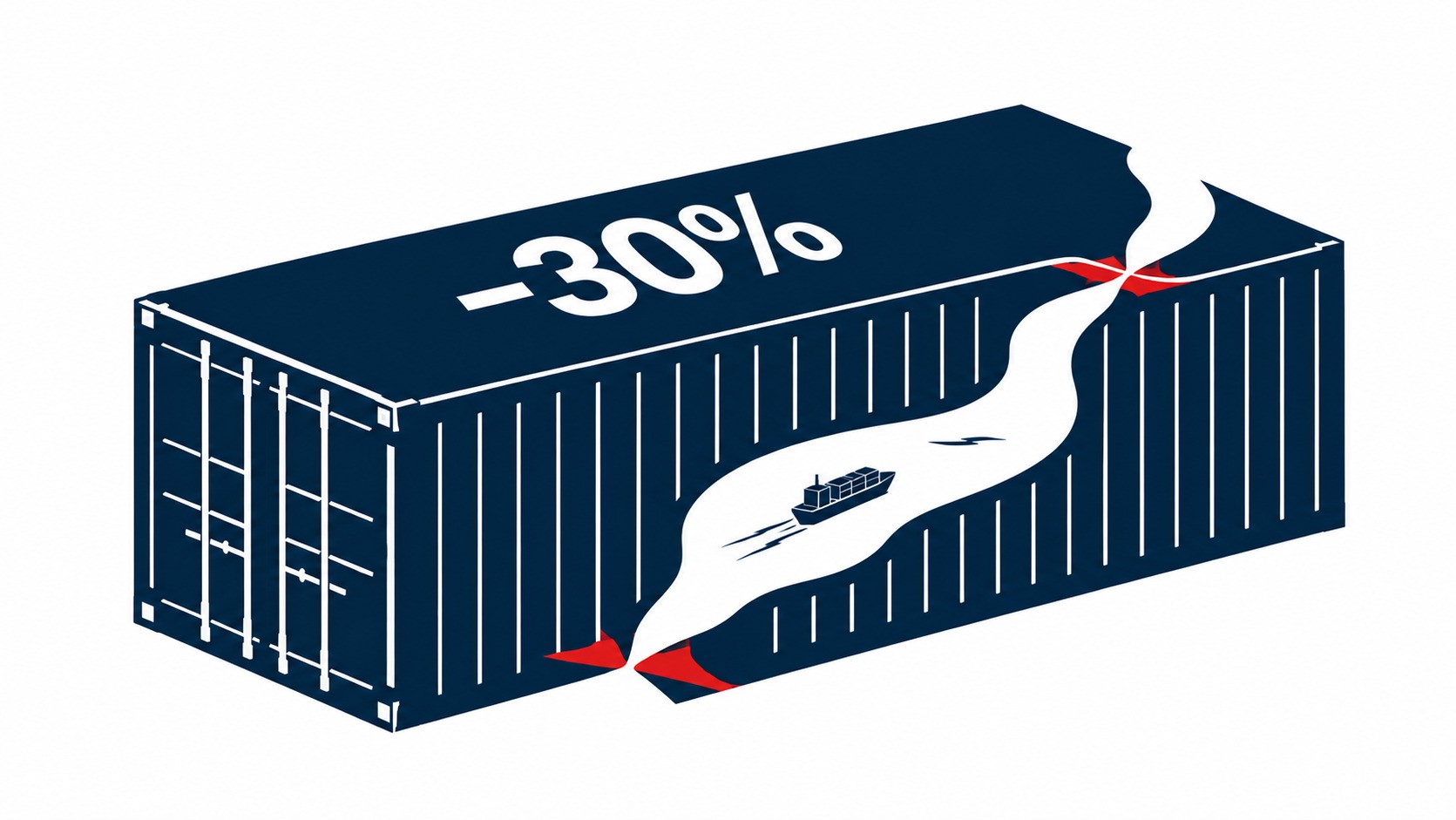

Start with the arithmetic, the least debatable part of any freight forecast. Xeneta expects demand to grow 2.5 to 4 percent in 2027, while the fleet grows 6.8 percent. Carriers take delivery of 2.9 million TEU of new ships and demolish only 0.5 million TEU. Supply outruns demand, so spot prices fall.
Now read the small print. The 30 percent is a global average of spot rates. It starts from the third quarter of 2026, which was no bargain. Drewry’s index stood at $4,305 per 40-foot box on 12 November, though it tracks a different basket from Xeneta’s averages. Long-term contract rates fall just 5 percent. So the sharpest fall in container freight rates lands on the spot market. Contracts cushion the blow without escaping it.
Xeneta also expects a slower start to 2027 and a weaker peak season. The rest depends on two chokepoints, and spreadsheets price those badly.
Why container freight rates ignore spreadsheets
Most forecasts of the past three years shared one flaw: they assumed the map would hold still. Peter Sand, chief analyst at Xeneta, points out that rates were due to soften each year. Then came the Red Sea crisis in 2024, U.S. tariffs in 2025 and the Hormuz crisis in 2026. Between 28 February and 31 October, Transpacific spot rates to the U.S. West Coast rose 343 percent.
That lane does not normally touch Hormuz, yet AJOT reported in June that the ripple reached all major trade lanes. The disruption travelled far beyond the strait. On 2 March, Linerlytica counted 132 containerships, 458,000 TEU, trapped in the Gulf. They were a fraction of the 3.4 million TEU on routes through the strait. Port delays then absorbed roughly 12 percent of vessel capacity, and Singapore bunker prices rose 107 percent.
Keep perspective, though. The 343 percent surge still left that lane 14 percent below its pandemic record. Hormuz has not healed either. By 10 November the IMO had verified more than 130 incidents and 25 seafarer deaths since 28 February.
The Red Sea is a coordination game
If rivals sail through Suez and you stay on the Cape route, you lose on voyage time and cost. So rivals tend to follow once someone breaks the ice. The data fits. Maersk and Hapag-Lloyd paused Suez sailings in March as the Iran fighting escalated. On 14 September they announced four more services for Suez, conditional on stability in the Red Sea. By mid-October, BIMCO counted 16 services with announced Suez returns since early July, across all three alliances and MSC.
Freightos, citing Alphaliner, put nearly two-thirds of Asia–Europe capacity back on Suez routings in late October. BIMCO measures transits at more than half of pre-disruption levels. Xeneta counts 467,297 TEU of weekly Red Sea capacity in October, about half the August 2023 level. Different measures, different baselines, same direction. Even Israeli carrier ZIM has resumed the route on a joint service with MSC, within months of the Houthis declaring the strait closed to Israel-linked vessels.
Then the Houthis enter. On 11 August a Houthi strike hit the cargo ship Tihamah, and the IMO confirmed four deaths. Carriers returned anyway. That creates an uncomfortable asymmetry. They invest in shorter routes, while the option to disrupt them stays with the Houthis. Lars Jensen of Vespucci Maritime argues on LinkedIn that the Houthis could shut Red Sea container traffic at will. Right now, he adds, they choose not to. Sand says the Red Sea cuts both ways. A full return could make rates plummet. A deterioration in security would bring chaos to networks and push rates up.
Overcapacity is a prisoner’s dilemma
Supply is where analysts agree, then argue about size. BIMCO sees fleet growth of 9 percent in 2027, with supply outpacing demand under both Hormuz scenarios. Drewry projects, in its 26 October outlook, net capacity growth of 8.8 percent in 2027 and 12.1 percent in 2028. Xeneta says 6.8 percent, within its own range of 5.4 to 8.3 percent. Different forecasts, different assumptions, same underlying imbalance.
Nominal fleet growth is only half the story. A return from the Cape to Suez adds no ships. It cuts the ships needed to run a weekly service. Shorter round trips release effective capacity without a single delivery. Xeneta says 599,000 TEU have already come back that way. Hormuz and congestion work in reverse, tying capacity up. That is 2027’s real contradiction: too many ships, yet a market that can still run short of effective capacity.
Now the game, as an analogy rather than a full model. Each carrier prefers that rivals idle ships while it fills its own. Defect with discounted slots and you win cargo. Then everyone defects, and rates slide toward the cost of moving a box. Sea-Intelligence forecast in October 2025 that overcapacity would peak in 2027, at a level comparable to 2016, a year of price war. Its model assumed the Red Sea would settle by mid-2026. Reality arrived late, so the glut may too. Carriers know the script. Drewry’s tracker of 13 November lists 52 blank sailings among 716 planned on the main East–West trades between 16 November and 21 December, about 7 percent. That is capacity discipline in action. Whether it survives the next wave of deliveries is another question. Discipline tends to fray when 2027 hands every player a new ship to fill. How far container freight rates fall depends on how long it holds.
Egypt wants its tollbooth back
Cairo has one of the strongest financial incentives to keep this return going. Suez Canal revenue fell to $3.99 billion in calendar 2024 from a record $10.25 billion in 2023. It then rose 23 percent to $4.67 billion in fiscal 2025/26. The authority’s chairman projected $8 billion for 2026/27 last December. That would mean about 70 percent growth in a year, and the Houthis have not read the budget.
Notice who profits from the same event. Every extra container ship that returns to Suez pays Cairo a toll and adds spare capacity to the market. Egypt’s recovery and Xeneta’s 30 percent are two faces of one return. Shippers get cheaper boxes, Cairo gets its tollbooth and carriers get the bill.
Container freight rates: cheaper boxes, rougher seas
Expect one of three years. A calm return delivers Xeneta’s 30 percent, perhaps more. Hesitation lets carriers cancel sailings and defend price. A relapse sends the fleet round the Cape again and prices back up.
Two wildcards sit outside that tree. Sand warns that low water in the Panama Canal could bring restrictions and premiums for shippers. FreightWaves adds that El Niño could threaten water levels in the dry season at the start of 2027. Meanwhile, China exports six laden containers for every one it imports, against 3.3 in 2019.
Xeneta’s number is a fair reading of the fundamentals. It says nothing about Sanaa, Tehran or Cairo, none of which will wait for the forecast. Lower container freight rates remain the base case, and the security of two chokepoints decides how far they fall.