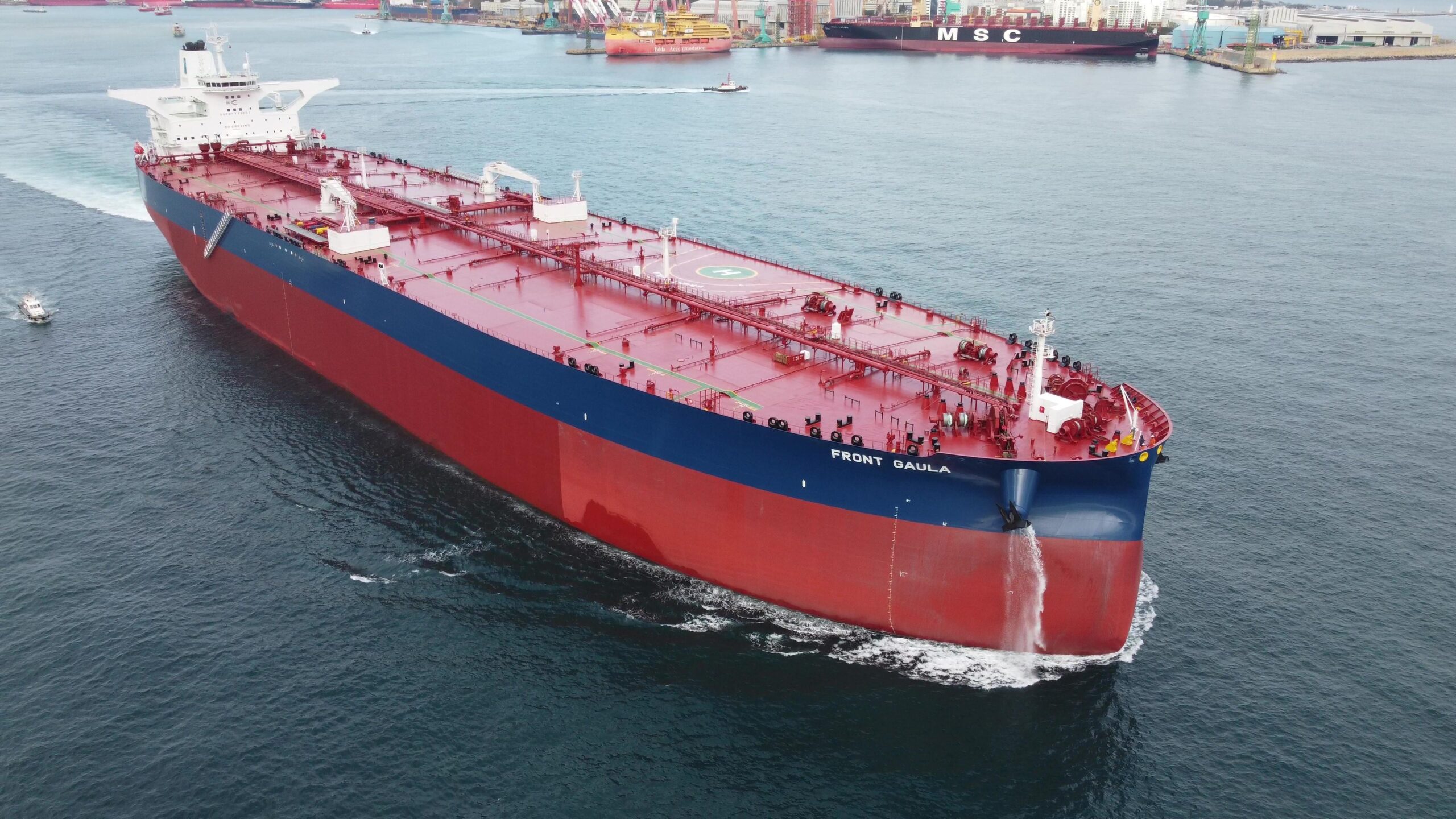

Frontline, John Fredriksen’s leviathan of the tanker world, has once again opted to let the market breathe on its own—and preferably, exhale profits directly into shareholders’ pockets. No cover. No safety net. No long-term charter shelter from the storm. Just pure, unfiltered exposure to the spot market.
CEO Lars Barstad made it excruciatingly clear during the latest earnings call: “We’re not going to start fixing ships on term.”
This, presumably, was not an attempt to win any awards for poetic phrasing but rather a blunt reaffirmation of a thesis that, while financially elegant, is operationally ruthless. Spot market exposure, it seems, remains not just a tactic but a belief system for Frontline—a sort of secular religion in a world cluttered with hedges, caveats, and carefully scripted risk aversion.
To anyone even mildly acquainted with tanker cycles, this approach isn’t entirely insane. In fact, during peaks of market froth, it looks borderline genius. When rates soar, those tied into long-term charters can only watch from the deck rail as spot-based operators inhale windfall earnings. Barstad and his team, clearly, would prefer the latter.
The religion of risk
What makes this stubborn devotion to the spot market all the more interesting is the backdrop against which it’s playing out. The world, dear reader, is not particularly stable. With Red Sea disruptions, Russian crude reroutings, OPEC recalibrations, and sanctions policies with the consistency of English spring weather, the spot market resembles less a financial arena and more an improvisational theatre.
And yet, Frontline leans in.
One might say it borders on philosophical. Other shipowners chase predictability. Frontline, meanwhile, seems to believe that any form of predictability is, at best, a trap in disguise. The balance sheet is clean. The dividend payout is generous. The confidence, as expressed by Barstad, is total: “We’re very comfortable with our strategy.”
Comfort, of course, is a relative term. For those invested in the company, it’s the kind of comfort best compared to sitting in a chair bolted to the deck of a supertanker in a Category 3 squall. Exhilarating, yes. Safe? Well, that depends on your constitution.
When dividends drop, faith is tested
There are, naturally, wrinkles. Frontline reported Q1 profits of $86.2 million—a notable drop from $240 million a year earlier. Revenue slid as well, from $555.8 million to $418.2 million. The dividend per share? Down to $0.37 from $1.03. These are not, by any stretch, cosmetic blemishes. They are the direct effect of what happens when the spot market yawns instead of roars.
But therein lies the catch: this is the price of the philosophy. You live by the spot market, you profit by it—and sometimes, you bleed.
Investors, of course, are rarely known for their Zen-like acceptance of volatility. When asked why the share price lags behind net asset value, Barstad refused to reach for the comfort of tactics. No buybacks. No term cover. No departure from the creeds of recent years. The implication was clear: the market will catch up eventually. Or not.
Why the spot market still seduces
Despite all, the appeal of the spot market endures. It’s the arena where shipping’s old alchemy still thrives—where information, timing, and a healthy dose of nerve can outstrip meticulous planning and contractual certainty. For a company like Frontline, whose brand is intertwined with velocity and scale, the spot market offers not just upside but identity.
It is also, to be fair, an environment that suits the modern geopolitical seascape. With energy corridors rerouted at whim and demand curves shifting faster than weather patterns, flexibility isn’t just a luxury—it’s an existential requirement. Spot market exposure allows Frontline to pivot (no, let’s call it what it is: turn) swiftly and monetise disruption with industrial-grade efficiency.
That being said, this elasticity comes with neuroses. For each profitable reroute around the Cape of Good Hope, there’s a slump waiting when tonnage builds and demand hiccups. Investors expecting linear returns are in for an education, or perhaps a headache. Probably both.
Barstad’s calculated obstinacy
What Lars Barstad offers, then, is not merely strategy. It’s conviction in the rawest sense. And that matters. In a sector notorious for impulsive over-ordering, short-term memory, and a somewhat elastic relationship with discipline, Frontline’s consistency borders on countercultural.
That doesn’t mean it’s universally admired. Critics argue that eschewing term charters is tantamount to gambling with shareholder value. But perhaps that argument rests on an outdated template. In today’s landscape, predictability may not be the virtue it once was.
Instead, it’s adaptability—and perhaps a touch of well-informed bravado—that defines success. Frontline is betting, quite plainly, that its scale and market savvy give it an edge that justifies full immersion in the spot market.
Who needs cushions when you’ve got convictions?
Ultimately, what emerges is a picture of a company content to ride the tides as they come. There’s a sort of Spartan purity in the model—a disdain for financial padding and a preference for real-time earnings, however volatile. It harks back to an older shipping ethos: you make your money on the water, not in the contracts.
Frontline may not placate the analysts or court the ESG crowd with synthetic stability. But it does something else: it tells the truth of the market in real time, dividends and all. And in an industry increasingly defined by opacity, that kind of transparency—however jagged—has its own strange allure.
One gets the feeling that Barstad wouldn’t want it any other way. Nor, perhaps, would Fredriksen. As long as the spot market remains a cauldron of chaos and opportunity, Frontline will be there, sails full, spreadsheets open, and hedges firmly left ashore.