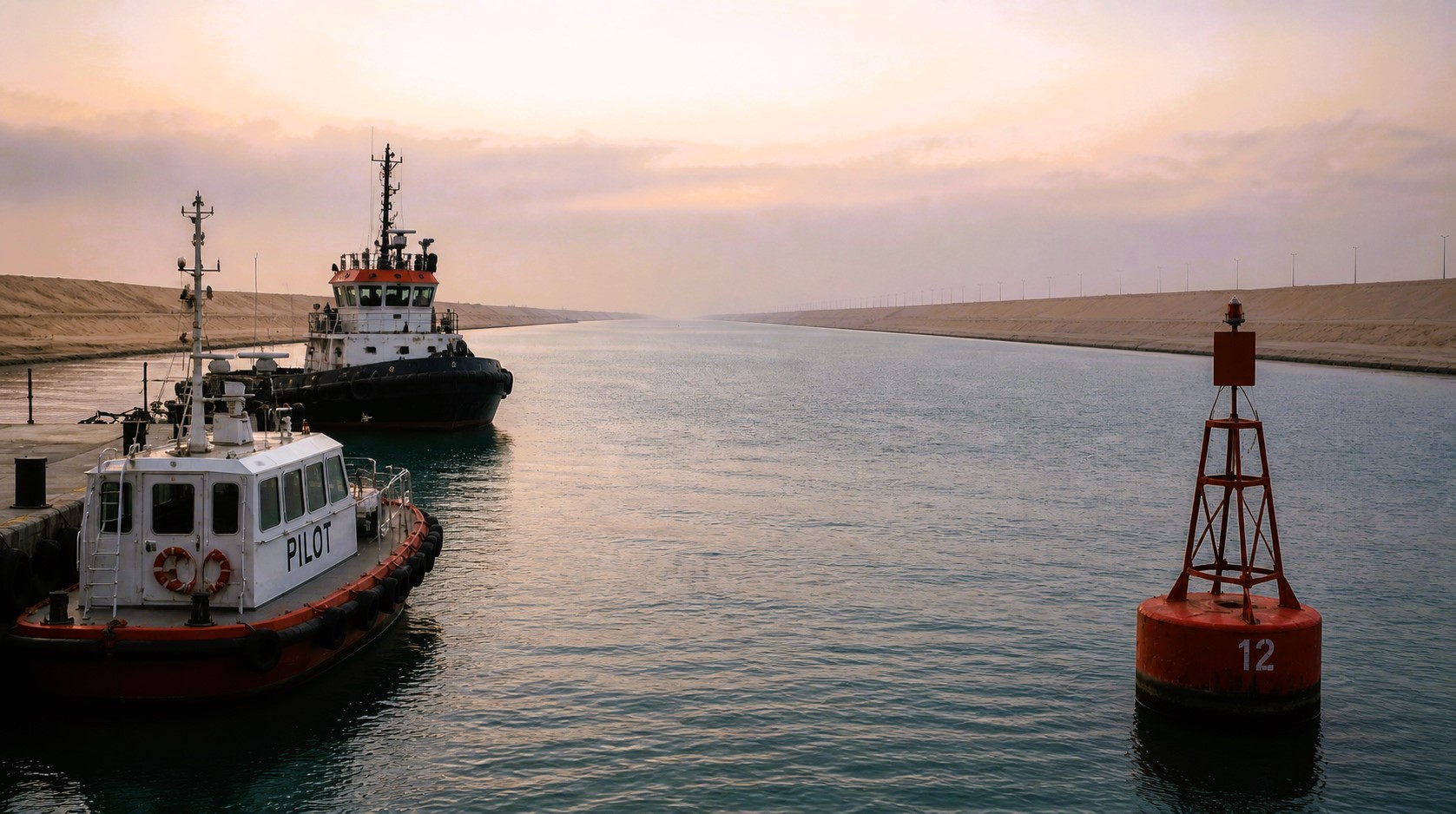

On 30 April 2026, the Drewry World Container Index closed at $2,216 per 40ft container, down for the third consecutive week. That figure deserves attention because it arrived during a regional war. The United States and Israel had killed Iran’s Supreme Leader two months earlier. The Joint War Committee at Lloyd’s had expanded the Middle East Listed Areas to include Bahrain, Djibouti, Kuwait, Oman, and Qatar. And container rates fell anyway.
This is the central puzzle of the partial Suez Canal recovery. Every traditional pricing mechanism that should generate a freight premium during regional conflict appears to be functioning, except in the one direction that matters. The market is not absorbing the geopolitical signal. To understand why, we must start with what failed to happen after the threat went away.
The threat that ended
The Yemen-based Houthi movement carried out its last successful attack on commercial shipping on 29 September 2025, against the Dutch-managed Minervagracht. Forty-three days later the Houthis declared an end to its maritime campaign, following the Israel–Hamas ceasefire signed earlier in October. By early December, the additional war risk premium for Red Sea transits had fallen to around 0.2% of hull values, the lowest level since November 2023, down from 0.5% before the ceasefire.
The Suez Canal Authority moved quickly to encourage carriers back. It introduced a 15% discount for large containerships and held direct talks with Maersk and CMA CGM. The French line responded first. The CMA CGM Jacques Saade, a 23,000 TEU LNG-powered vessel, transited southbound from Tangier Med in late December. Maersk sent the Sebarok through the Bab el-Mandeb on 19 December and described it as a trial.
What did not follow was a fleet. In the first week of 2026, Suez transits remained 60% below the corresponding week of 2023. The breakdown by segment told a sharper story. Container ship transits in the fourth quarter of 2025 were 86% below 2023 levels. Bulkers were down 55%, crude tankers 32%, and product tankers 19%. The threat had ended. The market had not returned. The mechanics of the early Suez Canal recovery were already failing to behave as the textbooks predicted.
Where the asymmetry lives
The segment data is the first clue. Product tankers were the only category to approach normality, and the reason is straightforward. Higher freight premiums on clean refined products allowed the segment to absorb war risk costs that container lines, locked into multi-leg networks, simply could not. The tanker market lives on point-to-point voyages that price each leg individually. Container shipping lives on rotating loops where one delayed call cascades through a quarterly schedule.
This asymmetry matters because it identifies who benefits from the existing arrangement. The Greek-controlled tanker fleet, valued at approximately $71.3 billion according to VesselsValue data for 2025, was the largest single beneficiary of the ton-mile demand surge created by the Cape of Good Hope rerouting. Greek owners hold roughly 27% of the global tanker orderbook, the highest concentration of any single national group. Their fleet earnings stayed elevated through 2024 and 2025 precisely because the Red Sea remained closed to them.
And yet, when push came to shove, those same owners chose safety over premium. In July 2025, after a fatal attack on a Greek-operated vessel, operators including Minerva Marine and Kyklades Maritime diverted tankers around the Cape of Good Hope despite carrying Russian Urals crude bound for India. When the largest beneficiary of the disruption refuses to test the corridor, the system has crossed an informational threshold. The signal is no longer about geopolitics. It is about whether the geography remains commercially trustworthy.
The structural reset
What happened during the two-year diversion was not a contingency. It was a capital allocation. Container carriers redesigned 2026 schedules around 40 to 45 day Asia–Europe transit windows, against the 28 to 32 days the Suez route had previously offered. The longer voyages absorbed roughly 6% of the global container fleet. That absorption mattered because the underlying orderbook stood at 32% of installed capacity by November 2025, according to Clarksons data cited by ING.
The Cape route, in other words, became the demand sink that made the orderbook tolerable. The Gemini Cooperation network operated by Maersk and Hapag-Lloyd promised customers 90% schedule reliability and largely delivered, recording 89.5% across all arrivals in December and January.
Returning to Suez means dismantling that reliability architecture. Industry analysts have warned that vessels would bunch at European ports as some services take the shorter route while others stay on the longer one, with equipment shortages at Asian origins likely to follow within eight to nine weeks. When schedule reliability dropped to 59% in February 2026, the lowest reading since April 2025, Sea-Intelligence attributed the decline partly to early Red Sea reintroduction colliding with the new Hormuz crisis. The cure was reproducing the disease. For carriers, the Suez Canal recovery had become an operational risk in itself, not a return to safety.
When the signal stopped firing
Then came the test. On 28 February 2026, joint United States and Israeli operations against Iran resulted in the death of Supreme Leader Ali Khamenei. Islamic Revolutionary Guard Corps (IRGC) retaliated immediately, including a kinetic strike on 1 March against the Palau-flagged tanker Skylight off Oman’s Musandam peninsula. The Joint War Committee responded on 3 March with circular JWLA-033, which took effect across all war risk policies from 9 March.
The Drewry index briefly rallied, climbing for six consecutive weeks as bunker fuel costs surged in the wake of the strikes, with carriers responding through emergency fuel and peak season surcharges. By mid-April, the rally had stalled. By 30 April, it had reversed entirely.
This is the part of the story that should make analysts uncomfortable. The decapitation of a major Middle Eastern power, accompanied by an open inter-state war involving the strait through which roughly a fifth of the world’s oil flows, produced a six-week freight rally that the structural overcapacity of the container market then digested without difficulty. The geopolitical premium had run out of room to expand.
Cairo’s climbdown
The Suez Canal Authority itself read the room and on 7 April quietly suspended its 15% transit discount, three months ahead of its scheduled expiry. The numbers explain why. Through mid-2025, only about ten containerships above the qualifying tonnage transited the canal each month, and nine of those were operated by CMA CGM under French Navy escort. The rebate was effectively a discount paid to a single customer that had already chosen to come back. Cairo’s strongest persuasive tool, a price reduction, had reached the limit of its usefulness.
Egyptian President Abdel Fattah el-Sisi, in a mid-March address, conceded that cumulative canal losses since 2020 had reached around 10 billion dollars and announced a politically painful 17% fuel price increase. The IMF facility supporting Cairo had already grown from 3 billion to 8 billion dollars.
What decoupling means
The conventional wisdom held that maritime chokepoints translated political risk into economic cost, and that this translation kept the system honest. Threaten the corridor, and rates rise. Close the corridor, and supply chains scream. The Suez Canal recovery of 2026 has revealed that the translation now depends on a tight supply-demand book, and that the 32% orderbook has loosened the book to the point of indifference.
Two consequences follow. First, the deterrent value of disrupting commercial shipping has weakened. If a state or non-state actor can no longer count on price signals to amplify a kinetic action into a strategic one, the political utility of the threat collapses. Second, and more awkwardly, this same insulation may invite further testing. When economic blowback fails to discipline behaviour, the calculus around grey-zone maritime activity becomes more permissive, not less.
The market’s verdict
The Egyptian fiscal position is the most exposed casualty of this new arithmetic. Cairo earned 3.991 billion dollars from the canal in 2024, against 10.25 billion in 2023, with only 13,213 ships transiting compared with more than 26,000 the year before. The IMF projected a further fall to 3.6 billion dollars in fiscal year 2024/25. The state with the strongest interest in restoring the corridor has the weakest leverage to make that happen.
After two years of marketing the canal, holding direct talks with major carriers, and welcoming the French back with public ceremony, Cairo accepted that pricing had reached the limit of its persuasive power. The Suez Canal recovery would proceed at the speed the market chose, which was no faster than indifferent.
The market’s indifference is itself a geopolitical fact. It tells us that, at this particular moment, with this particular orderbook, the global shipping system has been engineered to tolerate a closed Red Sea more comfortably than it can tolerate the operational disruption of reopening one. Whether that tolerance survives the next round of newbuild deliveries, or the next escalation in the strait, is the more interesting question. For now, the corridor is open, the war is hot, and the rates are falling. The signal has stopped firing.