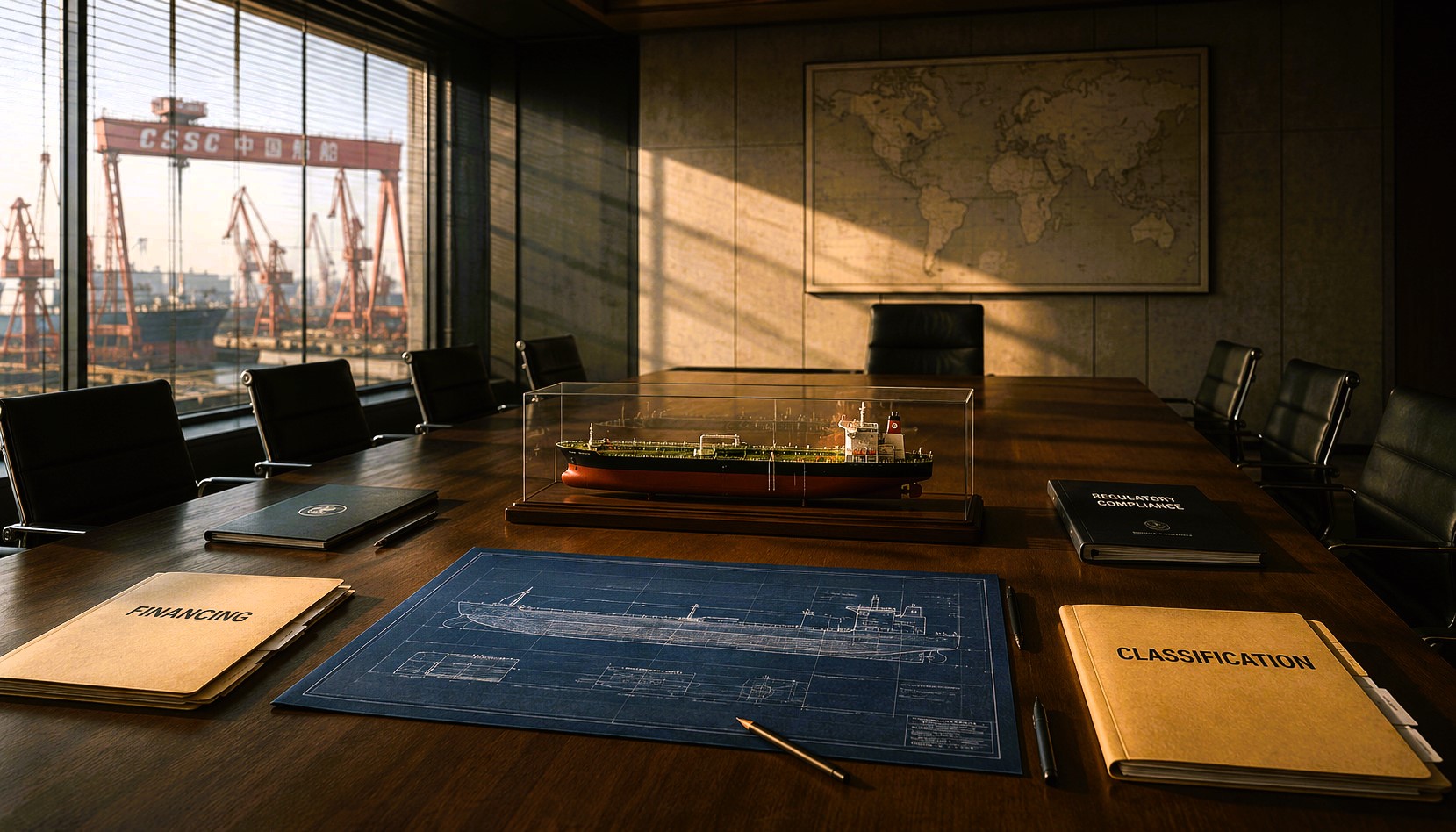

On 2 June 2026, at the Metropolitan Expo in Athens, the China State Shipbuilding Corporation opened a representative office. The Chinese Ambassador to Greece cut the ribbon. A Deputy Party Secretary of the largest state-owned shipbuilding group in the world stood beside him. Cameras rolled.
Two halls away, ABS — the American Bureau of Shipping — was doing what ABS always does at these events: classifying vessels, advising on compliance, and quietly underwriting the legal architecture that determines whether a ship can trade at all.
One country came to build. The other came to certify. At Posidonia 2026, that difference was the story.
What the numbers say — and what they don’t
The scale of this year’s exhibition was not in dispute. Posidonia 2026 was the largest in its history: more than 2,200 exhibitors from 83 countries, 24 national pavilions, and an economic footprint expected to exceed €100 million for the Greek economy before a single newbuilding contract was counted.
China accounted for over 200 of those exhibitors — roughly nine percent of the total floor. Shipyards, engine manufacturers, industrial suppliers, equipment builders: the full stack of a country that builds more commercial tonnage than the rest of the world combined. IMC Shipyard Zhoushan, Weihai Huadong Shipyard, Weihai Xinxia Heavy Industry, Weichai Power — names that appeared in the Posidonia exhibitor catalogue and in the orderbooks of Greek, Norwegian and Japanese owners simultaneously.
The number of American exhibitors at Posidonia 2026? Not formally published. Not promoted. Not the point.
This asymmetry is, itself, a data point.
China builds. Then it opens an office
The CSSC Athens office was not a press release. It was a strategic repositioning, announced at a moment — and in a location — chosen with precision.
CSSC’s own statement described the inauguration as “a pivotal milestone for the group’s deepened penetration into Europe’s high-end core maritime market.” The new office is “centrally managed by China Shipbuilding Industry Trading” and functions as a bridge for bilateral industrial cooperation. In plain language: China’s largest shipbuilder established a permanent institutional presence in the city where European shipowners make fleet decisions. The timing — Posidonia week — was not accidental. It was a message to every Greek owner walking the floor.
The commercial backdrop reinforces why this matters. Greek newbuilding activity hit a, with 102 vessels worth $10.1 billion contracted in a single quarter, led by tankers at $6 billion. Chinese shipyards hold the dominant share of those berths. The global orderbook reached a 17-year high at the end of Q1 2026, equivalent to 17% of the world fleet. The yards are full, the slots are priced accordingly, and the country that controls most of them now has a permanent desk in Athens.
Beyond the CSSC office, the Xinhua report on the opening ceremony noted that “several promotional and networking events” were hosted by Chinese organisations during Posidonia week. This was coordinated, government-backed commercial diplomacy executed through an exhibition floor. It worked because it was visible, physical and direct: stand here, shake hands, sign contracts.
America doesn’t build ships. And at Posidonia, it showed
The most prominent American presence at Posidonia 2026 was ABS, the U.S. classification society, offering what classification societies offer: safety standards, risk reduction, compliance tools. Useful. Respected. Not a shipyard.
That is the honest summary of American industrial representation at the world’s largest shipping exhibition. No newbuilding capacity. No engine manufacturers. No supply chain. The country that writes many of the rules governing global maritime trade does not, in any meaningful sense, compete in the business of building the vessels that carry it.
This is not a new development. American commercial shipbuilding has been industrially marginal for decades, protected domestically by the Jones Act and largely irrelevant internationally. What replaced it was influence of a different kind: sanctions architecture, dollar-denominated finance, classification standards, naval posture. These are real instruments of power. But they are not a presence at Posidonia. They are the backdrop against which Posidonia happens — and there is a significant difference between setting the environment and occupying the floor.
The distinction matters because it reveals something about the current moment. OFAC can sanction a vessel. The Fed’s rate decisions shape the cost of every newbuilding loan. American LNG fills the carriers that Greek owners order at Chinese yards. These are levers, and they work. But levers operated from Washington are not the same as 200 companies on an exhibition floor in Athens, signing contracts, opening offices and telling Greek shipowners, in person, that they are the ones who will build the next generation of the global fleet.
One kind of power sets conditions. The other kind shows up.
The Greek shipowner sitting between both
Greek Prime Minister Kyriakos Mitsotakis opened Posidonia 2026 by describing Greek-owned shipping as “a national and European strategic asset”. He was not wrong. What he did not say — could not say, in an opening address — is that this same fleet is built largely in Chinese yards, classified partly by American societies, financed in U.S. dollars, and sailing through corridors whose security depends on multilateral arrangements that are currently under significant strain.
Then Mitsotakis toured the floor and visited the PPA stand. The Piraeus Port Authority is 67% owned by COSCO Shipping. China’s Ambassador was present. The chairman welcomed the Prime Minister. The European strategic asset sits on a Chinese-owned quay.
This is not a contradiction. It is a precise description of Greece’s position in the current maritime order, and it illuminates something important: the Greek shipowner is not caught between two superpowers. The Greek shipowner is the most sophisticated operator in the space between them.
Order in China. Finance in dollars. Classify with ABS or Lloyd’s or DNV. Insure in London. Carry American LNG. Dock in Piraeus. This is not a compromise. It is a business model — and at Posidonia 2026, it is the model that 40,000 maritime professionals came to Athens to discuss, refine and extend.
The question that cuts through everything
Strip it back to the essential test.
Remove China from Posidonia 2026 and you lose the industrial base: the shipyards, the engines, the supply chain, the capacity to actually build the next generation of the global fleet. The orderbook collapses. The delivery schedules fail. The transition to green fuels, which depends on Chinese yards building the vessels that will carry them, stalls.
Remove the United States and the backdrop changes: the sanctions framework loses its enforcer, the dollar-denominated financing system becomes harder to navigate, the LNG trade reconfigures. These are real consequences. But they are consequences felt in boardrooms and legal departments, not on the exhibition floor. No berth disappears. No keel goes unlaid.
That asymmetry is the actual structure of maritime power at Posidonia 2026. China’s presence was physical, industrial and deliberate. America’s influence operates at a distance, through instruments that do not require a stand, a ribbon or a handshake in Athens.
For decades, the shipping industry treated this arrangement as stable and unremarkable. China builds. America sets conditions. Greek owners operate in the space between. It worked because both sides had reasons to let it work.
What Posidonia 2026 made visible — quietly, between contract signings and panel discussions — is that the arrangement is no longer unremarkable. The CSSC office in Athens is not just a commercial convenience. It is a signal that the country doing the building intends to close the distance between the shipyard and the shipowner. Whether the country setting the conditions has a credible response to that is a question Posidonia 2026 did not answer. It rarely does. That is what the next two years are for.