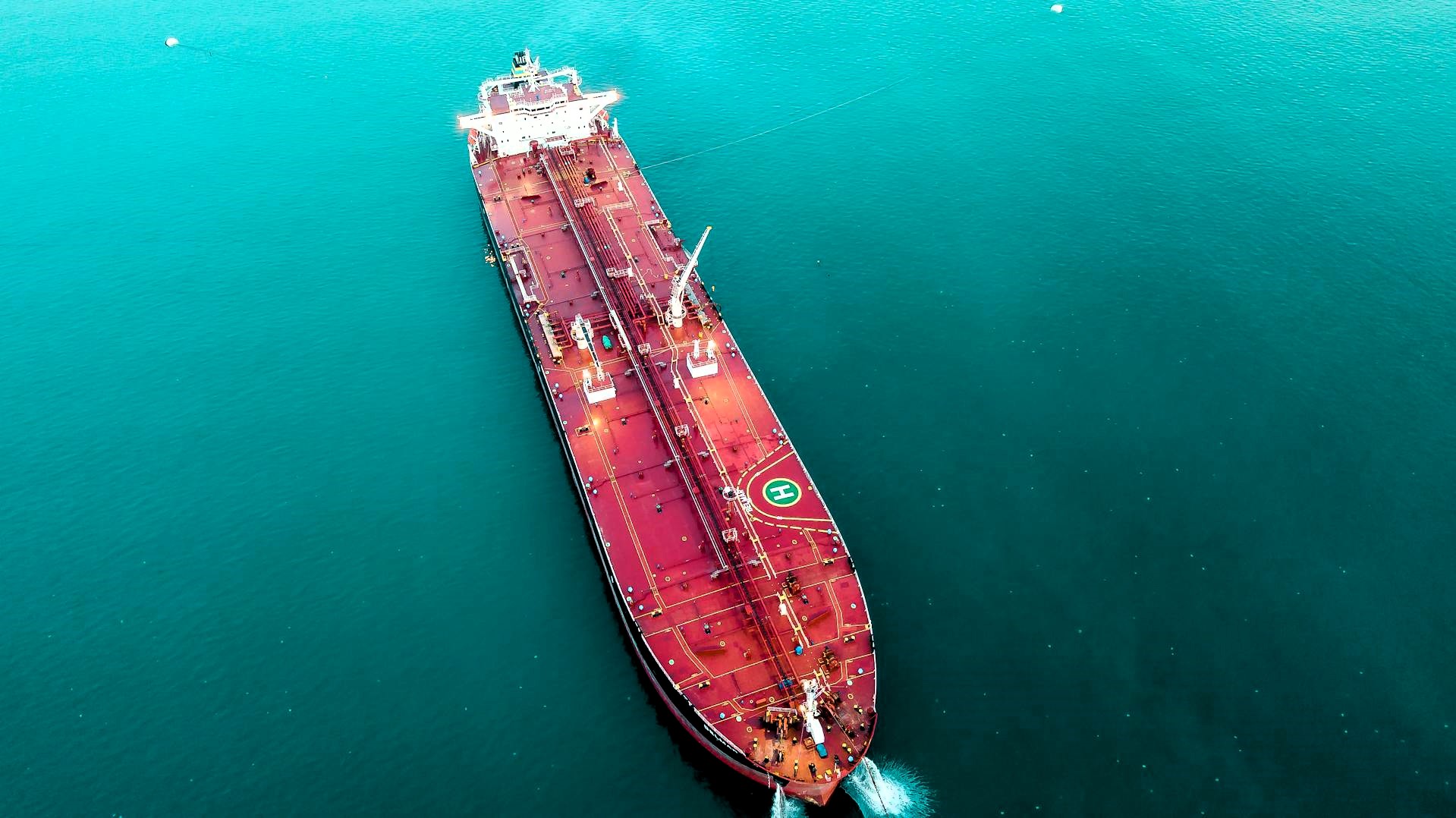

There are weeks in global shipping when nothing much happens. Rates drift, fixtures close quietly, and the most dramatic development is a Capesize resale somewhere off the coast of South Korea. The week of March 1–7, 2026 was not one of those weeks.
In seven days, the world’s most critical maritime chokepoint went from a theoretical vulnerability to a functional shutdown — not through naval blockade or minefields, but through drone strikes, VHF radio warnings, and a war-risk insurance withdrawal that accomplished what Iran’s military could not do alone. The Strait of Hormuz, through which roughly 20% of global oil and gas normally passes, recorded a single cargo transit on 3 March. The daily historical average is 138 ships.
Meanwhile, VLCC spot rates rewrote the record books, P&I clubs pulled cover, and Maersk, MSC, Hapag-Lloyd, and CMA CGM rerouted their fleets around the Cape of Good Hope. Again.
This is what that week looked like — with the numbers, the quotes, and, where relevant, a modest degree of scepticism about what comes next.
The Strait of Hormuz: how Iran closed the world’s most important waterway without actually closing it
On 28 February 2026, the U.S. and Israel launched coordinated strikes on Iran under Operation Epic Fury, killing Supreme Leader Ali Khamenei and multiple Islamic Revolutionary Guard Corps (IRGC) commanders. Within hours, the IRGC transmitted warnings via VHF radio to every vessel in the area, stating that no ship would be permitted to pass. Within days, the Strait of Hormuz — the 21-mile bottleneck through which roughly 20% of the world’s oil and gas normally flows — had effectively shut down. Not by decree. Not by mines. By actuaries.
The attacks: a chronology
1 March — The oil tanker Skylight — sanctioned by the U.S. Treasury’s OFAC in December 2025 for its links to the Iranian shadow fleet — was struck by a missile five nautical miles north of Khasab port, Oman. All 20 crew were evacuated, and four sustained injuries. Hours later, the Marshall Islands-flagged MKD Vyom, carrying approximately 59,000 metric tonnes of cargo, was hit by a bomb-laden drone boat roughly 52 nautical miles off Muscat. One Indian crew member died in the engine room fire; 21 others were evacuated.
2 March — A senior IRGC official formally declared the Strait of Hormuz closed and threatened to attack any vessel attempting to pass. The U.S.-flagged product tanker Stena Imperative — part of the U.S. Tanker Security Program — was struck twice at Bahrain port. A port worker was killed. Transit data from Lloyd’s List put vessel traffic at 81% below the level recorded the previous Sunday, with just one crude tanker crossing the entire strait.
3 March — The JMIC data told the full story. Tanker crossings collapsed from 50 on 28 February to 3 on 1 March, 3 on 2 March, and zero on 3 March. Cargo ship transits followed the same trajectory: 98 on 28 February, 18 on 1 March, 7 on 2 March, and a single vessel on 3 March. The historical daily average: 138 ships. Vessel tracking data showed the VLCC KHK Empress making a sudden U-turn midway through the strait and retreating back at speeds of up to 16.7 knots. The JMIC noted that Global Navigation Satellite System jamming throughout the strait, Gulf of Oman and Arabian Gulf meant that tracking tools “will likely become increasingly unreliable in the days to come.”
4 March — The VLCC Sonangol Namibe exploded at anchor 30 nautical miles southeast of Kuwait — the most northerly attack recorded in the crisis. The IRGC also claimed it had struck a U.S. tanker in the northern Persian Gulf.
“When analysts have looked at the things that could go wrong in global oil markets,” said Kevin Book, co-founder of Clearview Energy Partners, “this is about as wrong as things could go at any single point of failure.”
The mechanics of the shutdown bear examination. Helima Croft, global head of commodity strategy at RBC Capital Markets, described precisely how Iran achieved without warships what analysts had long assumed would require them: “All Iran had to do was several drone strikes in the vicinity of the Strait of Hormuz. And all of a sudden, insurers and shipping companies decided that it was unsafe to traverse that very narrow S-curve of that waterway. It’s really an insurance-driven shutdown.” She called it “the biggest energy crisis since the oil embargo in the 1970s.”
Washington responds — with a chequebook
The Trump administration’s reaction to the Hormuz shutdown was swift and, in its own way, instructive. On 3 March, Trump posted on Truth Social that the DFC would “effective IMMEDIATELY” provide political risk insurance for all maritime trade travelling through the Gulf — and that the U.S. Navy would escort tankers through the Strait “if necessary.” By 6 March, the DFC and Treasury Secretary Scott Bessent had finalised the implementation plan: the U.S. International Development Finance Corporation would insure losses up to $20 billion on a rolling basis, in close coordination with U.S. Central Command. “We are confident that our reinsurance plan will get oil, gasoline, LNG, jet fuel, and fertilizer through the Strait of Hormuz and flowing again to the world,” DFC CEO Ben Black declared.
The market received the announcement with polite scepticism. JPMorgan energy analysts estimated that roughly 329 vessels were operating in the Persian Gulf, and that each ship would require oil pollution, salvage, hull and third-party liability insurance — implying about $352 billion of maximum coverage that private markets were no longer providing. Against that figure, $20 billion looks less like a solution and more like a deposit.
David Smith, head of marine brokers McGill and Partners, captured the mood of the insurance market precisely: “Each underwriter is invariably increasing rates or, in some instances, for vessels passing through the Strait of Hormuz, even declining to offer terms right now.”
The container lines send their own message
While the tanker market grabbed the headlines, the container carriers moved quietly but decisively. Hapag-Lloyd introduced a War Risk Surcharge of $1,500 per TEU for standard containers and $3,500 per unit for reefer equipment, effective 2 March, covering cargo to and from the Upper Gulf, Arabian Gulf and Persian Gulf. CMA CGM followed with an Emergency Conflict Surcharge of $2,000–$3,000 per TEU for dry containers and $4,000 for reefers, also effective 2 March, covering Iraq, Bahrain, Kuwait, Qatar, Oman, the UAE, Saudi Arabia and several additional countries including Egypt and Djibouti. Maersk scheduled a further emergency contingency surcharge from 15 March.
Peter Sand of Xeneta delivered the container market verdict to The National: “Any plans for a phased return of container shipping to the Red Sea in 2026 will be shelved until the security situation becomes clearer. Carriers are on red alert.” Average China–UAE spot rates had already risen 5% since mid-February, reaching $1,572 per FEU. As Sand noted, there is “no viable alternative to getting containers in or out of ports such as Jebel Ali by ocean” if the Arabian Gulf is off limits — meaning cargo would pile up at alternative ports, waiting for road connections that were never designed to absorb this volume.
The double squeeze
The Strait of Hormuz crisis did not arrive alone. On 28 February, the Houthis of Yemen announced they were resuming attacks on Israeli-linked and commercial vessels in the Red Sea, forcing Suez Canal traffic back around the Cape of Good Hope. Maersk, MSC, CMA CGM, and Hapag-Lloyd all suspended Gulf transits and issued Cape of Good Hope rerouting guidance.
Adrian Beciri, CEO of DUCAT Maritime, explained the compound effect to CNBC: “If we’re looking at the Hormuz closing and the Suez effectively being tampered with by the Houthis, this could be quite significant — much like what we saw during the Covid era.”
The insurance market then landed the decisive blow. Effective 5 March, P&I clubs including NorthStandard, Gard, Skuld, the American Club, and the London P&I Club cancelled war-risk coverage for vessels operating in the Persian/Arabian Gulf. Without cover, shipowners faced a binary calculation: transit uninsured, or don’t transit at all. Most chose the latter.
Judah Levine, Head of Research at Freightos, was direct: “The U.S.–Israel strikes on Iran and subsequent Iranian retaliation are driving significant logistics disruptions in the region — and they could start to affect global freight markets if they persist.”
🔭 GeoTrends outlook: The assumption that Iran could not close the Strait of Hormuz — held with considerable confidence by Western security analysts for decades — is now demonstrably wrong. Iran did not need a fleet. It needed a drone budget and the foreknowledge that war-risk insurers would do the rest. The more uncomfortable question for shipping is structural: if the threat of targeted attacks is sufficient to trigger a de facto closure, then any future escalation in the Gulf carries the same leverage. That is a permanent recalibration of maritime risk — and it will reprice accordingly.
Tanker rates: the numbers that will end up in textbooks
The market’s reaction to the Strait of Hormuz disruption was immediate and, in places, spectacular.
VLCC benchmark rates on the Middle East–China route (TD3C) reached $423,736/day on 2 March, according to LSEG data — a 94% surge from the previous Friday’s close in a single trading session. That figure made headlines. A less-noticed one followed: Tankers International reported that Minerva Marine’s 317,000 dwt Pantanassa was fixed to South Korea’s GS Caltex at $436,000/day — the highest ever recorded spot fixture for a VLCC. Poten & Partners pegged the AG/FE daily hire at $445,200/day, against a 2025 full-year average of $133,000/day.
Bloomberg energy analyst Javier Blas offered a characteristically laconic summary on social media: “I wish I owned a VLCC right now. Even just a mere Suezmax would be good. Hell, an Aframax would do it.” He also observed that the Trump administration’s announcement of naval escorts would “encourage a few Greek tanker owners to risk crossing it: nighttime, AIS off, and a pray. That’s how fortunes were made — ask John Fredriksen.”
Sheel Bhattacharjee, head of freight pricing at Argus Media, explained the market’s logic: “Charterers in the VLCC segment stepped back from the market and avoided securing vessels as multiple incidents raised threat levels around the Strait of Hormuz, despite the waterway not being officially closed. Most shipowners avoided transits after insurers cancelled war-risk coverage.”
In the broader energy complex, Brent crude settled at $92.69/barrel on 6 March and WTI closed at $90.90 — weekly gains of 28% and 35.6% respectively. The 35.6% surge in WTI was the largest in the history of the futures contract, dating back to 1983. North Sea Dated crude added nearly $23.50/barrel in the same week — its biggest weekly gain since Argus began tracking prices in early 1990. Qatar’s Energy Minister Saad al-Kaabi told the Financial Times that crude could reach $150/barrel within two to three weeks if the situation persisted, and that every Gulf energy exporter stood on the verge of declaring force majeure. Qatar’s Ras Laffan LNG facility had already been struck by Iranian drones, taking roughly 20% of global LNG supply offline.
On the dry bulk side, the Baltic Dry Index fell 6% on 6 March to 2,010 points — its lowest level since 11 February — marking a third consecutive session of declines. Rates dropped across all vessel segments as maritime traffic disruptions from the Middle East conflict rippled into the dry bulk market: the Capesize index plummeted 10.8% to a one-month low of 2,631 points, the Panamax index fell 1.8% to 1,962 points, and the Supramax index slid 0.4% to 1,386 points. For the week as a whole, the benchmark index dropped approximately 6.1%.
Behind the scenes, the Baltic Exchange itself was wrestling with an institutional problem: how to price a market that had partially ceased to function. Mid-week, it announced it was consulting panelists on how to respond to conditions in the Strait of Hormuz as it determined benchmark freight assessments. By Friday, those same panelists declared they felt able to price Middle East loading for the crude oil shipping market — a cautious signal that, at the margin, some transactions were still being struck. Dry bulk routes do not depend on the Strait of Hormuz directly — but the market made clear that no segment of global shipping is entirely insulated from a conflict of this scale.
Amrita Sen of Energy Aspects offered the clearest framework for what follows, speaking to CNBC’s Europe Early Edition: “We don’t think that’s very likely” — referring to a full closure of the Strait. “The U.S. and Israel would just take that out, very, very quickly.” But, she added, “what the U.S. will not be able to do is control these one-off attacks on tankers — and that is enough to make the market extremely cautious about sending vessels in. And that’s what creates the disruptions.”
🔭 GeoTrends outlook: The $423,736/day VLCC rate will appear in shipping textbooks. But the more instructive figure is one — the number of tankers that crossed the Strait of Hormuz on 3 March. No military blockade achieved that; a handful of drone strikes and a P&I withdrawal did. For dry bulk, the insulation from Hormuz is real but not permanent: prolonged energy disruption eventually reshapes all commodity flows. Watch the Capesize market closely over the next 30 days. And if Qatar’s $150/barrel scenario materialises, the dry bulk numbers will stop looking so calm.
The week ends with a twist — of sorts
On 7 March, Iranian President Masoud Pezeshkian announced on state television that Tehran had instructed its armed forces not to attack neighbouring countries unless attacked from their territory. He apologised to Gulf states struck during the week. Hours later, Trump posted on Truth Social that Iran had “apologized and surrendered to its Middle East neighbors” — and then added, for good measure, that Iran would be hit “very hard” again and that additional targets were under consideration.
The UAE Ministry of Defence reported the vast majority of the 137 missiles and 209 drones launched at its territory were intercepted. Saudi Arabia’s air defences thwarted five waves of drone strikes against Aramco’s 1 million b/d Shaybah field in the Empty Quarter — the first attack on a major upstream oil asset since the conflict began.
The shipping market took note.
This week will be studied not as a geopolitical curiosity but as the moment when the theoretical vulnerability of global trade infrastructure became operational reality. The Strait of Hormuz, the world’s single most consequential maritime chokepoint, proved far easier to functionally close than Western analysts had publicly admitted — and the mechanism of closure was not military hardware but actuarial withdrawal.
Cormac McGarry, director of maritime intelligence at Control Risks, described the decisive moment plainly: mariners received Iran’s message via the international distress frequency stating the strait was closed — “Every ship in the area would have heard that… and it was enough for most ships to pause.” McGarry also noted, however, that a full, sustained closure would amount to Iran “tightening the noose around its own neck” — pushing Gulf states directly into the conflict and inviting a military response that Tehran could not absorb.
Iran secured maximum disruption at minimal cost. The shipping industry, once again, found that the risk it had stress-tested in theory looked rather different on a Monday morning.