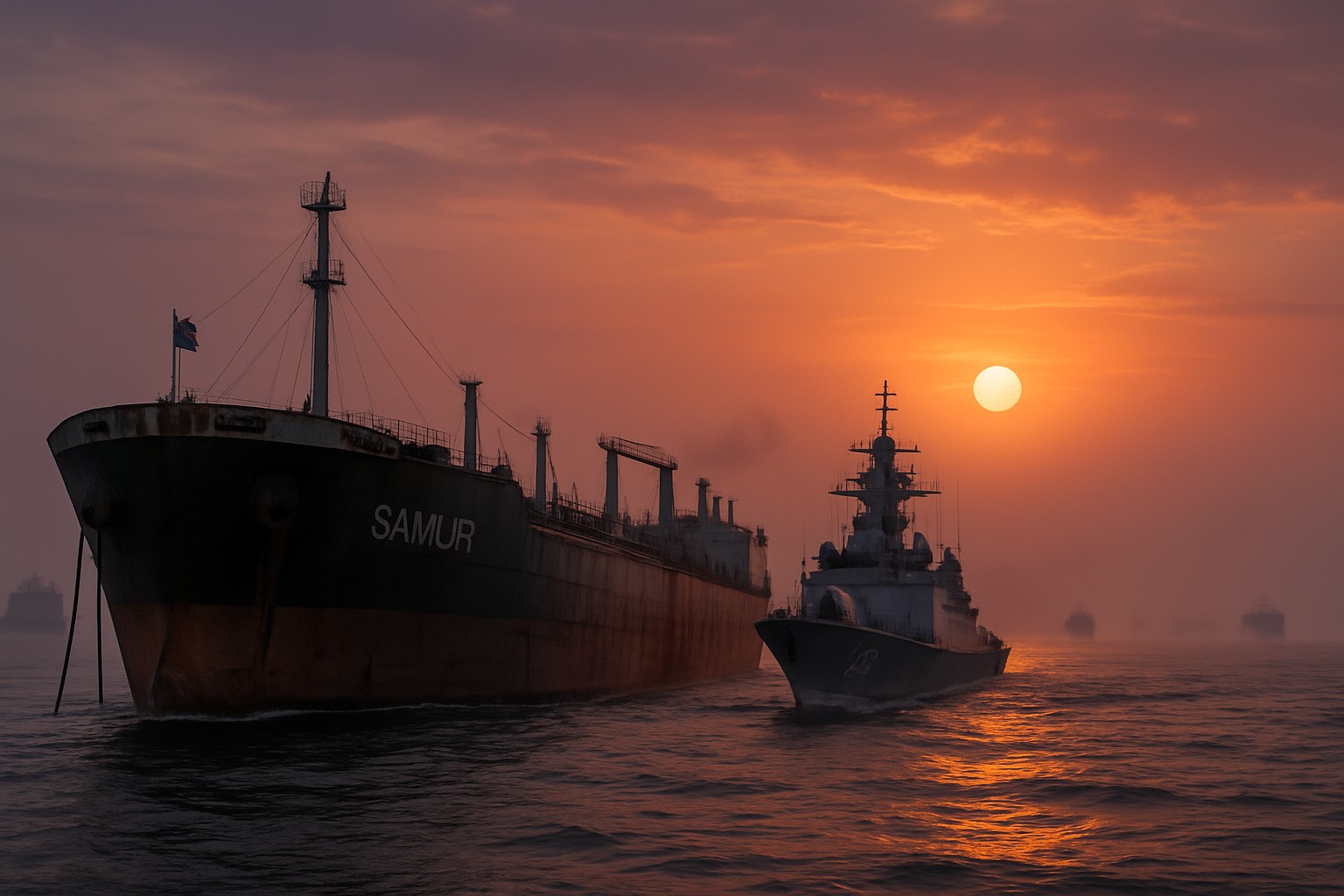

The maritime world witnessed significant geopolitical developments today as Finland’s Defense Minister Antti Häkkänen revealed Russia has begun providing naval escorts for its shadow fleet tankers in the Gulf of Finland. This “unprecedented” move, reported by The Maritime Executive, follows recent confrontations between Estonian authorities and suspected sanctions-evading vessels. The escalation comes after Estonia’s attempts to inspect tankers suspected of operating without legitimate registry, including a May incident involving the tanker Jaguar, which has since been renamed Blint and reflagged to Comoros.
Simultaneously, the Cook Islands registry faces international isolation after being ejected from the Registry Information Sharing Compact (RISC), a U.S.-backed database designed to help registries identify and block sanctions violators. According to The Maritime Executive, the registry has expanded by 140% in the first half of 2024 alone, raising concerns about “shadow fleet” tankers using its flag. New Zealand’s Foreign Affairs Ministry has repeatedly pressed the Cook Islands government to address these concerns, highlighting the diplomatic tensions maritime sanctions can generate between allied nations.
These maritime sanctions developments demonstrate how geopolitical conflicts increasingly manifest in shipping regulations, vessel registrations, and freedom of navigation disputes, creating complex challenges for international maritime governance.
Financial resilience amid market volatility
Despite geopolitical tensions, several shipping companies reported robust financial performance today. STEALTHGAS INC. announced first-quarter net income of $14.1 million with a basic EPS of $0.38, according to Hellenic Shipping News. The company has secured approximately 70% of its fleet days for 2025 on period charters, generating over $165 million in contracted revenues, demonstrating strategic positioning amid market uncertainty.
Similarly, Dynagas LNG Partners LP reported first-quarter net income of $13.6 million with 100% fleet utilization, as detailed by Hellenic Shipping News. The company also announced plans to fully redeem its outstanding $55 million Series B Preferred Units, expecting annual cash savings of approximately $5.7 million.
Meanwhile, Diana Shipping Inc. secured new time charter contracts for its Newcastlemax vessel m/v Philadelphia with Refined Success Limited at a gross charter rate of US$21,500 per day, as reported by Hellenic Shipping News.
These financial results highlight how well-positioned shipping companies can maintain profitability despite the complex regulatory environment created by maritime sanctions.
UK invests in efficiency, U.S. faces program turmoil
Naval modernization efforts gained momentum today with significant developments in both British and American naval programs. The UK Royal Navy’s first Type 31 frigate, HMS Venturer, emerged from its building hall in Rosyth, Scotland, ahead of its scheduled float-out later this summer. According to The Maritime Executive, these next-generation vessels are 60% larger than the frigates they replace but will operate with 40% fewer crew members, representing a £10 billion investment in the Fleet of Tomorrow.
In contrast, the U.S. Navy removed Rear Admiral Kevin Smith from his position as program executive officer for unmanned and small combatants, following a complaint substantiated by a Naval Inspector General investigation. The Maritime Executive reports this unusual public acknowledgment of an investigation highlights potential challenges in the Constellation-class frigate program and unmanned vessel technology development.
These contrasting naval developments illustrate how maritime powers are adapting their naval capabilities to address emerging security challenges while navigating program management difficulties.
Safety incidents and market shifts
Maritime safety incidents continue to test response capabilities worldwide. Vietnamese search and rescue forces successfully rescued all 10 crewmembers of the coal carrier Cong Thanh 07 after it sank off Vietnam’s Son Duong port. The Maritime Executive reports the 12-hour operation involved seven vessels and demonstrated effective coordination in emergency response.
Market dynamics are also shifting as French container shipping line CMA CGM announced plans to resume transit through the Suez Canal on its India-Med route next month. According to Hellenic Shipping News, this decision triggered a 4% drop in shares of shipping groups Maersk and Hapag-Lloyd, as analysts interpret it as a signal that Red Sea routes are beginning to reopen. A full reopening could reduce container shipping demand by approximately 10% as the distance between East and West declines.
Innovation in sustainable shipping
Environmental innovation continues to advance with CMA CGM launching the first fully electric container barge in Vietnam, supported by a solar-powered charging station at Cai Mep port. Hellenic Shipping News reports this joint venture with logistics operator Gemadept represents a significant step in decarbonizing river transport in Southeast Asia.
Workforce diversity is also improving, with Oldendorff Carriers announcing that nearly 125 female seafarers from 17 nationalities now serve onboard its vessels. According to Hellenic Shipping News, this figure is expected to reach 150 by next year, reflecting the industry’s gradual progress toward greater inclusivity.
In logistics developments, CEVA Logistics has expanded its global deep-sea car carrier operations with three additional roll-on, roll-off vessels connecting the Far East with Central and South America, as reported by Hellenic Shipping News.
Today’s maritime developments reveal an industry navigating complex geopolitical tensions while pursuing technological innovation and operational efficiency. The interplay between maritime sanctions, naval modernization, and commercial resilience will continue to shape global shipping patterns in the months ahead.