
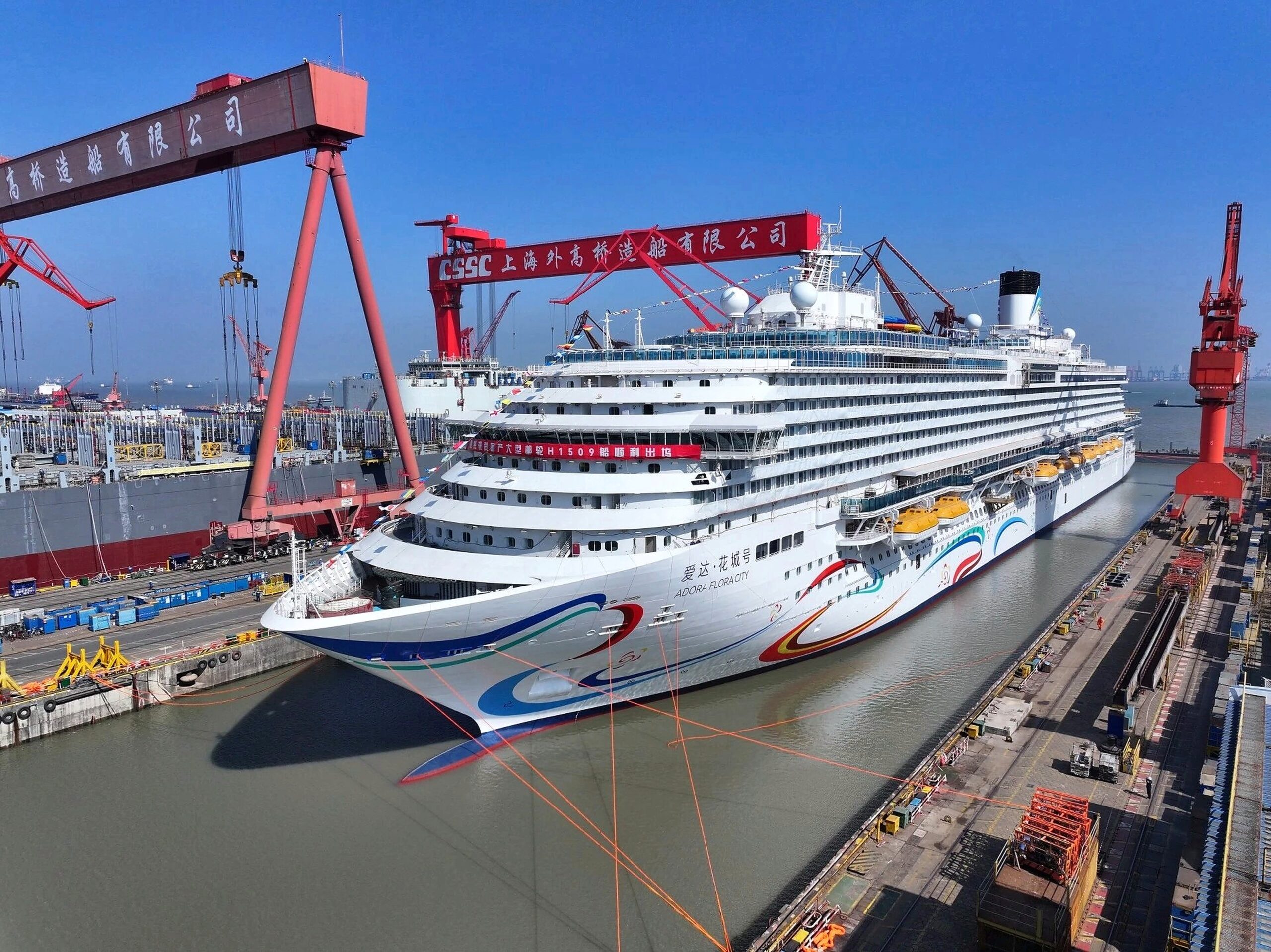

China delivered its second domestically built large cruise ship on 6 November. The 141,900-GT Adora Flora City, built by CSSC’s Shanghai Waigaoqiao Shipbuilding (SWS), is larger than its predecessor, Adora Magic City. But the real test lies beyond the handover: can China turn European-derived shipbuilding expertise into an independent design capability and win international orders?
A licence to learn
Beijing’s route into this market was a bargain with Europe. It offered access to Chinese cruise demand and gained shipbuilding know-how in return. Reuters reported in 2017 a $1.5 billion agreement involving Carnival and Fincantieri, covering two ships and options for four more. The design and construction contract followed on 6 November 2018.
Fincantieri had commercial reasons to enter. Its chief executive, Giuseppe Bono, told TradeWinds that an early position offered access to a strategic market ahead of European rivals. The arrangement carried the logic of a prisoner’s dilemma: each supplier had reason to secure access, even as collective participation helped build a competitor. That is our interpretation, not a reported motive. Two executives told Reuters that Beijing had linked Carnival’s expansion in China to support for local industry, a characterization Carnival disputed.
The second ship, in arithmetic
Adora Flora City is bigger, and CSSC says it was built faster. The ship measures 141,900 gross tons and 341 metres, against 136,200 tons and 324 metres for Magic City. The yard says it cut construction time by eight months and lifted efficiency by more than 20 percent.
| Adora Magic City | Adora Flora City | |
|---|---|---|
| Construction start | October 2019 | August 2022 |
| Delivery | 4 November 2023 | 6 November 2026 |
| Months, construction start to delivery (our arithmetic) | about 49 | about 51 |
However, the public calendar does not establish a shorter overall construction-to-delivery cycle. Construction start to delivery ran about 49 months for Magic City and about 51 for Flora City. CSSC’s eight months may measure a different span, and the yard has not said which. Still, the yard did something useful. It announced in April that delivery would come ahead of schedule on 6 November, and it handed the ship over that day. We found no comparable cycle time for Fincantieri or Meyer, so the claim that China has caught Europe stays unproven.
 © Pudong China
Where the money still leaves China
The second ship is less Chinese than the label suggests. Domestic suppliers provide about 35 percent of Adora Flora City by procurement cost, Nikkei Asia reports. That measures purchases, not value added, and it varies by category: CruiseMapper says more than 80 percent of interior outfitting materials came from Chinese suppliers. CSSC’s lead cruise designer told CCTV that the next ship will reach 50 percent. The stated goal is more than 80 percent from the fourth domestic ship, by 2035.
That target, however, collides with a supply chain that Europe built. A senior adviser at Tokyo’s Planning and Design Center for Greener Ships told Nikkei that passenger-ship equipment comes mainly from Europe. A large liner carries tens of millions of parts. A Lloyd’s Register manager made a related point to Reuters in 2017: such a ship needs at least a few hundred suppliers.
The headline numbers frame the gap, but they measure different things. China won 63 percent of all new orders in 2025 by compensated gross tonnage, across every ship type, according to Clarksons. Yet it built only 17 percent of passenger ships in 2024, ferries included, according to UNCTAD. Meanwhile, Europe built 97 percent of the world’s cruise ships, according to a December 2024 CLIA report cited by Nikkei Asia. That measure does not compare directly with China’s share of new orders. China cruise shipbuilding sits in that gap.
A customer who is also the shareholder
Adora Cruises belongs to CSSC, with Carnival as a minority investor. The yard’s first customer is therefore its own parent’s brand. Adora says it carried more than 500,000 guests on 172 voyages in 2025 and holds 40 percent of the Chinese market. Its millionth guest boarded on 8 February 2026.
The market underneath is thinner. Caixin, cited by Maritime Executive, reports low ticket prices and a sluggish recovery. However, passenger counts at Chinese ports rose 28 percent in the first nine months of 2025, past 2 million. Meanwhile, state groups consolidated: China Tourism Group, COSCO and China Merchants pooled the management of five ships into a new company, Huaxia, with about 16,000 berths.
Officials sell the policy with a multiplier. They say each ticket generates ten to fourteen times its value in wider economic activity, and in November 2025 the government told local authorities to stimulate consumption by promoting cruises. Therefore the return lands in the economy, not on the ship’s income statement. Our hypothesis, not a reported fact: when buyer and builder share an owner, losses can stay in the family, which economists call a soft budget constraint. Mitsubishi Heavy Industries quit building cruise liners after losses on two Carnival ships topped $2 billion. A commercially constrained builder may have to exit. A state-backed group may have more room to absorb losses, although we have seen no figures on this yard’s margins.
The export order book lives in the shallow end
Foreign owners do order in China, but small. Cruise Industry News counts at least five cruise vessels due from Chinese yards. They include the 400-guest sailing ship Atlas Adventurer for late 2028. SeaDream III, with 230 guests, follows in 2029, and the magazine understands China Merchants will build it. A 186-guest expedition ship for Poseidon Expeditions is due in September 2028.
The bigger programme belongs to United Waterways, which lists eight ships, four coastal and four expedition, at China Merchants Jiangsu, with the first due in 2028. Mystic Cruises, meanwhile, signed on 2 December 2025 for one sailing ship with three options.
China cruise shipbuilding is entering through the side door, and the first large foreign ship is still on paper. On 2 September, SWS signed a memorandum with Norway’s Nor Cruises for two sizeable cruise vessels, with options for three more. The deal is preliminary. Seatrade lists technical verification, commercial negotiation and schedule confirmation as the remaining steps. The buyer is a 2023 start-up. Cruise Industry News reports no registered employees and $1.4 million raised in 2025. The company’s filings say it will need to raise capital first, and fundraising in the Middle East has become difficult, although the board believes circumstances are improving. The same outlet adds that the memorandum would be the first large-ship order from a foreign company for CSSC, if confirmed. It also says the South China Morning Post expects Fincantieri designs.
Europe’s moat is a queue
Europe’s yards sell ten years of slots. Fincantieri, Meyer and Chantiers de l’Atlantique hold contracts with deliveries from 2030 to 2036. The September 2025 order book lists 37 large ships at Fincantieri, nine at Meyer and nine at Chantiers. Cruise Industry News counted 84 ships worth $88.8 billion by September 2026. Buyers keep joining the line: MSC added four ships at Meyer Werft in early 2026, and Viking confirmed two more at Fincantieri for 2032.
Here lies the awkward part for Europe, and it is our reading, not a reported fact. An owner who cannot get a European slot before the mid-2030s has an outside option, and a Chinese yard that wants references will price it keenly. Europe keeps the top of the market, yet China cruise shipbuilding could win the marginal order.
The sharper risk sits further down the supply chain, and it is far from inevitable. Suppose China reaches its 80 percent domestic-content goal. European suppliers could then lose the business that every Chinese hull gives them today, long before a European yard loses an order. In our reading, they have counter-moves: local production, joint ventures, higher-value systems. Much depends on who controls the technology, not on where the factory stands.
The ledger to 2030
Five entries will settle whether China cruise shipbuilding can win orders on its own, and none of them is a naming ceremony.
- Contract. Whether the Nor Cruises memorandum becomes a financed, binding order. This test arrives before 2030.
- Domestic order. Whether the March 2026 memorandum, signed by China Tourism Group and CSSC for two ships and an option reportedly destined for Adora, becomes a priced contract. Nikkei Asia reports that the first ship is due at the end of 2030.
- Content. Whether the next ship reaches 50 percent domestic content, and which European suppliers still appear on it.
- Customer. Whether an established owner, not a start-up, orders a large ocean-going liner from a Chinese yard.
- Cycle time. Whether the next ship beats the 49 and 51 months from construction start to delivery that its two predecessors needed.
Until then, China cruise shipbuilding has proved it can build a ship on licensed know-how. It has not yet proved it can sell one it designed itself.
image sources
- geo-trends.eu_China cruise shipbuilding_: Pudong China