
On 13 February 2026, the White House released the Maritime Action Plan—a 35-page document co-signed by Secretary of State Marco Rubio and OMB Director Russell Vought. The signatories matter. This is not a transport policy paper. It is a national security document dressed in industrial policy clothing, and it signals something important: Washington has decided that Chinese dominance over global shipbuilding is a problem too large to ignore. Whether the proposed remedy is credible is a different question entirely.
The $1.5 trillion price tag
The Maritime Action Plan’s central mechanism is a system of port fees on vessels built in China. The fees range from $0.01 to $0.25 per kilogram of imported cargo. The International Chamber of Shipping—the world’s largest representative body for shipowners—has run the numbers. Over ten years, these fees could add between $66 billion and $1.5 trillion to the cost of global trade.
The ICS supports the goal of rebuilding American shipbuilding capacity. It does not, however, support fees that punish 99% of ships calling at U.S. ports—simply because American yards currently produce fewer than 1% of the world’s commercial fleet. One can agree with a diagnosis and still object to the prescription.
Why Washington is right to worry
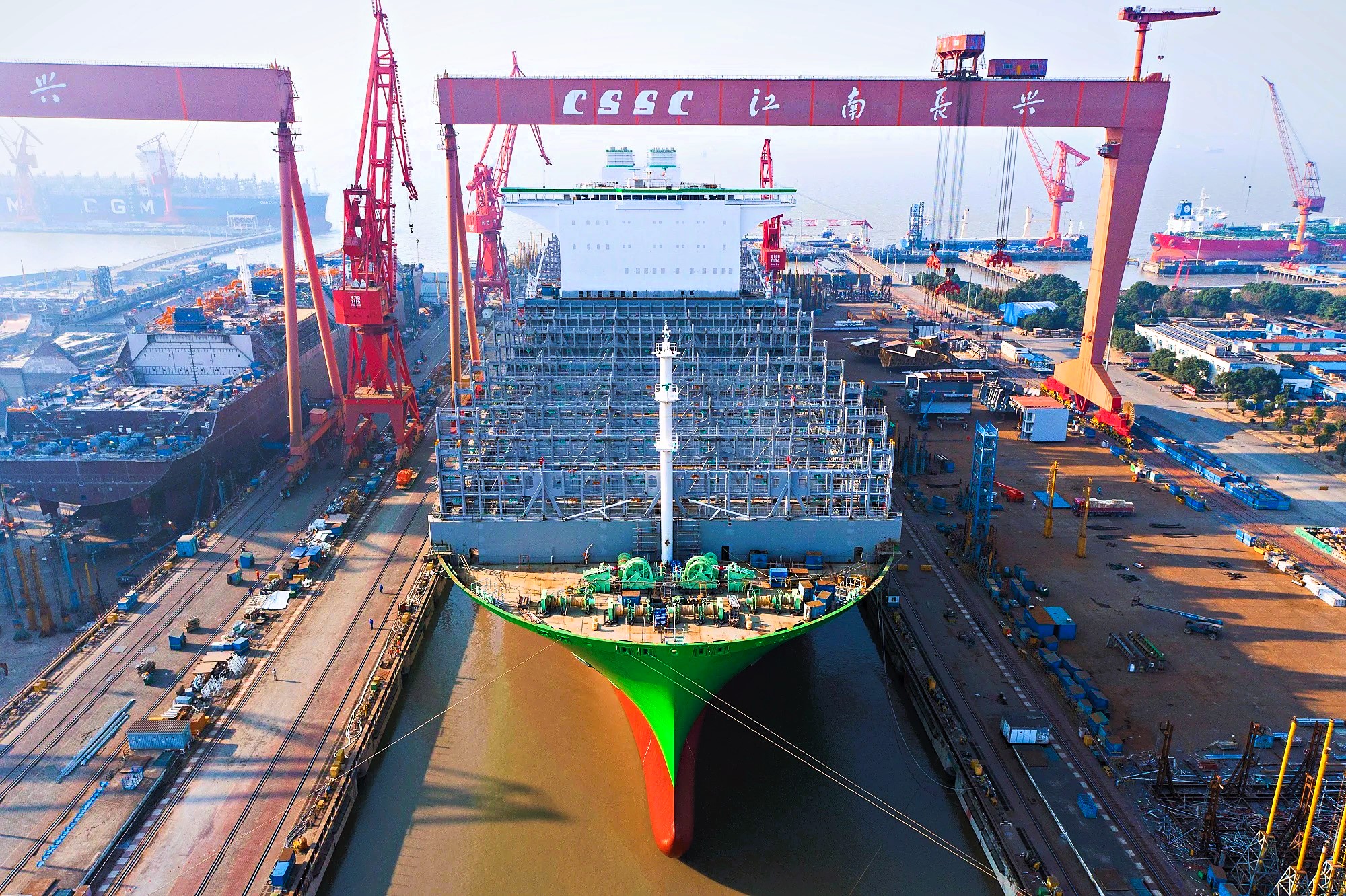
Set the fees aside for a moment. The underlying problem is real, and the numbers are genuinely alarming. The U.S. carries 99% of its own trade on foreign-flagged, foreign-built vessels. China, South Korea, and Japan account for approximately 99% of global commercial shipbuilding output. In 2024, Chinese yards delivered 717 large commercial vessels. American yards delivered one. The CSSC alone—China’s largest shipbuilding group—has built more vessels since 2020 than the entire U.S. has produced since 1945.
This is not a recent failure. It is the compounded result of fifty years of deindustrialisation, cost disadvantage, and deliberate neglect. A vessel built in the U.S. costs three to four times more than an equivalent ship built in East Asia. Washington did not stumble into this gap. It walked in slowly, and then sat down. The executive order signed by Trump in April 2025 labelled the situation a “strategic vulnerability.” That characterisation is accurate. According to U.S. Navy intelligence estimates, China holds 232 times the shipbuilding capacity of the United States. In any serious trade disruption—or conflict scenario—American dependence on foreign-built vessels becomes an acute operational risk.
Who actually pays the bill
The fee mechanism deserves close examination, because the political framing and the economic reality run in opposite directions. A 40-foot container, under the lower fee scenario, would attract an additional $140 in port charges. Under the upper scenario, that figure rises to $3,500—a sum that, in many trade lanes, exceeds the freight rate itself. For oil tankers, these fees translate directly into higher fuel costs for American consumers at the pump.
The revenue flows into a new Maritime Security Trust Fund, which will finance the re-industrialisation effort. It is, structurally, a tax on imports—designed to fund the domestic production that would eventually reduce dependence on those same imports. The internal contradiction is hard to miss: the plan imposes costs that make American trade more expensive today, in order to build an industry that might reduce those costs in fifteen years. Industry analysts note an additional irony—any serious expansion of U.S. shipyard capacity would require a large influx of skilled foreign workers, which sits awkwardly alongside the administration’s own immigration agenda.
The Greek factor: Collateral damage with a name
Greek shipowners control the world’s largest commercial fleet by tonnage. And 43% of that fleet was built in Chinese yards. In 2024 alone, Greek-owned vessels made 903 port calls to the U.S. in Chinese-built ships. The estimated additional cost to Greek shipping: over $1 billion annually.
The numbers compound further. Some 80% of the Greek dry bulk order book and 100% of the container order book— 46 vessels—sit in Chinese shipyards. These are not decisions made carelessly. They reflect price differentials, delivery schedules, and financing terms that no Western yard can match at scale. Harry Vafias, one of Greece’s prominent shipowners, predicts the fees will create a two-tier asset market: Korean- and Japanese-built vessels will command a premium, while Chinese-built ships trade at a structural discount. That restructuring will take years—and the adjustment costs will fall, as they always do, on end consumers and smaller operators first.
Can America actually build ships? The honest numbers
The Maritime Action Plan’s credibility ultimately rests on one question: can the United States rebuild its shipbuilding industry at scale? The answer, based on current industrial reality, is no—at least not within any politically useful timeframe. The U.S. operates eight active commercial shipyards capable of handling vessels over 400 feet in length. The average dry dock in these facilities is 107 years old. The US Navy’s own modernisation programme—the Shipyard Infrastructure Optimization Plan (SIOP), launched in 2018 as a 20-year, $21 billion effort—has already recorded cost overruns, delays, and planning failures according to the GAO.
The workforce problem is equally structural. The average age of skilled U.S. shipyard workers already exceeds 55, attrition runs above 20% annually, and generations of institutional knowledge have left the industry with no replacement pipeline. The U.S. does not have a pipeline of such workers, nor the apprenticeship infrastructure to build one quickly. The Congressional Budget Office has concluded it is “virtually impossible” for American yards to meet naval and commercial demand simultaneously. The Navy’s own programme—despite nearly doubling its budget over the past twenty years—has produced a shrinking fleet and a growing maintenance backlog. The domestic industry cannot currently sustain its existing commitments, let alone absorb a commercial expansion mandate.
The Bridge Strategy and its inconvenient complications
The Maritime Action Plan does include a more pragmatic near-term element: the so-called Bridge Strategy. In the immediate term, the U.S. would source vessels from allied yards—primarily South Korea and Japan—while simultaneously investing in domestic capacity. South Korea has pledged $150 billion in U.S. investments as part of broader bilateral negotiations. Hanwha Ocean, the world’s third-largest shipbuilder, is already acquiring stakes in U.S. facilities, including the Philadelphia Shipyard.
Structurally, this makes sense. Allied manufacturing capacity and transferred knowledge could, over time, give Washington something resembling a credible industrial base. The problem is that Beijing has noticed. In October 2025, China imposed sanctions on five U.S. subsidiaries of Hanwha Ocean—including Hanwha Philly Shipyard itself—in direct response to their cooperation with Washington. The sanctions were suspended a month later as part of a broader U.S.–China trade truce. The reprieve lasts one year. The Bridge Strategy depends on allies who are simultaneously being used as bargaining chips in a trade war they did not start. That structural tension the plan does not resolve.
There is also an environmental blind spot that analysts in the clean maritime sector have flagged. The plan focuses almost entirely on conventional vessel types and says almost nothing about alternative-fuel vessels—which already account for 38% of global newbuild orderbook tonnage according to DNV data. Washington is designing a twentieth-century industrial revival while the rest of the world orders the twenty-first-century fleet.
The real stakes
The Maritime Action Plan correctly identifies a strategic problem. Chinese dominance over global commercial shipbuilding is not a market outcome Washington can afford to ignore indefinitely—particularly when the same yards supply the People’s Liberation Army Navy. But identification is not remedy.
The fees will generate revenue and signal intent. They will also raise costs for American importers, increase consumer prices, disrupt Greek and European shipowners who built their businesses on economic logic rather than political geography, and likely provoke retaliatory responses from Beijing in sectors where China still holds significant leverage. China’s state media has already called the plan “unlikely to have a major impact” on Chinese yards. Given that the CSSC alone built more ships by tonnage in 2024 than the entire U.S. has since 1945, this is less bravado than arithmetic.
Whether this plan is a serious long-term industrial programme or a negotiating lever in a broader trade confrontation with China, the answer is probably both—and that ambiguity is deliberate. What is not ambiguous is this: the industrial base required to make the plan credible does not yet exist. Someone will pay for the gap between ambition and reality. And that, as usual, will not be Washington.