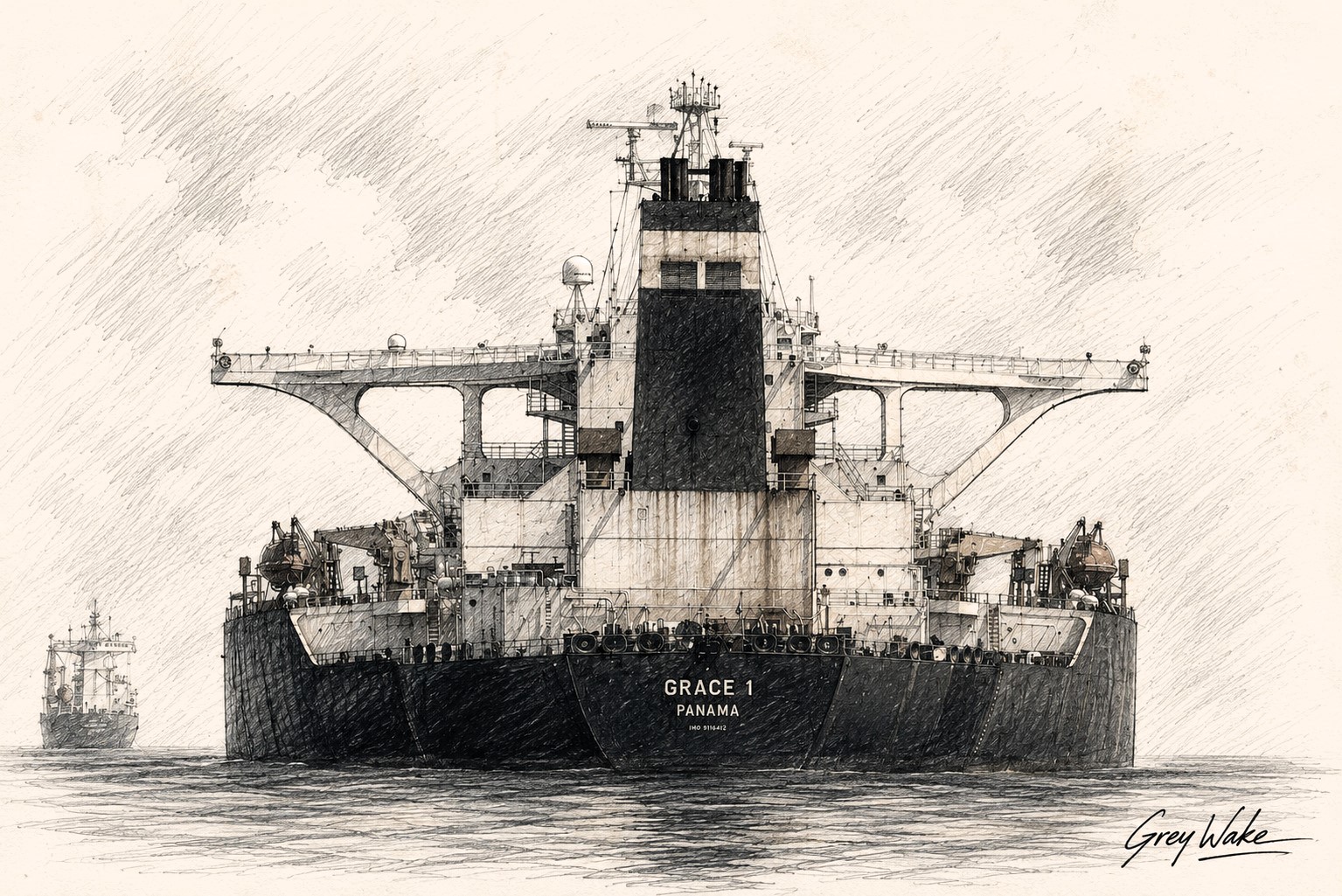

On the night of 4 July 2019, British Royal Marines descended from a helicopter onto the deck of a 330-metre oil tanker near Gibraltar. Thermal cameras captured the operation. Speedboats surrounded the hull. Armed personnel moved across steel corridors while the vessel drifted between Europe and Africa.
The target was the Grace 1 tanker.
At first glance, the operation looked like a sanctions enforcement action. Gibraltar authorities claimed the tanker carried Iranian crude oil destined for Syria’s Banias refinery in breach of European Union sanctions. Yet the seizure rapidly became something far larger. Within days, London, Tehran, Washington, Gibraltar, insurers, ship registries, traders, and intelligence analysts all collided around a single vessel.
The Grace 1 tanker became the moment when global shipping entered the grey zone.
The ship before the crisis
The Grace 1 tanker did not begin its life as a geopolitical symbol. Hyundai Heavy Industries built the vessel in Ulsan, South Korea, in 1997 as a Very Large Crude Carrier. The ship cycled through several identities during its commercial life. Originally named Meridian Lion, the vessel was later renamed Overseas Meridian, reverted to Meridian Lion in 2011, and became Grace 1 in 2013 under Panama’s registry. That registry status would not survive the crisis. On 29 May 2019, weeks before the seizure, the Panama Maritime Authority removed the vessel from its registry after an international alert indicated that it was participating in or linked to the financing of terrorism, leaving it without Panamanian registration by the time the Royal Marines boarded it.
The vessel could transport more than two million barrels of crude oil in a single voyage. For years, it operated inside the vast and often invisible machinery of global energy transportation. Tankers like Grace 1 connected refineries, sanctions regimes, traders, insurers, registries, and commodity markets across continents.
That anonymity vanished in 2019.
Maritime intelligence firms were already closely tracking the vessel. Windward had logged the Grace 1 anchored off Asaluyeh, Iran, for nearly a month in early 2019, followed by a ten-day AIS blackout near Bushehr. A Reuters investigation separately uncovered inconsistencies between cargo documentation and AIS tracking data by comparing documents supplied by ship owners claiming the tanker had loaded at Basra with port schedules showing no such call. TankerTrackers had separately logged the vessel’s departure from Iran on 17 April 2019 and initially assessed the cargo as fuel oil intended for ship-to-ship transfer near Syria — a hypothesis revised after Gibraltar’s comprehensive laboratory testing confirmed the tanker was fully laden with crude oil, a cargo later quantified at roughly 2.1 million barrels. The tanker had also sailed around the Cape of Good Hope instead of crossing the Suez Canal, which a fully laden VLCC of its size cannot transit. TankerTrackers attributed the route primarily to that draught constraint, while the longer passage also reduced exposure to predictable chokepoints and compliance scrutiny.
The sanctions collision
The Grace 1 tanker entered the Mediterranean during one of the most volatile phases of the Iran sanctions confrontation.
The United States had already withdrawn from the nuclear agreement with Tehran and reinstated heavy sanctions on Iranian oil exports. European governments formally remained inside the nuclear deal, yet the European Union still maintained sanctions against Syria and the Assad government.
That legal distinction mattered.
Gibraltar authorities argued that the vessel violated EU sanctions because it allegedly transported crude oil toward Syria’s Banias refinery, operated by an entity already subject to EU restrictions. British officials supported the operation. Washington publicly celebrated it. National Security Adviser John Bolton described the seizure as “excellent news.”
Iran responded immediately. Tehran summoned the British ambassador and condemned the operation as illegal. Suddenly, one tanker transformed into a floating diplomatic crisis stretching from Gibraltar to the Strait of Hormuz.
The Grace 1 tanker also exposed a second reality inside global shipping. Modern sanctions enforcement no longer relied only on naval patrols or customs inspections. Analysts combined AIS signals, satellite imagery, ownership records, insurance exposure, registry changes, and cargo documentation to reconstruct the vessel’s movements, while governments watched every development in near real time.
The boarding operation
The seizure itself carried enormous symbolic weight.
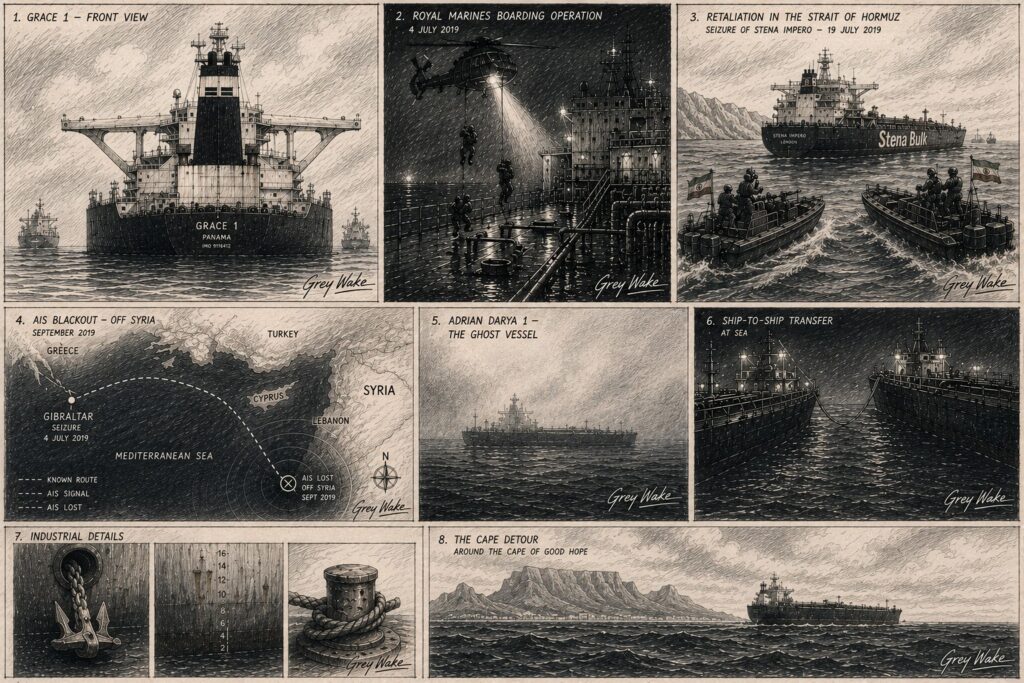
Royal Marines, supported by Gibraltar Port and law enforcement agencies, boarded the tanker during a night operation at the western entrance to the Mediterranean. The images travelled across global media within hours. Marines rappelled from helicopters while speedboats approached the hull from below. The scene looked closer to a military raid than a commercial enforcement action. A week later, Gibraltar’s Royal Police arrested the captain and chief officer on suspicion of transporting the cargo to Banias.
That imagery mattered because the tanker industry had already entered a dangerous period. Mines struck vessels near the Gulf. War-risk insurance premiums for the region climbed. Iran and Western governments exchanged threats almost daily. Every tanker crossing Hormuz suddenly carried geopolitical risk.
The Grace 1 tanker intensified that atmosphere immediately.
Spanish officials later claimed the United States had requested British intervention. Gibraltar rejected accusations of political pressure and insisted local authorities acted independently under European sanctions law. Yet few observers believed the operation existed outside the wider U.S.–Iran confrontation.
Shipping executives watched nervously because the seizure created a new precedent. European authorities had never previously conducted such a public interdiction operation against a tanker suspected of sanctions violations.
Retaliation in Hormuz
The response came two weeks later.
Iran seized the British-flagged tanker Stena Impero in the Strait of Hormuz after Iranian forces accused the vessel of maritime violations. The timing removed any illusion that the two incidents stood apart.
Tankers had become bargaining instruments.
The maritime industry suddenly faced a new operational reality. Commercial shipping no longer sat outside geopolitical escalation. Tankers could now become pressure points inside state confrontations. Cargoes, flags, insurance contracts, AIS data, and registry status all became strategic variables.
For decades, maritime globalization depended on one core assumption: cargo should continue moving regardless of political tensions.
The Grace 1 affair exposed how fragile that assumption had become.
From “Grace 1” to “Adrian Darya 1”
Then came the transformation.
In August 2019, Gibraltar released the tanker after receiving written assurances from Iran that the cargo would not discharge in Syria. Shortly afterward, the vessel adopted a new identity. The Grace 1 tanker became Adrian Darya 1 and sailed under the Iranian flag.
That renaming carried enormous significance.
Modern sanctions evasion often depends on identity fragmentation. Ships change names. Operators create layered ownership chains. Registries shift. AIS signals disappear. Cargo transfers happen offshore between vessels. Documentation changes between jurisdictions.
The Adrian Darya 1 soon demonstrated exactly how this system worked.
Reuters journalists tracked the vessel obsessively after its release. Reporters across multiple countries monitored satellite feeds and AIS transmissions while the tanker moved unpredictably across the Mediterranean. At one point, the vessel appeared to head toward Greece. The United States warned Mediterranean ports and governments not to assist the tanker. Within weeks, the U.S. Treasury Department formally designated the Adrian Darya 1 under counter-terrorism authorities (Executive Order 13224), blocking any U.S.-linked party from doing business with it — and named the vessel’s captain, Akhilesh Kumar, in the same action, extending the sanction from the hull to the individual operating it.
Then the AIS signal vanished.
In September 2019, the tanker stopped transmitting public tracking data near Syria. Four days later, satellite imagery from Maxar Technologies placed the vessel approximately two nautical miles off the Syrian port of Tartus. Britain subsequently accused Iran of breaching the written assurances given before the vessel’s release and summoned the Iranian ambassador in protest.
This was no longer a normal tanker voyage.
The Grace 1 tanker had become an early and highly visible precursor of the shadow fleet economy that would soon expand globally.
Ship identity
Principal specifications
| Specification | Value |
|---|---|
| Current name | Arman 114 |
| Previous names | Adrian Darya 1 (2019–2020), Grace 1 (2013–2019), Meridian Lion (2011–2013), Overseas Meridian (2006–2011), Meridian Lion (1997–2006) |
| IMO Number | 9116412 |
| Vessel Type | VLCC (Very Large Crude Carrier), Double Hull |
| Build Year | 1997 |
| Builder | Hyundai Heavy Industries, Ulsan, South Korea |
| Length × Beam × Draught | 330.26 m × 58.00 m × 20.62 m |
| Deadweight (as built) | Approx. 300,000 DWT |
| Gross Tonnage | 156,880 GT |
| Cargo Capacity | Approx. 2 million barrels of crude oil |
Identity timeline
| Period | Name | Flag | Reported registered owner | Ship manager |
|---|---|---|---|---|
| 2013 – 29 May 2019 | Grace 1 | Panama | Grace Tankers Ltd, Panama | Russian Titan Shipping Lines |
| 29 May – 15 Aug 2019 | Grace 1 | Panama registration withdrawn | Grace Tankers Ltd, Panama | Russian Titan Shipping Lines |
| 15 Aug 2019 – Dec 2020 | Adrian Darya 1 | Iran | Ocean Mark Shipping Inc | Ocean Mark Shipping Inc |
| Dec 2020 – present | Arman 114 | Iran | Ocean Mark Shipping Inc | Ocean Mark Shipping Inc |
This timeline covers the vessel’s documented identities from 2013 onwards.
What the case revealed
What this single vessel revealed went well beyond the immediate diplomatic crisis. Sanctions enforcement had moved from paperwork into open maritime confrontation. AIS blackouts had become core operational tools rather than isolated incidents. Tanker identity itself — names, flags, registries, manifests — had turned into a manipulable asset rather than a fixed legal fact. And commercial shipping had entered direct geopolitical competition, with insurers, registries, and intelligence firms drawn into roles closer to compliance enforcement than to traditional maritime administration.
The architecture of the shadow fleet was already visible in 2019, if you knew where to look.
After the headlines: the “Arman 114” era
The story did not end with the AIS blackout off Syria. If anything, the years that followed proved exactly what the Grace 1 affair had foreshadowed.
In December 2020, the vessel was renamed once again, this time as Arman 114, while remaining under the Iranian flag. It had now passed through three documented identities within eighteen months — a useful illustration of how rapidly sanctioned tanker identities could evolve.
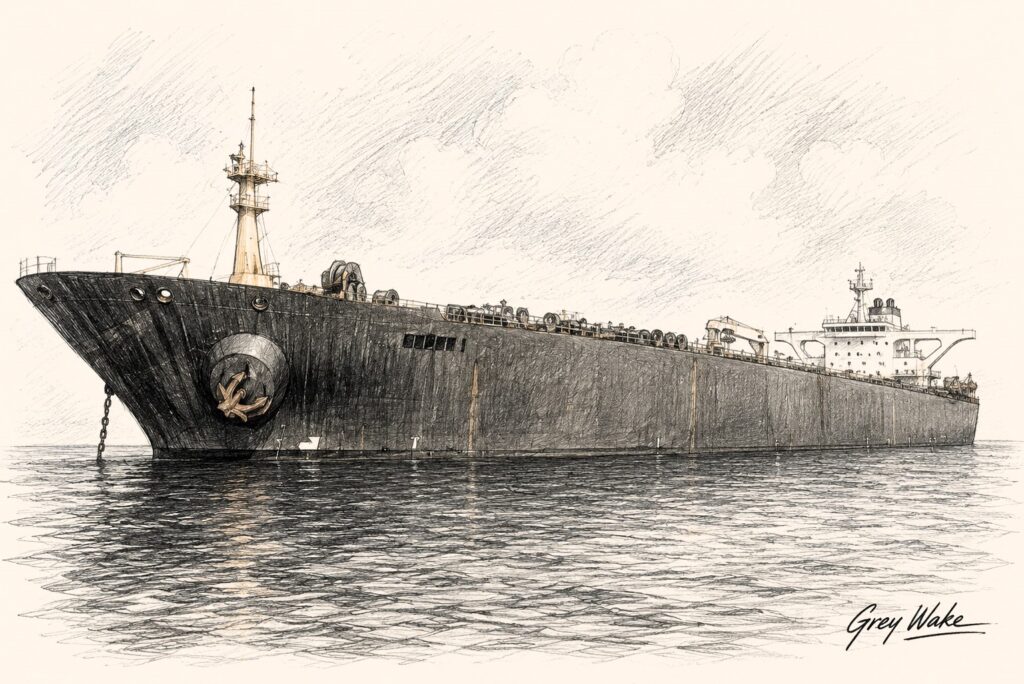
On 7 July 2023, Indonesian Maritime Security Agency (Bakamla) patrol boats detected the Arman 114 in the North Natuna Sea in the middle of an illegal ship-to-ship oil transfer with a second tanker. Both vessels had their AIS transponders switched off, neither displayed a flag, and the partner ship was broadcasting the identity of S Tinos — a vessel that had been scrapped in 2018, the classic “zombie identity” tactic now common across the global shadow fleet. When confronted, both ships tried to flee. The Arman 114 was eventually intercepted in Malaysian waters and returned to Indonesia.
In July 2024, the Batam District Court sentenced the vessel’s master — Egyptian national Mahmoud Abdelaziz Mohamed Hatiba, aged 43 — in absentia to seven years in prison and a fine of approximately $300,000 for environmental offences linked to the transfer. The defendant had disappeared from the country shortly before the verdict. The court also ordered the seizure of the tanker and its cargo as state assets.
From late 2025 into early 2026, the Indonesian Attorney General’s Office and its Asset Recovery Agency moved to auction the vessel together with its remaining cargo of roughly 167,000 tonnes of light crude oil. The reserve price was set at approximately $69.5–$70 million; the initial auction scheduled for 2 December 2025 was later rescheduled to 30 January 2026, though as of mid-2026 the sale had still not been completed, with the Attorney General’s Office seeking to accelerate the disposal process.
A single hull — built in 1997, sanctioned, renamed twice, prosecuted in Indonesia, and still anchored off Batam three years after its seizure — has become a complete case study of the modern sanctioned tanker lifecycle.
Case file: “Grace 1”
The bigger picture
The Grace 1 tanker did not merely survive a geopolitical crisis. It marked the beginning of a new maritime era.
Before 2019, many observers still treated sanctions evasion as a secondary layer surrounding global trade. After the Grace 1 affair, that distinction collapsed. Oil transportation, intelligence collection, naval power, insurance exposure, registry politics, and financial warfare fused into a single operational environment.
The tanker industry changed with it.
Today, shadow fleets transport sanctioned cargoes across multiple regions using tactics that became globally visible during the Grace 1 affair. AIS disappearances, offshore cargo transfers, reflagging operations, opaque ownership structures, and legal ambiguity now define a significant part of global oil shipping.
One vessel revealed the architecture of that system before the rest of the world fully noticed it.
And somewhere between Gibraltar and Batam, the Grace 1 tanker stopped being a commercial ship and became a geopolitical method — one that, after 2022, would expand dramatically across Russian crude exports and turn shadow shipping from a peripheral phenomenon into a structural layer of the global energy trade.