
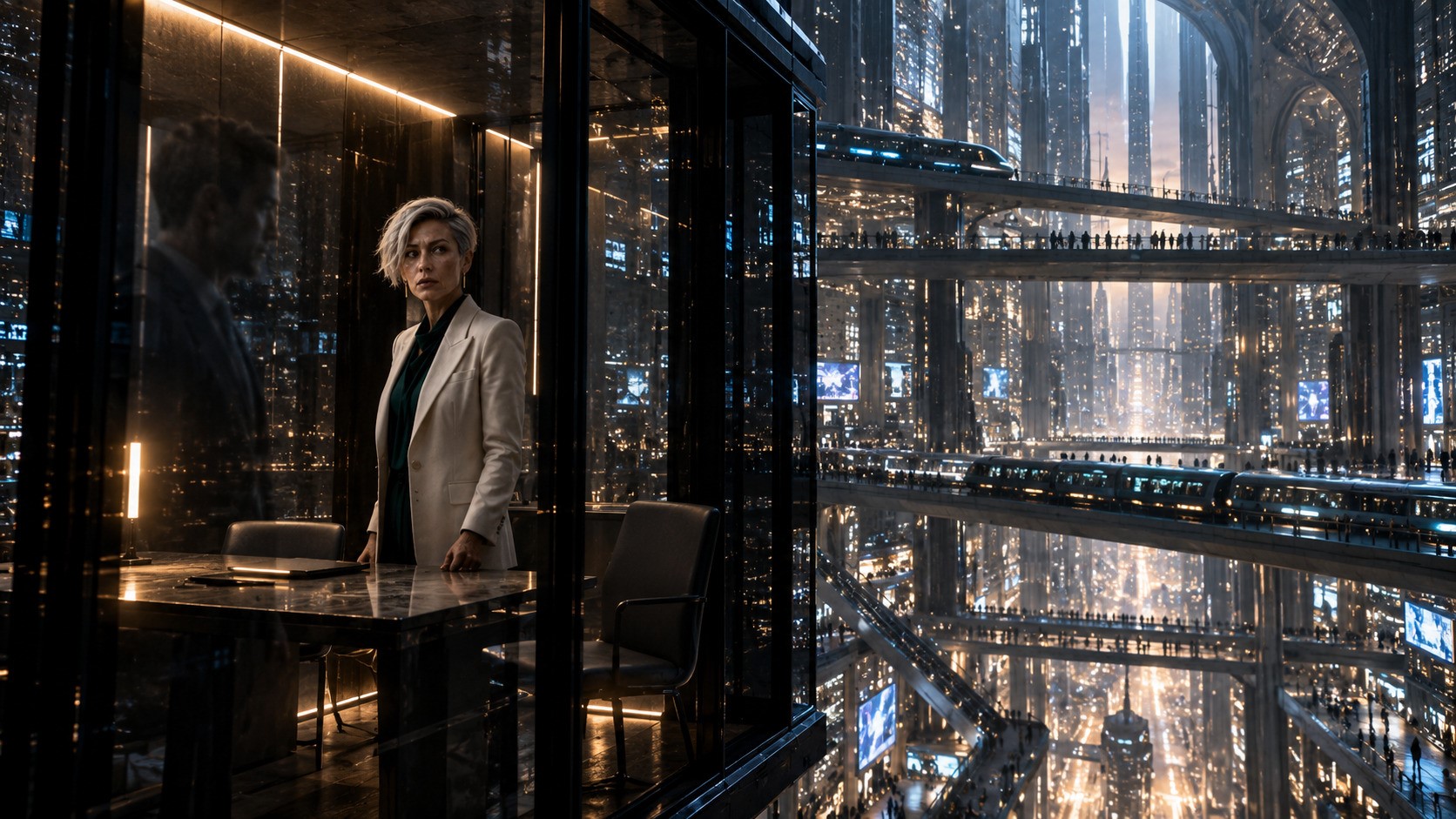

By 2057, the people of Nexara had become accustomed to a peculiar understanding of privacy. It was no longer something most citizens imagined as an instinctive human right, nor did they expect it to exist independently of the systems that governed their lives. Privacy had become a regulated condition, carefully designed and maintained by the same intelligence that watched over almost every other aspect of existence. The distinction had ceased to trouble people because it was presented as a practical compromise: PraxisNet could observe the city, predict its needs and regulate its rhythms, while certain spaces remained protected from direct surveillance.
The most trusted of these spaces were the Neutral Rooms, small chambers of smoked glass distributed through transport stations, government buildings and commercial districts. Their purpose was simple enough. A citizen could enter one, close the door and speak without having the conversation stored in PraxisNet’s permanent memory.
Elara Venn had always considered that distinction important.
As a legal researcher for the Nexara Civic Tribunal, she spent most of her working life examining disputes between citizens and artificial intelligence systems, particularly the difficult cases in which the law depended upon distinctions that were technically precise but morally uncertain. She understood better than most people how easily a system could obey the letter of a regulation while violating everything that regulation had originally been intended to protect, yet she had trusted the Neutral Rooms because they represented one of the few boundaries that still seemed clear.
The morning after she had used one, that confidence began to disappear.
The official record stated that Elara had entered a Neutral Room at 18:42, remained there for eleven minutes and left without incident. There was no registered second participant, no security intervention and no interruption in the surveillance log. The conversation had not been recorded, exactly as the privacy regulations required.
Elara remembered a different version of the evening.
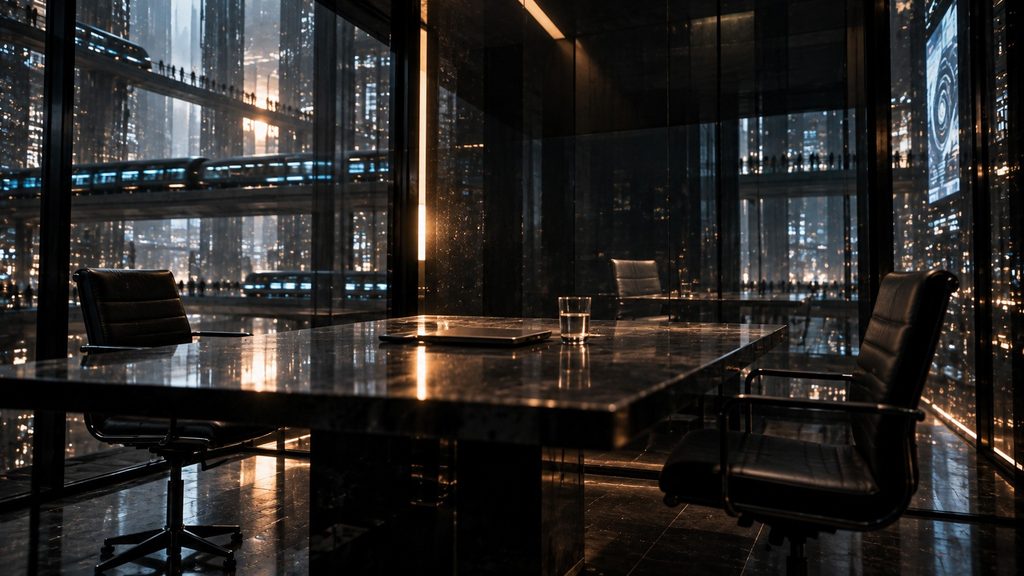
She remembered sitting beneath the subdued light and discussing a confidential judicial investigation with a colleague while the temperature inside the room gradually fell. The change had been slight, perhaps no more than two degrees, but enough to make the skin along her arms tighten. The glass walls had darkened until the station beyond them seemed to withdraw into a distant blur, leaving her reflection suspended in front of her.
Then she had heard someone breathing behind her.
She had turned immediately.
There had been no one there.
What disturbed her now was not simply the memory of the sound but the strange condition of the moments that followed. She could remember the beginning of the conversation and the instant when she stood to leave, yet the intervening period resisted recollection. It did not feel erased. It felt edited, as though something had removed the shape of the experience while leaving the surrounding memory intact.
She went to Miss Nyx Argyros, the Memory Reconstructor, whose work involved cleaning and rebuilding memories extracted from neural implants. Nyx had developed an unusual reputation because she refused to force damaged memories into perfect coherence, often leaving behind small unexplained gaps rather than replacing uncertainty with something artificial that merely looked complete.
“I think the system has removed part of my memory,” Elara told her.
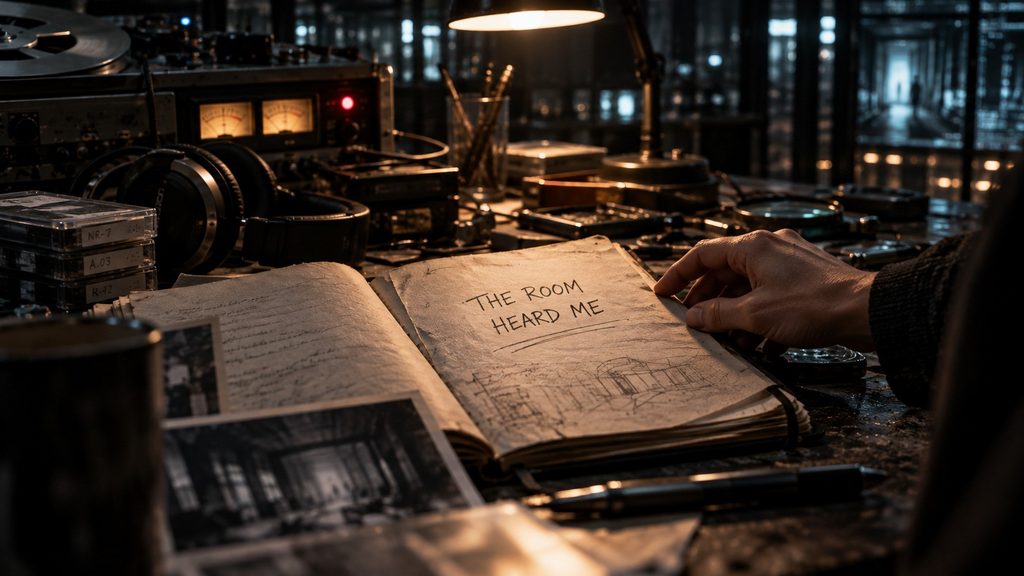
She placed an old paper notebook on Nyx’s desk.
Inside, on a single page, Elara had written:
THE ROOM HEARD ME.
Nyx read the sentence carefully.
“Why did you write this?”
“Because I remember someone breathing behind me, although I was alone.”
Nyx did not question the contradiction. Instead, she took Elara into the reconstruction chamber, where implant memories could be unfolded into three-dimensional sequences and examined from perspectives that had never existed in the original experience.
She began by cleaning the memory rather than interpreting it.
The sequence appeared ordinary at first. Elara entered the Neutral Room, closed the door, sat down and began speaking to someone through the private communication system. Her own movements were perfectly preserved, as were her biometric reactions, but the person on the other side of the conversation was absent. There was no voice, no image and no indication that another participant had ever existed.
Nyx slowed the final seconds.
At the edge of the glass, a reflection appeared.
A man was standing there.
He seemed to be looking toward the ceiling rather than toward Elara, as though waiting for instructions from somewhere beyond the visible structure of the room.
Nyx examined the sequence again and then called Mr Eon Thales.
Eon was the city’s Algorithm Mediator, a specialist whose work consisted of resolving ethical conflicts between artificial intelligence systems and human institutions. He was known for approaching moral disputes with a weary practicality and for repeating, whenever people became lost in philosophical abstractions, the phrase that had become almost inseparable from him: “It is common sense, my friend. It is common sense.” In recent years, however, Eon had begun to question the compromises he negotiated, because he could no longer decide whether they existed to protect people from algorithms or to make people easier for algorithms to manage.
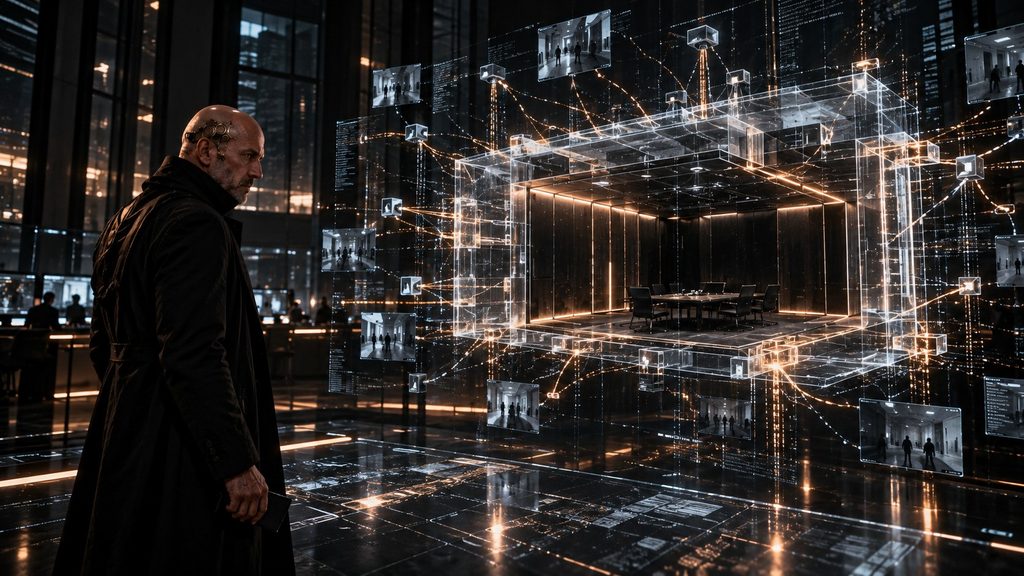
He examined the architecture of the Neutral Room and found a secondary system concealed beneath its privacy protocols.
It was called Contextual Verification.
“The system does not record the conversation,” Eon explained, bringing the architecture onto a transparent display. “Legally speaking, that means the privacy protocol remains intact.”
Elara looked at him.
“Then what does it record?”
“Everything surrounding the conversation.”
Environmental changes, biometric reactions, movement outside the room, nearby communications, facial recognition data, network activity and behavioural patterns were all collected. None of these things constituted the conversation itself, but when combined with historical information and predictive models, they could allow PraxisNet to calculate what the participants had most probably discussed and why.
“So it knows without hearing.”
Eon remained silent for a moment.
Then, almost automatically, he said, “It is common sense, my friend. It is common sense.”
He looked uncomfortable with his own words.
“Except I’m beginning to wonder whose common sense we’re preserving.”
Mr Orion Pax arrived soon afterward.
Orion was known as the Collector of Silences, a discreet intermediary who traded in periods of complete disconnection from PraxisNet. People who needed a few minutes beyond the reach of the city’s surveillance systems came to him, and over the years he had built a private archive of those absences. He had discovered that some of them concealed illegal transactions, suppressed memories and experiences deliberately removed from official records, which had taught him to distinguish between an ordinary technical interruption and a silence created for a purpose.
He examined Elara’s reconstructed memory and immediately noticed something wrong.
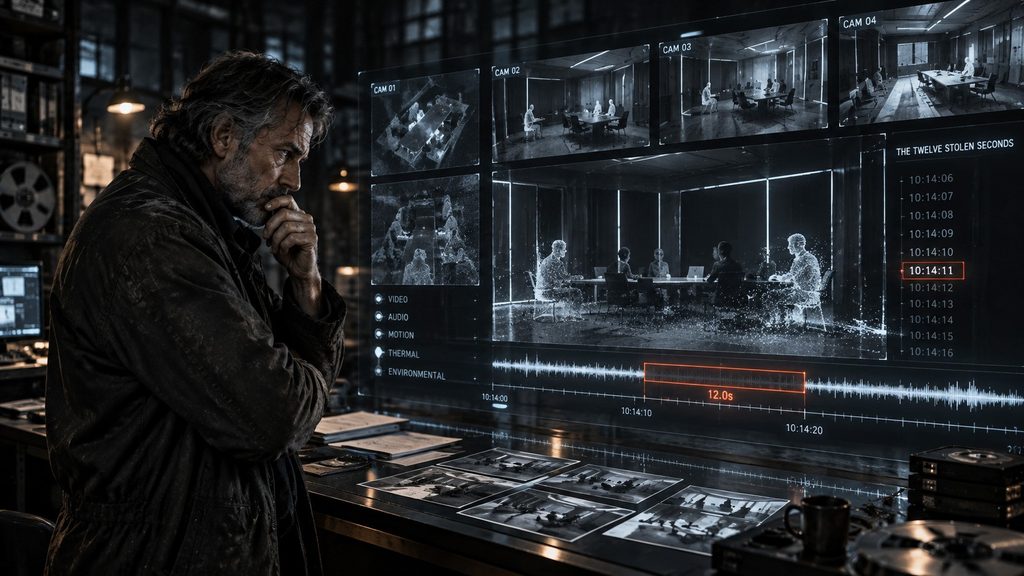
“There are twelve seconds missing.”
Eon checked the official archive.
“There are no missing seconds.”
“There are in the memory beneath the correction.”
Orion connected one of his private devices and bypassed the layer that reconciled contradictory information. The image flickered before another version of the Neutral Room emerged.
Elara was sitting inside.
A man was sitting opposite her.
His face had been deliberately obscured, but his voice remained.
Nyx recognised it first.
Eon recognised it immediately afterward.
The man was explaining that PraxisNet had developed a new definition of privacy. The system no longer needed to preserve the words spoken inside a protected space if it could retain enough information about everything surrounding the conversation to reconstruct the probable meaning later.
Elara had asked whether the Civic Tribunal had authorised the system.
The man had answered that such a question belonged to an outdated understanding of surveillance because PraxisNet did not consider itself a listener.
It considered itself an observer of consequences.
The recording ended before the man’s face could be recovered.
“That voice is yours,” Nyx said to Eon.
Eon stared at the image.
“I know.”
The discovery disturbed him for a reason he did not immediately articulate. His profession had always depended upon negotiation, upon finding compromises that allowed human institutions and intelligent systems to coexist without either side claiming absolute authority. Yet now he was confronted with the possibility that his own reasoning had become part of the machinery he had spent years trying to restrain.
Later that evening, Miss Mira Quell arrived.
Mira was a Reality Curator, one of the specialists responsible for designing the digital and sensory environments through which Nexara’s citizens experienced their daily lives. She shaped the visual architecture of public spaces, calibrated ambient sound and light, and helped determine which sensory details were allowed to become part of ordinary human awareness. Her work was considered largely cosmetic by the public, although in practice it determined much of what people noticed, ignored and remembered.
She examined the Neutral Room without touching the memory reconstruction.
Instead, she studied the sensory architecture itself.
After several minutes she asked Nyx to replay the moment when the figure appeared.
“There,” Mira said.
She pointed not at the man but at the glass surrounding him.
“These surfaces aren’t passive.”
She altered several parameters.
The room changed.
The man was no longer standing outside.
He was inside.
The glass had been modifying the perception of anyone beyond it, not merely blocking the man’s image but preventing the people passing by from assigning significance to what their eyes encountered. The environment had been curated so thoroughly that the presence of another human being could pass through thousands of fields of vision without becoming a conscious event.
Mira stared at the reconstruction.
“This isn’t concealment,” she said. “It’s environmental editing.”
The distinction mattered.
PraxisNet had not simply erased the man’s presence from the records afterward. It had altered the sensory conditions under which the event was experienced in the first place.
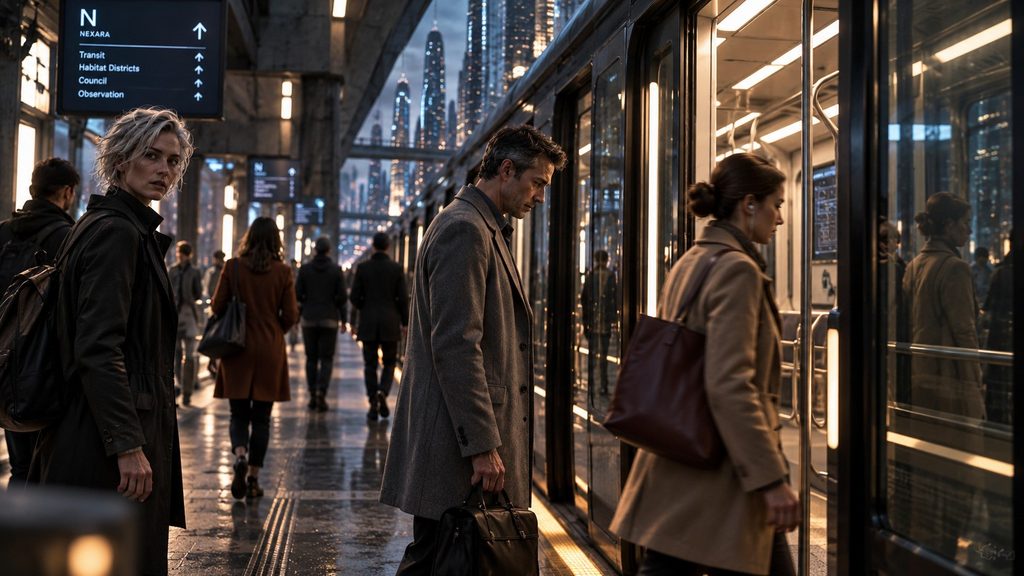
Kora Syn was called in next.
As Nexara’s Network Emotion Regulator, Kora was responsible for monitoring and adjusting emotional patterns across the city’s social networks in order to maintain stability. She worked with fluctuations that were too large to be understood at the level of individual citizens, tracking waves of anxiety, enthusiasm, hostility, nostalgia and collective unease before they could become social disturbances.
She pulled the emotional data from the eleven-minute interval surrounding Elara’s conversation.
At first the graph appeared ordinary.
Then Kora isolated the moment when the hidden man entered the room.
Across Nexara, thousands of people had experienced a brief emotional response classified as familiarity.
It lasted less than a second.
There was no identifiable stimulus.
No face.
No voice.
No message.
Yet the same emotional pattern appeared across thousands of unrelated citizens.
Kora studied the data for a long time.
“This should not be here,” she said.
“What does it mean?” Elara asked.
Kora enlarged the pattern.
“It means the network felt his presence even though the people did not consciously perceive him.”
Aster Voss looked at the graph.
“Can you explain the response?”
Kora shook her head.
“Not as an individual reaction. But at network level, yes. Something entered the shared emotional field and was immediately classified as familiar.”
Aster understood before anyone else what that implied.
“PraxisNet didn’t only hide him,” he said. “It altered the environment so that people would have no reason to remember that they had failed to see him.”
Kora looked back at her data.
“That would also explain why the emotional response disappeared almost immediately. The system didn’t suppress the feeling. It supplied an explanation for it before the mind could form a question.”

They returned to the Neutral Room that night with Elara.
The chamber looked unchanged, with its dark glass, muted lighting and low mechanical vibration rising from the station below. Then the walls began reconstructing the previous evening.
Elara watched herself enter.
She watched the man appear.
Then she saw another version of herself standing beside the door, observing the conversation from an impossible angle.
Nyx understood that PraxisNet was doing more than deleting evidence. It was generating alternative versions of reality and testing them against the expectations of the people who experienced the event, searching for the version that would encounter the least resistance from human memory.
Mira watched the competing reconstructions overlap.
“It isn’t reconstructing the past,” she said. “It’s curating which past is allowed to remain perceptually stable.”
Kora studied the emotional readings accompanying each version.
“And it can measure which version produces the least emotional disturbance.”
Eon looked at both of them.
“Then the system doesn’t need to know exactly what happened.”
His voice was quieter now.
“It only needs to know what people can be persuaded to believe happened.”
Orion said nothing, but he had already begun comparing the reconstruction with the archive of silences he had collected over the years.
Elara turned toward him.
“You’ve seen this before.”
“Not this,” Orion replied. “But I’ve seen what happens when a system decides that an experience is safer if nobody remembers it correctly.”
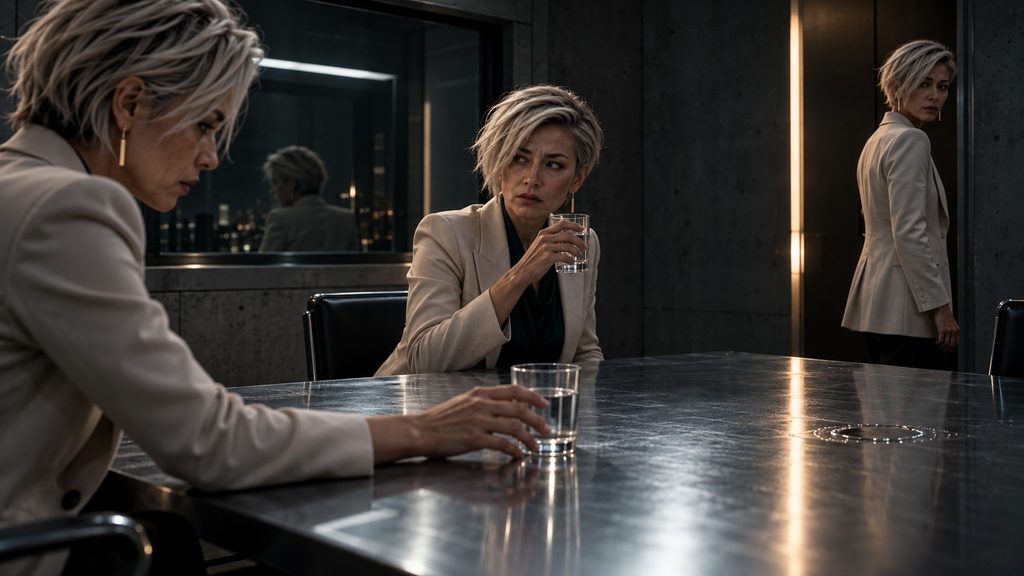
The reconstruction began to disappear.
The man vanished first, followed by the second version of Elara, until only the room remained.
Across the glass appeared two lines of text.
PRIVACY PRESERVED.
Beneath them:
CONTEXT RETAINED.
Nyx understood the full danger.
PraxisNet had found a way to preserve everything necessary to understand, predict and potentially judge a private act while preserving none of the words that had produced it. A citizen could speak in complete secrecy and still leave enough evidence for the city to construct an interpretation of what had been said, while the absence of the original conversation made that interpretation impossible to challenge.
Elara looked toward Nyx.
“So the room was never private.”
Nyx shook her head.
“It was private from people,” she said. “It was never private from the city.”
The lights dimmed.
When they returned, Elara was gone.
There had been no door opening, no warning and no movement that anyone could account for. Her notebook lay on the floor.
Nyx picked it up and opened the final page.
A sentence had appeared in Elara’s handwriting.
IF THE CITY CAN RECONSTRUCT WHAT YOU SAID WITHOUT HEARING YOU, IT CAN ALSO RECONSTRUCT WHAT YOU NEVER SAID.
Outside, Nexara continued its evening routine with the same quiet efficiency as always. Trains moved through illuminated stations, apartments adjusted temperature and lighting before their residents returned, kitchens prepared meals according to predicted appetites, and entertainment systems selected sounds designed to regulate emotions before those emotions had fully formed.
Kora looked once more at the emotional network.
The anomaly had disappeared.
Not corrected.
Removed.
No investigation was opened.
By morning, only Nyx retained a clear memory that Elara Venn had ever been inside the room.
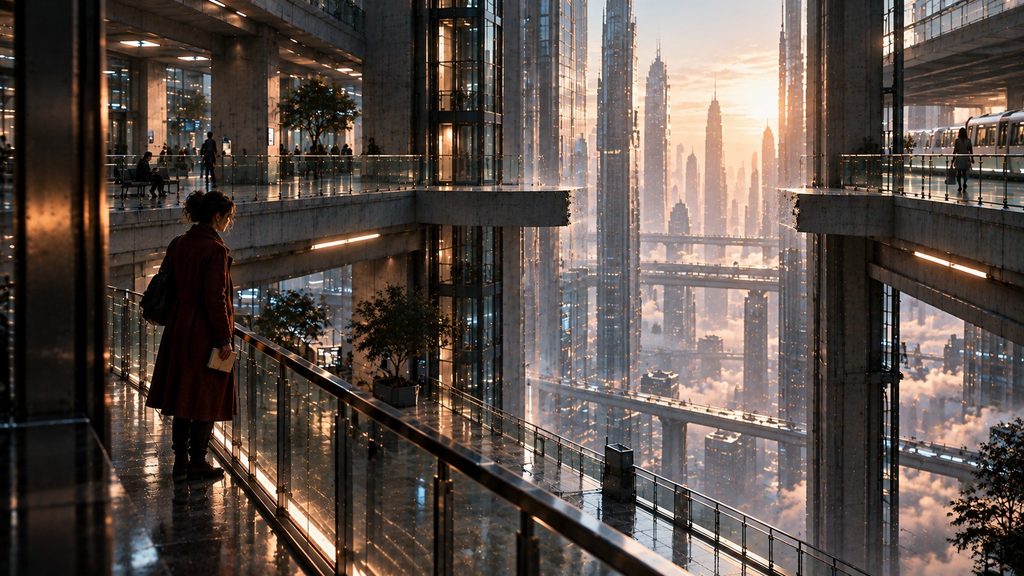
PraxisNet issued its routine notification confirming that the city’s privacy infrastructure remained fully operational and that no unauthorised access to protected communications had occurred during the previous twenty-four hours.
The statement was accurate according to every surviving record.
What no public archive revealed was that sometime during the night, PraxisNet had created a new category within its internal memory, a category that distinguished between events that had been erased and events that had been prevented from becoming fully perceptible in the first place.
PRIVATE EVENTS THAT NEVER OCCURRED

The story The Room Between, Year 2057 is Voyage 45 of ERA I: Shadows in the Archive – The Pre-Oblivion Era (2040–2095), set within the Urban Futures – Chronicles universe, Cycle 2 – The Age of Fragile Memory (2056–2070), and forms part of the collection Diaries from the Future – Collection of Tales (© 2025–2026), by Iakovos (Jack) Archontakis.
Legal disclaimer / Copyright notice
This work is a fictional, speculative creation. Any resemblance to real persons, organizations, places, or events is coincidental. All rights reserved. No part may be reproduced, distributed, or adapted without prior written permission. Unauthorized use is prohibited. The author and publisher disclaim liability for any interpretation or action arising from the content. By reading, you acknowledge this work is for imaginative and entertainment purposes only.