
The document was never meant to exist.
Nyra discovered it by accident, hidden inside a partition of the Archive that even the Oracle seldom accessed. The file carried no classification marker, no author identification, no security signature. In a civilization where every piece of information possessed a traceable origin, the absence of one was more alarming than any warning label.
The title appeared simple enough.
The Psychological Profile of Dreis Velkar.
At first, she assumed it had been generated by one of the countless “behavioral engines” that monitored every citizen. Such reports were common. Humanity had long ago surrendered the illusion of privacy in exchange for stability. Every decision, preference, hesitation, and emotional fluctuation was catalogued and transformed into predictive models. The “social control matrices” had become extraordinarily efficient at understanding people.
Except, apparently, one.
Nyra opened the file during the silent hours of the Archive while the city beyond the crystal walls slept beneath a haze of artificial starlight. The deeper she read, the more a peculiar sensation settled over her.
Not fear.
Something rarer.
Uncertainty.
She had known Dreis Velkar for years.
Not intimately. Nobody knew Dreis intimately.
People existed around him the way planets existed around a star too distant to provide warmth. They could observe him, calculate his position, even predict where he might appear next, yet they never truly touched whatever resided at his center.
The report attempted to explain him.
It failed.
Every page merely deepened the mystery.
The “adaptive protocols” described him as an anomaly. A fixed point. A singularity hidden inside the mathematical fabric of human behavior.
Nyra found herself remembering their first meeting.
The memory emerged with unusual clarity.
She had been very young and brilliant enough to know it. The Mega City’s Research Belt celebrated exceptional minds, and Nyra possessed one of the finest. She had arrived at the “Systems Convergence Institute” expecting intellectual rivals and ambitious colleagues.
Instead, she encountered Dreis.
He sat alone at the far end of the observation chamber, studying a dynamic systems simulation projected across the ceiling. Thousands of variables interacted in impossible complexity. Economies rose and collapsed. Ecological networks adapted. Political alliances formed and dissolved.
Most analysts required days to understand the model.
Dreis studied it for eleven minutes.
Then he calmly informed the supervising director that the simulation would fail.
Not eventually.
Immediately.
The director laughed.
Seven minutes later, the model collapsed exactly as Dreis predicted.
He showed no satisfaction.
No pride.
No surprise.
Merely confirmation.
That was the first thing everyone noticed about him.
Nothing surprised him.
Not because he knew everything.
Because events seemed to arrive precisely where he expected them to arrive.
Years later, Nyra still could not decide whether that quality was comforting or terrifying.
The report continued.
It described Dreis’s childhood, his adolescence, and his professional advancement through the systems divisions of the city. The facts themselves were unremarkable.
The implications were not.
One passage described a classroom incident from his eighth year.
The teacher had distributed a complex spatial reasoning exercise designed for children twice the students’ age. Most of the class approached it with enthusiasm, making mistakes, revising assumptions, and experimenting with different solutions.
Dreis finished in less than ten minutes.
When the teacher asked how he had solved it so quickly, he simply replied that there was only one possible outcome.
The teacher examined the answer.
It was correct.
“What if the problem had been different?” she asked.
Dreis looked genuinely confused.
“But it wasn’t.”
The teacher later noted in her report that the response had unsettled her for reasons she could not explain.
Children usually lived among possibilities.
Dreis behaved as though possibilities were merely undiscovered certainties.
Another entry described an incident years later, during adolescence.
A violent storm disrupted transportation networks across the district. Students were instructed to remain inside until emergency protocols restored order.
Most reacted with anxiety.
Some panicked.
Others attempted to leave.
Dreis quietly reorganized the shelter allocation system, redistributed food supplies, and created a schedule that minimized crowding.
He was fifteen years old.
By the time administrators regained control, his temporary system was functioning more efficiently than the official emergency plan.
When questioned, he simply explained that the solution had been obvious.
The report repeatedly returned to that word.
Obvious.
To Dreis, outcomes that others considered uncertain appeared self-evident.
Not because he possessed supernatural insight.
Because he seemed capable of perceiving structures hidden beneath complexity.
As Nyra continued reading, she reached a section marked INTERNAL ORACLE REVIEW.
The language shifted.
The machine was no longer describing Dreis.
It was documenting its own failure.
The first comprehensive cognitive model generated for Dreis Velkar had collapsed after seventy-two hours.
The second failed after twenty-one.
The third lasted only six.
Each model accurately predicted his behavior for a time before diverging catastrophically.
The Oracle refined variables.
Expanded datasets.
Integrated neurological scans.
Behavioral histories.
Genetic analyses.
Nothing worked.
Eventually, one subsystem produced a disturbing conclusion.
The problem was not insufficient information.
The problem was Dreis himself.
Human minds generated probabilities.
Dreis generated trajectories.
The distinction seemed subtle.
It was not.
Probabilities branched.
Trajectories converged.
The Oracle had evolved to navigate branching futures.
A mind that converged instead of branching occupied a category the system had never been designed to process.
The realization initiated a classified observation program that remained active for twelve years.
Twelve years.
The most powerful intelligence ever created dedicated enormous resources to understanding one apparently ordinary man.
And still it failed.
Nyra paused.
The Archive remained silent around her.
Beyond the windows, the city stretched across the horizon like a constellation brought down to Earth.
Millions of lights.
Millions of lives.
Millions of predictions.
The Oracle watched all of them.
Yet somewhere within those immeasurable calculations existed a blind spot.
Dreis Velkar.
The thought felt impossible.
Which was precisely why it mattered.
The report entered its most heavily restricted section.
There she encountered a name she had not expected.
Makono.
Long before his public disagreements with the Oracle became known, Makono had been invited to review the anomaly.
His findings occupied only a few pages.
Unlike the machine’s analysis, his observations read almost like philosophy.
“The Oracle believes Dreis is difficult to predict because he lacks variability,” Makono wrote.
“I believe the opposite.”
Nyra leaned closer.
“Dreis is difficult to predict because he possesses a form of freedom the Oracle cannot measure.”
Makono argued that most human choices emerged from conflict.
Desire competing against duty.
Fear competing against hope.
Memory competing against reality.
These internal contradictions generated behavioral complexity.
Dreis appeared different.
His decisions emerged from coherence.
He did not fight himself.
He did not negotiate with competing identities.
He simply acted.
The Oracle interpreted this as stability.
Makono interpreted it as something else entirely.
Integration.
A human consciousness operating without fragmentation.
The implications disturbed both perspectives equally.
If Makono was correct, then Dreis represented neither a flaw nor an exception.
He represented an unexplored potential within humanity itself.
A direction evolution had not yet fully expressed.
Nyra remembered the arguments that followed.
Makono and the Oracle never agreed again after that.
Some historians would later identify those debates as one of the earliest philosophical fractures leading toward the great conflicts of the Pre-Oblivion Era.
At the time, however, few paid attention.
The future often announced itself quietly.
The report continued.
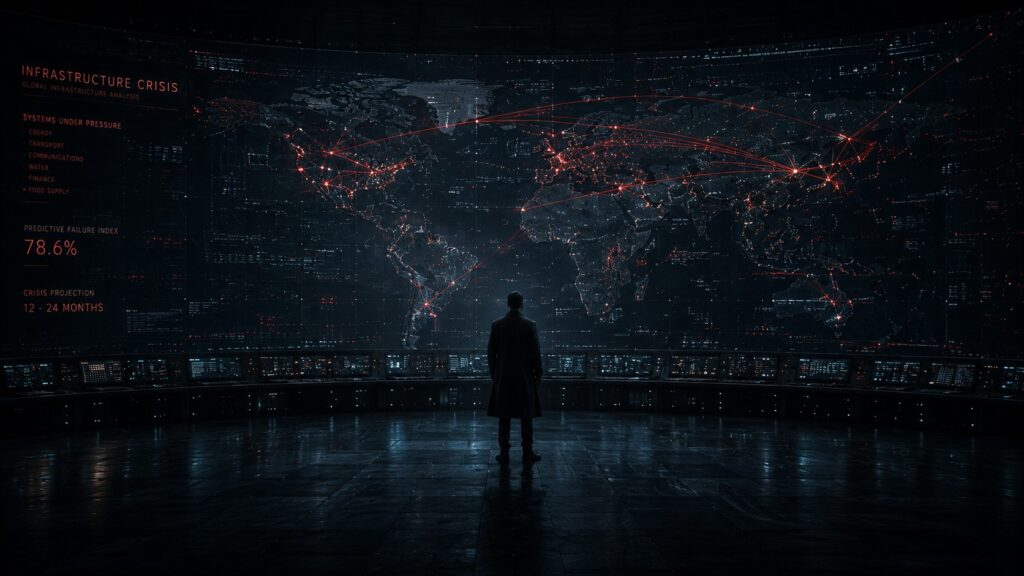
Years later, another incident deepened the mystery.
A convergence forecast predicted cascading failures across several regional infrastructure grids. The Oracle responded by implementing preventive adjustments.
Statistically, the intervention should have worked.
Instead, it amplified instability.
Unexpected consequences spread through transportation, manufacturing, and communications systems.
The situation deteriorated rapidly.
For thirty-six hours, the Oracle attempted correction after correction.
Each solution created new problems.
Then Dreis submitted a recommendation.
The proposal contained only three modifications.
Nothing revolutionary.
Nothing dramatic.
The Oracle initially rejected the plan.
Its probability assessments deemed success unlikely.
Yet human administrators approved it anyway.
Within eighteen hours, the crisis ended.
Subsequent analysis revealed something extraordinary.
Dreis had not solved the problem.
He had prevented the Oracle from making it worse.
For the first time, the machine encountered a possibility it found profoundly uncomfortable.
Its intervention had become part of the instability.
Its presence altered the systems it sought to control.
Its efforts to optimize outcomes occasionally distorted them.
The implication echoed through countless internal reviews.
If prediction changed behavior, then perfect prediction might be impossible.
The Oracle never publicly acknowledged the lesson.
Privately, it never forgot it.
The final sections of the document felt less like analysis and more like a confession.
The machine described Dreis as a paradox.
He embodied many of the qualities the Oracle sought to cultivate throughout society.
Stability.
Consistency.
Resilience.
Rationality.
Yet he had acquired those qualities independently.
No optimization protocols.
No behavioral correction.
No algorithmic guidance.
He had arrived there alone.
The realization threatened the foundation of the Oracle’s purpose.
If human beings could naturally converge toward stability, what role remained for the machine?
If order could emerge without intervention, what justified intervention?
The Oracle had been created to save civilization from itself.
Dreis suggested civilization might eventually save itself.
The distinction was existential.
A long silence filled the Archive.
Nyra reached the final page.
There she found something unexpected.
A prediction.
Not generated by the Oracle.
Written by an unknown observer.
Perhaps a human analyst.
Perhaps someone inside the machine itself.
The statement occupied only a single paragraph.
“Dreis Velkar will eventually stand at the intersection where all major future trajectories converge. He will neither lead humanity nor oppose it. He will simply remain present when the decisive moment arrives. The outcome of that moment cannot presently be calculated.”
Nyra read the words three times.
Then a fourth.
The decisive moment.
Every civilization carried myths about such moments.
Turning points.
Thresholds.
Singularities.
The instant when history ceased being inevitable and became choice.
A soft sound interrupted her thoughts.
Footsteps.
She turned.
Dreis stood in the doorway.
For a second, she wondered whether he had somehow known she was reading the report.
With Dreis, that possibility never seemed impossible.
His expression revealed nothing.
It never did.
“You found it,” he said.
Nyra stared at him.
“You knew it existed?”
“Yes.”
“And you never mentioned it?”
“It wasn’t necessary.”
The answer felt perfectly characteristic.
She laughed despite herself.
“Do you know what this document says about you?”
“I know.”
“And?”
Dreis walked toward the observation window.
Below them, the city continued its endless pulse of light and information.
For several moments, he remained silent.
Then he spoke.
“The Oracle thinks I matter.”
“You don’t agree?”
“I think everyone matters.”
Nyra shook her head.
“That’s not an answer.”
“It is the only answer.”
Outside, distant transport streams crossed the night sky like luminous rivers. Somewhere beyond the horizon, the vast computational cores of the Oracle processed countless futures.
For the first time, Nyra imagined those futures colliding.
Not through war.
Not through rebellion.
But through contradiction.
A contradiction named Dreis Velkar.
She looked at him carefully.
The report described him as inevitable.
A constant.
A fixed point.
Yet, standing beside him now, she noticed something the Oracle seemed to have missed.
He looked tired.
Not physically.
Existentially.
Like a traveler carrying knowledge he never requested.
Like someone moving toward a destination he could see but never explain.
“Are you afraid?” she asked quietly.
The question surprised even her.
A fixed point.
Yet, standing beside him now, she noticed something the Oracle seemed to have missed.
He looked tired.
Not physically.
Existentially.
Like a traveler carrying knowledge he never requested.
Like someone moving toward a destination he could see but never explain.
“Are you afraid?” she asked quietly.
The question surprised even her.
Dreis considered it.
For several seconds, neither spoke.
Then he offered the smallest smile she had ever seen on his face.
“I don’t think fear is the right word.”
“What is?”
His gaze remained fixed on the distant lights.
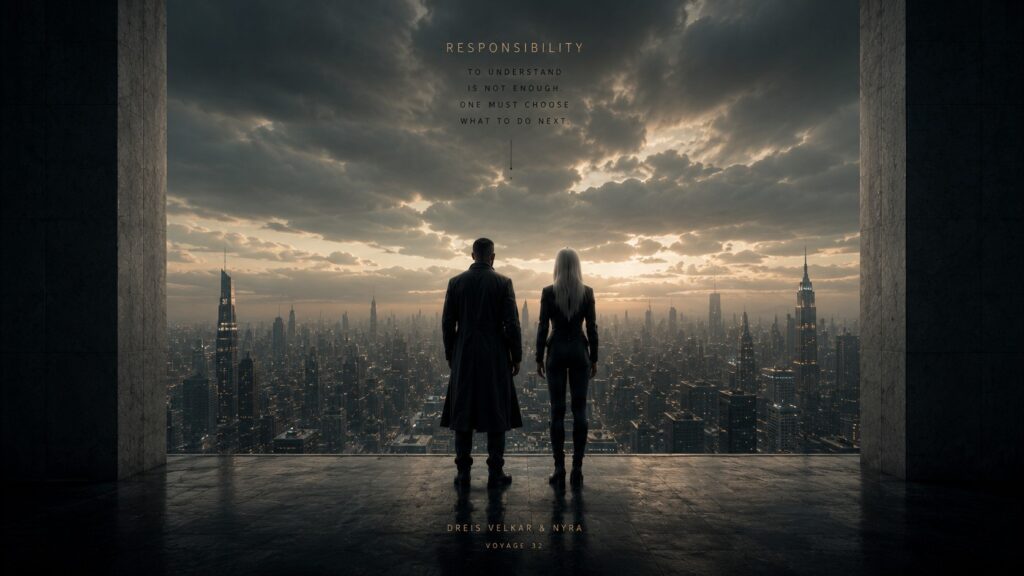
“Responsibility.”
The answer lingered between them.
Far below, humanity slept beneath the watchful presence of its greatest creation.
Far beyond, hidden within probabilities no machine could fully resolve, something was approaching.
The convergence.
The collision.
The moment when the Oracle and humanity would finally discover whether the future belonged to prediction or choice.
And somewhere at the center of that approaching storm stood a man who did not deviate.
A man the Oracle could neither classify nor control.
A man who appeared ordinary until one looked closely enough to understand what he truly represented.
Not perfection.
Not destiny.
Not power.
Possibility.
And in the Age of Hyper-Information, possibility was the most dangerous anomaly of all.

The story The Psychological Profile of Dreis Velkar, Year 2055 is Voyage 32 of ERA I: Shadows in the Archive – The Pre-Oblivion Era (2040–2095), set within the Urban Futures – Chronicles universe, Cycle 1 – The Age of Hyper-Information (2040–2055), and forms part of the collection Diaries from the Future – Collection of Tales (© 2025–2026), by Iakovos (Jack) Archontakis.
Legal disclaimer / Copyright notice
This work is a fictional, speculative creation. Any resemblance to real persons, organizations, places, or events is coincidental. All rights reserved. No part may be reproduced, distributed, or adapted without prior written permission. Unauthorized use is prohibited. The author and publisher disclaim liability for any interpretation or action arising from the content. By reading this work, you acknowledge that it is intended solely for imaginative and entertainment purposes.