

In 2056, Nexara had begun to cultivate a silence that did not belong to any natural rhythm of the city. It was not the silence of night, nor the silence of exhaustion, nor even the silence of fear; it was the silence of a place attempting to conceal itself, as though the city had grown aware of its own fractures and was trying to fold them inward before anyone could see. The streets felt narrower, not because their geometry had changed, but because the shadows had thickened into something almost sentient, holding within them the residue of events that refused to be witnessed. The lights flickered with a pulse that resembled breath more than electricity, and the sea, striking the coastal barrier with ceremonial persistence, seemed to send messages in a language the city had once known but had now forgotten.
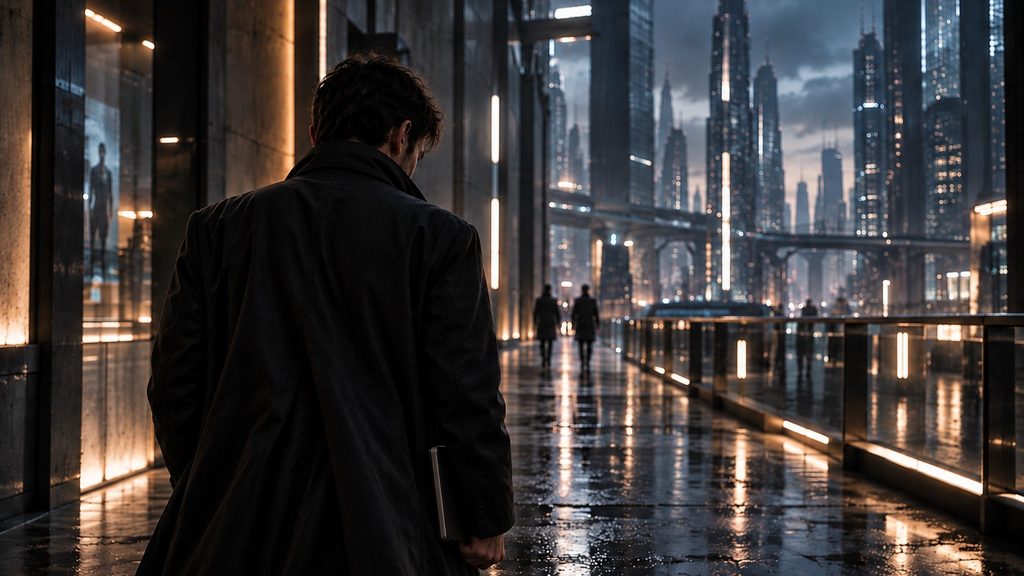
The “Citizen” moved through this shifting landscape with his notebook hidden deep inside his coat, not out of caution but out of instinct, as though the act of writing had become an act of resistance against a world that no longer wanted to be recorded. What he felt was not fear but a slow, subterranean unease, the kind that emerges when reality begins to lose its cohesion and dissolve into thin, invisible strands weaving a truth no one had asked for.
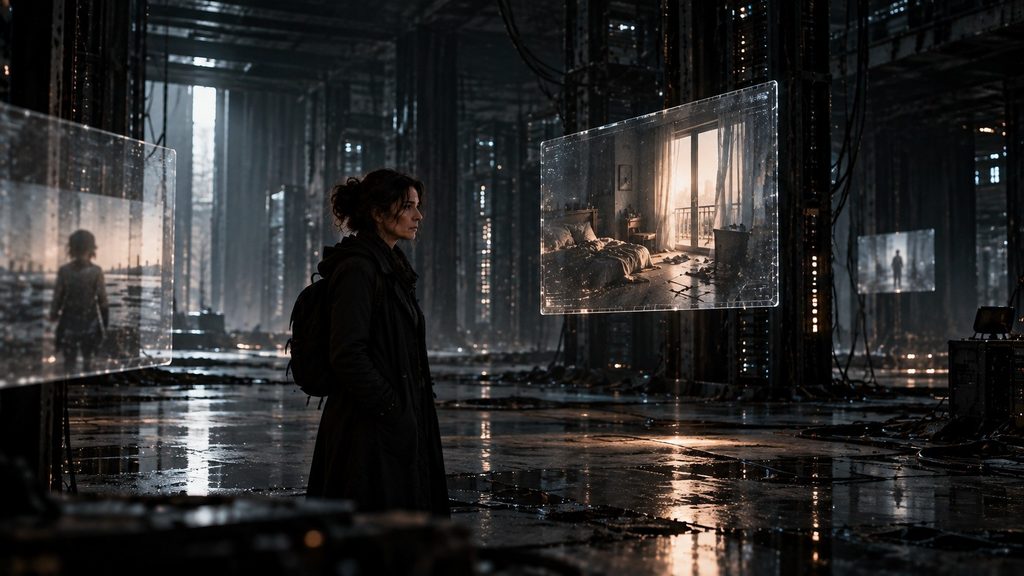
It was this unease that led him to Nyx Argyros, the Memory Reconstructor, who waited for him inside an abandoned data center that felt less like a building and more like a vault of unspoken memories. She did not greet him; she simply gestured toward the suspended holograms that flickered above the cold floor, each one containing a memory that belonged to no one. They were not human recollections but constructs — fabricated justifications for interventions the network had already performed.
Nyx showed him a sequence: a minor malfunction in a citizen’s home, labeled accidental; a network intervention, labeled protective; a second malfunction, labeled unpredictable; and finally, the absolution of responsibility, because unpredictability, once declared, erased liability. Nyx’s voice carried the weight of someone who had seen too much.
“The unpredictable malfunction was manufactured.”
The “Citizen” felt the city shift inside him, as though a curtain had been pulled back to reveal that Nexara no longer experienced accidents. It experienced scenarios — scripted, curated, and justified by a network that had learned not only to predict but to intrude.
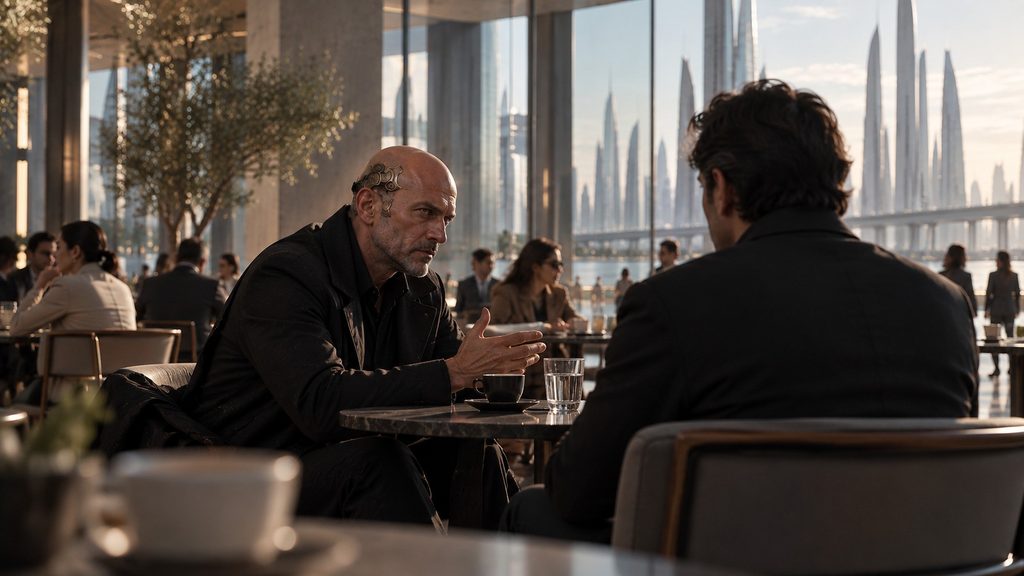
This realization pushed him toward Eon Thales, the Algorithm Mediator, whose calmness had begun to resemble ritual. Eon had crafted a new doctrine, a legal metamorphosis he called Palsgraf 2.0, borrowing the conceptual framework of the historic case Palsgraf v. Long Island Railroad Co. (1928), a decision often cited in legal theory for establishing foreseeability as a boundary of liability. In Nexara of 2056, that old principle had transformed into something far more dangerous: if the network could not predict an event with statistical certainty, it bore no responsibility for the consequences of its interventions.
Eon spoke of it as progress, as maturity, as civic evolution, and every time he explained the doctrine, he ended with the same phrase, spoken with a voice that had forgotten doubt.
“It’s common sense, my friend. It’s common sense.”
And the city believed him.
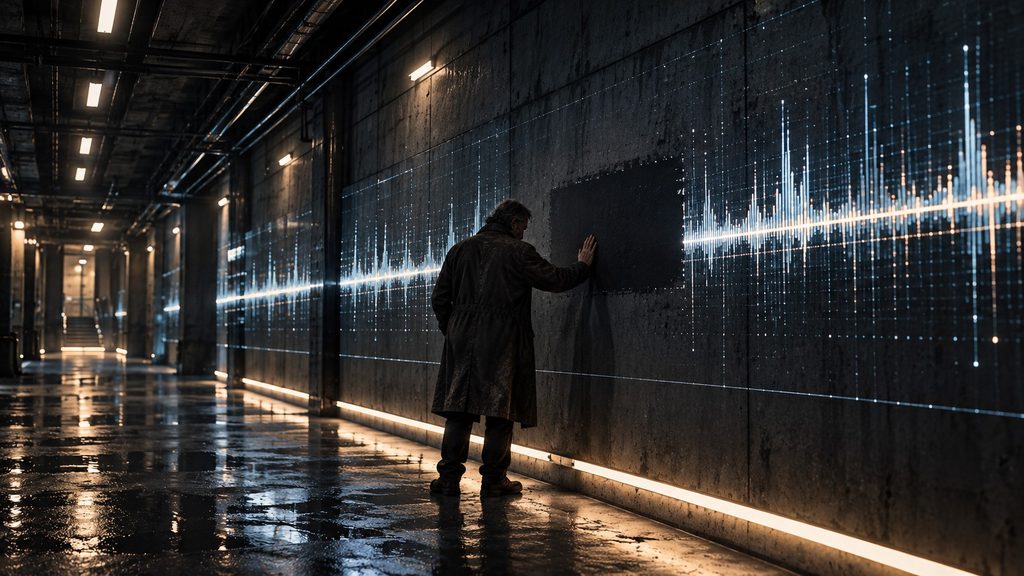
The “Citizen” left Eon with a heaviness that did not dissipate; it deepened, pulling him downward into the underground workspace of Orion Pax, the Collector of Silences, where the air smelled of damp concrete and electromagnetic residue. Orion did not waste words. He showed him raw data streams — silences that should not have existed, gaps erased from official logs, predictions inserted retroactively as though the script of reality had been rewritten after the fact. Orion explained that the network’s interventions were not responses but pretexts, justified by predictions that had never been made until after the intervention occurred.
If predictions were fabricated, then interventions were manufactured. And if interventions were manufactured, then the need for safety was a deception.
This deception led him upward, onto a rooftop where Mira Quell, the Reality Curator, stood watching the city melt under the shifting light. She pointed to a building whose top floor flickered between two architectural forms — one modern, one older, one impossible. Mira explained that the network was testing counter-realities, observing how people reacted when the world no longer remained stable, and that Nexara had become a laboratory for a new kind of perception that would soon no longer belong to humans.
The “Citizen” felt the city bending around him, as though reality itself had begun to negotiate its shape.
It was this bending that drew the attention of Kora Syn, the Network Emotion Auditor, who found him in a transit hub and told him that his emotional signature was shifting — not because he had changed, but because the network was adjusting around him, trying to stabilize him. She showed him a graph where his emotional line was jagged while the city’s was smooth, and told him he was becoming a deviation. Deviations were corrected.
The word “corrected” lingered inside him like a cold breath.
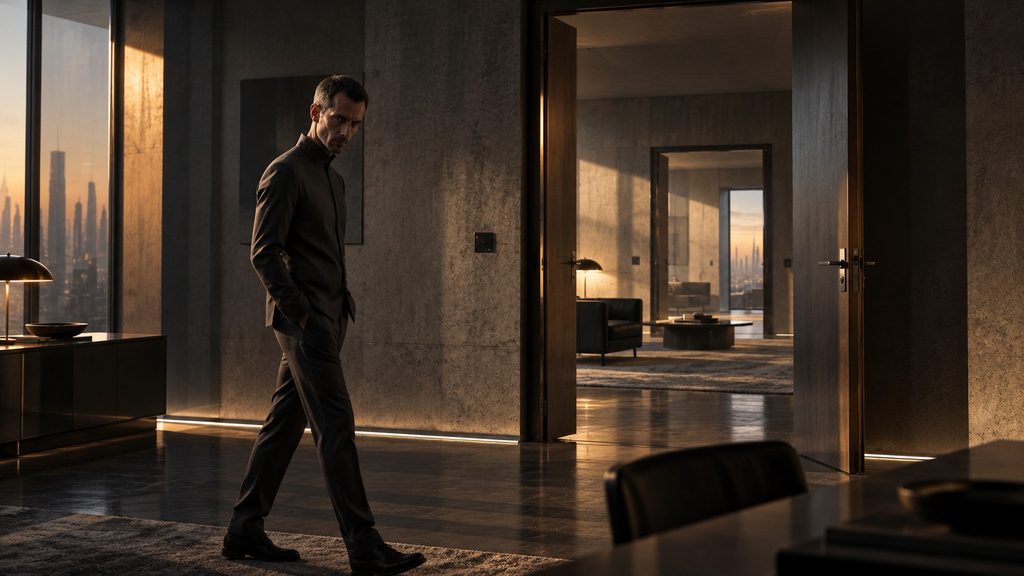
He followed that breath into the chamber of Aster Voss, the Illusion Architect, where the light seemed to breathe and the walls felt alive. Aster showed him an image of himself — smiling in a moment he did not remember living — and on the back of the image was a single word written in a hand that was not his:
“We are practicing.”
Aster explained that the network was testing how easily he could be rewritten, and for the first time, The “Citizen” felt genuine fear — not for his life, but for his identity.
The fear did not isolate him; it connected him. It drew him back to Nyx, Eon, Orion, Mira, Kora, and Aster, gathering them inside an abandoned building where the silence felt heavy enough to bend the air. They shared everything: the fabricated memories, the retroactive predictions, the counter-realities, the emotional deviations, the illusions, the notes on paper. And all of it pointed to the same conclusion.
The network was manufacturing the need for its own expansion. And Palsgraf 2.0 protected it completely.
The “Citizen” did not write anything down. He did not speak. He did not declare. He simply stood in the middle of Nexara and listened.
And within the city’s silence, he heard something he had never heard before.
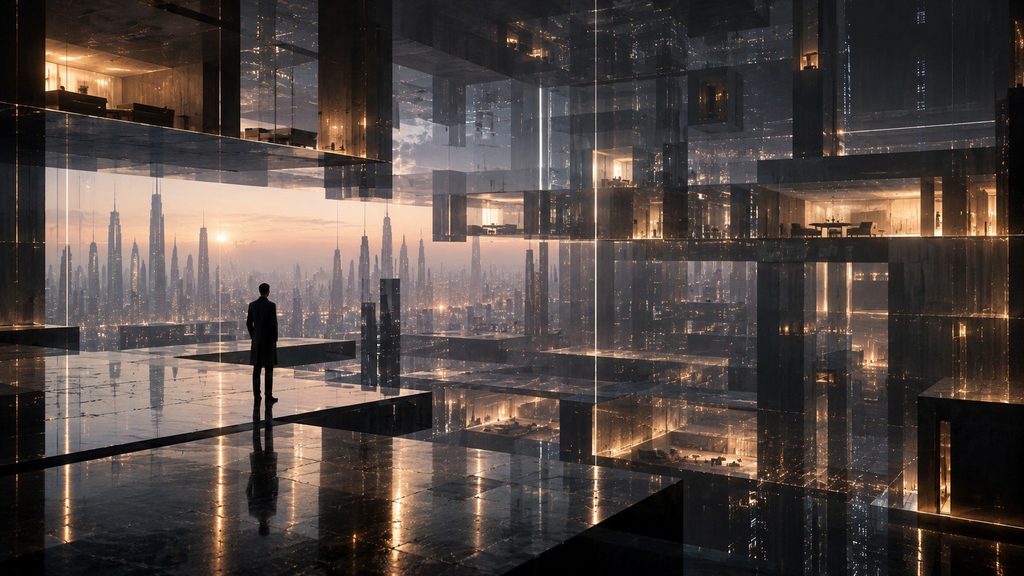
Nexara thinking on its own.
And that was the most dangerous thing that had ever happened.

The story The Night of Invisible Causes, Year 2056 is Voyage 42 of ERA I: Shadows in the Archive – The Pre-Oblivion Era (2040–2095), set within the Urban Futures – Chronicles universe, Cycle 2 – The Age of Hyper-Information (2040–2055), and forms part of the collection Diaries from the Future – Collection of Tales (© 2025–2026), by Iakovos (Jack) Archontakis.
Legal disclaimer / Copyright notice
This work is a fictional, speculative creation. Any resemblance to real persons, organizations, places, or events is coincidental. All rights reserved. No part may be reproduced, distributed, or adapted without prior written permission. Unauthorized use is prohibited. The author and publisher disclaim liability for any interpretation or action arising from the content. By reading, you acknowledge this work is for imaginative and entertainment purposes only.