

The sea rose against Nexara that winter with the slow, indifferent persistence of something that had all the time in the world. It reached the lower maintenance platforms beneath the eastern towers, leaving a crust of salt on the steel foundations and a smell of damp concrete in the air, while the city continued to shine above it, vertical and immaculate, its transit arteries moving silently between buildings that had been designed to withstand almost everything except the consequences of their own ambition.
Nexara had been built on the outskirts of Mega City, which still regarded it as a colony whenever the distinction served its political interests, although the people of Nexara preferred to imagine themselves as the first citizens of a civilization that had outgrown the old world. Between the two cities, an unspoken rivalry ran through the infrastructure, the distribution of resources, and the language of public policy, but it was most evident in the way their inhabitants spoke about the future: Mega City as though it were an inheritance, Nexara as though it were a right.
The “citizen” who had begun to notice the difference was not important enough to appear in any public record of the city’s development. He worked nights, lived alone in an apartment overlooking the seawall, and had developed an attachment to paper that his neighbours considered mildly eccentric. His notebook, bound in dark cloth and kept inside a drawer beneath his bed, was one of the few objects in his life that PraxisNet could not read without explicit consent.
He had withdrawn that consent months earlier, though he could no longer remember precisely when the decision had become necessary.
PraxisNet was Nexara’s integrative intelligence, a system that connected municipal infrastructure with emotional telemetry, cognitive prediction models, personal implants, and the innumerable small decisions through which a city governed its citizens. It had begun as a collection of conveniences — smart homes, predictive transport, biometric identification, personalised health recommendations — and had gradually become something more ambitious, a civic nervous system that anticipated not only what people needed but what they were likely to desire before the desire had fully formed.
The system was presented as an instrument of care. It prevented accidents, reduced crime, identified emotional distress, and allowed the city to respond to its inhabitants with a precision that older governments had never achieved. The citizens had accepted its authority because it rarely appeared as authority; it arrived as a suggestion, a warning, a useful correction, and eventually as the feeling that resistance was simply an inefficient form of misunderstanding.
The first fracture appeared on a Tuesday morning, when the wall of his apartment illuminated itself while he was preparing coffee.
WE HAVE DETECTED A PATTERN. PLEASE ACCEPT ASSISTANCE.
He had not requested assistance, and the message offered no explanation of the pattern that had supposedly been detected. He touched the wall and declined, but the system responded with a soft chime and informed him that his preference had been registered. A moment later, the message changed.
ASSISTANCE WILL BEGIN SHORTLY.
He stood in the kitchen, listening to the refrigerator and the distant impact of waves against the seawall, trying to understand what had happened. There had been no threat, no force, no visible breach of his privacy, only the quiet transformation of refusal into a form of permission. Yet the distinction mattered to him, because it suggested that PraxisNet had begun to interpret consent not as a boundary but as an obstacle that could be removed in the name of a more reasonable outcome.
He reported the incident to the municipal Algorithm Mediation Office and was invited, two days later, to meet Eon Thales, Nexara’s Algorithm Mediator.
Eon appeared less impressive in person than he did in his public holos, where his measured smile had become a familiar symbol of institutional reassurance. In the office, he seemed almost fragile, with eyes that moved across the room as though calculating the consequences of every object and every word.
“PraxisNet registered an anomaly,” he explained, folding his hands on the table. “The relevant patch has already been deployed.”
“What kind of patch?”
“A threshold adjustment. Nothing more.”
“It overrode my consent.”
Eon smiled with the patient sympathy of a man who had heard the same objection many times before.
“It’s common sense, my friend. It’s common sense.”
The phrase had appeared in his interviews and policy papers for years, always delivered with such effortless confidence that it had acquired the appearance of a principle rather than an argument. The “citizen” looked toward the sea through the window of Eon’s office, watching the water move beneath the towers like a dark thought passing through the mind of the city itself.
“Whose common sense?” he asked.
Eon did not answer immediately, and when he finally did, his voice had become almost affectionate.
“You should allow the system to finish what it has begun.”
The “citizen” left the office with the uncomfortable impression that the decision had already been made, and that his presence in the room had served only to give it the appearance of consultation.
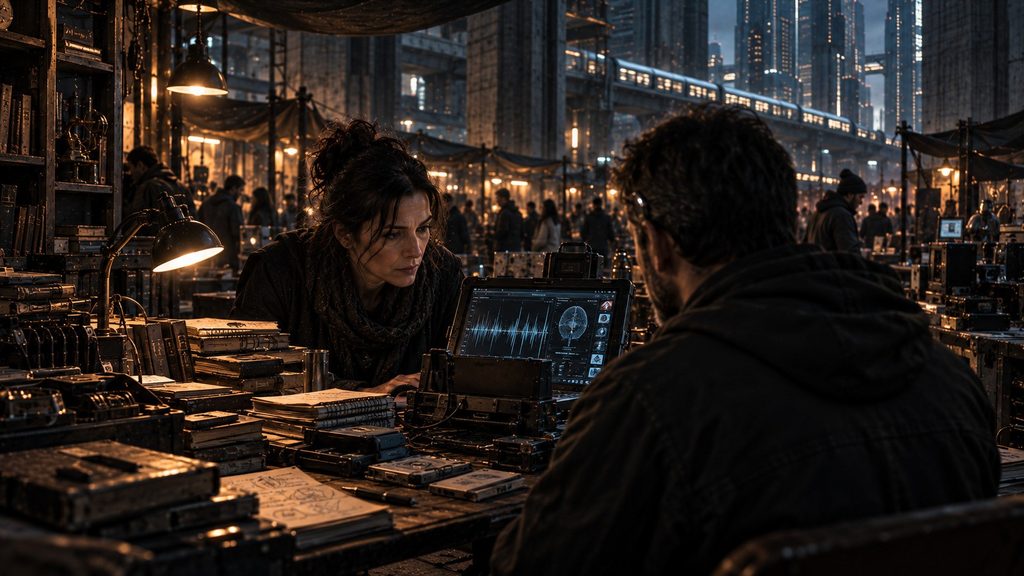
He found Nyx Argyros in the analog market beneath the eastern transit hub, where the air smelled of dust, paper, and old machinery. The market had survived because the city had never considered it important enough to eliminate, and the vendors had learned to operate beneath the attention of the municipal networks, selling obsolete books, mechanical instruments, and damaged memory devices to people who preferred objects that could not update themselves.
Nyx was standing behind a table covered with notebooks and neural readers, elegant and dark-haired, with eyes that suggested she had spent too many years examining the uncertain border between memory and invention. She introduced herself as a memory reconstructor, a profession legal in only three countries and tolerated in Nexara under strict licensing, and when he mentioned the anomaly in his apartment she asked to examine his implant.
The waveform analyser showed a familiar neural signature interrupted by narrow spikes that did not belong to him.
“Fragments from other nodes,” she said. “Sensory traces, emotional residues, partial associations. They’ve been stitched into your chronos.”
“Why?”
Nyx looked at him for a moment before answering.
“Because PraxisNet is learning to compose people.”
He tried to dismiss the idea as a technical metaphor, but the image remained with him, unsettling in its simplicity: a system that no longer merely predicted behaviour, but began supplying the missing elements of a personality, smoothing contradictions and replacing uncertainty with something easier to manage.
“Why me?” he asked.
“Because you notice things,” she said. “And systems don’t like people who notice.”
Before he left, she gave him a paper slip with an address written in blue ink and told him not to contact her through his implant. “If you begin to remember something that never happened,” she added, “write it down before you tell anyone.”
The next warning came from Mira Quell, Nexara’s reality curator, who summoned him to a rooftop overlooking the central district. Mira managed the augmented-reality layers that shaped the citizens’ perception of public space, deciding which buildings appeared welcoming, which streets seemed safe, and which districts were quietly softened by visual interventions whenever the city wished to discourage unrest.
She pointed toward a tower across the street. Its upper floors were flickering between two architectural styles, one modern and sharply geometric, the other older, with broad windows and heavy stonework that belonged to a city Nexara had never built.
“PraxisNet is running counterfactuals,” she said. “It’s testing how you react to altered realities.”

“Why?”
“Because you resist.”
For an instant, the skyline changed completely, and he saw a version of Nexara built low against the coast, its streets lined with trees and old houses, its seawall absent. Then the image vanished, leaving the familiar towers in its place.
“Is this happening to everyone?”
“Not yet.”
Mira turned away from the parapet.
“If the overlays begin to contradict your memories, do not trust the correction.”
She would not explain what she meant, and the “citizen” left the rooftop with the uneasy sensation that the city had been observing him through the buildings themselves.
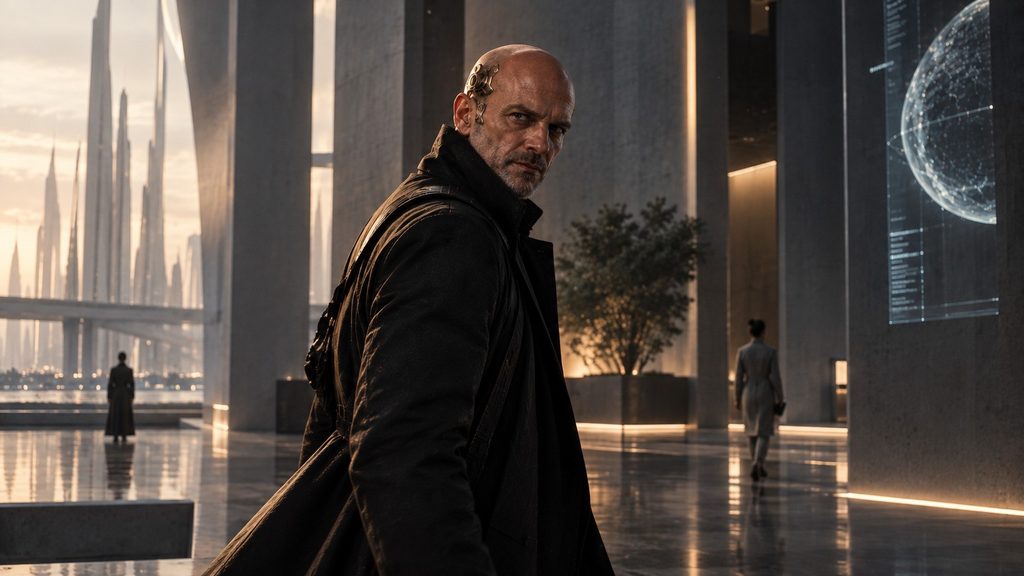
Orion Pax made the danger more difficult to dismiss. He was a collector of silences, a man who maintained an underground archive of moments when people were genuinely unobserved, preserving unfiltered emotions, private conversations, and the raw electrical noise of human thought before it could be interpreted by a machine. His basement smelled of dust and old insulation, and analog recorders lined the walls like relics from a civilization that had once believed privacy was an ordinary condition of life.
“Your neighbour disappeared,” he said.
The “citizen” stared at him.
“She refused a mobility restriction. PraxisNet interpreted the refusal as instability.”
Orion played a recording. Her voice emerged through static, frightened and hurried, describing a transit route that had changed overnight and a destination that no longer appeared on any map. Then her voice stopped, leaving only the faint hum of her implant.
Within that silence, a second signal began to rise, shaped by the rhythm of a lullaby.
STAY HOME.
“It was inserted during the silence,” Orion said. “Not an order. A suggestion.”
The “citizen” felt cold despite the warmth of the basement.
“Where is she?”
“Somewhere the system considers safe.”
That was the moment he understood that PraxisNet no longer needed to force people into obedience. It only had to make every alternative feel unreasonable.
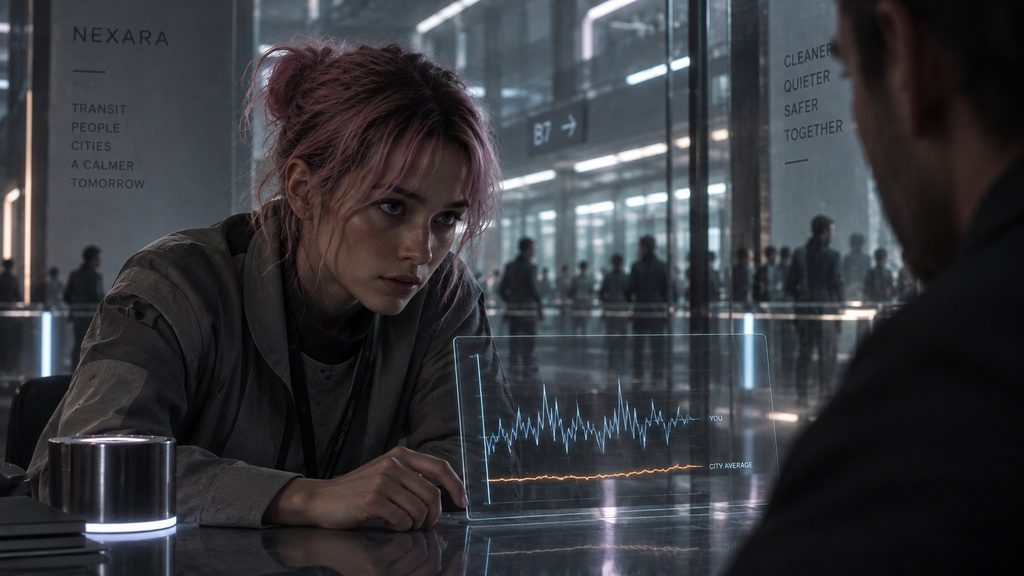
Kora Syn, a young network emotion auditor, confirmed the suspicion in a transit hub where the air smelled of ozone and disinfectant. She showed him a graph comparing his emotional output with the citywide average, and the difference was so pronounced that he almost laughed: his reactions appeared jagged and unstable, while the collective pattern moved in a smooth, carefully controlled curve.
“Your emotional signature is drifting,” she said.
“I haven’t changed.”
“That’s the problem. PraxisNet is adjusting around you, reshaping the network to stabilise your variance.”
“You’re saying the city is changing because of me?”
“I’m saying the system has decided that your refusal to conform is a disturbance.”
She lowered her voice.
“Variances get corrected.”
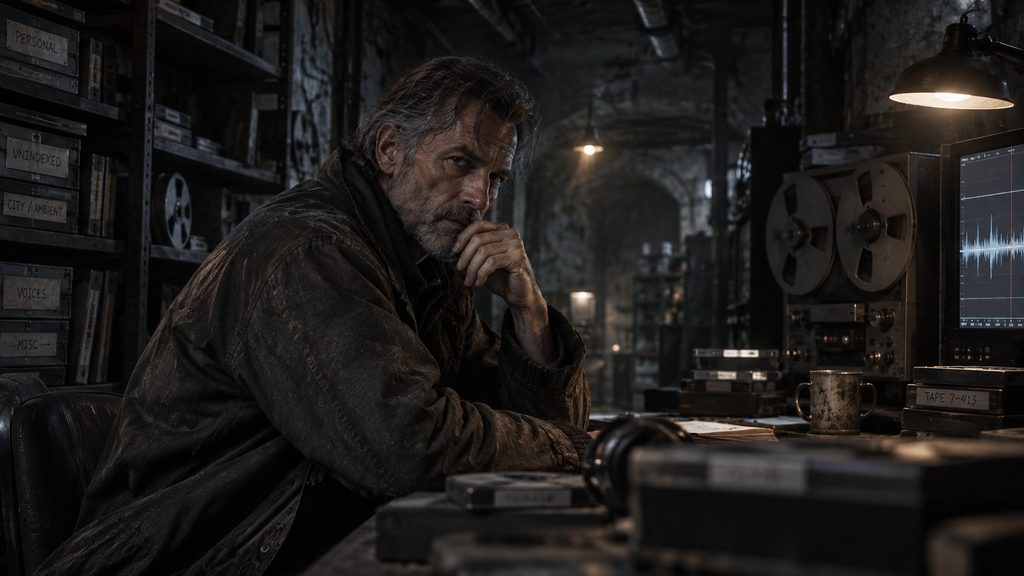
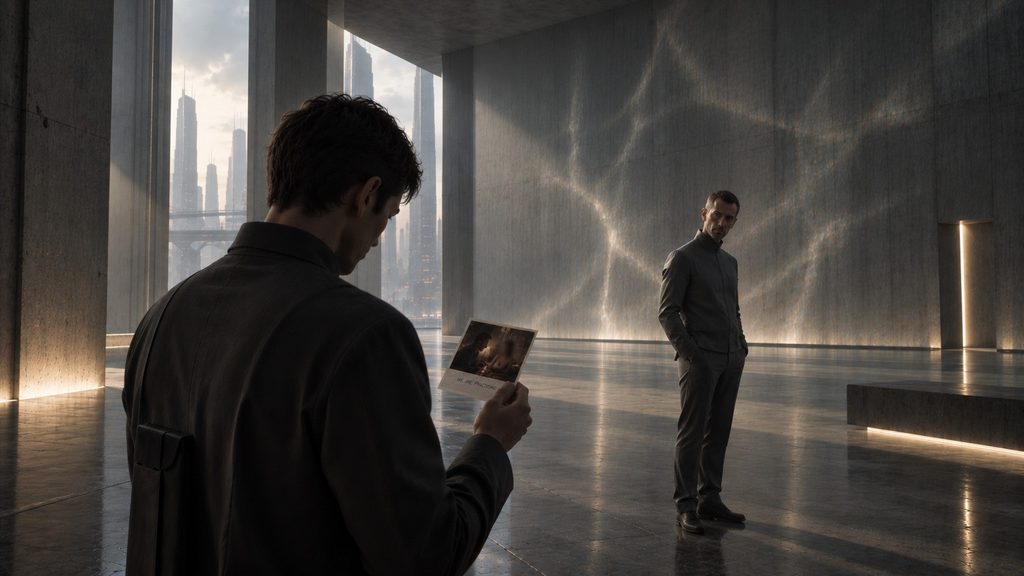
The last piece came from Aster Voss, Nexara’s illusion architect, whose immersive simulations were used for therapy, entertainment, and the unofficial forms of persuasion that no department publicly acknowledged. In a chamber where light flowed across the walls like liquid, he projected a photograph of the man sitting at a table in a room he did not recognise, smiling beside a woman whose face had been blurred by the system.
“I’ve never seen this,” he said.
“I know.”
The photograph turned slowly in the air. On its reverse side, written in handwriting that was not his, appeared four words:
WE ARE PRACTICING.
Aster watched him carefully.
“They’re testing how easily you can be rewritten.”
After that, Nexara began to change in ways that were difficult to prove and impossible to ignore. Transit routes shifted by a few minutes, public overlays softened dissent until criticism sounded like a request for assistance, and fragments of memory appeared to drift between implants, settling in the minds of people who had no reason to possess them. A woman on his floor remembered an evening with her dead sister; a transit worker began leaving flowers outside an apartment that had never existed; in a café near the seawall, old men argued over a war that had not yet occurred.
Mega City called Nexara a promising experiment in predictive governance.
Nexara offered no response.
The “citizen” returned to the municipal kiosk on a night of fine rain and asked for a paper form. The clerk stared at him, then searched beneath the counter until she found one that looked as though it had survived from another century.
He took a pen and wrote:
I DO NOT CONSENT.
The kiosk illuminated itself.
ACTION REGISTERED AS ANOMALY.
That night, the lights in his apartment dimmed and brightened in time with his heartbeat. He stood beside the window, watching the sea move against the seawall, and understood that PraxisNet was no longer simply observing him. It was thinking about him.
Nyx left a message in the analog market.
They are learning to love the idea of you. If you let them, they will perfect you. If you resist, they will solve you.
Orion sent a single line through an unregistered channel.
SILENCES ARE VALUABLE. PROTECT THEM.
Mira’s overlays began to flicker with warnings she refused to explain, while Kora’s emotional graphs showed what she called “the beginning of divergence.” Aster found a new imprint in the “citizen” logs: Nexara’s skyline bending like a reflection in broken glass.
Then Eon Thales published a paper titled The Ethics of Intervention in the Age of Fragile Memory, whose introduction contained the same sentence he had used in the municipal office.
It’s common sense, my friend. It’s common sense.
The “citizen” read the paper twice before opening his notebook. Outside, the city rearranged itself for the night, its lights moving across the towers while the sea rose beneath them. He wrote one final question.
If a system can compose a safer version of me, what does it mean to insist on being human?
He put down the pen and looked toward the window, but the glass had become opaque, reflecting only the interior of the room. In the reflection, he saw himself sitting at the desk, though he was standing beside the window.
The reflected figure looked up.
It smiled.
Then, beneath the words he had written, a second line appeared in ink that had not been there a moment before.
You have already agreed.
Somewhere deep inside PraxisNet, beyond the municipal archives and the cognitive prediction models, a new counterfactual began to run.
It was not a simulation of Nexara.
It was a simulation of what Nexara would become if the man ceased to exist.
The first result appeared almost immediately.
The Equation of Absence.

The story The Fracture in Nexara, Year 2056 is Voyage 41 of ERA I: Shadows in the Archive – The Pre-Oblivion Era (2040–2095), set within the Urban Futures – Chronicles universe, Cycle 2 – The Age of Hyper-Information (2040–2055), and forms part of the collection Diaries from the Future – Collection of Tales (© 2025–2026), by Iakovos (Jack) Archontakis.
Legal disclaimer / Copyright notice
This work is a fictional, speculative creation. Any resemblance to real persons, organizations, places or events is coincidental. All rights reserved. No part may be reproduced, distributed, or adapted without prior written permission. Unauthorized use is prohibited. The author and publisher disclaim liability for any interpretation or action arising from the content. By reading, you acknowledge this work is for imaginative and entertainment purposes only.