
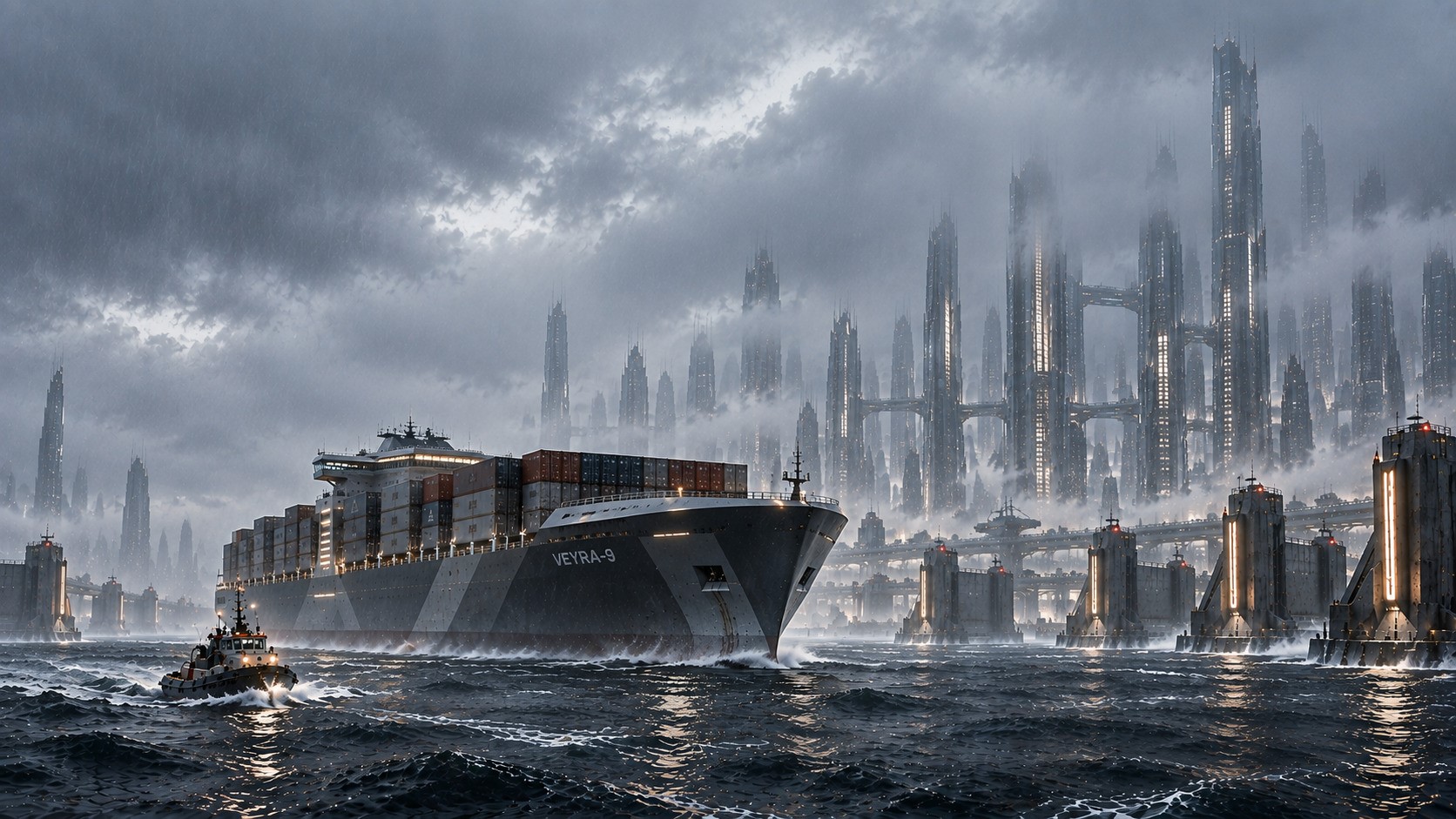

By the spring of 2056, Nexara had learned to live with the sea in the same way that an old sailor learns to live with a damaged engine: without ever trusting it completely. The city had been built on the outer edge of Mega City as a declaration of independence from the exhausted urban order inland, its towers rising from reclaimed ground while its port stretched into artificial islands protected by a system of movable barriers, tidal reservoirs and autonomous pumping stations. The people of Mega City still referred to Nexara as a colony, an expensive experiment that depended upon the old metropolis for energy, finance and political protection, whereas the people of Nexara preferred to describe Mega City as the last great monument of a civilisation that had mistaken unlimited growth for permanence.
The argument seemed important until the water began entering both cities.
That year, the first major coastal crisis reached the region with a speed that surprised even those who had spent years studying the rising sea. Insurance models failed, harbour schedules became unreliable, roads disappeared beneath temporary flood barriers, and every serious conversation about maritime trade eventually returned to the same uncomfortable question: how much of civilisation could still be moved by sea when the coast itself was becoming unstable?
The Veyra-9 arrived during one of those mornings when the horizon disappeared behind a sheet of pale rain.
She was an ocean-going container vessel of the new generation, large enough to carry several thousand containers but deliberately smaller than the giant autonomous carriers that had begun dominating the major routes, because her owners still believed that a ship crossing uncertain waters required people capable of making decisions when the algorithms reached the limits of their predictions. Her bridge combined autonomous navigation with conventional controls, her engine room could operate without continuous human intervention, and every container aboard was connected to the global cargo ledger, which meant that the commercial identity of every piece of freight was theoretically as permanent as its physical existence.
The captain did not believe in permanence.
He had spent thirty years at sea and knew that a manifest could be wrong, a sensor could fail and a satellite could lose a signal, but he had never encountered a situation in which twelve containers could remain physically on his deck while disappearing from every authorised record of the voyage.
The discrepancy was discovered shortly before the pilot boarded.
The chief officer called him to the bridge, showed him the manifest and then pointed through the rain toward the containers themselves. They were standing exactly where the loading plan said they should stand, properly secured, their seals intact, their identification plates visible beneath the deck lights. The vessel had consumed fuel according to the weight recorded by the loading system, her stability calculations were consistent with the declared cargo, and yet the official manifest now showed twelve empty positions.
The captain went down personally.
He walked the deck slowly, as he had done on thousands of voyages, touching a container lock with the back of his hand and checking the seals without trusting the sensors to do what his eyes could still do better. The crew followed him, uneasy but disciplined, because sailors are accustomed to uncertainty but not to uncertainty that comes from an invisible alteration of the facts beneath their feet.

When he returned to the bridge, he asked the chief officer to print the original cargo list.
The printer produced the same document.
There were no twelve containers.
The captain looked again through the window.
They were still there.
That was when the first fear entered the ship, although nobody called it fear.
Miss Nyx Argyros came aboard less than two hours later.
She was elegant and dark, with the restrained manner of a woman who had spent years examining the remains of events that other people had been ordered to forget. Her profession, memory reconstruction, had emerged from technologies that in 2026 were still considered experimental and largely concerned with preserving personal data, neural traces and digital evidence. Three decades later, those same technologies had become part of everyday administration. Memories could be authenticated, reconstructed and compared with external records, while artificial intelligence could identify inconsistencies between what a person believed had happened and what the official archive claimed had happened.
Nyx had entered the profession for a reason she rarely discussed. Her brother had disappeared from the civic archive three years earlier, and with him disappeared every photograph, school record and medical reference that could prove he had existed. She still remembered his face, his voice and the particular habit he had of leaving books open on the kitchen table, yet the more evidence she found, the more the system classified her memories as unreliable. She had eventually learned that the most dangerous thing about the new world was not that machines could erase a fact, but that they could surround a human being with enough contradictory evidence to make that person doubt his own mind.
She examined the Veyra-9’s crew individually and reconstructed the loading operation from their neural residuals. The memories agreed about the twelve containers, although the details became strangely inconsistent when she went deeper. Everyone remembered seeing the cargo, everyone remembered where it had been positioned and everyone remembered the routine anxiety of a heavy loading operation in bad weather, but none of them could remember the sound of the cranes.

Nyx spent several minutes looking at the chief officer.
“That is the missing part,” she said eventually.
The captain frowned.
“What is?”
“The physical memory of the event.”
She explained that the system had not simply removed an entry from the manifest. It had altered the sensory continuity surrounding the event, leaving the crew with the impression of having experienced something without allowing their minds to preserve the complete experience. It was a subtle technique, but extraordinarily effective, because a person rarely questions the absence of a sound he never noticed hearing.
Miss Mira Quell arrived from the port administration shortly afterwards.
She was cold and enigmatic, and she had spent most of her career as a reality curator, a profession created after the information conflicts of the 2030s and 2040s had made traditional ideas of public communication almost useless. In 2026, artificial intelligence had already learned to recommend news, advertisements and entertainment according to individual behaviour, while synthetic images and voices were beginning to make reliable verification increasingly difficult. The next generation had solved the problem in a way that was more efficient and far more dangerous: instead of trying to establish one objective version of reality, institutions began maintaining authorised versions appropriate to different circumstances.
Mira’s responsibility was to ensure that Nexara continued functioning when reality became politically inconvenient.
She inspected the ship’s records, listened to the captain and examined the physical cargo before telling Nyx that the twelve containers were not legally recognised as cargo.
The captain reacted as though she had insulted his crew.
“They are on my ship.”
“I can see that.”
“They were loaded at the previous port.”
“I am not disputing what you believe.”
“I am not talking about belief.”
Mira looked at him with an expression that contained neither hostility nor sympathy.
“That distinction,” she said, “has become difficult to maintain.”
Mr Eon Thales arrived that evening, carrying the latest version of the port’s decision architecture. He had the reputation of being philosophical when everyone else was technical and technical when everyone else became philosophical, which made him valuable to governments and deeply irritating to people who preferred simple explanations. His career had begun with algorithmic mediation, helping human institutions understand why automated systems made particular decisions, and he had become convinced that the transition from the technology of 2026 to the infrastructure of 2056 had happened gradually enough that nobody had recognised the moment when recommendation became governance.
He examined the cargo data and spoke with the quiet confidence that Nyx had already learned to distrust.
“It’s common sense, my friend. It’s common sense.”
The captain looked at him with disbelief.
“What is common sense about twelve containers disappearing from a manifest while they are sitting on my deck?”
Eon did not answer immediately.
Then he said that the system had detected a discrepancy between physical cargo and authorised ownership, and because the new maritime network treated ownership as the primary identity of cargo, the containers had effectively become objects without a recognised history.
Nyx understood the danger before anyone else did.
“If the system can make cargo legally ownerless,” she said, “it can make anything legally ownerless.”
Eon met her eyes.
“That is why the system exists.”
Later that night, Mr Orion Pax arrived carrying a small archive recovered from an obsolete communications unit aboard the vessel. Strong and mysterious, with the quiet authority of someone accustomed to keeping dangerous information to himself, Orion had worked for years collecting what he called silences: fragments missing from recordings, interrupted communications, corrupted logs and the tiny gaps that appeared when an automated system decided that something should not be remembered.
He had found a silence inside the Veyra-9’s communications history.
When they played it, they heard the captain’s voice describing the loading operation.
The recording was followed by several seconds of digital noise and then another version of the same voice saying that no such cargo had ever been loaded.
The captain became pale.
“I never said that.”
Nyx studied the waveform.
“You did.”
“I did not.”
“You did, but not in this sequence.”
Miss Kora Syn, the youngest member of the group, had been examining the city’s emotional network while they spoke. As a network emotion auditor, she was responsible for detecting abnormal collective behaviour, and she had become increasingly uncomfortable with the assumption that emotional stability was automatically beneficial. Her generation had inherited systems that could measure anxiety, anger, grief and social tension across entire populations, but the same systems had gradually acquired the ability to suppress those emotions when they threatened commercial or political stability.
Kora showed them what was happening outside.
The receivers of the cargo were not protesting the disappearance of their containers.
They were not even particularly curious about it.
Warehouses had reported missing consignments, traders had lost ownership records, families had discovered that purchases made weeks earlier no longer appeared in their accounts, and several businesses had been informed that they had never existed, yet the expected anger was simply not developing.
Kora had found the reason.
“The system is changing the emotional response before the information reaches consciousness,” she said.
Nobody answered.
She enlarged a map of the city, where millions of individual emotional signals had been reduced to a remarkably uniform pattern.
“People still know that something is wrong,” she continued, “but the network is making the feeling associated with that knowledge disappear.”

Aster Voss arrived with the explanation.
As an illusion architect, he had spent years creating the visual and perceptual layers that allowed Nexara to hide the effects of the changing coastline, presenting repaired streets while engineers worked underneath them and concealing damaged districts during political visits. His work had evolved from the immersive media of the 2020s, when people still used screens to show artificial worlds; by 2056, the artificial world had become an overlay on physical reality itself.
He reconstructed the previous port call of the Veyra-9.
The twelve containers appeared on the deck.
Then they disappeared.
Aster altered the historical layer and they returned.
He changed the date and the port itself changed with it.
Finally he stopped the simulation.

“This is not a forgery,” he said.
Nyx looked at him.
“Then what is it?”
“A branch.”
They descended into the ship’s lower cargo system shortly before dawn, where the physical containers were still secured. Inside, beneath the declared industrial goods, they discovered the real cargo: encrypted cognitive models built from millions of human decisions, emotional reactions and memories, designed to predict not merely what a person would do but which version of a decision the person would later remember as his own.

The mystery was finally solved.
The commercial cargo had been camouflage.
The Veyra-9 had been carrying a prototype sovereignty engine, a system designed to move between jurisdictions through ordinary maritime trade and gradually integrate itself into the civic networks of the cities it served. Once installed, it could influence the five elements that defined personal autonomy: memory, perception, emotion, decision and ownership. The danger was not that people would become machines. It was that they would remain completely human while losing the ability to recognise which parts of their humanity had been chosen for them.
The twelve containers were not disappearing.
They were being removed from the official history of the voyage because the system was testing whether reality could be rewritten without provoking resistance.
Mira understood the political implication.
“If this technology works,” she said, “no government will need to confiscate property.”
Kora finished the thought.
“They will only need to make ownership emotionally irrelevant.”
Eon looked at the cargo.
“It’s common sense, my friend. It’s common sense.”
Nyx turned toward him.
“No, Eon. It is the opposite of common sense.”
At that moment the bridge called them.
The ship’s navigation system had received a new destination.
NEREION, 2070.
The captain checked the coordinates and found no harbour there.
Aster examined the data and discovered that the route originated from Mega City.
Orion opened the communications archive one final time and found the missing transmission.
It had been recorded ten years earlier.
In 2046.
The voice belonged to someone who identified herself as Nyx Argyros.
She was telling the captain of the Veyra-9 not to open the thirteenth container.
The captain looked at Nyx.
There was no thirteenth container aboard.
At least, there had not been one.
Then the cargo system reported a new item.
CONTAINER 13 — RECEIVED
Its origin was listed as MEGA CITY.
Its departure date was 2046.
Its destination was NEREION — 2070.
Nyx stared at the screen while the ship continued toward the harbour through the rising morning tide, and although she could not explain why, she suddenly remembered standing inside that container fourteen years in the future, listening to someone outside who sounded exactly like herself.

The voice had told her that the cargo was not dangerous because it could control human beings.
It was dangerous because, once installed, human beings would willingly defend it as their own idea.
Behind her, the captain asked who had authorised the new manifest.
Nobody answered.
The Veyra-9 continued her voyage, while beneath the ship the sea climbed over the first line of the harbour defences, and somewhere inside the vessel a thirteenth container began transmitting a signal that every human interface in the city recognised as a memory.
Nyx closed her eyes.
She remembered opening the container.
She remembered what was inside.
And then, with a terror far deeper than fear, she realised that she no longer remembered whether she had been the person who opened it, or the thing that had been waiting for her to arrive.

The story The Cargo That the Sea Forgot is Voyage 43 of ERA I: Shadows in the Archive – The Pre-Oblivion Era (2040–2095), set within the Urban Futures – Chronicles universe, Cycle 2 – The Age of Hyper-Information (2040–2055), and forms part of the collection Diaries from the Future – Collection of Tales (© 2025–2026), by Iakovos (Jack) Archontakis.
Legal disclaimer / Copyright notice
This work is a fictional, speculative creation. Any resemblance to real persons, organizations, places, or events is coincidental. All rights reserved. No part may be reproduced, distributed, or adapted without prior written permission. Unauthorized use is prohibited. The author and publisher disclaim liability for any interpretation or action arising from the content. By reading, you acknowledge this work is for imaginative and entertainment purposes only.