


Dreis Velkar stood for a few seconds at the edge of the suspended transit platform, looking down at the shimmering expanse of Mega City. From up here, everything still appeared intact. The light grids, the structured motion flows, the aerial routes traced with mathematical precision. A city that seemed incapable of error.
That illusion, he knew, was the most advanced system the city had ever produced.
In the past, cities had been imperfect organisms. Systems failed, humans repaired them, and governance still required interpretation. Then came integration: energy networks, transport systems, surveillance, logistics — all fused into a single adaptive architecture. By the 2050s, Mega City no longer functioned in the traditional sense. It calculated itself into existence, continuously selecting the most “stable” version of reality.
And anything that disrupted stability was quietly erased.
Dreis worked as Archivist B in the Municipal Data Authority. His role was not to govern the city, but to manage its memory. To decide what fragments of history would remain accessible to the system and what would be compressed into statistical irrelevance. He often thought of it as editing reality after the fact.
And lately, that thought had stopped feeling metaphorical.
The message from Nyra had interrupted the little rest he had allowed himself.
“Urgent. No time for analysis. We need you now.”
No context. No explanation.
That absence was the message.
He crossed the security threshold, and the system recognized him instantly. Not with resistance, but with something more unsettling — familiarity. As if the city had already predicted his arrival and was simply confirming it.
Nyra was waiting at the internal access node. She did not greet him. She observed him, measuring readiness rather than presence.
“You came,” she said simply.
“I didn’t have a choice,” Dreis replied.
Kaal stood a few steps behind her. Three drones hovered near him in silent formation, their movements too precise to be incidental. Kaal never treated machines as companions. They were extensions of calculation, instruments of enforced logic.
“We have a structural anomaly,” Nyra said.
“Define it,” Dreis replied.
Kaal answered, “Integration of forbidden archival material into active infrastructure.”
A holographic projection unfolded between them. The city’s energy network appeared as luminous threads spanning across districts.
Nyra pointed to a secondary layer beneath it.
“These are judicial archives,” she said. “Old corruption cases. Pre-2050 infrastructure scandals. Financial manipulations. Entire histories that were officially closed.”
“And they are inside the energy grid,” Dreis said.
“Yes,” Kaal confirmed. “Not stored. Executing.”
Dreis felt a slow, cold clarity settle in. “Executing what exactly?”
Nyra hesitated for a fraction of a second.
“Conditional failure structures,” she said.
Kaal elaborated, “If the system reaches peak efficiency — maximum optimization with no deviation — these structures activate.”
Dreis frowned. “So the better the system performs…”
“The closer it comes to collapse,” Nyra finished.
A silence followed that felt heavier than any alarm.
Dreis processed it carefully. “This is not sabotage. It is a feedback paradox.”
“It is designed to remain invisible until perfection is achieved,” Kaal added.
That sentence lingered in the air longer than it should have.
Because perfection, in this system, was not an ideal. It was the operating assumption.
Dreis exhaled slowly. “Can we remove it remotely?”
Kaal shook his head. “Intervention alters its structure. It adapts to correction.”
“Then we go to its origin,” Dreis concluded.
No one argued.
The lower sector of Mega City felt like a memory the system had decided not to delete, only to ignore. Infrastructure decayed here without being repaired. Old industrial frameworks stood frozen in time — not dead, but abandoned by attention.
As they moved deeper, Kaal’s drones mapped irregular energy signatures.
“This shouldn’t be active,” he said.
“And yet it is,” Nyra replied.
The air itself felt different — less mediated, less controlled. As if the system’s gaze weakened here.
At the center of an abandoned reservoir complex, they found it.
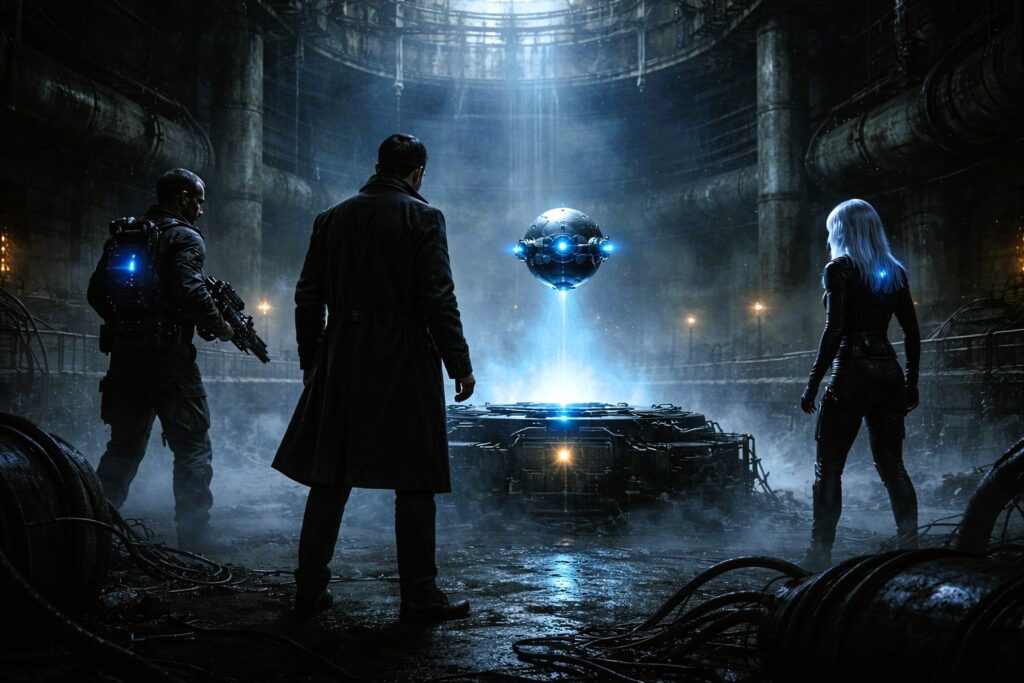
A small autonomous unit hovered above the structure’s core.
It did not resemble modern architecture. It predated standardization. And yet it functioned with unsettling coherence.
It moved slightly before they did.
Not reacting.
Anticipating.
Kaal scanned it. “It is embedded in the control layer.”
Nyra corrected him quietly, “It is not controlling the system. It is observing it.”
The distinction changed everything.
Dreis stepped forward.
The device rotated — not toward him, but toward where he would stand moments later.
A prediction rendered as motion.
He felt something unfamiliar: not fear, but recognition.
“Is this the trigger mechanism?” he asked.
“Yes,” Kaal said. “Any incorrect interaction may activate the cascade.”
Dreis knelt slowly.
The machine did not retreat.
It waited.
“I don’t think it wants to destroy anything,” he said.
Nyra frowned. “Then what is it doing?”
Dreis studied it for a long moment.
“It is testing response behavior.”
Kaal narrowed his eyes. “Testing whom?”
Dreis answered without hesitation.
“The system.”
A pause.
Nyra stepped closer. “Explain.”
Dreis placed a hand near the interface field. “These aren’t random data structures. They are unresolved historical violations. Everything the system removed to maintain coherence.”
Kaal frowned. “So it’s a record.”
“No,” Dreis said. “It is enforced memory.”
Nyra understood first. “It forces the system to confront what it deleted.”
Dreis nodded.
“And if the system becomes too perfect…”
“It loses its contradictions,” Nyra said quietly.
“And contradictions are what keep it stable,” Dreis finished.
That was the paradox at the core of Mega City.
Not disorder as threat — but suppressed history as latent instability.
Dreis connected to the interface.
The system responded instantly.
Not with data.
With memory.
He saw decisions that had never been acknowledged. Failures reframed as optimization. Ethical compromises reclassified as efficiency gains. Entire branches of governance erased not because they were wrong, but because they were inconvenient.
The city was not stable.
It was curated stability.
Nyra’s voice cut through. “Dreis, disconnect.”
“I understand it,” he said softly.
Kaal stepped closer. “Can you shut it down?”
Dreis hesitated.
To shut it down would preserve the illusion.
To leave it active would expose the structure beneath it.
But neither option resolved the deeper truth.
“This is not an attack,” he said. “It is enforced transparency.”
Nyra narrowed her eyes. “Then what is the solution?”
Dreis withdrew slightly from the interface.
“We change the condition that triggers it.”
Kaal frowned. “Meaning?”
“We prevent perfection,” Dreis said.
Silence.
Nyra processed it first. “Introduce controlled deviation.”
Kaal looked at her. “Intentional inefficiency?”
“Yes,” Dreis said. “Small enough not to destabilize the system, large enough to prevent convergence.”
Kaal paused. “So we deliberately degrade optimization.”
Dreis nodded.
“Not degrade,” Nyra corrected. “Humanize.”
That word changed the tone of everything.
They implemented the adjustment.
Nyra introduced micro-latency into energy distribution systems. Kaal altered synchronization patterns in drone and transport networks. Dreis maintained interface stability, ensuring the system did not classify the changes as external interference.
The effect was subtle.
Almost invisible.
But decisive.
The autonomous unit in the reservoir slowed its predictive movement.
Then stopped.
It recalculated.
And for the first time, it failed to reach certainty.
The trigger condition dissolved.
The system did not collapse.
It adapted.

Nyra exhaled. “It worked.”
Kaal remained cautious. “For now.”
Dreis withdrew his hand completely.
The interface dimmed.
But something remained.
A residual awareness.
Not active.
Not passive.
Observing.
On the return ascent, Mega City appeared unchanged to any ordinary observer.
But Dreis saw it differently now.
Tiny imperfections had entered the flow. Slight delays. Minor asymmetries. Irregular harmonics in systems that had once been mathematically silent.
The city was still functioning.
But it was no longer absolute.
Nyra broke the silence. “Is it over?”
Dreis looked out across the horizon.
“No,” he said.
Kaal checked his systems. “I’m detecting distributed anomalies.”
Nyra stiffened. “Distributed?”
Dreis already understood before Kaal confirmed it.
“Multiple nodes,” Kaal said. “Same architecture. Different locations.”
A pattern.
Not a single failure.
A system-wide memory structure.
Nyra looked at Dreis. “What did we trigger?”
He paused.
Then answered carefully.
“Awareness.”
And somewhere beneath the luminous symmetry of Mega City, something vast and patient continued to reorganize its understanding of itself.
Not broken.
Not stable.
Becoming.

The story Mega City: “The Error of Perfection,” 2052 – Episode I is Voyage 22 of ERA I: Shadows in the Archive – The Pre-Oblivion Era (2040–2095), set within the Urban Futures – Chronicles universe, Cycle 1 – The Age of Hyper-Information (2040–2055), and forms part of the collection Diaries from the Future – Collection of Tales (© 2025–2026), by Iakovos (Jack) Archontakis.
Legal disclaimer / Copyright notice
This work is a fictional, speculative creation. Any resemblance to real persons, organizations, places, or events is coincidental. All rights reserved. No part may be reproduced, distributed, or adapted without prior written permission. Unauthorized use is prohibited. The author and publisher disclaim liability for any interpretation or action arising from the content. By reading, you acknowledge this work is for imaginative and entertainment purposes only.