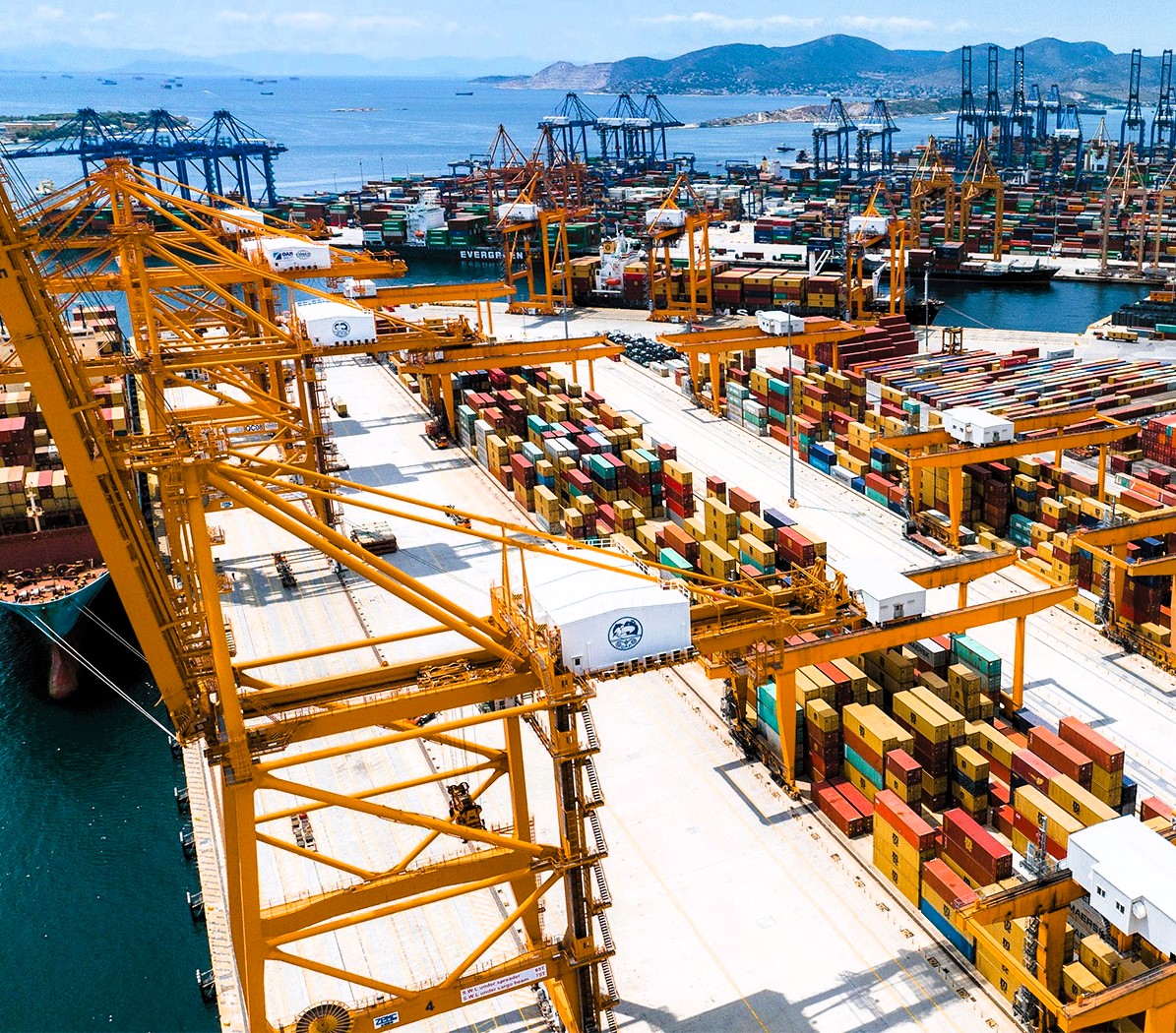

Angelos Karakostas, Deputy CEO of Piraeus Port Authority (PPA), took the stage at the Delphi Economic Forum XI (April 22–25, 2026) and opened with what he called the best financial results in the port’s history. Consolidated revenues for 2025 reached €250.8 million, up 8.6% year-on-year, and EBITDA rose 2.2% to €132.3 million. He then went further, disclosing that preliminary indications for Q1 2026 pointed to positive results. Those figures had not been officially announced at the time of the forum. Previewing unreleased results at a public event is a choice, and it shapes the narrative before the numbers arrive.
The disaggregated 2025 figures introduce structural caveats the Delphi presentation did not emphasise. Net profit after tax fell 1.5% to €86.2 million, and the EBITDA margin contracted from 56.08% to 52.75%. More tellingly, Piraeus Container Terminal (PCT), operated by COSCO Shipping Ports at Piers II and III, handled 3.98 million TEU in 2025, a 6% decline year-on-year. Container Management observed that PPA attributed this to weakening Mediterranean transshipment demand, but noted that the explanation sits uncomfortably alongside Tanger Med’s simultaneous growth. And that whether the Port of Piraeus is experiencing a market contraction or a competitive share loss is a distinction PPA’s results do not resolve. Total container throughput across all three piers reached 4.64 million TEU, down 3.15%, partially offset by Pier 1’s all-time high of 664,581 TEU, up 17.9%, and by Piers II and III recording a 10.8% revenue increase despite lower volume.
The record, in short, belongs to cruise, Pier I, and revenue resilience at Piers II and III despite volume weakness. Ferry revenues, by contrast, fell 28.4%, following a government-mandated reduction in port fees introduced in May 2025 to protect ticket prices. The cruise sector’s 24.8% revenue surge is genuinely impressive. But the Port of Piraeus’s strategic weight in global trade is determined by the COSCO-operated terminals. And by that measure, 2025 was the second consecutive year of decline. PCT had already fallen 7.9% in 2024, to 4.22 million TEU, after handling 4.58 million TEU in 2023.
The Suez illusion
Karakostas’s recovery thesis is straightforward: when the Suez Canal reopens, at least 500,000 additional TEU flow back to Piraeus. The logic has surface appeal and a geographic basis. Two conditions must hold for it to materialise, and neither is currently settled.
First, Suez must normalise. The Houthis suspended attacks on November 11, 2025, yet by the first week of 2026, canal traffic remained 60% below the corresponding week in 2023, with container transits running 86% below pre-crisis levels in Q4 2025. Some carriers began cautious trial runs — Maersk’s Gemini Cooperation rerouted the ME11 service through the Red Sea in mid-February 2026. Then, in March 2026, renewed security concerns in the region led carriers, including members of the Gemini Cooperation, to reverse those decisions and reinstate Cape of Good Hope diversions. The share of east-to-west container shipments transiting Suez now stands at 18.7%, compared to roughly 80% before the crisis began. The recovery thesis is not wrong. It is simply not actionable.
Second, even a full Suez reopening will not reverse two years of structural network reconfiguration overnight. Industry analysts warn of a likely congestion spike as Cape-routed and Suez-routed vessels converge simultaneously at European ports, followed by rate compression as roughly 6% of global fleet capacity re-enters an already oversupplied market. The reopening will benefit the Port of Piraeus, but the timeline remains hostage to a conflict that now involves Iran, not merely Yemen — and on that, Karakostas, to his credit, acknowledged he had no useful commentary.
Africa is no longer a detour
This is the argument Karakostas did not make, and it most directly undermines the Suez recovery thesis. By March 2026, major carriers, including members of the Gemini Cooperation, had reinstated Cape of Good Hope diversions, reversing tentative returns to the Suez Canal. Cape routing remained structurally elevated while Suez traffic stayed well below pre-crisis levels — pointing not to a temporary disruption but to an ongoing redistribution of global shipping flows. Governments and private operators across the African corridor have not waited for the outcome. They have responded with capital, and they have not stopped.
South Africa’s Transnet launched a R3.4 billion equipment programme at Durban: 20 straddle carriers, 9 RTG cranes and 4 ship-to-shore cranes, delivered between December 2024 and May 2025. In December 2025, South Africa completed its first port privatisation, awarding ICTSI a 25-year concession for Durban Container Terminal Pier 2 at approximately $647 million, expanding capacity from 2 million to 2.8 million TEU per year. MSC secured a Train Operating Company licence in South Africa, integrating its maritime services at Durban and Cape Town with six strategic inland rail corridors. SADC endorsed its first regional port development and integration policy framework in 2025, formally establishing the Cape route as a permanent supply chain option.
East Africa mirrors this pattern. Transshipment through Mombasa rose 132.9% in 2024, with the KPA recording total cargo of 41.1 million tonnes, up 14%. Tanzania’s Dar es Salaam posted 27.7 million tonnes, up 15%, with DP World cutting container dwell times from as many as 30 days to near-zero. China finalised a $1.4 billion deal to rehabilitate the Tanzania–Zambia railway on a 30-year concession, repositioning Dar as the gateway of choice for Zambia and the DRC interior. Kenya’s Lamu Port processed 74 vessels in the first two and a half months of 2026 alone. These are not traffic spikes. They are 25-year concession agreements, $647 million privatisation deals and railway rehabilitation contracts. All will still be in force long after any Suez reopening. The infrastructure that absorbed the cargo which left Piraeus was built, in large part, with the revenue that left Piraeus.
The competitor nobody named
Karakostas was asked about competition. He acknowledged Valencia, noted the Italian ports and expressed confidence that the Port of Piraeus would reclaim its European ranking once Suez normalises. He did not once mention Tanger Med.
In 2025, Tanger Med processed 11,106,164 TEU across its four container terminals, an 8.4% increase over 2024’s 10.24 million TEU , supported by the commissioning of the TC4 terminal extension operated by APM Terminals. The port received 1,319 mega-vessels exceeding 290 metres in 2025, up 8.4%, and has operated on 100% green energy since the start of that year. Since 2015, Tanger Med’s throughput has grown 245%.
Tanger Med’s 2025 volume is 2.4 times that of the Port of Piraeus and grows at roughly three times the pace. Piraeus holds a genuine advantage in deep-water berth capacity (18.5-19.5 metres) and eastern Mediterranean positioning, and those attributes are real, as Karakostas correctly pointed out. Yet Tanger Med and Piraeus increasingly compete for the same mega-vessel calls and the same transshipment cargo pools on the Asia–Europe corridor. Treating the Moroccan port as simply another name on a competitor list, or leaving it unmentioned entirely, reflects the limits of what a corporate executive can comfortably say at a public forum. It does not reflect the current Mediterranean port hierarchy.
The question nobody asked at Delphi
COSCO Shipping owns 67% of the Port of Piraeus. In January 2025, the U.S. Department of Defense added COSCO to its list of companies considered to cooperate with the Chinese military. The designation carries no automatic sanctions, but Washington does not compile such lists for administrative tidiness. In November 2025, the U.S. Ambassador to Greece, Kimberly Guilfoyle, publicly suggested during a TV appearance on ANT1 that China could be encouraged to divest parts of its stake, calling COSCO’s control of the port “unfortunate.” The Chinese Embassy in Athens responded within days, accusing her of “malicious slander of normal Sino-Greek commercial cooperation.” The U.S. has since pledged investment in the port of Elefsina, 20 kilometres northwest of Piraeus, a move widely interpreted as deliberate strategic counterbalancing. Two global powers are now positioning themselves in the same Attic gulf, a development that received no scrutiny at Delphi.
Karakostas mentioned, almost in passing, that “the parent company adjusts routes to support us more.” Without the reassuring framing, that sentence describes a port whose transshipment volumes depend on routing decisions made in Beijing by a state-owned enterprise the Pentagon has flagged. Reports from April 2025 indicate that COSCO resisted Greek government pressure to accelerate infrastructure upgrades, with the tourism minister stating the need for direct investment “without delay.” A December 2025 academic study published by Tandfonline examined COSCO’s contrasting behaviour in Hamburg and Piraeus, arguing against a simplistic geopolitical framing while acknowledging that the interests of multiple actors, including Beijing, Athens, and Brussels, do not align. The study is careful. The underlying tension is not.
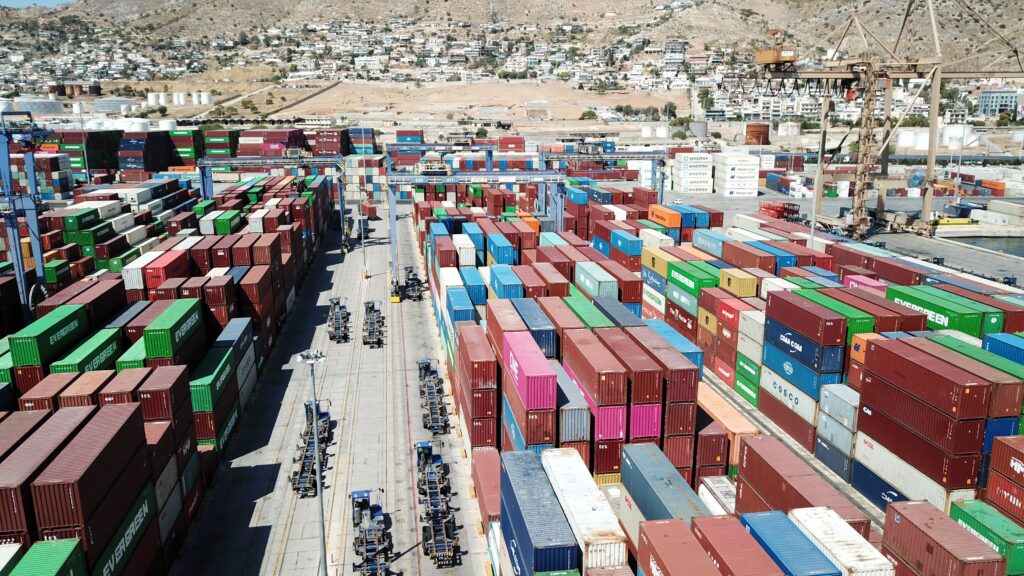 © Greece’s Independent Authority for Public Revenue / EPPO
Eight years without a protocol
While Karakostas spoke at Delphi about investment programmes and digital transformation, a parallel story was unfolding in the pages of Kathimerini — one that his presentation did not address and that no one in the room thought to raise.
In June 2025, the European Public Prosecutor’s Office (EPPO) conducted a coordinated raid across Greece, Spain, France and Bulgaria, targeting criminal networks that had been using the Port of Piraeus as the primary EU entry point for fraudulently imported Chinese goods. The operation, codenamed Calypso, resulted in the seizure of 2,435 shipping containers at Piraeus — one of the largest seizure of containers in EU history — primarily filled with e-bikes, textiles and footwear. The fraud mechanism was simple and systematic: goods were massively undervalued or misclassified at customs, with importers declaring as few as 10 to 15 items per container when the actual count ran to hundreds. A network of customs brokers, shell companies and enablers operating across 14 countries managed the full circuit, from importation through distribution to money laundering back to China.
The EPPO determined that the scheme had been running for at least eight years, generating estimated losses of approximately €350 million in customs duties and €450 million in VAT. Two customs officers at the Port of Piraeus were among those charged, according to investigators. As of late April 2026, according to Kathimerini, 1,750 containers remain frozen in legal proceedings, with only 250 of a priority batch of 500 having completed inspection. The practical consequence is a dead weight on the port’s operational flow — cargo immobilised, yard space occupied, importers in limbo — that appears nowhere in the FY25 financial presentation.
The detail that demands attention is not the scale of the fraud. It is the timeline of the response. Greece’s centralised Customs Audit Centre, the independent unit that now reviews container clearance documents rather than leaving that responsibility to local port staff, was planned in February 2025 and began operating in August 2025 — after the EPPO raid, not before it. For eight years of documented fraud at a COSCO-majority-controlled port, no such protocol existed. The European Public Prosecutor’s Office created the conditions for its introduction. Customs revenue at Piraeus subsequently rose 11%, reaching €420 million in 2025, according to government data. That improvement is real. Its precondition — the absence of adequate oversight for nearly a decade — is the rather more uncomfortable fact.
Sovereignty by concession
The investment programme at Piraeus is credible, the deep-water berth advantage is genuine, and the hinterland connections to the Balkans and Central Europe carry real strategic value. Yet a port that posted a 6% decline in COSCO-terminal throughput for the second consecutive year, operates under a shareholder the Pentagon has flagged, bases its recovery narrative on a geopolitical settlement that now extends to Iran, and whose deputy CEO previewed unreleased quarterly results at a public forum two weeks before their official release — that port deserves scrutiny proportional to its ambitions.
The next decade may well surpass this one, as Karakostas predicted. However, the conditions that determine whether it does lie in Washington, Beijing, Tehran and Sanaa, not in Piraeus. On that question, the Port of Piraeus has very little room to manoeuvre, and so far, nobody has thought to press the point.
image sources
- DCIM\100MEDIA\DJI_0027.JPG: Greece’s Independent Authority for Public Revenue / EPPO