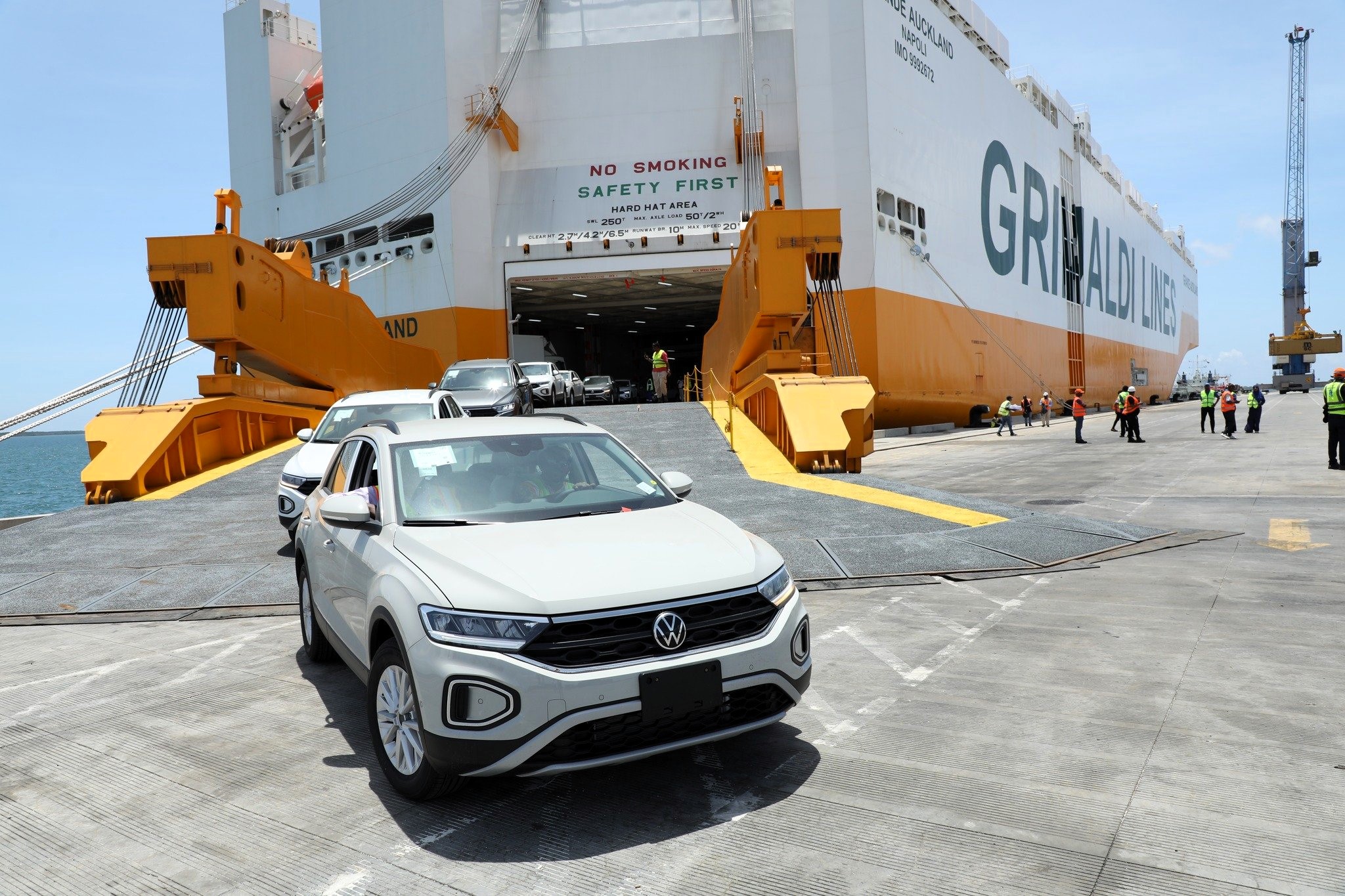

In early March, the MV Grande Auckland, a 9,000-capacity pure car carrier, called at Lamu in northern Kenya and offloaded 469 vehicles originally booked for Jebel Ali in the UAE. The image captures the moment with unusual precision. A consignment meant for the Gulf instead landed on a Kenyan quay that the Kenya Ports Authority had spent four years struggling to fill. In the first quarter of 2025, Lamu received exactly two container ships. By the first ten weeks of 2026, it had received 74.
This looks like an African ascent. It is not, or at least not yet. The same crisis that fills Lamu drains Suez and squeezes Djibouti. The Iran war does not produce one African winner; it accelerates a maritime reordering that began in late 2023, and it divides the continent into three categories. Some African ports gain cargo. Others sell services. A third group, mostly inland or import-dependent, loses flows, revenues or security. What matters is not the surge but what survives once the straits reopen.
A reordering that did not start in 2026
The Cape of Good Hope detour is a returning condition rather than a new one. It started in late 2023 with Houthi attacks on Red Sea shipping, eased after the bilateral Houthi-U.S. ceasefire of May 2025, and resumed on 28 February 2026 with the joint U.S.-Israeli strikes on Iran. Within forty-eight hours, Maersk, CMA CGM and Hapag-Lloyd had suspended Bab el-Mandeb transits and rerouted around southern Africa.
That second activation is what gave the East African coast its present relevance. As the Kenya Ports Authority told the regional press, “conflicts come with both negative and positive impacts,” a phrase that contains rather more economic theory than its author likely intended. East Africa has now absorbed two consecutive global shipping crises in just over two years.
The double absorption matters analytically because the two straits do different things. A Hormuz crisis isolates Gulf transhipment hubs. A Bab el-Mandeb crisis isolates the Suez route. When both go simultaneously, the eastern African coast is no longer an alternative path but the only available rim. The Cape detour ceases to be a workaround and becomes the route itself.
The 2026 numbers at Lamu and Mombasa are therefore not a sudden spike but the second wave of a two-year process. Their duration depends on whether either strait reopens, not whether one does.
The first Africa: ports that gain cargo
The leading cases of African ports gaining cargo sit on the Kenyan coast, not uniformly across East Africa. According to the Shippers Council of Eastern Africa, Mombasa recorded roughly 15 to 20 more vessels in its 14-day schedule than Dar es Salaam, which posted only six. The Tanzanian port has been held back by what regional analysts describe as cargo-handling problems, while Mombasa and Lamu have absorbed the diversion.
In a single week in March, more than 4,000 vehicles bound for the UAE were offloaded in the two Kenyan ports, with another 10,000 expected in the days that followed.
Mombasa’s annual cargo throughput hit a record 45.45 million tonnes in 2025, marking a 10.9 percent year-on-year increase. Lamu, commissioned in 2021 with three of thirty-two planned berths in operation, has gone from running well under capacity to handling roughly a third of its lifetime ship calls in just the first ten weeks of 2026.
This is not endogenous growth. It is reallocation by geographic constraint. With the Strait of Hormuz effectively closed, the Gulf transhipment hubs of Jebel Ali and Khor Fakkan in the UAE, which routinely linked Asia, Europe and Africa, find themselves on the wrong side of the chokepoint. The closer functioning ports on the western Indian Ocean rim become natural substitutes, not victorious competitors. Vessels that once turned north now keep going south, and Kenyan quays catch
Lamu deserves attention. Mombasa is a mature hub absorbing additional cargo it would have wanted anyway; Lamu, by contrast, is an emerging port for which the war has supplied something close to a survival mandate. The constraint here is one of scale rather than competence. Lamu, with three operational berths out of thirty-two planned, is by definition working far below the capacity its designers intended. The opportunity, in other words, presses against infrastructure built for a different scenario. Whether African ports in this category convert flow into permanent position depends on operational capacity and inland connectivity. The Tanzanian case is a warning: a port that already has the geography can still lose the moment if it cannot turn the cargo around fast enough.
The second Africa: ports that sell services
The southern coast offers a different model. Durban, Cape Town and Ngqura in South Africa, Walvis Bay in Namibia, Maputo in Mozambique and Port Louis in Mauritius are not absorbing diverted boxes; they are servicing the diversion itself. The mechanism is straightforward. A vessel routed around the Cape is on a longer journey, not a different one, and the southern African coast happens to sit at the geographic midpoint. These African ports therefore monetise distance, not destination. Bunker fuel, repairs, crew changes and provisioning generate revenue precisely because the journey has been forcibly extended; their gain is, in effect, a tax on global shipping’s detour.
A second tier of South African gain remains invisible on a port manifest. Geopolitical risk has driven safe-haven demand into gold and platinum group metals, where South Africa holds the largest known reserves on the planet. Pretoria collects a premium that Iran’s ayatollahs help underwrite without quite meaning to. The Daily Maverick has noted, with characteristic understatement, that any durable ceasefire would cost Cape Town much of this windfall as ships return to Suez.
The structural problem in this zone, as the Mail & Guardian has argued, is organisational rather than commercial. Durban, Walvis Bay and Maputo could function as a coordinated southern network. They currently behave as competitors. The war has brought them adjacent traffic without bringing them coordination. The second Africa earns on global shipping’s terms, not its own; if those terms shift, the revenue ends with them.
The third Africa: economies that lose
The accounting of losses is more straightforward and considerably grimmer. Egyptian Suez Canal revenues collapsed from $10.2 billion in 2023 to roughly $3.9 billion in 2024, a 61 percent fall triggered by Houthi attacks and now extended by Hormuz uncertainty. The same diversion that lifts Lamu hollows out Egypt’s largest single source of foreign currency. It is the inverse face of the same phenomenon, not a separate story.
The Horn of Africa offers no upside at all. Djibouti and Port Sudan sit inside the Bab el-Mandeb risk zone rather than outside it, and Ethiopia, which depends on Djibouti for almost the entirety of its imports and exports, has no alternative outlet of comparable scale. For landlocked states, the war does not enhance strategic relevance; it deepens dependence on a single threatened corridor.
Across the continent, the picture for net oil importers is harsher still. Over half of the petroleum consumed by fifteen African countries originates in Western Asia. Since March 2026, nearly thirty African currencies have depreciated, and analysts estimate a 0.2 percent reduction in continental GDP if the crisis runs beyond six months. About 31 percent of African state revenues already go to debt service, and a sustained shock in such conditions has political consequences as much as fiscal ones. UNCTAD has warned that the sharpest constraints from Hormuz disruptions fall on developing economies already carrying heavy debt burdens and limited fiscal space. The “African win” featured in conference circuits is coastal, selective, and substantially financed by the inland economies of the same continent.
Corridors, AfCFTA and the Gulf
Two strategic observations follow. The first is internal. The competition between Kenya’s Northern Corridor (Mombasa to Uganda, Rwanda and the DRC) and Tanzania’s Central Corridor (Dar to the same markets) has intensified, but it is not a contest of equals. The DRC alone accounts for 11.8 percent of Mombasa’s transit cargo and over 42 percent of Central Corridor volumes since 2020. The African Continental Free Trade Area (AfCFTA) provides the institutional frame, while the war supplies the volume in advance of the rail capacity. Whichever country combines port efficiency with rail connectivity will keep what the war has lent. Tanzania currently fails the first test before reaching the second.
The second observation is external. In the Gulf, the same crisis has accelerated the rerouting of the India–Middle East–Europe Economic Corridor through Saudi Arabia, Jordan and Syria, rather than through the UAE and Israel as originally conceived. Africa and the Gulf are not separate theatres. They share a single reordering, and whoever controls the alternative corridors of 2026 sets the commercial geography of 2030.
The geographic question, in other words, is also a temporal one. Cargo that passes once is custom; cargo that passes twice is a route. The infrastructure decisions taken between Nairobi, Pretoria, Addis Ababa and Maputo over the next twelve months will determine which of the two African ports will become for global carriers.
A note for the Mediterranean
If Africa is not yet consolidating the moment, neither is Europe. The Cape diversion is a cost to European supply chains, and the Mediterranean transhipment ports that once depended on a functioning Suez, including Piraeus, Valencia and Genoa, lose relevance with each rerouted vessel. Mediterranean centrality is being questioned not by a rival but by geography itself.
For Greece, the question is unusually direct. Piraeus stands exposed both as a transhipment hub and through the wider corridor interests of COSCO, the Chinese state-owned operator that has held the port’s main concession since 2016 and whose Asia–Europe network depends on the same Suez route now under pressure. The most awkward winner of the Iran war is a quay in Lamu; the quietest loser is the European assumption that commercial geography remains a settled matter, and that Mediterranean ports occupy their place by right rather than by the continued operation of a particular Egyptian canal.
The straits may, of course, reopen. The Houthis may stand down, the carriers may return to Suez, and the African moment may recede as quickly as it arrived. African ports gained a moment in 2026. Whether they keep it depends on work that has not yet been done.