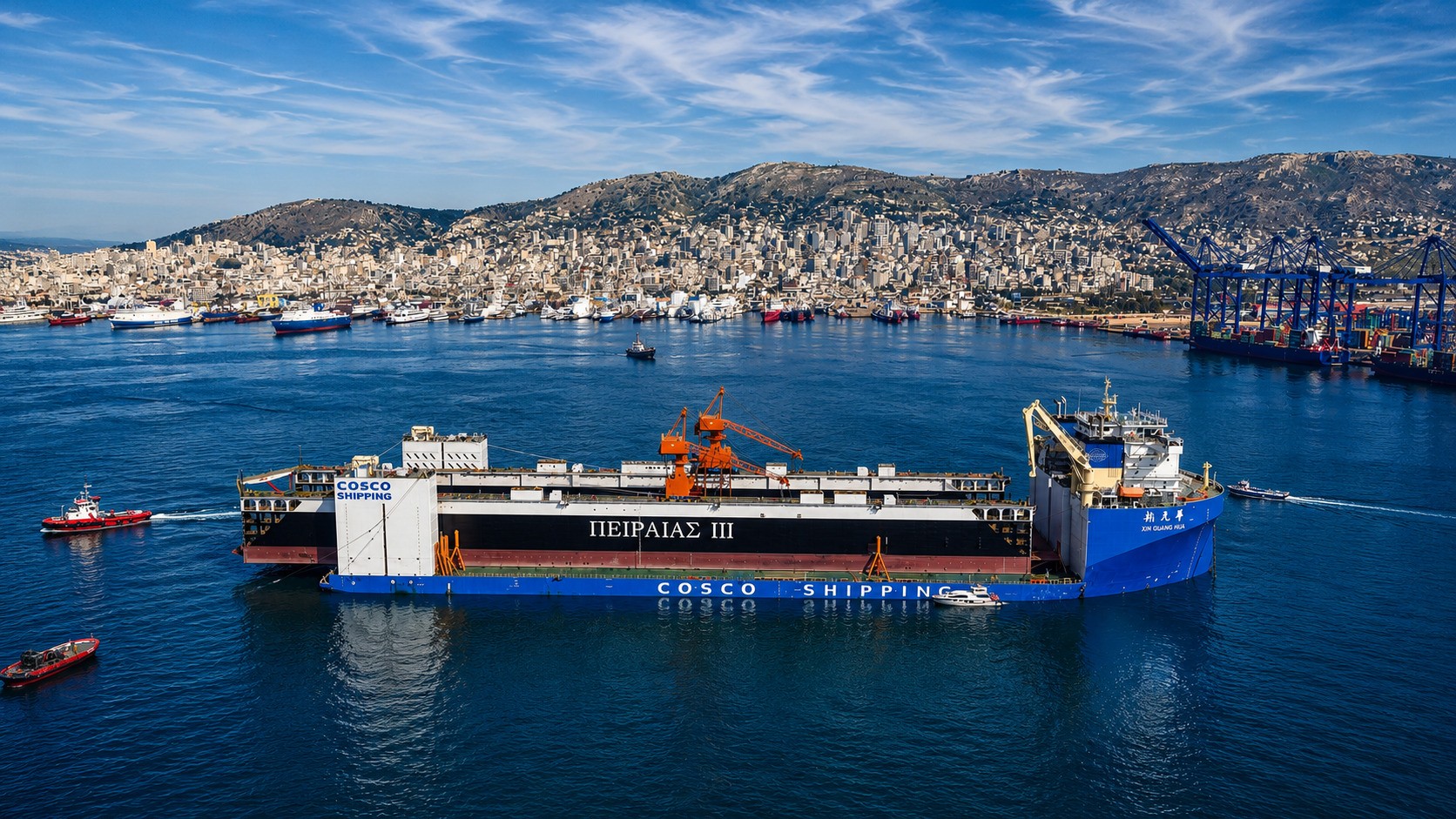

On 10 August 2026, Piraeus Port Authority (PPA S.A.) marked ten years since COSCO SHIPPING became its majority shareholder. The press release reads like every corporate decennial should: rising container throughput, record cruise numbers, an expanding ship-repair zone, a completed car-terminal upgrade, a green urban park in the making. CEO Su Xudong framed the decade as proof that COSCO’s original bet on Piraeus had paid off, thanking the Greek state and PPA staff for what he described as a shared achievement — before pivoting, notably, straight to the future.
All of it is true. None of it is the whole story. A decade after Beijing’s flagship Mediterranean acquisition, Piraeus is a useful lens for three overlapping questions that matter well beyond one Greek port: what does Chinese ownership of critical European infrastructure actually look like in practice, how exposed is that model to a cooling geopolitical climate, and can a Chinese-controlled asset credibly wear the ESG label the EU now expects of it?
From regional harbor to Mediterranean chokepoint
The numbers behind the anniversary language are not exaggerated. COSCO’s investment — which began with a concession in 2009 and deepened into majority ownership in 2016 — turned Piraeus from a mid-tier regional port into one of the top transshipment hubs in the Mediterranean, competing directly with Tanger Med, Valencia, Algeciras, and Gioia Tauro for the east–west container flow that passes through Suez. That positioning depends on Piraeus’s role as the first major EU call after Suez — a geography that has served it well for most of the decade, but one whose value is tied to the Suez–Red Sea corridor actually functioning. Sustained diversion of traffic around the Cape of Good Hope, as some carriers have adopted amid Red Sea instability, doesn’t automatically favor Piraeus; it can just as easily alter the relative attractiveness of calls further west. There’s already a live data point for this: Tanger Med’s 2025 surge to 11.1 million TEU is partly attributed by analysts to exactly this dynamic — Suez disruption strengthening the Gibraltar Strait corridor’s appeal as an alternative transshipment point, at the western end of the Mediterranean rather than the eastern one where Piraeus sits.
Cruise homeporting and the car terminal expansion round out a genuinely diversified port, not just a container operation. That diversification is itself a hedge: it means Piraeus’s fortunes are not purely a bet on transshipment volumes, which are cyclical and exposed to shifts in Mediterranean routing decisions largely outside PPA’s control.
The geopolitical price tag
None of this growth happened in a vacuum. Piraeus is the anchor asset of China’s Belt and Road ambitions in Europe, and it has functioned for a decade as a proof of concept: that a Chinese state-linked enterprise can acquire, operate, and profitably scale a strategic EU port without the acquisition being unwound. That precedent matters because the environment around it has shifted considerably since 2016. Brussels has since built an EU-wide foreign direct investment screening mechanism aimed explicitly at critical infrastructure. Germany tested it directly on COSCO: Berlin only approved COSCO’s bid for a Hamburg container terminal after an 18-month fight that split Chancellor Scholz’s own cabinet, and only after the stake was cut from the 35 percent COSCO originally wanted down to 24.99 percent — deliberately below the threshold that would have granted blocking rights. Italy’s experience with Chinese port ambitions ended even more decisively: after years of an unfulfilled 2019 memorandum targeting Trieste as a Chinese logistics gateway, and a competing bid that ultimately handed the port’s key stake to Hamburg’s own operator instead of Beijing, Rome formally withdrew from the Belt and Road Initiative altogether in 2023.
Piraeus is now something of an outlier — a fait accompli from an earlier, more permissive era, grandfathered into a stricter regulatory climate. Which raises the question the anniversary press release was never going to ask: would Europe approve the Piraeus transaction today, if it had not already happened a decade ago? Almost certainly not without a far more contentious screening process, political debate, and scrutiny of the kind that was largely absent when the original deal took shape. That reframes Piraeus from simply a Chinese investment case study into something closer to a historical anomaly — a deal produced by a European geopolitical moment that has since largely closed.
The decade-ahead question is whether that grandfathered status holds if EU–China relations deteriorate further, or whether Piraeus becomes the test case for how far Brussels is willing to go in revisiting infrastructure it would no longer approve today. Nothing in the current picture suggests an unwinding is imminent — Greece’s government has been a consistent defender of the relationship, and the port’s economic weight in the local economy makes any confrontation politically costly. But “no crisis yet” is not the same as “no exposure.”
Chinese ownership’s ESG test
The press release leans hard into ESG language: PERS “Eco Port” status, inclusion in the Euronext Athens ESG index, a spot among Greece’s “Most Sustainable Companies,” and the PPA Park being handed to the city as a green, public space. This isn’t incidental branding. A Chinese state-linked operator running critical EU infrastructure faces more scrutiny on governance and environmental standards than a domestic or intra-EU owner would, which makes a credible ESG record less of an optional extra and more of an operating requirement. The investments behind it — energy upgrades, marine protection, the park — are real and measurable. But the alternative framing is unavoidable and precisely the one against which PPA’s sustainability narrative will inevitably be judged: Chinese state capital controlling one of Europe’s largest ports.
Whether that strategy works longer-term depends on outcomes as much as messaging: continued cruise growth, visible progress on the Perama ship-repair upgrades, and a park that actually opens to Piraeus residents on the promised timeline. ESG credentials earned through delivery are harder to challenge than ESG credentials earned through a press release.
That pivot is worth pausing on. Su Xudong didn’t close the anniversary statement by dwelling on the ten years behind PPA — he used it as a launchpad, pledging fresh investment and describing the goal for the next decade as building, in his words, “an even more modern, greener, and more competitive port of international standing.” It’s a forward-leaning note for an anniversary release, and it tells you where PPA wants the conversation to go next: not “look what we built,” but “here’s what’s coming.”
What the next decade actually depends on
Four variables will decide whether that vision of a greener, more competitive port of international standing actually materializes:
Trade route stability, not instability. The comfortable assumption is that turmoil near Suez and Hormuz automatically benefits Piraeus. It’s more accurate to call this a structural vulnerability than a tailwind — and the 2025 numbers already bear that out. Piraeus’s advantage rests on the Suez corridor working normally, with the port positioned as the natural first EU call after the canal. Instead, Alphaliner’s read on Piraeus’s second straight year of throughput decline is that Red Sea disruption has been rerouting cargo toward Spain and northern Europe, not toward Piraeus. Sustained Cape diversion doesn’t reroute that traffic through the eastern Mediterranean — it can just as easily route around it entirely, and Tanger Med’s simultaneous double-digit growth at the western end of the Mediterranean suggests exactly that is already happening. Piraeus needs the current chokepoints to stay open and functional far more than it needs them to stay dangerous.
EU–China political weather. Screening rules, tariff disputes, and the broader trajectory of the relationship (the subject of ongoing analysis on this site, from the Thucydides Trap framing to the repricing of dollar-based hegemony) will determine whether Piraeus remains a settled precedent or becomes a live political flashpoint. A genuinely adversarial turn in EU–China relations is the single biggest tail risk to the “steady decade ahead” narrative.
Competitive pressure from rival Mediterranean hubs. This is no longer a marginal concern, and it isn’t hypothetical. COSCO SHIPPING Ports’ own 2025 results show Piraeus Container Terminal’s throughput fell 6 percent to 3.97 million TEU — its second consecutive year of decline. PPA’s official explanation pointed to softer Mediterranean demand generally; Alphaliner’s analysts read the same numbers differently, attributing the drop specifically to Red Sea service reconfigurations that have been diverting cargo toward gateways in Spain and northern Europe. Over the same period, Tanger Med grew 8.4 percent to 11.1 million TEU. Algeciras and Valencia are also both larger than Piraeus by throughput today. Piraeus’s next decade of growth cannot simply be an extrapolation of the last one; it will require winning back share in a field where it is now, by the numbers, a mid-sized player currently losing relative ground in container traffic rather than the presumptive leader.
Hinterland economics. The deeper test of the second decade isn’t how many containers Piraeus unloads — it’s how many of them it can convert into value-generating gateway cargo bound for the Balkans and Central Europe, rather than cargo that simply transits onward. A port that stays primarily a transshipment machine is renting its relevance from carrier rerouting decisions it doesn’t control. A port that becomes an indispensable European logistics gateway owns more of its own future — though even that depends on hinterland rail and demand growth PPA can’t fully control either. That shift, from transshipment success story to gateway infrastructure, is the harder and more consequential decade-two project — and arguably more urgent now than it looked a year ago, given how quickly Piraeus has lost relative ground within the Mediterranean port hierarchy.
The anniversary press release is, understandably, a celebration. The more interesting document is the one nobody wrote: an honest accounting of how much of Piraeus’s last decade was earned through operational excellence, and how much was geopolitical circumstance that may not hold for the next one. The first COSCO decade proved that Piraeus could be transformed. The second will test whether the model that transformed it still fits the geopolitical age now taking shape.