
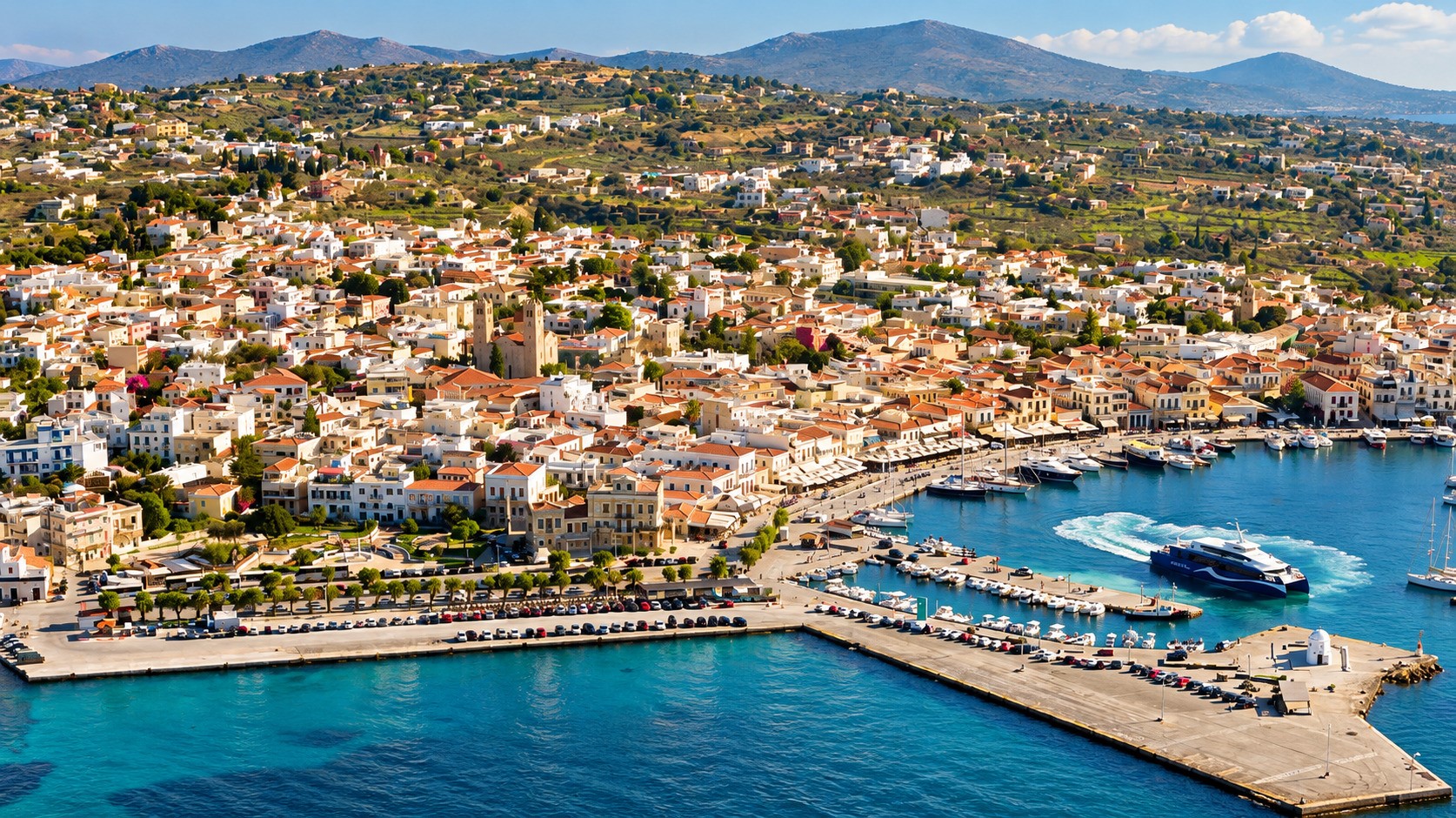

Some islands require a long journey before they reveal themselves. Aegina asks for little more than a ferry ticket and a willingness to leave the city’s rhythm behind.
Less than an hour from Piraeus by high-speed ferry, it feels both wonderfully familiar and unexpectedly different. For generations of Athenians, Aegina has been their first encounter with island life. The first ferry crossing. The first glimpse of fishing boats rocking in the harbour. The first realisation that freedom can sometimes be found surprisingly close to home.
Yet familiarity has never diminished its appeal. If anything, it has deepened the connection. People return to Aegina not simply because it is convenient, but because it offers something increasingly precious: the pleasure of belonging somewhere without having to explain why.
On the waterfront, fishing boats, neoclassical buildings and cafés share the quay with arriving ferries, and visitors discover that the island’s charm lies as much in its ordinary moments as in its celebrated landmarks.
Aegina welcomes you without ceremony, which is partly why leaving it can feel unexpectedly difficult.
When Aegina ruled the waves
Long before Aegina became a favourite escape from Athens, it was a formidable maritime and commercial power.
Its position in the Saronic Gulf helped shape a history of trade, seafaring and rivalry that reached far beyond its shores. In antiquity, Aegina became an important trading centre with commercial connections across the Mediterranean, and one of the earliest centres of silver coinage in the Greek world.
Its famous turtle coins travelled along ancient trade routes. They were more than instruments of exchange. They reflected the confidence of an island whose influence extended well beyond its modest size.
The sea was never simply the scenery surrounding Aegina. It was the source of its prosperity, its ambitions and its place in Greek history.
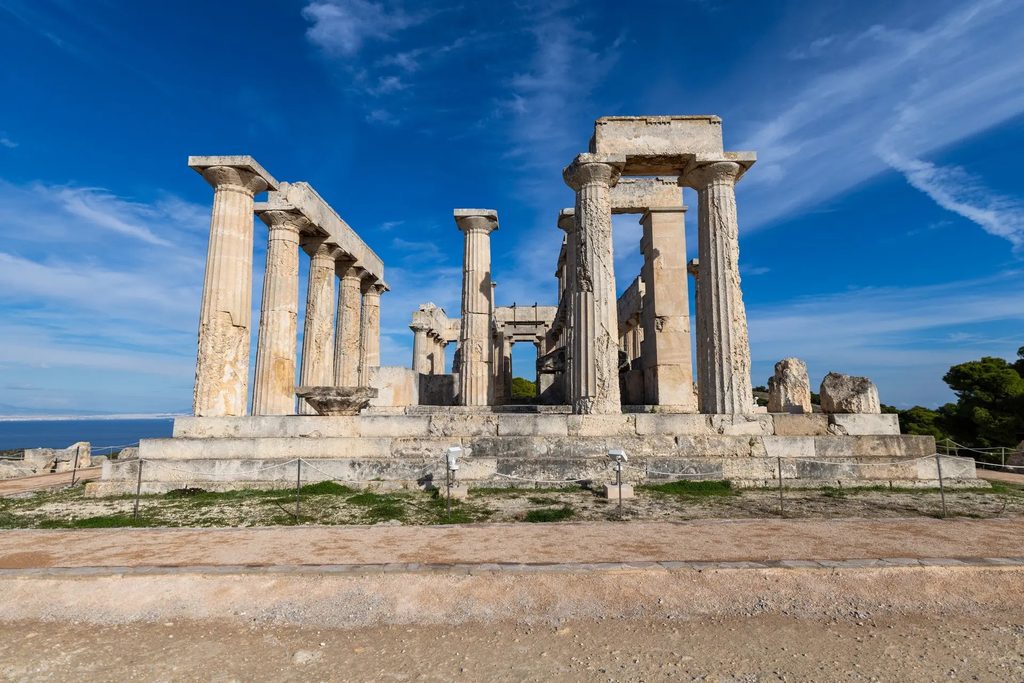
That legacy finds one of its most extraordinary expressions at the Temple of Aphaia.
Built around 500 BC, the late Archaic temple stands among pine trees on a hill overlooking the Saronic Gulf. Its surviving Doric columns frame a landscape where the blue of the sea meets the distant outlines of neighbouring shores.
There is something deeply moving about standing there. The centuries seem to fall away, not because the past has disappeared, but because it remains so visibly present.
Aegina also holds a distinguished place in the birth of modern Greece. In 1828, Ioannis Kapodistrias established his government’s seat on the island, making it a temporary administrative centre of the emerging Greek state before the government moved to Nafplio in 1829.
For a brief but significant period, this small island stood at the centre of a nation attempting to build its future after years of struggle.
Few places so close to a major European capital carry such an extraordinary concentration of memory.
Saint Nektarios and the quiet strength of faith
History explains much of Aegina’s importance, but faith reveals another dimension of its character.
For countless visitors, the island’s name is inseparable from Saint Nektarios, one of the most beloved saints of the Greek Orthodox Church.
His life was marked by hardship, humility, spiritual devotion and a profound concern for those who suffered. After years of service and personal trials, he founded the Holy Trinity Monastery on Aegina and settled permanently on the island in 1908, spending the final years of his life there.
Today, the monastery and the imposing church dedicated to him attract pilgrims from Greece and abroad.
Some arrive carrying prayers they have repeated for years. Others come to give thanks, seek consolation or simply spend a few quiet moments in a place they regard as sacred.
In the courtyards, visitors move slowly. Candles flicker. The scent of incense lingers in the air. There are whispered prayers, private sorrows and expressions of gratitude that need no audience.
For believers, Saint Nektarios represents the possibility that suffering need not extinguish hope. Accounts of miracles associated with his intercession form an important part of the island’s religious tradition.
This spiritual presence has become part of Aegina’s identity, woven into its history and the lives of those who call it home.

A different rhythm of everyday life
Not everything memorable about Aegina appears in a guidebook.
A morning coffee beside the harbour, when the fishing boats are returning with their catch, can reveal as much about the island as a famous monument.
So can an afternoon walk through narrow streets, past old houses, shaded courtyards and small shops where the pace of life feels reassuringly unhurried.
By evening, the waterfront takes on another character. Conversations stretch long after the plates have been cleared, and the lights across the water begin to shimmer.
Aegina’s villages and coastal settlements offer different expressions of the same island character. Agia Marina brings together beaches and summer activity. Perdika retains the appeal of a fishing village, with waterfront tavernas and views towards the nearby islet of Moni. Inland, the landscape reveals olive trees, pistachio groves and quieter corners that many hurried visitors never discover.
And then there are the pistachios.
Aegina’s famous pistachios are much more than a local delicacy. Recognised under the European Union’s Protected Designation of Origin (PDO) scheme, they carry well over a century of farming knowledge and a close relationship between the island’s people and their land.
Behind every harvest lie the patient rhythms of cultivation, the uncertainty of weather and the commitment of families who have kept this tradition alive.
Their distinctive flavour has become one of Aegina’s most recognisable signatures. But their greater significance lies in what they represent: a local identity that can be tasted, shared and carried home.
Where writers and artists found their place
Aegina has long attracted writers, painters, sculptors and others seeking the freedom to think and create. Its light, landscape and proximity to Athens have made it a refuge for those who need both solitude and a connection with the wider world.
Among them was Nikos Kazantzakis, one of Greece’s most influential writers. In the 1930s he began building a house in the Livadi area of Aegina, where he spent much of the following decade writing, with the sea as a constant presence. Zorba the Greek was written there during the years of the German occupation.
The sculptor Christos Kapralos settled on Aegina in the early 1960s and worked there for three decades. His studio and home now form the Christos Kapralos Museum, a branch of the National Gallery.
Aegina is close enough to Athens to sustain professional and cultural connections, yet sufficiently removed to offer the physical and emotional space in which creativity can flourish.
Here, inspiration need not arrive dramatically. It can begin with a quiet morning, an open window and the changing light upon the sea.
Protecting what makes Aegina different
Aegina’s closeness to Athens is one of its greatest advantages. It is also one of its most demanding challenges.
Easy access brings visitors, commercial activity and opportunities for local businesses. It allows the island to maintain close ties with the mainland and gives residents a degree of mobility that more remote islands cannot enjoy.
But popularity inevitably raises questions about the future.
The pistachio groves offer a particularly revealing example.
They are part of Aegina’s agricultural economy, but also of its landscape and cultural memory. Their survival depends on more than the reputation of a celebrated product. It requires viable farming, access to land and water, and people willing to continue the work.
Changing weather patterns, pressure on agricultural land and the competing demands of residential and tourism development make that balance increasingly important.
A pistachio grove cannot simply be replaced by a new building without something of the island’s character disappearing with it. The same applies to traditional neighbourhoods, small businesses and the everyday relationships that sustain local communities.
How can Aegina welcome visitors without sacrificing the qualities that attract them? How can development respect its architectural heritage and natural environment? And how can the island remain a living home for its residents rather than becoming merely a convenient destination for weekend visitors?
These questions concern many Greek islands, but Aegina’s proximity to the country’s largest urban centre gives them particular urgency.
The island does not need to reject change. It needs to shape it.
Its future will depend not simply on attracting more visitors, but on protecting the conditions that allow local life to flourish throughout the year. The most meaningful form of progress would be one that gives Aegina’s people new opportunities while allowing future generations to recognise the island they have inherited.
The journey that never quite ends
Perhaps the most remarkable thing about Aegina is how easily it becomes part of someone’s personal history.
For one visitor, it is the memory of a childhood summer. For another, a candle lit at Saint Nektarios. For someone else, the view from the Temple of Aphaia, a conversation beside the harbour or an evening spent watching the sun disappear beyond the sea.
These memories may seem small, but they are rarely insignificant. They remind us that places matter not only because of what happened there centuries ago, but because of what continues to happen in our own lives.
Aegina brings together the grandeur of ancient Greece, the spiritual comfort of faith, the imagination of artists and the simple generosity of everyday island life.
And it does so without asking visitors to choose between them.
You can arrive in search of history and discover peace. You can come for a weekend by the sea and encounter a story much older than yourself. You can visit a sacred place and leave with a renewed appreciation for the kindness of ordinary people.
The ferry eventually returns to Piraeus. The city comes back into view. Familiar obligations begin to reclaim their place.
But something of Aegina travels with you.
Not just the scent of the sea or the memory of its light, but the quiet feeling that a place so close to everyday life can still make the world seem larger, richer and more meaningful.
And sooner or later, you find yourself looking across the Saronic Gulf, already thinking about the next crossing.

Disclaimer
This article reflects solely the personal views of the author and is intended for informational and analytical purposes. It does not constitute an official position or representation of any organisation or institution.
About the author
Iakovos (Jack) Archontakis is a Maritime Strategy Consultant and Chartering Executive specialising in shipping market intelligence, strategic trade development, voyage economics and commercial risk management.