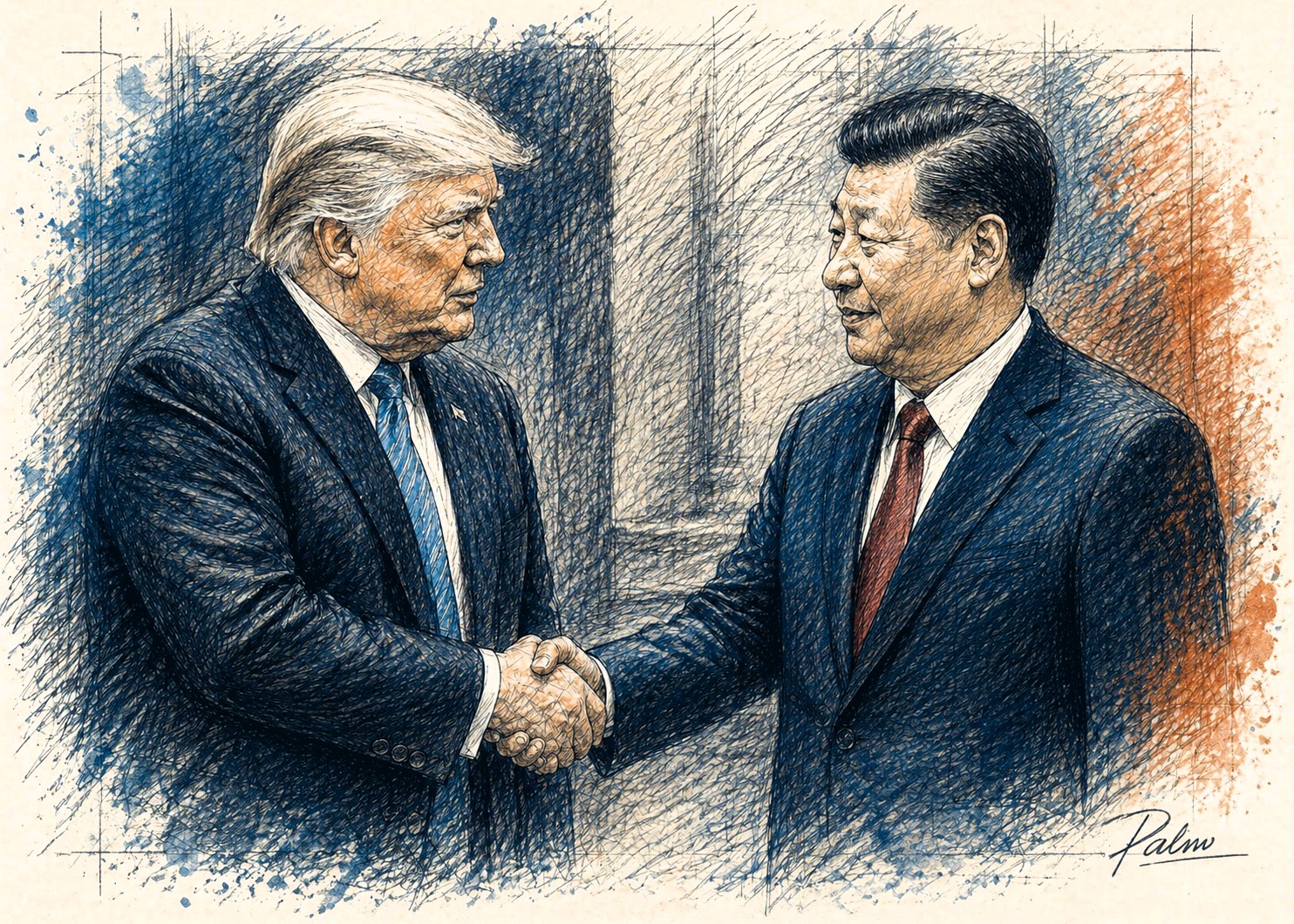

Great-power rivalry rarely announces itself openly. It hides behind trade talks, diplomatic ceremonies, and carefully staged symbolism. The Beijing summit of 14 May 2026 between Presidents Donald Trump and Xi Jinping fits the pattern. Welcoming a U.S. delegation that included Secretary of State Marco Rubio, Defense Secretary Pete Hegseth, and business figures such as Elon Musk, Tim Cook and Jensen Huang, Xi opened the talks with a question loaded with history: can the two powers avoid the “Thucydides’ Trap”?
This was not the first Trump–Xi encounter — they had met before, in Mar-a-Lago in April 2017, in Beijing in November of the same year, and on the margins of multilateral forums in between. But Xi’s invocation of an ancient Greek historian to frame today’s relationship is significant in its own right. It is a deliberate diplomatic act: by naming the trap, Beijing reassigns analytical and moral responsibility for the relationship’s trajectory. The implicit message is that the rising power is aware of the danger and prepared to manage it; the established power had better do the same.
Washington’s anxiety has shifted accordingly. For a generation, U.S. strategy half-assumed that China might falter — that reform would destabilise the system, or that authoritarian capitalism could not hold its contradictions together. That assumption is gone. The United States no longer fears Chinese collapse; it fears Chinese permanence — a durable peer that consolidates an alternative pole of the global order. In that climate, economic interdependence, far from being an automatic guarantor of peace, becomes a catalyst for competition.
Hegemonic transition: the framework and its critics
Graham Allison’s reading of the Peloponnesian War — that war becomes likely when a rising power threatens to displace a ruling one — has shaped a generation of U.S.–China analysis. But the framework has serious critics. Joseph Nye has argued that economic interdependence and nuclear deterrence weaken the analogy. Historians including Arthur Waldron have questioned both the use of Thucydides himself and Allison’s case selection. Steve Chan and others have shown that the canonical “sixteen cases” are constructed with considerable interpretive latitude. The trap, in short, is more a heuristic than a law of history.
Robert Gilpin’s earlier War and Change in World Politics (1981) offers a less deterministic but more structural lens. A dominant power facing the erosion of its relative position has incentives to push back while it still can — through tariffs, technology controls, alliance hardening, or pre-emptive containment. Today’s competition is not a clash of personalities; it is a system under pressure from differential rates of growth.
| Case | Allison’s “rising” power | Allison’s “ruling” power | Outcome | Where the framing strains |
|---|---|---|---|---|
| Peloponnesian War | Athens | Sparta | War | By 431 BC, Athens was at peak power, not still rising — a peer rival rather than a challenger |
| World War I | Germany | Britain | War | The cleanest fit: industrial and naval ascent confronting an established imperial order |
| Cold War | USSR | USA | Rivalry without direct war | A bipolar order from 1945 onward — neither pole was clearly “rising”; the framework applies only loosely |
| Today | China | USA | Undetermined | The asymmetry is real, but technology, finance, and supply chains do not map neatly onto a single rising–ruling axis |
From doux commerce to weaponized interdependence
Montesquieu’s doux commerce — the Enlightenment intuition that trade civilises politics — survives in liberal economic doctrine. Volume of trade was supposed to make conflict irrational. The U.S.–China relationship, the most heavily traded bilateral relationship in modern history, was meant to be its strongest case.
Dale Copeland’s Economic Interdependence and War explains why the intuition has buckled. His “trade expectations theory” makes peace contingent on future expectations of access. When a dominant power believes that continued integration will erode its position — by transferring technology, hollowing out industrial capacity, or creating dependencies it cannot easily exit — interdependence becomes a reason for confrontation, not cooperation. The political success of Trump-era protectionism, including pressure to rebalance agricultural exports such as soybeans and beef, reflected this reversal of expectations as much as the grievances of U.S. industrial classes.
Henry Farrell and Abraham Newman’s notion of weaponized interdependence sharpens the diagnosis. Global networks — financial messaging, semiconductor supply chains, cloud infrastructure — are not flat. They have hubs. States with jurisdiction over the hubs gain two coercive levers: a “panopticon effect” (visibility into the network) and a “chokepoint effect” (the power to cut others off). Tariffs are the crude version. Export controls on advanced chips, restrictions on lithography equipment, and Beijing’s curbs on rare-earth exports are the sophisticated version. Interdependence has not declined. It has been re-engineered as leverage.
The domestic roots: Milanovic and national market liberalism
The external rivalry has internal foundations. Branko Milanovic’s The Great Global Transformation: National Market Liberalism in a Multipolar World (Allen Lane, 2025) argues that the post-1980 neoliberal order has given way to a different model — “national market liberalism” — that is liberal at home but mercantilist abroad. Two structural forces drive the shift: the rise of Asia, above all China, and the political backlash of Western publics against domestic elites enriched by globalisation.
The framework makes the U.S.–China rivalry continuous with the populist turn in Western politics. The deindustrialisation of the American Midwest, wage stagnation, and the concentration of gains at the top produced the electoral conditions in which Trump-style protectionism became viable. The same global forces, in inverted form, helped consolidate China’s bargain of state-led growth and rising mass incomes. Two political economies that need each other have re-organised their politics around resentment of that need.
This is why simple “decoupling” rhetoric is misleading. Each side is responding to domestic constituencies whose preferences pull in opposite directions: continued access to the other’s markets, but reduced exposure to the other’s leverage.
Technology as the new battleground
The bilateral agenda has migrated from agricultural goods to technological architecture. Semiconductors, AI compute, 5G, quantum, biotech, and the critical-minerals supply chain are now treated by both capitals as questions of national security, not commerce. The presence of Tim Cook, Jensen Huang and Elon Musk in Trump’s Beijing delegation was not incidental: their companies sit at the chokepoints that define the contemporary balance.
China’s command of rare-earth extraction and processing is the mirror image of U.S. dominance in advanced chip design and lithography. Each side now reads the other’s strengths as its own vulnerability. The result is a competition over network position: who controls the nodes through which the next industrial revolution will run.
Europe between the giants
Europe is the missing third actor in much of this literature, but it is not a bystander. Its economic exposure to China — German automotive supply chains, Italian luxury exports, Dutch lithography — combines with its security dependence on the United States to create an uncomfortable structural position. The European Commission’s formula of “de-risking, not decoupling” is an attempt to occupy a middle ground that the bilateral logic of Washington and Beijing keeps narrowing.
Two specific pressures matter. First, weaponized interdependence runs through Europe in both directions: U.S. extraterritorial sanctions enforcement, Chinese export controls on critical inputs, and EU instruments such as the Anti-Coercion Instrument all turn European firms into instruments and targets of others’ statecraft. Second, the technological competition forces choices Europe would prefer to defer — on 5G vendors, AI chips, electric-vehicle tariffs, cloud sovereignty.
If the Thucydides framing is incomplete, it is incomplete in part because it is bipolar. The actual system has a third pole that is institutionally rich but strategically under-armed, and whose choices will shape whether the rivalry consolidates into blocs or remains a managed competition.
A new geometry of power
The current period is not a cyclical fluctuation. The lines between economic policy, domestic politics, and security policy have been redrawn. Interdependence has not vanished; it has been turned into a domain of coercion. Xi’s invocation of Thucydides at the Beijing summit was a warning, but also a piece of statecraft — an attempt to set the terms on which the rivalry is interpreted.
The trap is not destiny. The Cold War shows that managed rivalry between systemic competitors is possible, though not cheap. What is required is political leadership able to hold two ideas at once: that the competition is structural and will persist, and that the institutions to contain it must be built deliberately rather than assumed. For Europe in particular, the cost of waiting for the giants to settle the architecture is now visible. The question is no longer whether the trap can be avoided, but on whose terms.