

In four minutes, Volodymyr Zelensky was a wartime hero standing up to American indifference. In ten, he was a desperate man pushing his luck. In forty, he was simply outgunned.
The recent Oval Office meeting between Zelensky and Donald Trump was not a routine diplomatic affair. It was raw, unscripted dominance politics. The Ukrainian president came to plead for continued American support. Instead, he found himself cast in a humiliating performance where his job was to express gratitude—preferably on his knees.
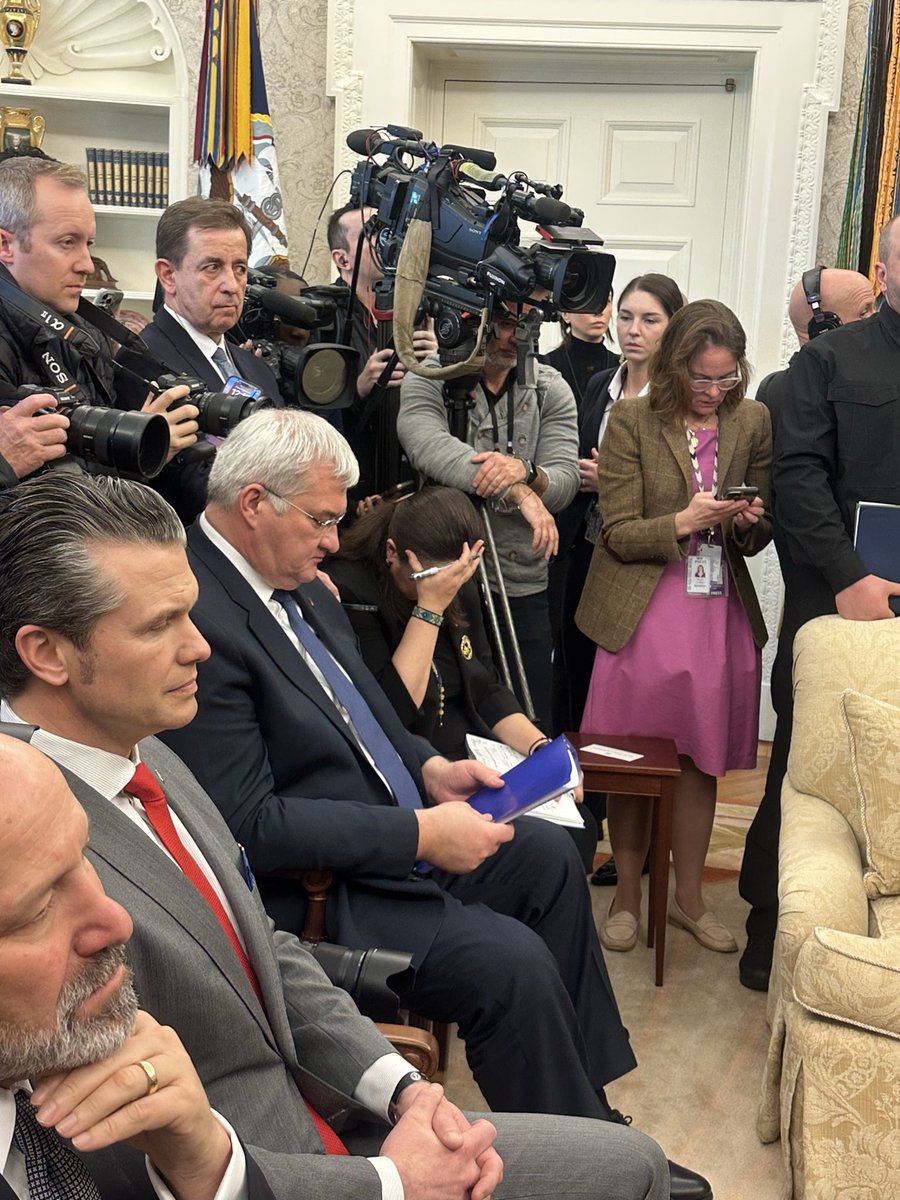
But the real battle wasn’t just fought in words. It was fought in the split-second glances, the awkward pauses, and, most strikingly, in the silent gesture of Ukraine’s ambassador to the U.S., Oksana Markarova, who at one point buried her face in her hands. That moment spoke louder than anything said in the room.
The four-minute hero
A carefully curated four-minute clip of the meeting soon hit social media. In it, Zelensky was confident, unyielding—a man defending his nation’s right to fight. Trump and his vice-presidential hopeful, JD Vance, appeared callous, pressing him on whether he had sufficiently thanked the American people.
“I said thank you—I say thank you to the American people,” Zelensky responded, measured but clearly irritated.
For many, this was all they needed to see. The brave leader of Ukraine, holding his ground against the transactional arrogance of an American political machine that increasingly viewed him as a nuisance. The clip reinforced a narrative: Zelensky as David, Trump as Goliath’s less sophisticated cousin.
The ten-minute recalibration
Expand the clip to ten minutes, and the dynamic shifts. Zelensky is still pressing, but his confidence wavers. His repeated insistence that Ukraine is fighting for the West, not just for itself, feels more strained. His frustration is palpable, but the weight of the conversation begins tilting against him.
JD Vance, playing the role of enforcer, cuts in sharply: “The path to peace is maybe engaging in diplomacy.”
Zelensky, without missing a beat, fires back: “What kind of diplomacy, JD, are you speaking about?”
It’s a devastatingly fair question. Ukraine has tried diplomacy. Zelensky has sat at negotiation tables, signed ceasefires, and even engaged with Putin directly. Each time, Russia has responded with fresh invasions and new massacres.
But by the ten-minute mark, the pressure on Zelensky is mounting. His arguments, while logical, now feel like an uphill battle. He is no longer just confronting indifference—he is defending his right to continue fighting at all.
The full forty-minute reckoning
In the full forty-minute exchange, any remaining illusions are shattered. This is not a discussion—it is an exercise in dominance.
Trump leans in. “If you didn’t have our military equipment, this war would have been over in two weeks.” It is a statement of fact, but one wielded like a club. Zelensky does not argue, because there is no argument to be made. It is true.
But the unspoken counterpoint is just as clear: Would Ukraine have even been allowed to fight if Trump had been in office? Would he have armed them or forced a surrender on Moscow’s terms?
Zelensky understands this is the real question, but he cannot afford to ask it. Instead, he pivots. “Of course I want to stop the war. But with guarantees.”
Trump smirks. “You don’t have the cards.”
That is the moment the game is fully exposed. This was never about helping Ukraine achieve victory. It was about forcing Zelensky to accept that America’s patience has limits—and that gratitude, not battlefield success, is now his primary currency.
The ambassador’s silent verdict
Then, there is the moment of pure, unscripted despair. As the exchange turns increasingly lopsided, Ukraine’s ambassador to the U.S., Oksana Markarova, lowers her head into her hands.
It is a reaction that requires no interpretation. The Ukrainian delegation came seeking aid and support. They found themselves in a test of submission.
The image is haunting, not just for what it says about Ukraine’s position, but for what it reveals about the West’s shifting priorities. The moral certainty that once surrounded the conflict is eroding. Cold calculations are taking its place.
Zelensky’s new strategy: Europe
Zelensky is no fool. He has played the international stage long enough to recognize shifting tides. If Washington is losing interest, then Europe must be the next act.
The four-minute clip, widely shared and dissected, serves a dual purpose. In America, it is a plea for continued aid. In Europe, it is a warning: If the U.S. steps back, the burden of supporting Ukraine will fall elsewhere.
France and Germany, already uneasy about their reliance on American security guarantees, are watching closely. If the U.S. is wavering, they may have no choice but to take a more proactive role. Zelensky’s defiance in the Oval Office is not just a show of strength—it is an argument for European strategic independence.
The final insult
And then, the final demand. The one thing Zelensky had apparently failed to provide despite all the weapons, all the aid, all the speeches in Congress.
“Just say thank you,” Vance pressed again.
By this point, the conversation was no longer about Ukraine. It was about power. About submission. About knowing one’s place in the grand hierarchy of American foreign policy.
Zelensky did say thank you. Many times. But he refused to grovel. And in the brutal world of geopolitics, there are worse things than losing a war. Losing one’s dignity is one of them.