
Here is that sentence, in full. Pursuant to the memorandum between the People’s Bank of China and the Deutsche Bundesbank, Announcement No. 20 of 2026, dated 7 August, authorises Deutsche Bank AG to serve as the renminbi clearing bank in Frankfurt. That is the whole document. No preamble, no strategic framing, no quotation from anyone with a title.
Deutsche Bank, by contrast, said rather more. It will handle direct end-to-end processing, clearing and settlement for cross-border renminbi transactions, and it will act as a local bridge to China’s payment systems. Alexander von zur Mühlen, Deutsche Bank’s regional chief executive for Asia Pacific, EMEA and Germany, talked up Frankfurt as an international financial centre and the bank’s long commitment to renminbi internationalisation. The German press release added the line that actually matters commercially: Deutsche Bank already runs the world’s largest euro clearing operation, and it now clears both.
Markets shrugged. The shares gained 0.59 per cent on the day, closing near €33. Traders, unlike headline writers, priced this as a fee-income story rather than the end of the dollar order.
The translation error that travelled the world
Read that opening clause again. The Chinese original names 德意志联邦银行, which is the Bundesbank, not 德意志银行, which is Deutsche Bank. Two institutions, separated by two characters: 联邦, meaning federal. Xinhua’s English service rendered the clause as a memorandum between the PBOC and Deutsche Bank, and the error then propagated across much of the English-language coverage.
The distinction is not pedantic. The institutional foundation remains the memorandum of understanding that the Bundesbank and the PBOC signed in March 2014, during Xi Jinping’s visit to Berlin. Deutsche Bank has not negotiated a bilateral arrangement with a foreign central bank. It stepped into a twelve-year-old framework between two central banks, and the announcement itself rests the new mandate on that agreement.
That framing changes the reading. Beijing did not open a new front. Beijing added a second clearer to a structure Frankfurt built for itself over a decade ago, and it chose a European institution rather than a Chinese one.
Frankfurt has had a renminbi clearing bank since 2014
Almost every account this week implied that Europe can now clear renminbi for the first time. Europe has cleared renminbi since 2014. The PBOC designated the Frankfurt branch of Bank of China on 19 June that year, and the eurozone’s first renminbi clearing bank went live on 26 August 2014. Before that, German firms largely relied on offshore Asian clearing channels, especially Hong Kong, at higher cost and higher risk.
Nor is Deutsche Bank the first non-Chinese institution to hold such a mandate. The PBOC appointed JPMorgan Chase in the United States in February 2018, and that was the global first. Deutsche Bank is the first European one, which is a narrower and less thrilling claim. The bank has also been a direct CIPS participant since 2015, and it held a renminbi account at Bank of China Frankfurt from the very beginning, alongside Commerzbank and DZ Bank.
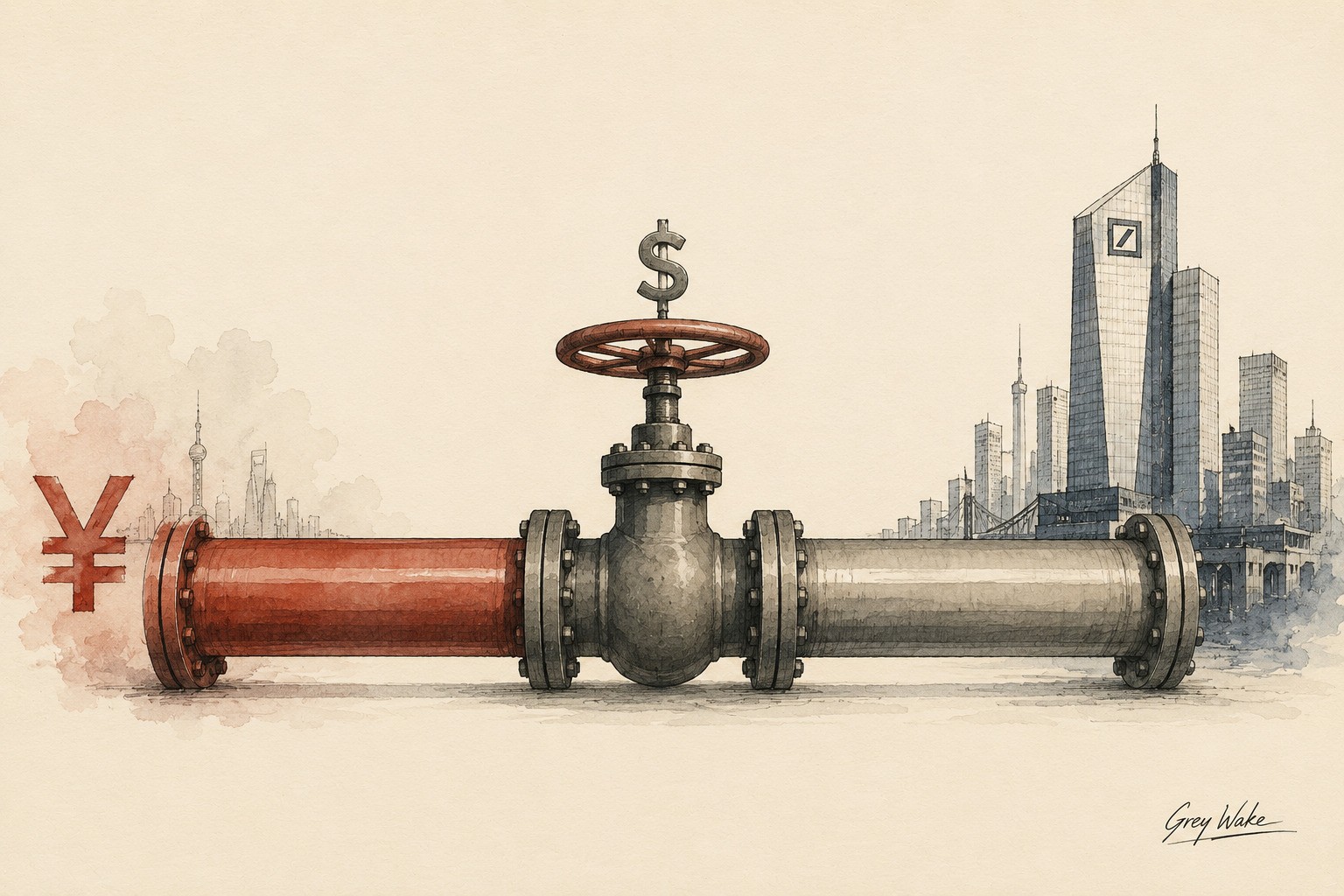
So the genuine change is one of nationality rather than capability. A European bank now clears alongside a Chinese state bank, and it does so under direct ECB supervision. Whether that counts as Beijing extending its reach or Berlin reclaiming a chokepoint depends entirely on which end of the pipe you stand at.
The numbers refuse to cooperate
Anyone reaching for de-dollarisation should first read the SWIFT data. In July 2026 the renminbi accounted for 2.38 per cent of global payment value recorded by SWIFT, against 58.63 per cent for the dollar and 13.46 per cent for the euro. On the June breakdown, Hong Kong alone handles 75.90 per cent of all offshore renminbi payment traffic, the United Kingdom takes 6.84 per cent, and France, the largest centre in the euro area, manages 2.02 per cent. Germany, which has just acquired Europe’s newest clearing mandate, manages 0.72 per cent. On the reserve side the picture is worse: the IMF put the renminbi at 1.99 per cent of allocated reserves in the first quarter of 2026, roughly a tenth of the euro’s share. One measure cuts the other way. In trade finance the renminbi ranks second in the world on 8.00 per cent, ahead of the euro on 5.59 per cent, and up from 7.00 per cent a month earlier. Where China itself sits on one side of the transaction, the currency travels. Beyond those corridors, it struggles.
The trend line embarrasses the narrative further. The renminbi’s SWIFT payment share peaked at a record 4.74 per cent in July 2024. Two years later, it is almost exactly half that. That volatility is hard to square with steady structural migration, and it points instead to international use concentrated in particular trading relationships. The euro offers the cautionary precedent. It has been the world’s second reserve currency since 1999 without displacing the first. Size alone dethrones nothing.
CIPS looks healthier, and it still disappoints. The system processed about 8.44 million transactions worth ¥180 trillion in 2025, with 193 direct and 1,573 indirect participants across 124 countries. Its single-day record is ¥1.22 trillion, set in April 2026, against average daily volume of ¥674 billion in May. Crucially, CIPS still relies on SWIFT messaging for much of its traffic, and SWIFT signed a cooperation memorandum with CIPS in March 2025. That is not what a clean break from SWIFT looks like.
The June package, and the template behind it
The Frankfurt mandate did not arrive on its own, and the sequence explains the timing. At the Lujiazui Forum in June 2026, PBOC Governor Pan Gongsheng unveiled a package of measures that included authorising six banks to conduct offshore yuan business in the Shanghai free trade zone, plus a new facility letting foreign central banks and sovereign wealth funds borrow yuan liquidity against top-rated Chinese bonds. A day earlier, the digital yuan operations centre had signed direct participant agreements with 26 institutions in Shanghai.
That repo facility deserves more attention than it received, because it addresses the structural contradiction at the heart of the whole project. A country that supplies the world with its currency normally runs deficits, and China runs enormous surpluses. Beijing therefore has to push liquidity outward through lending, swap lines, panda bonds and repo windows rather than through trade. The panda market shows the machinery working: issuance reached a record ¥136.5 billion in the first five months of 2026, up 90.3 per cent year on year, with Kazakhstan and Pakistan joining Volkswagen and Henkel at the window. Peter Alexander of Z-Ben Advisors reads panda bonds as an integral part of the internationalisation strategy, and he is right.
The Africa precedent supplies the template. On 26 June the PBOC named Standard Bank and ICBC jointly as the renminbi clearing bank for Africa, covering 19 countries and making Standard Bank the first African institution to hold the status. Frankfurt followed in under seven weeks. The structures differ, since Africa gets a joint operation and Frankfurt a second clearer, but the direction runs the same way: Beijing is bringing non-Chinese commercial banks into an architecture Chinese state banks still dominate.
Why a German bank, and why now
The commercial logic is obvious enough. By 2024, 25 to 30 per cent of China’s own trade was settling in renminbi, and China reclaimed its place as Germany’s largest trading partner in 2025, after a year in second place. Deutsche Bank had also been auditioning loudly. In March it priced a ¥5.5 billion panda bond, the largest single issuance by a foreign bank on record, then returned in May with a further ¥3.5 billion, setting record-low coupons for a foreign panda issuer in both tenor buckets. That sort of enthusiasm hardly hurt its case in Beijing, and analysts meanwhile put Brussels in a cautious do-no-harm phase after China’s rare earth restrictions of 2025.
The supervisory subtext is more interesting, and German reporting supplies it. In 2021 Handelsblatt revealed that Bank of China’s Frankfurt operation had serious trouble with BaFin. The regulator doubted that the remaining staff could handle compliance and anti-money-laundering properly after the departure of the relevant department head, and it imposed conditions that amount to a rare vote of no confidence in management. Handelsblatt noted the trajectory bluntly: a few years earlier politicians and regulators had held the branch in high regard, and by 2021 the picture had reversed entirely.
Read that alongside this week’s decision and a different story emerges. Adding a renminbi clearing bank that is a G-SIB under direct ECB supervision, rather than leaving the function solely with an institution BaFin distrusted, is not obviously a concession to Beijing. It may be the tidiest available solution to a supervisory headache. The irony sits elsewhere, because group chief executive Christian Sewing told the Handelsblatt Banking Summit in 2022 that China’s isolation and its tensions with Washington posed a considerable risk for Germany, and called for the country to reduce its dependence on China. Four years later his bank became the pipe.
Beijing’s studied restraint
Beijing’s official announcement was studiedly spare. Xinhua ran two sentences, reproducing the decision without strategic commentary. China Daily went further: its initial report added Deutsche Bank’s commercial case, and two days later it explicitly placed the appointment inside Beijing’s broader push to expand the renminbi’s global footprint. No minister commented independently.
The contrast with 2014 is stark. When Frankfurt launched its first renminbi clearing bank, China Daily called it a significant milestone on the road to renminbi internationalisation, and the president of Bank of China declared at the opening ceremony that the currency now met the basic conditions of an international currency. Chinese outlets also tracked the 2014 clearing race in detail, noting that the PBOC named London’s clearer on 18 June and Frankfurt’s the following day.
Beijing has learned since then. Loud framing makes a renminbi clearing bank politically toxic in Brussels and conspicuous in Washington. What has changed is not the strategy but the register. The PBOC’s first solo five-year plan in at least a decade, published the same day, commits to expanding the yuan’s role in trade, investment and financing and to building a cross-border payment system that is multi-tiered and broad-based. The formal announcement carries none of that language. The plan carries the ideology. The announcement carries only the plumbing.
The habit problem, which is the real one
Beijing’s harder obstacle is not Western resistance. It is corporate inertia, and Chinese bankers admitted this years ago. In 2016 the deputy head of Bank of China Frankfurt explained to Economic Daily that German institutions had opened renminbi accounts in Hong Kong back in 2009, that they simply kept using the channels they trusted, and that most transactions therefore still ran through Hong Kong or Asian markets. He had 46 participating banks and 27 per cent of the German market, and he still could not break the habit.
Deutsche Bank itself has form here, and it is not flattering. In 2014 the bank published research finding that 31 per cent of German companies already used the renminbi and another 17 per cent planned to adopt it, and it forecast that Europe would very likely become the second largest offshore renminbi market. The hierarchy did emerge, but not the weight the prediction seemed to imply. The United Kingdom now ranks second among offshore renminbi centres on 6.84 per cent of payment flows, against Hong Kong’s 75.90 per cent. Second place has never looked so distant from first.
The prize is also smaller than it sounds. Over its first decade the Bank of China clearing operation in Frankfurt processed more than 550,000 transactions worth close to ¥20 trillion, roughly ¥2 trillion a year, with a network of nearly 50 participating banks and about 30 per cent of the German market. Market share shifts through client migration first, not from the mere existence of a new clearer, and capital controls remain exactly where they were on Friday.
The pipe that nobody dares use
Now to the part that should worry Deutsche Bank’s lawyers more than it excites its salespeople. The bank carries the worst possible history for this role. In 2015 the New York Department of Financial Services fined it $258 million and installed an independent monitor over more than 27,200 dollar clearing transactions worth $10.86 billion for Iranian, Libyan, Syrian, Burmese and Sudanese entities. Internal training materials had instructed staff to keep embargoed institutions off any instruction heading for New York. The Federal Reserve returned in July 2023 with a further $186 million penalty, finding insufficient remedial progress under the earlier consent orders. A bank with that record has just taken on the European end of China’s alternative payment architecture.
The environment has hardened since. Treasury Secretary Scott Bessent confirmed in April 2026 that Washington had sent warning letters to two Chinese banks over Iran-linked transactions, and secondary sanctions can reach foreign institutions even without a direct U.S. nexus. Dollar clearing through American correspondent banks creates a separate exposure under primary sanctions jurisdiction. Chinese counter-sanctions law then pulls the other way, and law firms now advise banks to map in advance the scenarios where American or European demands would force actions that Chinese regulators treat as discriminatory. A clearing bank sits in that fault line. American sanctions rules and Chinese blocking measures can demand opposite conduct, leaving no way to satisfy both.
Which brings us to the fact that settles the matter. Moscow has repeatedly asked Beijing to connect Russia’s SPFS messaging system to CIPS, and Beijing has refused, citing secondary sanctions risk. Chinese commercial banks curtailed Russian business for the same reason. The architecture that supposedly liberates the world from dollar discipline is itself disciplined by fear of the dollar, and its builder still refuses to use it in the geopolitical test case most often cited as proof of its independence. That is the real measure of this week. Deutsche Bank has acquired a commercially valuable piece of financial infrastructure and a genuine competitive edge in the China corridor, and Frankfurt has strengthened its hand in Europe’s competition for renminbi business. Beijing has acquired something more valuable, which is legitimacy: a renminbi clearing bank that nobody can dismiss as an arm of the Chinese state. Neither party has moved the monetary order by a single basis point, and neither expected to.
Watch three things over the next eighteen months, because they will settle the argument better than any communiqué. First, whether German exporters actually invoice in renminbi through Frankfurt rather than reverting to Hong Kong, since habit beat infrastructure comprehensively between 2014 and 2024. Second, whether another European bank receives a comparable mandate, because one appointment is a favour while three constitute a policy. Third, whether the SWIFT renminbi share holds above three per cent through a full trade cycle instead of spiking and collapsing with bilateral flows. If all three land, the conversation changes. If none do, this week joins the long list of milestones that led nowhere in particular. The dollar will not fall to better plumbing. It will fall, if it falls, when Washington makes holding dollars feel more dangerous than holding the alternative, and on that project the United States has lately been working far harder than China.