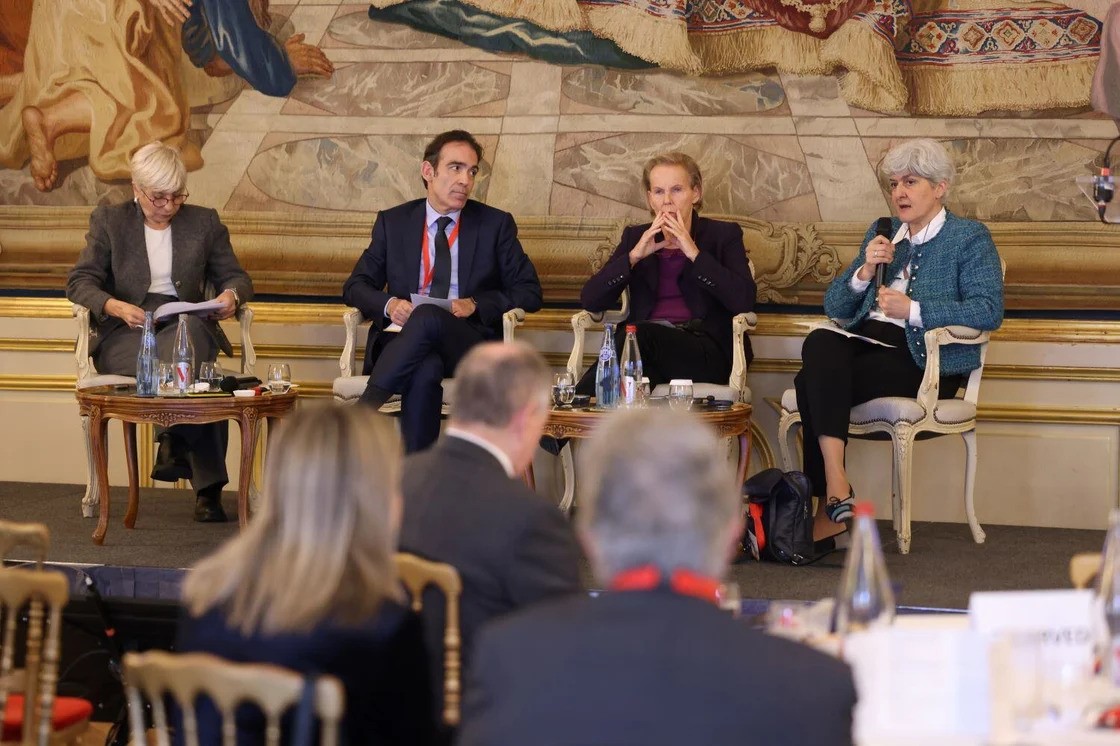

The Draghi Report is “a wake-up call for Europe’s survival,” stated George Pagoulatos, Ambassador and Permanent Representative of Greece to the OECD, emphasizing the scale of the proposed investments: “The increase in annual investments is equivalent to 5% of the EU’s GDP, which corresponds to 2-3 Marshall Plans.”
He noted that it is an extremely bold investment plan aimed at bridging the gap between the EU and its international competitors. “The EU lags behind its competitors, and this is exacerbated by the deregulation environment in the US after Trump’s election, as well as the statements of the new administration on areas like energy and climate.”
Mr. Pagoulatos stressed that Europe built its prosperity model in a post-war world, relying on domestic policies of social contracts and open external markets. However, this model is now being challenged. “Europe is like an athlete with decent pentathlon skills, but now it has to face Mike Tyson in the ring.” He pointed out that the EU needs to invest decisively in its competitiveness, as this is a matter of survival.
Anni Podimata, Vice-President of the European Parliament (2011-2014), observed that the Draghi Report has elicited varied reactions, with some welcoming it as a sign of “opening the financial taps,” which alarmed Northern European countries. “Beyond differing interpretations, the Draghi Report is suitable for Europe and, consequently, for its member states.”
She noted that Draghi emphasized that the report is about ensuring Europeans’ ability to defend their shared values. “For several years, Europe has been losing ground to China and the US. With Trump’s election, the radically different environment and the risks it entails for Europe enter a new scale.”
According to Ms. Podimata, while individual chapters of the report can be critiqued, it is essential to agree on its overall approach. “The report should be read as a unified alarm bell.”
Sylvie Goulard, Professor of Practice in Global Affairs (sustainability, green finance and geopolitics) at SDA Bocconi School of Management and former Deputy Governor of the Banque de France (2018-2022), stressed that the Draghi Report includes noteworthy proposals but pointed out that “we haven’t done much in France and Greece, for instance.” The issue, she argued, is what individual countries can do to help Europe. “In political discussions, we often revert to a nationalism that is incompatible with the times.” She also highlighted the need for citizens to understand the sacrifices required, particularly in sectors such as defense. “It’s not just about Ukraine but also the Middle East and Africa.”
Ms. Goulard expressed her admiration for the fact that the Draghi Report does not focus solely on money. “Talking only about decarbonization is a mistake. The issue of greening the economy must be examined more broadly,” she said. She stressed that Europe needs unity, as “Europe will be strengthened by both the South and the North working together in cooperation.” At the same time, she warned about the dangers of nationalist tendencies: “The nationalist frenzy must stop. If the EU didn’t exist, we would need to create it now.”
Responding to a question about handling Trump, she said, “Europe is based on the rule of law; it operates with rules. We are not naive, but we have been greedy.”
The forum is organized by the Delphi Economic Forum with the support of the Greek newspapers To Vima and Ta Nea and under the auspices of the Permanent Delegation of Greece to the OECD and the General Secretariat for Greeks Abroad and Public Diplomacy of the Ministry of Foreign Affairs.
The panel was moderated by Christine Ockrent, Senior Producer at France Culture.