
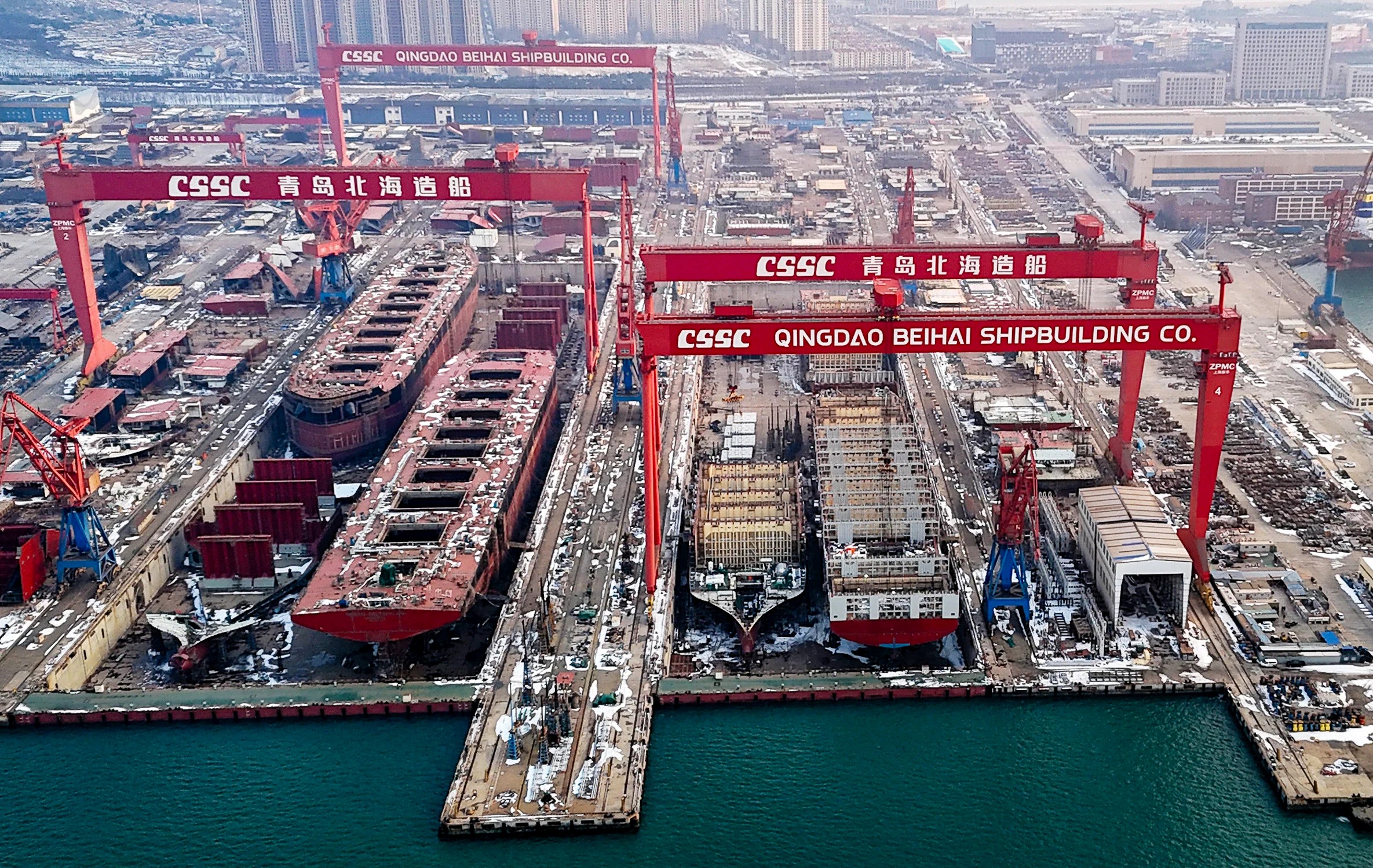

China’s rise to maritime supremacy is the product of over 30 years of meticulous industrial planning. The U.S. Trade Representative (USTR) report, published on January 16, 2025, exposes Beijing’s strategic use of industrial subsidies, forced technology transfers, and restrictive trade practices to dominate global shipping and logistics. China has implemented aggressive policies under successive Five-Year Plans, which have allowed it to systematically displace foreign competitors and control critical supply chains.
The evolution of China’s shipbuilding supremacy
1990s: The foundation of state-driven growth
In 1999, China accounted for less than 5% of global shipbuilding tonnage. Recognizing the strategic importance of the sector, Beijing launched industrial policies that provided massive state financing, tax incentives, and export subsidies to position itself as the world’s leading shipbuilder. The government also pushed consolidation among domestic shipbuilders, ensuring that national champions could compete on a global scale.
2006–2015: Accelerated industrial planning
- 2006: China set a goal of 20% global market share in high-tech ships by 2011.
- 2011: Achieved dominance in bulk carriers, tankers, and container ships.
- 2015: Revised its objectives to secure 50% of the global shipbuilding market by 2025.
During this period, China’s Made in China 2025 plan further emphasized shipbuilding as a pillar of national economic strategy. The state directed financial support to major shipyards, ensuring that Chinese firms had an overwhelming cost advantage over global competitors.
2023: The fulfillment of China’s vision
By 2023, China had exceeded its own projections:
- Over 50% of global ship production was controlled by China.
- Chinese-owned fleets accounted for 19.1% of the world’s commercial shipping(measured in deadweight tonnage).
- 86% of intermodal chassis, 95% of shipping containers, and 80% of ship-to-shore cranes were produced in China.
The dominance of China’s shipbuilding industry ensures that international shipping is increasingly dependent on Chinese infrastructure and supply chains.
The global logistics takeover: Controlling supply chains
China’s ambitions extend beyond shipbuilding. Through state-backed enterprises, China has secured control over major ports and logistics hubs worldwide.
- 96 overseas ports controlled or operated by Chinese firms, including 36 of the top 100 ports by container throughput.
- 65 of these ports are state-owned, reinforcing CCP control over maritime trade.
- LOGINK, a state-controlled logistics data platform, manages at least 50% of global container traffic, granting Beijing unprecedented insight into global supply chains.
China’s control over maritime logistics allows it to dictate global trade terms, effectively granting it leverage over supply chain stability in multiple industries.
How China dismantled U.S. shipbuilding
China’s aggressive industrial policies have come at a direct cost to the U.S. maritime sector:
- In 2000, the U.S. had 149 commercial vessels on order; by 2024, that number had fallen to four.
- The U.S. shipbuilding and repair industry saw a 14.9% decline in employmentfrom 2008 to 2021.
- Major U.S. shipyards, including Bender Shipbuilding (2012) and Avondale Shipyards (2014), were forced to close due to the inability to compete with subsidized Chinese firms.
The Jones Act, which mandates that ships operating between U.S. ports be built in the United States, has done little to shield the domestic industry from China’s overwhelming global dominance.
China’s market manipulation and supply chain risks
The USTR report highlights several key risks posed by China’s maritime dominance:
- Market suppression: China’s use of state subsidies allows its firms to undercut foreign competitors, forcing them out of business.
- Economic coercion: Beijing has previously used supply chain dependencies to exert political pressure, as seen in trade disputes with countries such as Australia and South Korea.
- Supply chain vulnerability: China’s overwhelming control of shipping containers, port logistics, and ship-to-shore cranes creates a fragile system that could be weaponized.
- Military-civil fusion: The report suggests that China’s commercial shipbuilding revenues indirectly support its naval expansion, further cementing its military dominance.
China’s long-term goals and future risks
The USTR report outlines China’s long-term objectives in the maritime sector:
- By 2025: China aims to secure 50% of the global market share in high-tech ships.
- By 2030: Chinese state planners project continued consolidation of maritime logistics, AI-driven shipping technologies, and autonomous vessels.
- By 2040: China seeks complete independence from foreign ship components, ensuring full domestic control over production and supply chains.
These goals, combined with ongoing state intervention, pose major challenges for global competitors.
Policy recommendations from the USTR report
The USTR report recommends several countermeasures to mitigate China’s maritime dominance:
- Targeted tariffs and trade actions: The U.S. government could impose additional tariffs on Chinese-built ships and maritime equipment.
- Investment in domestic shipbuilding: Increased federal funding and incentives for U.S. shipyards are critical to restoring domestic ship production.
- Strengthening alliances: Collaborating with allies to diversify supply chains and reduce dependence on Chinese-controlled ports and logistics systems.
- Technology safeguards: Implementing stricter controls on technology transfers in shipbuilding and maritime logistics.
The future of global maritime trade
The findings of the USTR report confirm that China’s maritime dominance is not a result of free market competition but a calculated effort to control global trade. With Beijing now commanding shipbuilding, logistics, and maritime supply chains, the geopolitical and economic ramifications are profound. The challenge for policymakers and industry leaders will be devising a coordinated strategy to counteract China’s growing influence in global shipping and logistics.