
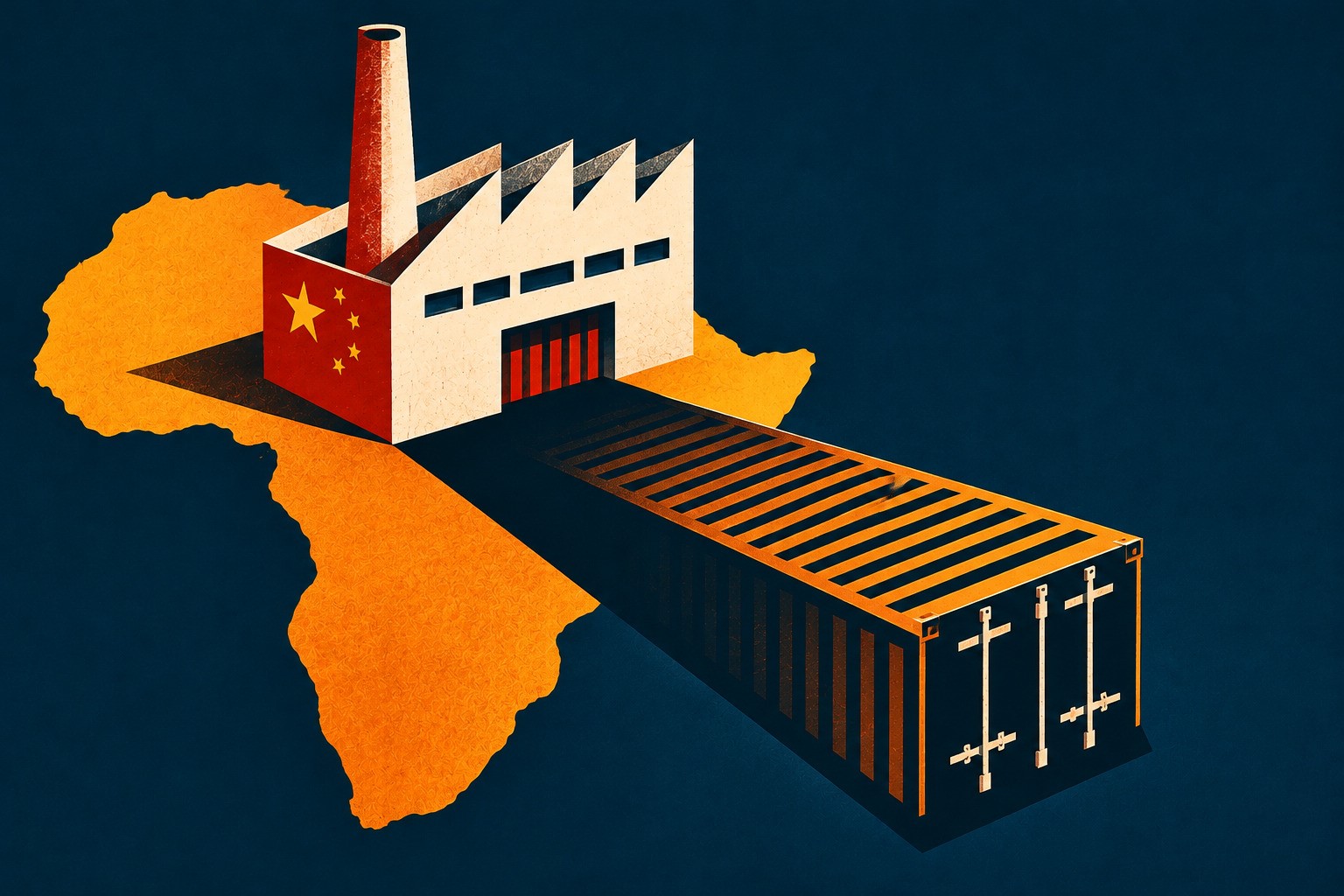

China sold Africa $225bn of goods in 2025 and bought $123bn, leaving an African deficit of $102bn, up 64.5%. Two stories are told about that gap. In one, Chinese factories are industrialising the continent. In the other, Chinese goods are flooding it. The data can be bent to either. The same customs figures show construction-machinery exports up 63% in the first seven months of 2025, and transformers and converters up more than 51% in eight: equipment for building plants, grids and roads, not only consumer goods.
Neither story proves much. A growing surplus does not show that African industrialisation is failing, and growing factory investment does not show that it is succeeding. The sharper question is how much of China’s commercial presence creates productive capacity that stays in Africa, and how much merely widens the market for Chinese industry. Cargo is the earliest hard evidence, because it records what actually moves. But the answer will depend less on how many factories are built than on who owns the layers around them: the capital, the technology, the logistics and the margin.
What China is actually building
Three figures circulate for Chinese manufacturing investment in Africa, but their different methodologies and coverage make direct comparison misleading. China’s commerce ministry, as reported by the Financial Times, puts the total value of Chinese direct investment in African manufacturing at almost $8bn in 2025. Rhodium Group data cited in the same article put investment in manufacturing and processing at $7.7bn in 2025, compared with $4.8bn in extraction. Rhodium’s China Cross-Border Monitor uses a transaction-based methodology, although the published African figures do not establish whether these totals refer to announced or completed transactions. The Economist reports, citing fDi Markets, $12.3bn across 64 new manufacturing projects in 2025, and cautions that not all planned projects will come to fruition. None of these figures, on its own, establishes how much investment has translated into operating factories.
The announcements are lumpy and lean toward building materials. The Boston University and AERC bulletin, which uses verified fDi Markets deals, records Chinese greenfield announcements of $13.7bn in 2023 and $8.6bn in 2024, driven by a few large projects; the number of deals in 2022–24 was lower than in 2017–18. About 70% of 2023–24 greenfield investment in industry, trade and services went to “materials production and processing,” which the bulletin says means cement, steel and fertiliser ingredients rather than mineral refining: a $1.2bn cement plant in Uganda, an $8bn potash complex in Egypt, a $1bn steel plant in Zimbabwe. These projects point toward industrial capacity in construction inputs, not necessarily a diversified manufacturing base.
The most diversified chain sits in Morocco, which received all of the verified Chinese greenfield automotive investment in 2023–24: $3.9bn across a tyre plant and six EV and battery-materials facilities, helped by preferential access to US and EU markets. Morocco and Egypt together took 31% of Chinese FDI in Africa in 2022–24. A story told only from Mombasa and Dar es Salaam misses two countries that account for nearly a third of the total.
East Africa’s showcase shows how much an announcement can cover. In 2023 Zhende Medical announced a Kenyan investment of $180m, 7,000 jobs and $320m of annual exports. In 2024 Tatu City announced the opening of a first $30m facility with 1,800 jobs and a $60m export target. The FT says the factory was built in 2022 and describes a $100m second phase with 8,000 jobs expected. These need not conflict: a first operating plant and a wider investment plan are different things, and a phased programme is normally announced ahead of delivery. What no source gives is output or export data. The chain the factory bet has to prove is announced, financed, built, operating, exporting. For FullCare’s first facility we can document the early steps; for the second phase and for exports, which matter most for the cargo, we found no confirmation yet.
What the ships can and cannot show
The first sign of industrialisation in a port is not output but equipment: machinery, steel, vehicles and project cargo for plants that do not yet produce. Confirmation comes later, when the outbound mix changes. Almost everything we can document sits on the first leg. Since December 2024 COSCO Shipping Specialized Carriers has run a weekly service from Qingdao to Dar es Salaam, Mombasa and Durban, about 20 days to Dar es Salaam. The first sailing carried more than 20,000 cubic metres of machinery, vehicles and steel. That is construction cargo, not proof of production: the same steel can go into a factory, a bridge or an office block. Note also who runs the leg: a Chinese carrier moving Chinese-made equipment. Whatever the plants end up doing, the first link in the chain is already Chinese-run.
A busy port is not a proxy for factories. The Kenya Ports Authority reports 45.45 million tonnes at Mombasa in 2025, up from 40.99 million, and 2.11 million TEU, up from 2.00 million. Transit cargo for neighbouring countries rose from 13.29 to 15.88 million tonnes: roughly a third of the total, and growing faster than the whole. Mombasa is measuring regional logistics, and the authority is adding berths and yard space for another 1.4 million TEU. Maersk’s new hub in Dakar shows the same ambiguity: a 10,000 sq m warehouse for fast-moving consumer goods, retail and technology products. Port and warehouse growth can come from consumption as easily as from production.
The cargo that matters is what plants add once they run, and it differs by type. Cement, steel and fertiliser plants move heavy bulk through ports in both directions. Plant construction is project and multipurpose cargo. Garments and medical goods, such as those Zhende says it will sell to Africa, Europe and the U.S., are containers on fixed schedules. Tanzania’s investment authority told the FT that a new solar-panel plant will make $300m of panels a year for the U.S. market under AGOA; if so, a Dar es Salaam factory becomes a container exporter to a third market rather than a supplier of the local one. An integrated battery chain such as Gotion’s in Morocco, if built as planned, would create two-way industrial traffic instead of import-only traffic.
Our inference, not a measured finding: a value deficit says little about tonnage. African exports to China are overwhelmingly extractive; agriculture and manufacturing together make up only about 13% of their value since 2000, and bulk minerals and energy weigh far more per dollar than machinery. They are not alike, though: iron ore, copper concentrate, refined copper and crude oil differ in value per tonne, ship type and route. We have no tonnage data by commodity, so the physical balance of the trade remains unmeasured.
Corridors: the contest is over the exit route
Copperbelt minerals now have two rival outlets, and the numbers attached to both are plans. On the Atlantic side, the U.S. Development Finance Corporation announced financial close in December 2025 for the Lobito Atlantic Railway: rehabilitation of the mineral port and about 1,300 km of line to Luau, on the Angolan border. DFC expects capacity to rise tenfold to 4.6 million tonnes and the cost of moving critical minerals to fall by up to 30%, and says the investment is meant to prevent monopolisation by China. On the Indian Ocean side, Zambia, Tanzania and China signed in September 2025 a 31-year concession for China Civil Engineering Construction Corporation to rehabilitate and run freight on TAZARA, a $1.4bn programme: $1.17bn up front and $238m in reinvestment.
Zambia’s transport minister told parliament that volumes would rise from about 400,000 tonnes to 2.4 million within two years of full operation. In the same statement he also said they had fallen below 100,000 tonnes in recent years. TAZARA’s own board, in an October 2026 communiqué, targets 110,000 tonnes this fiscal year and 1.8 million in 2030/31, and says conditions must still be met before the concession takes full effect. Government and railway do not share a baseline or a timetable.

The financial terms are as telling as the tonnage. Zambia receives a fixed annual fee plus a share of gross freight revenue, whose percentage the minister did not disclose, while the concessionaire pays no corporate tax for its first five years. Opposition MPs asked why a 31-year concession of a state asset did not go to parliament under Article 210 of the constitution; the government replies that nothing was sold and only the freight business was concessioned.
These are capacity targets for Lobito and traffic targets for TAZARA, set by interested parties. They cannot be compared with each other, or with Mombasa’s actual throughput. The comparison that would matter, cost and transit time per tonne of copper to the Atlantic versus the Indian Ocean, we have not found published. What the corridors share is the logic: neither is about factories. Each is a contest over who runs the exit route for African minerals and who keeps the margin on the way out, with U.S.-backed financing of a port-and-rail route on one side and a Chinese operator running the freight line on the other.
Who captures the value
The clearest test case is Gotion’s battery project in Morocco, and it is useful for what is proven as much as for what is projected. A Boston University post of 12 November describes a first phase of up to 20 GWh of integrated lithium-iron-phosphate capacity, covering cathode materials, cells and packs, with expansion toward 100 GWh planned. The African Development Bank has approved a €100m loan and helped mobilise about €141m more, and the post says construction is on schedule. Those are the realised facts. Everything else is an AfDB estimate for 2026–33: €413m of domestic value added, more than 600 direct jobs, links with up to 130 local firms. One of the post’s three authors, Jing Li, is an AfDB division manager, so the lender backing the project is also the source of its projected benefits. It is a more integrated chain than most, and for now it is a forecast.
Zimbabwe shows the other end of the range, and one thing that can drive it. The bulletin notes that Harare banned raw lithium ore exports in 2022 and extended the ban to concentrates in 2026, which prompted a new round of Chinese investment in lithium sulfate plants. Whether this builds wider links to domestic industry, it says, remains uncertain, and Chinese involvement in African mineral processing is still small next to extraction. The case suggests that host-government policy can shape how much processing happens locally, alongside investor preference and local capacity.
Here is our reading of the larger shift. Chinese loan commitments to Africa have been below $5bn a year since 2020, and in 2024 China was the only creditor receiving more in repayments than it disbursed. At the same time Chinese firms are taking positions in the assets that make and move goods. The Economist reported in April that they operate or hold stakes in at least 129 ports outside China, spending at least $80bn on construction, and are building industrial parks beside African ports. A Chinese concessionaire will run TAZARA’s freight, and a Chinese carrier runs the Qingdao to Durban service. Private Chinese firms build the factories. China looks less like a lender and more like an operator.
Four roles need to be kept apart, because each carries different risk and captures different value. A lender earns interest and bears the risk of default. A contractor earns a fee for building and leaves when the asset is handed over: the bulletin finds that EPC contracts made up 70 to 80 percent of Chinese overseas renewable energy engagement in Africa in 2022–25, which it reads as a preference for lower risk and faster revenue. A manufacturer owns the plant and the product, and with them the technology and the export margin. An operator holds the concession, the terminal or the fleet, and earns from the volume that passes through. Our reading is that the weight of Chinese activity is moving from the first two roles toward the last two, though unevenly. What an operator actually earns depends on its contract, and has to be established case by case. The question shifts from how much China invests to which layers of the chain it holds, and which ones remain African.
The price of entry belongs in that accounting. The Tatu City zone where FullCare operates offers VAT zero-rating, import duty exemptions and a 10% corporate tax rate for ten years, then 15% for another ten; TAZARA’s concessionaire pays none for five. Such incentives are standard and may be worth paying, but the revenue they forgo is part of what stays in Africa. On the export side, China has extended zero tariffs to all 53 African countries that have diplomatic ties with Beijing. The bulletin’s own caution is that duty-free access does not by itself change the structure of trade; that depends on African industrial upgrading. Africa produces only 1.5% of the world’s manufactured output. Charles Kenny of the Center for Global Development, in a 2025 paper and a podcast, reads the picture as mixed rather than dire: manufacturing for local markets is raising productivity, but the export-led wave long promised has not arrived.
What it means for Greek shipping
The Greek-owned fleet numbers about 5,800 vessels and 458 million dwt. The Union of Greek Shipowners puts that at 19.1% of world deadweight and says more than 98% of capacity serves other countries’ trade. A 2026 survey by the Greek Shipping Co-operation Committee gives 14.2% of the world fleet; the share depends on who counts and how. What matters here is exposure. Greek owners carry third-country bulk and multipurpose cargo, so a change in the African flows described above would reach them.
The mechanism, which no one has measured, would differ by commodity and by how far processing goes. Where concentrate gives way to refined metal, less tonnage leaves per unit of metal, and it may move from bulk carriers toward containers or multipurpose ships. Where processing is minor, little changes. Shipping demand is counted in tonne-miles, so the destination matters as much as the weight: a processed product sent to Asia, Europe or another African market changes distance as well as volume. Inbound equipment and plant inputs add cargo of their own. Whether demand for bulk tonnage on African routes rises or falls therefore cannot be read off the processing shift alone. This is a hypothesis. Nothing in our sources quantifies it, and the bulletin stresses that Chinese involvement in African mineral processing is still small next to extraction.
Piraeus shows a different side. COSCO-controlled Piraeus handled 3.97 million TEU in 2025, down 6%, marking a second consecutive annual decline. Alphaliner blames Red Sea service changes that moved cargo to Spanish and northern European gateways, while COSCO Ports’ international throughput grew 7.9% and its Suez Canal terminal 41%. COSCO is growing, but not mainly in Greece. Whether Africa’s industrial turn bears on Piraeus is an open question. The plausible link is that an operator investing in African gateways and industrial parks directs its growth there, leaving Piraeus as one node in a network whose expansion lies elsewhere. That is our inference, not a sourced finding.
Three tests that would settle it
- Production test. How many plants operate, what they make and how much of the value is added locally. Follow each project through announced, financed, built, operating and producing. Gotion and FullCare are the two cases to watch; for both we know the early steps and not the last.
- Cargo test. How the mix of inbound and outbound cargo changes over time, by country, product and port. Equipment and project cargo come first, then intermediates, then the plants’ own exports. Port totals cannot isolate a single factory: Mombasa’s TEU count mixes FullCare’s shipments with everything else, and transit cargo with both. The test needs product-level trade and customs data, by commodity code and exporter where available, and the importers’ own records, to see whether categories such as garments, medical supplies or solar panels begin to appear in Kenyan and Tanzanian exports.
- Value-capture test. How much of the final product’s value, technology and revenue stays in the African economy: local content, who owns the logistics layer, which fiscal terms were conceded, and whether African exports to China broaden beyond extractives after a year of zero tariffs. A plant can operate, export and fill a port without changing the host country’s dependence.
Verdict: the early evidence supports neither story. The investment is real but narrower than the headlines, concentrated in a few large projects, in building materials and in Morocco’s automotive chain. The cargo evidence assembled here documents equipment moving in, but does not yet establish a corresponding rise in manufactured exports. And value capture, the decisive test, is being shaped now in contract terms (concession fees, tax holidays, local-supplier commitments) rather than in ports.
China may be moving more production to Africa. The harder question is whether Africa is gaining control over what it produces, or merely becoming another location in a value chain still run from elsewhere.