
KEY TAKEAWAYS
- The United States has historically shaped the postwar liberal international order through promotion of globalisation, free trade, migration policies, population control, environmentalism, cultural norms, and technological innovation.
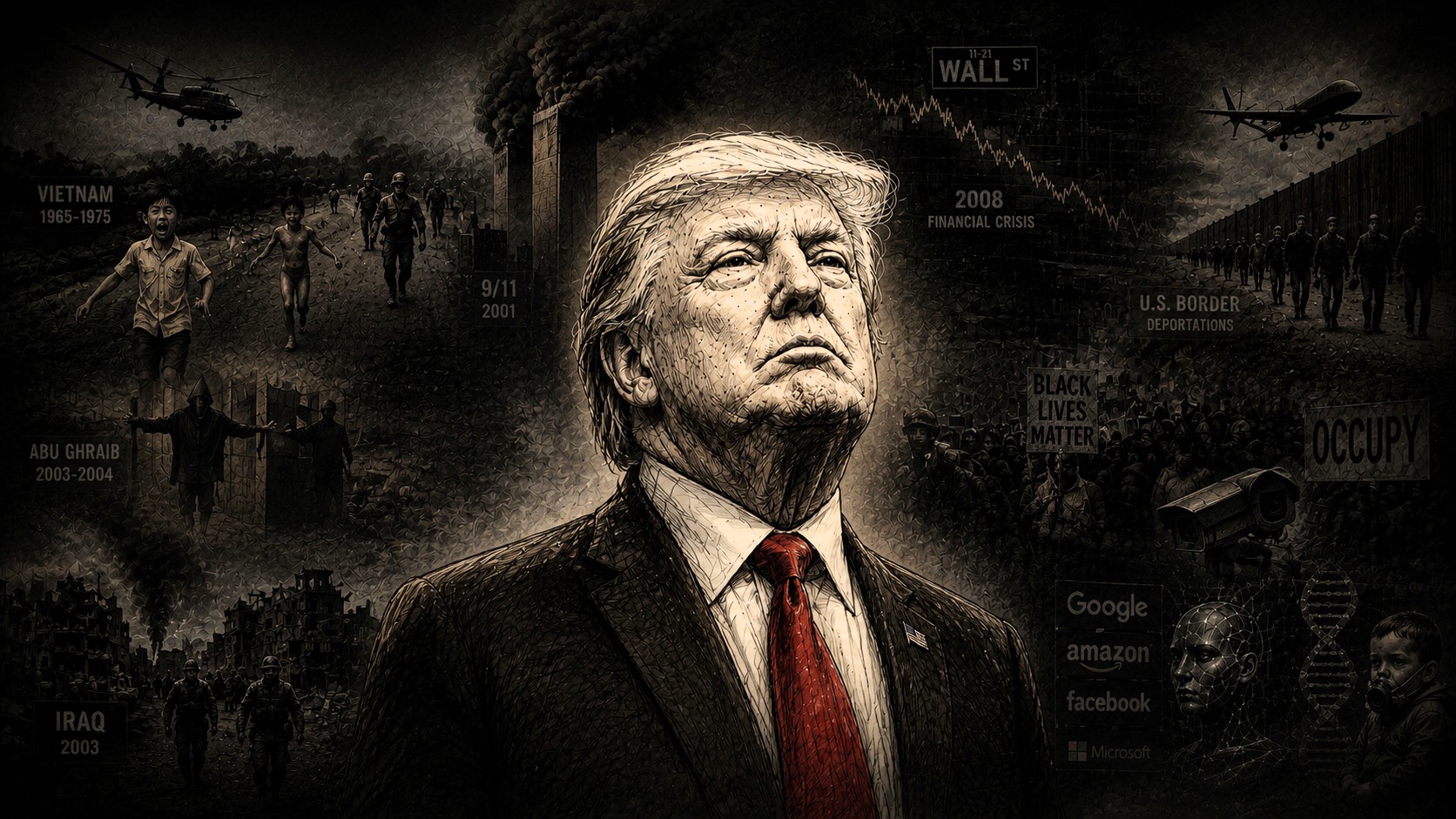
- Despite apparent discontinuities, the American state exhibits underlying continuities in power and interests, with policy reversals often reframing past actions rather than acknowledging responsibility. Furthermore, its military interventionism (and claim of impunity) is not showing any signs of reduction, in spite of rhetoric to the contrary.
- The “liberal paradox” highlights inherent tensions in open economies, where economic competitiveness demands openness to trade, capital, and migration, yet political legitimacy and social cohesion require forms of closure: border controls.
- Postwar population policies, influenced by security concerns and Malthusian thought, contrast with current demographic anxieties.
- American cultural and intellectual exports, from environmental narratives to transhumanism, have globalised certain ideas now subject to domestic reassessment.
- Military interventions and transatlantic strains underscore persistent geopolitical influence.
- Drawing on E.H. Carr, dominant powers tend to present national interests as universal goods, a trait evident in Anglo-American traditions.
- The Trumpian “U-turn” may represent tactical adjustment rather than fundamental change, potentially reflecting a new phase of hegemony, the old one being “somebody else’s fault.” The Greek word for this is hybris.
Since the end of the Second World War, the United States of America has occupied a central position in the international system. Its role has not been limited to that of a military or economic superpower, but has extended to the formulation, financing, and dissemination of a comprehensive set of ideas, institutions, and practices that have shaped the global economy, international society, and political life across continents: a worldview, a Weltanschauung. For much of the postwar period, the United States functioned as a principal architect of a liberal international order that combined market integration, political liberalism, and a distinctive normative vision of social progress.
Over time, however, tensions and contradictions within this order have become more visible. In recent years, the United States has increasingly distanced itself from several ideas and policies that it previously promoted, often reframing them as external impositions, unintended consequences, or the product of autonomous global forces rather than explicitly and sincerely acknowledging its own role in bringing these about.
Globalisation and the liberal paradox
One of the most enduring features of the postwar order has been the expansion of globalisation. The United States played a leading role in promoting free trade, capital mobility, and a liberal approach to migration. These policies were embedded in a broader vision of open societies and integrated markets, which were seen as mutually reinforcing and conducive to stability and prosperity.
Scholars such as James F. Hollifield have described a structural tension inherent in this model, known as the “liberal paradox.” Liberal states depend on openness to sustain economic competitiveness, yet political legitimacy and social cohesion require a degree of control over borders and membership. While goods, capital, and services can circulate with relatively low political cost, the movement of people raises questions about identity, citizenship, and the social contract.
This paradox has characterised many Western democracies since the mid twentieth century. International economic forces have pushed states towards greater openness, while domestic political pressures and the logic of the interstate system have favoured forms of closure. Rather than being a temporary policy dilemma, this tension reflects contradictions embedded within liberal governance itself. Arguably, it is the fact that the liberal paradox reached its breaking point and turned against the erstwhile prime promoter of globalisation, the U.S., that now dictates a change of course — rather than the ideological predispositions of Donald J. Trump and his administration.
War, interventionism, and impunity
Apropos of Donald J. Trump, over the past year alone (from early 2025 to early 2026), the United States has conducted military operations in seven states — Iran, Iraq, Syria, Yemen, Somalia, Nigeria, and Venezuela — across Asia, Africa, and the Americas, while issuing threats of force against Mexico, Panama, Cuba, and Colombia, and even intimations of annexation concerning Canada and Denmark (Greenland). In the post–Cold War era (1991–2026), Congressional sources record at least 250 U.S. military interventions, ranging from overt uses of force to covert regime-change efforts, sanctions, and diplomatic coercion. Estimates of regime-change operations vary from roughly twenty to as many as eighty; wars number between three and five, depending on definitional criteria. These figures exclude the already extensive record prior to 1991.
Historically, the United States has formally declared war in five conflicts against eleven states, yet has fought numerous major undeclared wars — from Korea and Vietnam to Iraq and Afghanistan — authorised without formal declarations and justified by long-standing constitutional precedent. The geographical scope of these conflicts spans Europe, the Mediterranean, the Middle East, Central and East Asia, and the Pacific. Even this catalogue understates the scale of U.S. coercion, omitting NATO operations and the hundreds of lesser military actions and interventions that have profoundly shaped political outcomes worldwide.
Taken together, this record reveals an extent, frequency, and global reach of intervention without historical parallel. This is all the more striking given the United States’ unparalleled strategic security: a continental power buffered by two oceans and bordered by only two neighbours. Yet it is precisely this uniquely secure state that has exercised military power with the least restraint, rendering American interventionism — by scale, scope, and systemic impact — unprecedented in modern international relations.
Population control and security thinking
Another significant dimension of postwar American influence concerns population policy. During the Cold War, demographic trends in the Global South were increasingly interpreted through a security lens. The National Security Study Memorandum 200, declassified in the 1980s, identified rapid population growth in regions such as Africa, Asia, the Middle East, and Latin America as a potential risk to American strategic interests. The document recommended the promotion of population control measures, including family planning and birth limitation, often through international organisations and development programmes, including USAID and UNFPA.
Historical research, including Matthew Connelly’s work on the global population control movement, documents how these policies were implemented in diverse national contexts. In some cases, they contributed to coercive practices, including mass sterilisation campaigns. These initiatives were frequently justified in terms of economic development, resource scarcity, and political stability, reflecting a broader technocratic approach to governance.
In contemporary debates, concerns about demographic decline, ageing populations, and the sustainability of pension systems have gained prominence, particularly in industrialised societies. The contrast between earlier American efforts to limit population growth and current anxieties about global demographic contraction (see, for example, Elon Musk’s pronouncements on the topic) illustrates the shifting priorities of state policy over time, as well as the long-term effects of earlier interventions. Yet the failure to acknowledge American responsibility in these developments is indeed a form of interstate hypocrisy.
Malthusianism, environmentalism, and demography
The intellectual roots of population control lie partly in Malthusian thought, which links population growth to resource constraints. In the twentieth century, these ideas were reinterpreted and expanded in the United States, where they became intertwined with environmental concerns. Neo-Malthusian arguments increasingly connected population growth not only to economic scarcity but also to ecological degradation and, later, to climate change.
Works such as Paul Ehrlich’s 1968 The Population Bomb and Donella Meadows’ writings framed population growth as a central environmental problem. This perspective contributed to the emergence of American environmentalism, as analysed by historians such as Thomas Robertson. Within this framework, humanity’s relationship with nature was often presented in abstract aggregate terms, emphasising numerical limits rather than social organisation, industrial technologies, or patterns of consumption.
Critics of this approach have argued that the interaction between human societies and the natural environment is mediated by factors such as industrialisation, urbanisation, technological development, and economic systems. From this perspective, demographic size alone does not determine ecological impact, and a focus on population risks obscuring structural and distributive dimensions of environmental change.
Cultural influence and social norms
Beyond economics and demography, the United States has exercised considerable influence through culture and norms. Movements associated with social justice, identity, and sexual orientation (LGBTQ+, “woke,” etc.) emerged within specific historical and social contexts in American society. Over time, these movements became part of a broader normative framework promoted internationally through diplomacy, civil society networks, and development funding — and became equated to belonging to the U.S.-led “free world.”
Embassies, non-governmental organisations, and international institutions often supported the adoption of these norms abroad, framing them as universal expressions of rights and equality. States that aligned with this framework were frequently portrayed as progressive, while those that resisted it faced criticism or political pressure. This process illustrates how domestic social movements can be transformed into elements of foreign policy and soft power.
In recent years, internal debates within the United States have intensified, with some states and social groups questioning aspects of this normative agenda. As these debates have unfolded, Trumpism proclaimed the necessity of a radical, global U-turn — as if these ideas were not the product of American hegemony to begin with.
Mass culture and misanthropic narratives
American popular culture has also played a role in shaping global perceptions of humanity’s place in the world. Films, music, and other media have at times depicted humanity as a destructive force within a fragile planetary system. Such representations, including the portrayal of humans as a “virus” or “cancer” on the Earth, have circulated widely and entered mainstream discourse.
These narratives resonated with broader environmental anxieties and were reinforced during periods of crisis, such as the Covid-19 pandemic. While often metaphorical, they reflect deeper philosophical assumptions about human nature, responsibility, and the limits of growth, going back to American neo-Malthusian thought, yet now globalised via Hollywood.
Posthumanism, transhumanism, and technology
The United States has been a central site for the development of posthumanist and transhumanist thought. Advances in biotechnology, artificial intelligence, and human enhancement have been closely linked to institutions such as Silicon Valley firms, defence research agencies like DARPA, non-profit international organizations like Humanity+, and academic networks. These developments reflect a long-standing relationship between military funding, technological innovation, and civilian application.
Proponents of transhumanism emphasise the potential to overcome biological limitations and improve human capacities. Critics, however, have drawn parallels between contemporary enhancement projects and earlier eugenic ideas, suggesting that technological optimisation may reproduce older hierarchies in new forms. What was initially a prototypically American project is now contradicted with the Trumpian desire to globalise traditional values and conservatism, squarely placing the blame for what is now identified as a problem on foreign states and societies, as well as particular previous American administrations — rather than America’s role as a hegemon at large.
War, intervention, and transatlantic relations
Now the U.S. desires to build Fortress America, but the geopolitical dimension of American power is evident in its extensive record of military intervention and overseas presence. With hundreds of military bases across dozens of countries, the United States has maintained an unparalleled global reach. Conflicts such as the war in Iraq and the ongoing war in Ukraine have had significant consequences for international stability and transatlantic relations, to say the least, and they would be inconceivable without this extent of American presence abroad.
The Iraq war, in particular, marked a low point in relations between the United States and key European states, leading to public protests and intellectual debates about the future of the West. Retrospective reassessments of that conflict have since become common in American political discourse. Similar dynamics are observable in current disagreements over Ukraine, where roles and narratives within the Western alliance have again evolved.
Continuity, responsibility, and power
A recurring theme in analyses of American global influence concerns the question of continuity. States operate over long historical periods, yet political narratives often emphasise rupture and renewal. The tendency to reframe past policies as errors while distancing present actors from earlier decisions raises questions about responsibility and institutional memory.
As E.H. Carr observed in his analysis of interwar politics, dominant powers frequently present their interests as universal principles: “the English-speaking peoples are past masters in the art of concealing their selfish national interests in the guise of the general good, and that this kind of hypocrisy is a special and characteristic peculiarity of the Anglo-Saxon mind” (pp. 78–79). This characteristic is not unique to the United States, but it has been particularly influential given the scale of American power. Understanding this dynamic is essential for analysing how ideas, norms, and policies circulate globally.
Can Trump’s U-turn be trusted?
Taken together, the developments discussed above illustrate the breadth and depth of American influence in shaping the modern world. From globalisation and migration to population policy, environmental thought, cultural norms, technological futures, and military intervention, the United States has played a formative role. Many contemporary debates, tensions, and crises cannot be fully understood without reference to this historical context.
Now, Donald J. Trump more or less claims that all of the above are somebody else’s fault, not a direct outcome of American hegemony, and that MAGA will heal the world apart from the United States by reversing these trends with gusto. This reversal raises a deeper question that extends beyond the immediate political moment. Is this shift evidence of a fundamental transformation within the American state, suggesting the emergence of two competing Americas with divergent values and global roles, or does it instead reflect a cyclical rearticulation of power in which policy reversals obscure a deeper continuity of interests and influence? Whether this turn can be treated as a genuine departure, rather than a temporary or tactical adjustment, remains central to assessing the credibility and implications of the new American posture. Yet there are no two Americas, a “good” and a “bad” one; there is one state vis-à-vis the world at large, i.e., the United States of America — and its continuities persevere through its apparent discontinuities.
* Dimitris B. Peponis holds an MA in Governance and Public Policies from the University of the Peloponnese’s Department of Political Science and International Relations and is the author of “The End of the Great Deviation: From Ukraine and the Pandemic to the Shaping of the New Global Order” (Topos books, in Greek).