
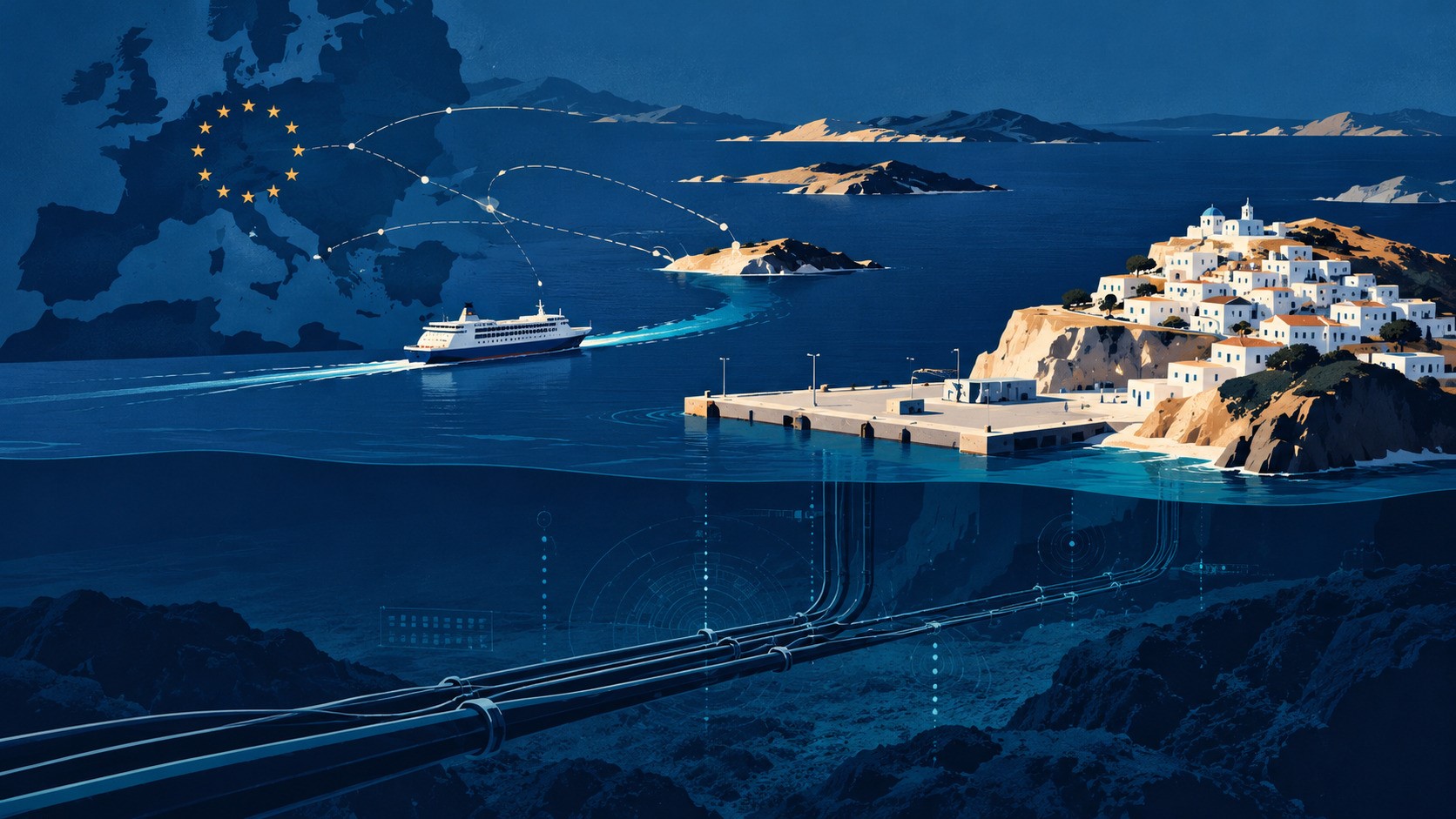

Ports are becoming increasingly important strategic infrastructure assets, with their role now extending well beyond the traditional functions of handling cargo and passengers. They serve as critical hubs for ensuring economic and energy security, the resilience and uninterrupted operation of supply chains, and the strengthening of the European Union’s strategic autonomy.
The growing strategic importance of ports is reflected in the two strategies presented by the European Commission in March 2026: the EU Ports Strategy and the EU Industrial Maritime Strategy. Both recognise security, resilience and technological development as essential prerequisites for strengthening competitiveness and ensuring the long-term sustainability of Europe’s maritime and port sectors. The challenges facing European ports extend well beyond the physical protection of their facilities. Geopolitical tensions, cyberattacks, hybrid threats and the increasing exposure of underwater infrastructure to security risks are creating a complex security environment. At the same time, ageing port infrastructure, the impacts of climate change and growing operational demands call for a more integrated approach to infrastructure planning, management and protection.
Managing port infrastructure as a strategic asset
Under these circumstances, port resilience cannot be confined to the ability to prevent and respond to security incidents. It is equally dependent on maintaining the operational integrity and reliability of infrastructure, systematically monitoring its condition, ensuring effective maintenance and renewal, and safeguarding business continuity or rapidly restoring operations in the event of disruption. The new European priorities highlight the need to move away from isolated protection and maintenance interventions towards an integrated, long-term approach to port infrastructure management. Such an approach should link security and operational reliability with investment planning and the broader objective of strengthening port resilience. An important instrument in this direction is port infrastructure asset management, encompassing the inventory and condition assessment of infrastructure assets, monitoring of operational performance, risk assessment, and the planning of maintenance, upgrading or replacement interventions. Related decisions should be guided by operational criticality, risk exposure and life-cycle costs, enabling more effective prioritisation of needs and more efficient allocation of available resources.
The importance of this approach is particularly evident in an environment of constrained financial resources and increasing requirements for the modernisation of port facilities. The adoption of evidence-based assessment and planning processes can improve investment efficiency, reduce the risk of infrastructure failures and extend the useful life of infrastructure assets. At the same time, advances in technology are creating opportunities to move from periodic inspections and corrective maintenance towards more systematic infrastructure condition monitoring and preventive approaches to potential failures. Sensor networks, underwater robotic systems, digital platforms and advanced data analytics tools can support both the surveillance and protection of port facilities and the monitoring of their structural and operational condition.
From research to operational readiness: the SMAUG experience
A representative example of the application of such technologies is the European research project SMAUG (Smart Maritime and Underwater Guardian), funded under Horizon Europe, which developed integrated maritime and underwater surveillance solutions. In March 2026, pilot demonstrations were conducted at the ports of Elefsina and Heraklion, coordinated by the Intelligent Shipping and Transport Systems (ISTS) Laboratory of the University of Piraeus, in cooperation with the respective port authorities, technology partners and the Hellenic Coast Guard.
The two demonstrations enabled the testing and evaluation of the combined operation of advanced surveillance technologies in different port operating environments, highlighting their potential integration into port security procedures. They also demonstrated the potential for broader applications of individual technologies, particularly underwater inspection and monitoring systems, in supporting the management of critical port infrastructure. This potential is particularly relevant to efforts to maximise the value of technological investments while strengthening the operational resilience of ports.
Dual-use ports and Europe’s strategic autonomy
An additional dimension of European port policy concerns strengthening the role of ports as dual-use infrastructure, capable of supporting military mobility, logistics and crisis management requirements alongside their conventional commercial and passenger transport activities. Such capabilities require more than adequate port capacity and appropriate connections to hinterland transport networks. They depend on highly reliable infrastructure, appropriate levels of protection and maintenance, and operational readiness to accommodate different requirements, including under conditions of increased pressure or disruption to transport chains. Complementing this approach, the EU Industrial Maritime Strategy promotes the strengthening of Europe’s technological and industrial base, with an emphasis on innovation, the development of advanced maritime technologies and capabilities that can serve both civilian and defence needs. In this context, maritime surveillance technologies, unmanned systems and critical infrastructure protection solutions are acquiring greater strategic significance.
These developments highlight the close relationship between port security and resilience, European industrial policy, technological autonomy and the effective use of investments in research and innovation. They also create opportunities for developing technological solutions with multiple applications, enabling their deployment by different stakeholders and across a wider range of operational requirements.
Greece’s island ports: where resilience becomes a national imperative
The challenges and priorities outlined above are not limited to the country’s major commercial ports. They are equally relevant, and in some cases even more critical, to smaller and island ports. In Greece, insularity and the extensive geographical dispersion of port infrastructure make security, operational reliability and resilience matters that extend beyond transport service provision and are directly linked to territorial cohesion, economic activity and the social sustainability of island communities. On many islands, the port represents the principal, and in some cases the only, infrastructure providing regular transport connections with the mainland and other islands. Its reliable operation is essential for the mobility of residents and visitors, the supply of essential goods, the functioning of local economies and access to services. However, island ports face specific challenges. The limited availability of alternative infrastructure, pronounced seasonal fluctuations in demand and often insufficient financial and technical resources for the maintenance and upgrading of port facilities increase their vulnerability. These challenges are compounded by ageing infrastructure and growing exposure to extreme weather events, potentially affecting the continuity and reliability of maritime transport connections.
The particular importance of island infrastructure resilience is also recognised in the new European strategy for islands, presented in June 2026. Among other priorities, the strategy sets out directions for strengthening the resilience of critical infrastructure and promoting monitoring systems to support preventive maintenance, with explicit reference to island ports.
In this context, developing a systematic infrastructure asset management framework tailored to the specific needs of small and island ports has clear strategic and operational value. Combining standardised assessment procedures, appropriate monitoring technologies and targeted investment planning can support the early identification of problems, improve maintenance efficiency and reduce the risk of disruption to essential transport services.

Four policy priorities for Greece’s port system
Adapting the Greek port system to the new European priorities requires a coherent national approach that integrates security, resilience and infrastructure asset management into long-term port planning. This approach should reflect the diversity of Greek ports in terms of size, functions, strategic importance and available technical and financial resources. Four key policy priorities emerge:
- Systematic inventory and assessment of port infrastructure, aimed at establishing a reliable understanding of infrastructure condition, operational adequacy, and maintenance and upgrading requirements. Priority should be given to critical facilities and ports where operational disruptions would have significant consequences for economic activity and transport connectivity.
- Development of a common national framework for port infrastructure asset management, based on internationally recognised principles and standards, incorporating standardised procedures for risk assessment, infrastructure condition monitoring and the planning of interventions throughout the asset life cycle. Such a framework could support more transparent and evidence-based decisions on investment prioritisation at the national level.
- Promotion of technological modernisation and interoperability through the deployment of advanced surveillance, inspection and infrastructure monitoring systems. Particular emphasis should be placed on the potential to use common technological solutions for different operational requirements, while strengthening the links between research activities and the practical needs of port authorities and operators.
- Development of targeted financing and support mechanisms for small and island ports, based on criteria that extend beyond narrowly defined financial returns on investment and take into account the contribution of ports to territorial cohesion, access to essential services and the resilience of local economies.
The next challenge: turning European priorities into national port policy
European research, technological development and pilot demonstrations offer significant opportunities for modernising the port system. However, the transition from pilot demonstration to systematic operational deployment requires appropriate institutional and organisational arrangements, adequate technical support and stable financing mechanisms.
Port security, reliability and resilience must be addressed as interconnected components of an integrated policy for port infrastructure management and development. For Greece, embedding this approach into national port planning is an essential prerequisite for strengthening the competitiveness and long-term sustainability of its port system, while ensuring that the specific needs of its island regions remain an integral part of national port policy.
About the authors
Prof. Maria Boile
Director, Quantitative Analysis in Shipping Laboratory | Department of Maritime Studies | University of Piraeus
Coordinator, Waterborne Technology Platform
Dr. Sotirios Theofanis
Managing Partner, MARLOGMIND PC