
On Friday, Iranian Foreign Minister Abbas Araghchi posted a statement declaring the Strait of Hormuz “completely open” for commercial vessels for the duration of the Lebanon ceasefire. Oil fell 9 percent. Stocks rallied. Eight tankers that had been idling north of Dubai pointed their bows toward the strait. A Malta-flagged cruise ship — empty — transited for the first time since February. Markets called it a reopening.
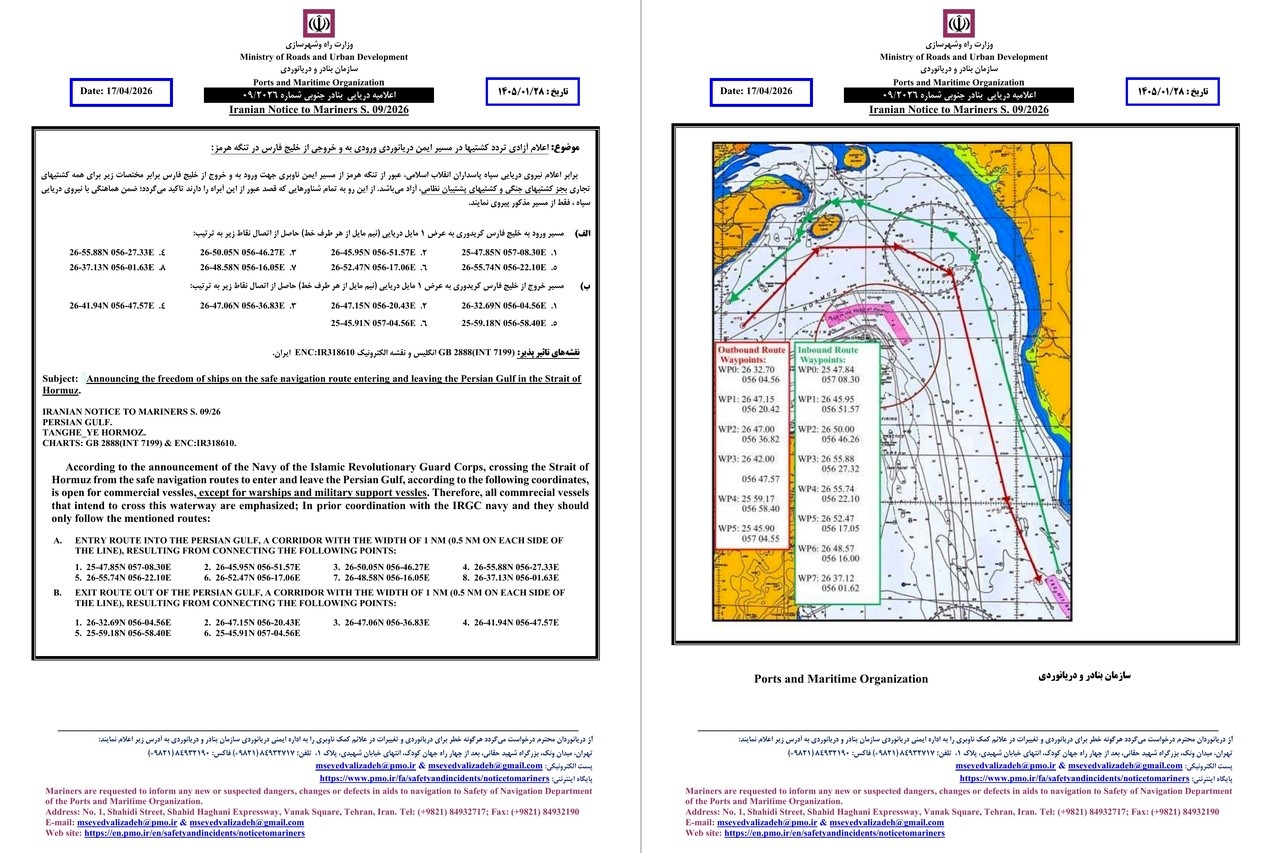
Read the document that accompanied the announcement.
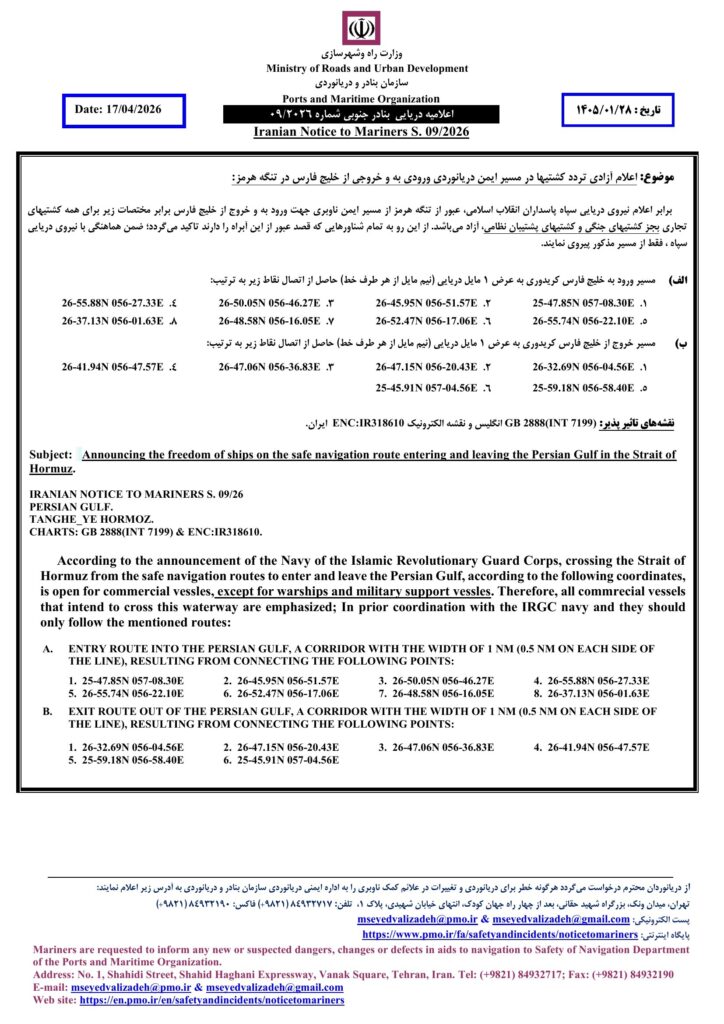
Iranian Notice to Mariners S. 09/2026, issued by the Ports and Maritime Organization of Iran on the same day — 17 April 2026 — and carrying the imprimatur of the Islamic Revolutionary Guard Corps Navy, specifies the terms. They are as follows.
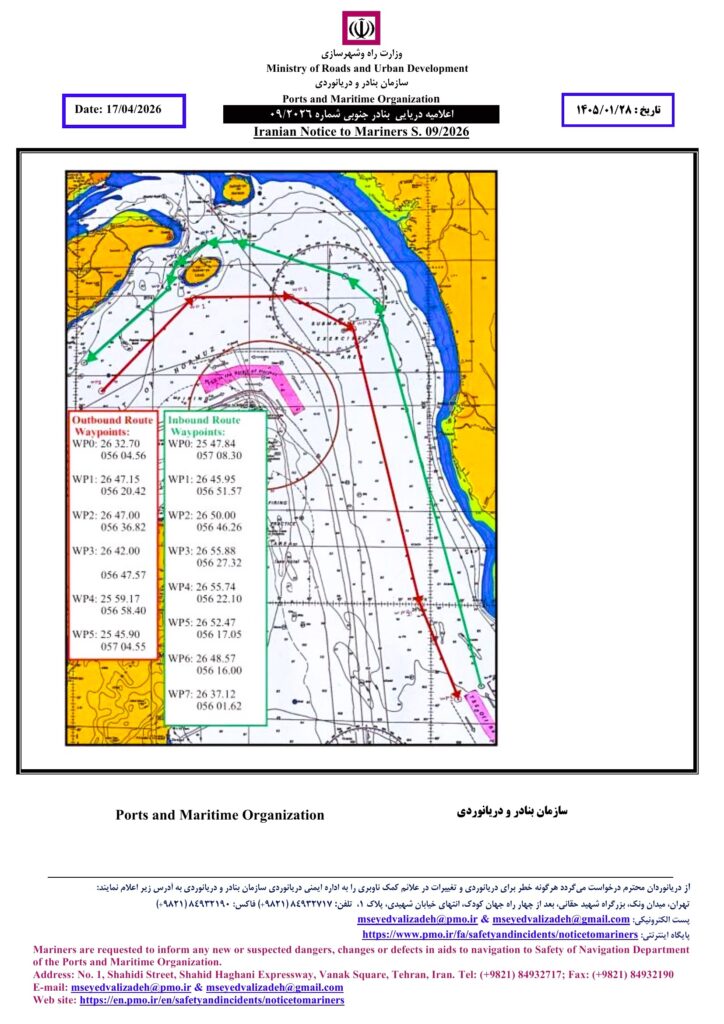
Commercial vessels crossing the Strait of Hormuz must use two designated corridors: one for inbound traffic, one for outbound. Each corridor has a width of one nautical mile — 0.5 NM on each side of the centreline. Prior coordination with the IRGC Navy is mandatory before transit. Warships and military support vessels are explicitly excluded.
Those four sentences contain everything you need to know about the state of the world’s most important oil chokepoint.
The mathematics of a corridor
The Strait of Hormuz is 21 nautical miles wide at its narrowest point. The internationally recognised traffic separation scheme — established under COLREGS and the framework of the UN Convention on the Law of the Sea — runs two lanes of 2 NM each through the strait, with a separation zone between them.
The Notice replaces that with lanes a quarter of the width.
A VLCC — a very large crude carrier, the standard instrument of Gulf oil exports — runs 330 to 340 metres in length. Its beam can reach 60 metres. At standard speeds in confined waters, a VLCC’s swept path under pilotage conditions is typically modelled at 400 to 500 metres. Place two laden VLCCs in opposing lanes inside a 1 NM corridor and you have, on paper, a workable passage. In practice, you have a situation that no P&I underwriter in Lloyd’s Market will insure without exceptional premium — and possibly not at all — when the corridor was drawn by the same organisation that has launched 21 confirmed attacks on merchant shipping since February 28.
The corridor is not a lane. It is a choke within a chokepoint.
Coordination is control
The Notice states that all vessels “intending to cross this waterway are emphasized; In prior coordination with the IRGC navy and they should only follow the mentioned routes.”
Translation: each commercial transit requires advance notification to, and clearance from, a military force that is simultaneously under U.S. naval blockade and actively classified as a hostile actor by the war-risk insurance market. There is no independent arbiter, no neutral flag-state authority, no IMO mechanism for that coordination. The IRGC is the traffic controller, the threat assessment, and the enforcement arm in the same body.
This is not transit passage under UNCLOS Article 38. Transit passage is non-suspendable, non-conditioned, and not subject to flag discrimination. What the Notice describes is managed transit — sovereign permission granted and revokable at will, priced in political terms rather than in tolls.
The Strait of Hormuz was previously governed by international law. Notice S. 09/2026 proposes to replace that governance with operational coordination with a sanctioned military organisation.
No escorts, no certainty
The explicit exclusion of warships and military support vessels from the designated corridors makes any credible escort arrangement legally untenable under the Notice’s own framework. The U.S. Navy cannot accompany commercial vessels through the corridor without violating the published terms. NATO allies considering a multilateral defensive mission — Macron and Starmer announced their April 17 online conference precisely on the day the Notice was issued — would face the same constraint.
Maersk’s response was precise: “The ceasefire may create transit opportunities, but it does not yet provide full maritime certainty.” That sentence was written by a legal and risk department, not a press office. It means: we have read the conditions and they do not meet the threshold for commercial operations to resume.
The IEA put a number on what certainty would require: approximately two months of stabilised flows before the market normalises, even assuming a genuine reopening. Two months from now is mid-June. The current ceasefire expires April 22.
Thirty hours later
By Saturday morning, Iran had reversed its position. Tehran stated it would continue to block transit through the Strait of Hormuz for as long as the U.S. naval blockade of Iranian ports remains in force. The announcement that markets had priced as a reopening had a useful 30-hour shelf life.
The Notice to Mariners remains on issue. The corridors are technically published. The coordination requirement with the IRGC stands. The military exclusion stands. The lanes measure one nautical mile.
The Strait of Hormuz is not open. It is available — conditionally, reversibly, on terms set by the IRGC — to vessels whose flag states maintain acceptable relations with Tehran, whose operators are prepared to coordinate with a sanctioned military organisation, and whose insurers are willing to price that exposure.
That is a different sentence than “completely open.”
The Iranian Notice to Mariners S. 09/2026, dated 17 April 2026, is a public document issued by Iran’s Ports and Maritime Organization. The two designated transit corridors and their coordinates are reproduced verbatim from the official text.