
Iran has lived under U.S. sanctions, in various configurations, since 1979. The standard Western assumption was that sustained economic pressure would eventually force Tehran to the table. What actually happened was less flattering to Washington’s assumptions: four decades of isolation produced not a compliant Iran, but a remarkably well-connected one.
Iran’s trade routes today stretch north through Russia, east through Central Asia and China, and south through ports that compete directly with established Gulf hubs. The infrastructure is not theoretical. The trains are running, the terminals are open, and the financial mechanisms to settle transactions outside the dollar system are advancing faster than most Western analysts prefer to acknowledge.
Tehran’s response to Trump’s latest sanctions threats — “you have routes, so do we” — is not bluster. It is a logistics briefing.
The INSTC: steel rails as strategic doctrine
Iran, Russia and India signed the International North-South Transport Corridor (INSTC) agreement in 2000, but the project spent two decades as an aspirational document. Russia’s full-scale invasion of Ukraine changed that calculation entirely: Moscow needed new trade arteries, fast, and the INSTC was the most viable option on the table.
The critical missing link is the Rasht–Astara railway in northern Iran. Russia has committed over €1.3 billion toward the €1.6 billion project, with Russian engineers already on-site and a completion target of Q3 2027. Once operational, the 7,200-kilometre corridor will cut Russia-to-India transit times from 37 to approximately 19 days and reduce freight costs by around 30% compared to the Suez Canal route. For countries that have been told Western-controlled maritime lanes are the only viable option, this is a pointed rebuttal.
Iran stands at the structural centre of this network, not at its periphery. Cargo volumes on INSTC routes tripled between 2023 and 2024 to approximately 1.8–2 million tonnes, and a roadmap agreed by Kazakhstan, Russia, Iran and Turkmenistan targets 15 million tonnes annually by 2027 and 20 million by 2030.
The Chinese dimension: Belt, road and a direct train to Tehran
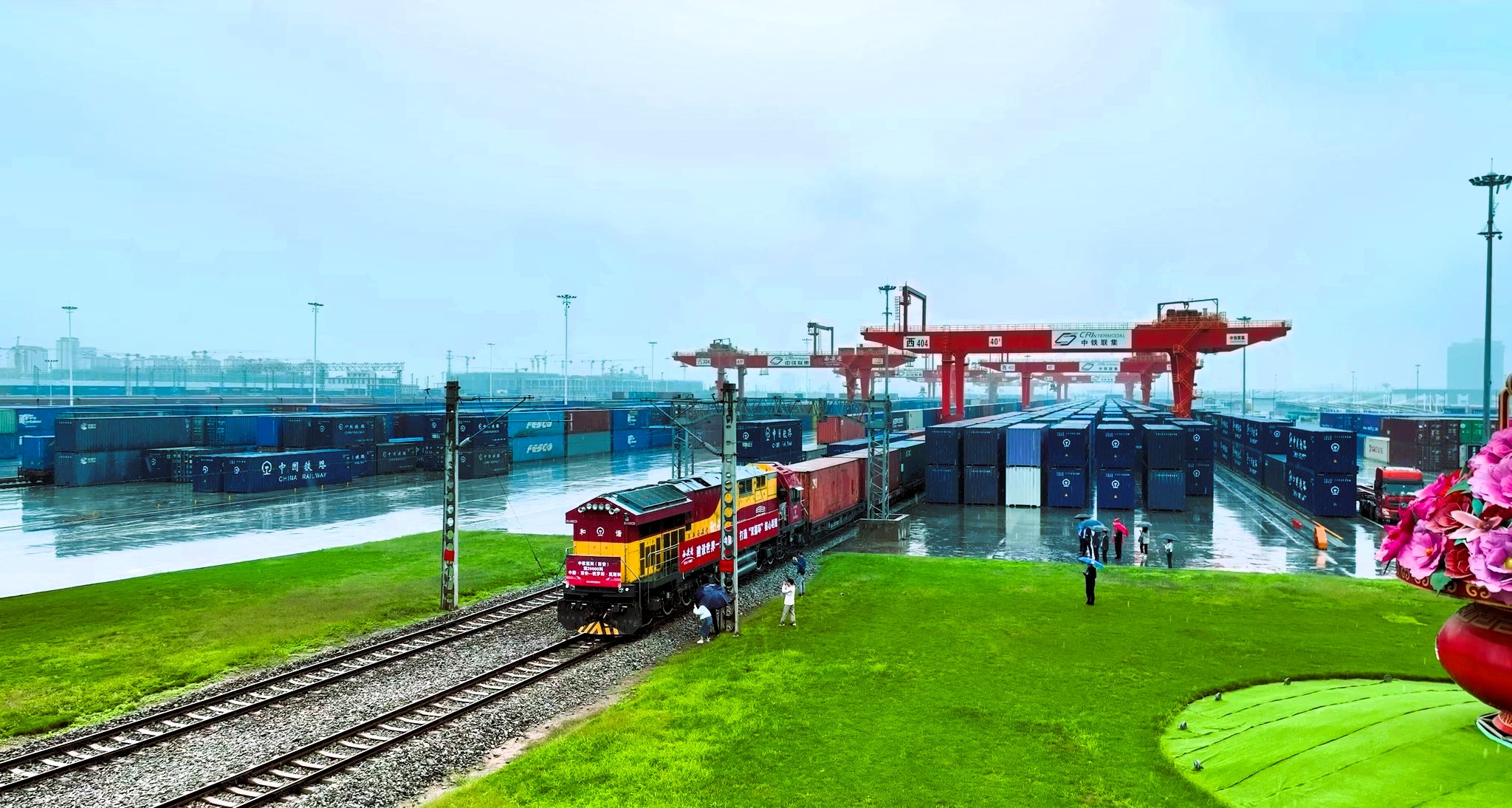
While Russia anchors the north-south axis, China is building the east-west one. Iran joined the Belt and Road Initiative in 2019 and formalised a 25-year, $400 billion strategic partnership with Beijing in 2021, covering trade, energy, infrastructure and military cooperation. The partnership acquired physical form in May 2025, when the first freight train from Xi’an arrived at Iran’s Aprin dry port, covering 10,400 kilometres via Kazakhstan and Turkmenistan in approximately 14 days — roughly half the time of equivalent sea transport.
The pace of adoption tells its own story. By the end of 2025, China had dispatched 40 cargo trains to Iran, against just seven over the previous seven years. In May, senior railway officials from Iran, China, Kazakhstan, Uzbekistan, Turkmenistan and Türkiye met in Tehran to formalise a transcontinental rail framework. A follow-up meeting in Beijing in August then established uniform tariffs and simplified customs procedures across the full China–Central Asia–Iran–Türkiye/EU corridor.
China’s calculation is straightforward: these Iran trade routes bypass Russia (whose reliability as a transit country has been compromised since 2022), avoid the U.S.-backed Middle Corridor through the South Caucasus, and give Beijing a land link to European markets that no naval force can interrupt. For China, Iran is not simply a trade partner — it is a structural component of long-term logistics sovereignty.
Central Asia: the landlocked countries that need Iran
The Central Asian dimension of Iran’s trade route network tends to receive less attention than it merits. Kazakhstan, Uzbekistan, Turkmenistan and Tajikistan are all landlocked, all growing, and all looking for reliable access to open water. Iran offers exactly that, via Bandar Abbas and, increasingly, Chabahar on the Gulf of Oman.
Uzbekistan has already announced plans for a terminal and warehouse facility at Chabahar’s Shahid Beheshti Port. Kazakhstan and Iran agreed in February 2025 to move 5 million tonnes of cargo via Iranian territory over five years. Iran and Turkmenistan, meanwhile, are working toward cross-border freight of 20 million tonnes annually, including up to 6 million by rail. These are commercial contracts with specific targets, not diplomatic communiqués.
Chabahar itself became a flashpoint precisely because of its strategic weight. The Trump administration revoked the Indian sanctions waiver for the port in September 2025, then reinstated it six weeks later under pressure from New Delhi, which holds a 10-year operating contract. The episode was instructive: U.S. sanctions on Iran’s trade routes routinely collide with the interests of countries Washington considers allies, and the allies often win.
Energy: the flow that sanctions cannot stop
Hydrocarbons remain the foundation of Iran’s export economy, and on this front the picture for Washington is equally uncomfortable. Iran delivered an average of 1.38 million barrels per day to China in 2025, a decline of just 7% from 2024, despite a full year of intensified maximum pressure. Tehran’s total estimated energy export revenues for 2025 stand at approximately $60 billion — not the profile of a country being effectively squeezed.
The mechanism is a shadow fleet: hundreds of non-sanctioned vessels operating under flags of convenience, conducting ship-to-ship transfers and routing cargoes through intermediary networks in the UAE, Malaysia and Singapore. The U.S. Treasury designated 29 vessels in late 2025, yet Vortexa data showed Iranian export volumes running at 1.5–1.7 million barrels per day, up 25% from 2023. The enforcement gap is not a temporary anomaly — it is a structural feature of sanctions applied against a country whose principal buyer has no interest in enforcing them.
One detail deserves particular attention: the UAE, Washington’s closest Gulf security partner, imports approximately 70% of Iran’s fuel oil exports. If the sanctions architecture cannot deter the UAE, the argument that it constitutes serious pressure on Tehran requires some generous qualification.
This system is not without structural risk. Much of Iran’s export resilience now rests on a single dominant buyer — China — creating a concentration dynamic that sanctions were originally designed to prevent. The shadow fleet itself operates with limited insurance, opaque ownership structures and elevated operational risk, making it functional but inherently fragile. These are not immediate constraints, but they define the outer limits of how far sanctions evasion can scale.
Iran’s trade routes are no longer a contingency plan
The picture that emerges is not of a country seeking diplomatic off-ramps. It is of a country that spent twenty years constructing a parallel economic system and is now operating it at scale. The INSTC, the China–Central Asia–Iran railway, the Chabahar port complex and the shadow energy fleet together form an architecture that is distributed, multi-partner and structurally resistant to any single point of external disruption.
Washington’s competitive response — the IMEC corridor and the proposed TRIPP route through the South Caucasus — is a legitimate countermove, but neither has moved beyond the planning stage. The Sarakhs railway terminal on the Turkmenistan–Iran border, which China is constructing, was already more than halfway complete by August 2025. The Eurasian Development Bank projects the INSTC alone will handle 30 million tonnes of goods annually by 2030, generating $1.5 billion in transit revenue for Iran each year.
Iran’s trade routes, in short, are the plan — not the backup. The more consequential question for Western strategists is not how to close corridors that are already operational, but whether anything on offer from Washington is more attractive than what Moscow and Beijing have already delivered. So far, the evidence suggests it is not.