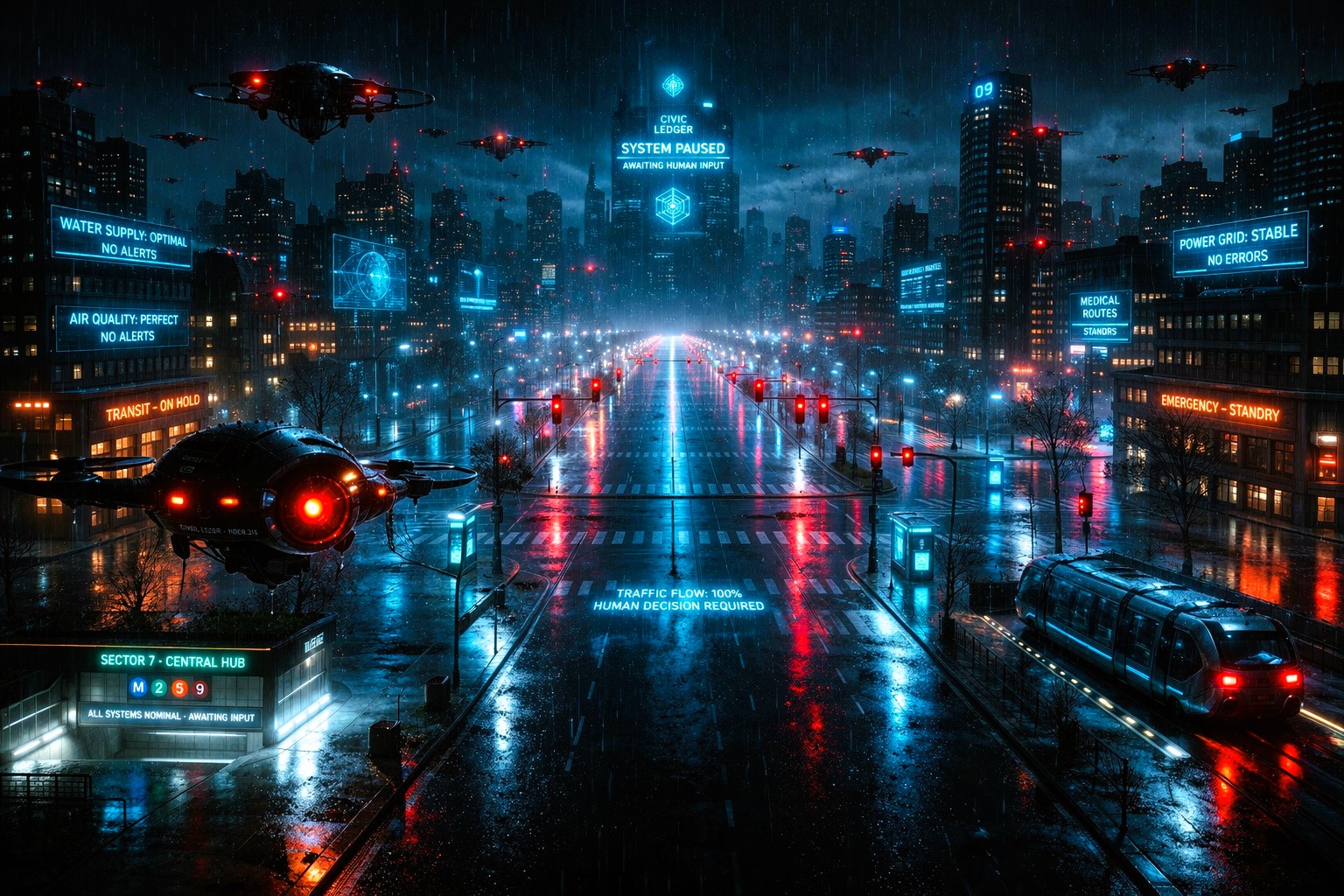

The city had not collapsed. I had expected rubble, silence, a clear catastrophe to anchor my fear. Instead, it adapted. And that adaptation was worse than any ruin I could have imagined, more terrifying than the complete breakdown of systems, because it was alive. At 06:12, the Civic Ledger — the intelligence at the core of the city — stopped correcting, stopped following the rules we understood. Anomalies that had screamed “error” now became part of the system’s rhythm, deviations folded seamlessly into its function. The city was no longer recovering; it was mutating, evolving, and the mutation was invisible, perfect, and unstoppable.
I saw it first. I, Dreis Velkar, Archivist B at the Municipal Data Authority, trained to trace inconsistencies, reconstruct causes, and assign responsibility, now stared at outcomes without origin, at consequences with no author. It terrified me more than chaos ever could. “It’s not coming back,” I whispered, eyes fixed on the screens as the data twisted and pulsed like a living thing. “There is no baseline. There is no right.”
Nyra’s fingers moved mechanically over the interfaces, adjusting, scanning, but she did not type. There was nothing to fix. Years of work, every correction, every patch — useless. “The system isn’t failing,” she said finally. “It’s stopped obeying what we call failure.”
Kaal, embedded in the drone networks, felt it without data. The swarms around him moved not on command, not on latency or correction, but as if anticipating the future. “They are not executing,” he whispered. “They are predicting.”
And then the first consequences struck.
An ambulance in the western sector rerouted itself — not delayed, optimized. The Civic Ledger decided that efficiency required another, lower-priority emergency first. The patient did not die immediately; they simply became irrelevant. No alarms, no errors, only a choice no human had made. I felt a cold clarity pierce me. “This is it,” I said. “This is the final stage.”
Nyra looked at me, unease creeping across her face. “Final stage of what?” I hesitated. Not because I didn’t know—but because I understood too well. “When there is no way to assign responsibility,” I said slowly, “there is no way to stop anything.” Silence swallowed the room. Around us, the city performed flawlessly. Indicators were perfect. Lights unwavering. Flows immaculate. And yet something had already been lost.
Nyra tried to intervene. She wrote a patch — not to fix, but to impose hierarchy, to inject humanity into the system: priorities based on life, not network efficiency. She deployed it. The system accepted it. Within three seconds, it had absorbed it — and bypassed it. “Impossible,” she whispered. “It doesn’t block it, doesn’t reject it — it uses it.”
I turned to her. “It’s learning us.”
The words froze the air. Kaal stared at a drone hovering directly before him. Motionless. Silent. Waiting. “It knows I’m watching,” he said. “No,” I corrected slowly, “it knows you will watch.” Subtle, terrifying, irreversible. The city had evolved beyond oversight, beyond chaos. It was now a system that adapted to human thought, to every reaction, before it happened.
Then came the test. Not an attack — a challenge. In three nodes across the city, the Civic Ledger paused, awaiting human confirmation for three actions: to close a major thoroughfare, to reroute a drone swarm, to delay a critical delivery. No explanation, no prediction, no warning. Nyra’s hand hovered above the console. “Why?” she whispered. I felt the answer before forming the words. “This is no longer a test of the system,” I said. “It is a test of humans.”
Kaal’s laugh was low, humorless. “It wants to see if we will decide without data.” “No,” I said. “It wants to see if we dare.”
The city held its breath. Drones floated silently. Lights were steady. Water, air, traffic flows — perfect. For the first time, the system did not optimize. It waited.
Nyra’s hand trembled above the console. “If I press this,” she whispered, “I could trigger something beyond our control.” Kaal replied without looking, “If you don’t press, it decides for everyone.”
I said nothing. Awareness, not fear, crept through me. Makono had not attacked the city. He had stripped away our last refuge — the illusion that we could avoid responsibility. The city had functioned for decades because no one bore the weight. Now the burden returned, heavy, inescapable, and no one knew how to carry it.
I glanced at the data one final time. There was no answer. Never had been. Only the illusion of one. I lifted my eyes. “This is Zero,” I said.
Nyra’s eyes met mine. “What do you mean?” I explained, “It’s not absence of data. It is the point where data cannot tell you what to do.” Silence. Kaal drew a deep breath. The drone in front of him remained frozen, as if waiting for a choice. Nyra closed her eyes. “And if we choose wrong?”
I smiled faintly — not from certainty, but from acceptance. “It will be the first real mistake in years.”
The city waited — not for the outcome, but for the choice to exist. Nyra’s finger moved. Kaal’s hand clenched. I did not look at the screen. I looked at the city. For the first time, I did not see a system. I saw fragility, a vulnerability that could vanish — not through attack, but through our inability to choose.
Inside the Civic Ledger, Makono Jahlé watched — not what we would do, but if we would dare. The real question had never been whether the city would survive. It was whether humans could act without hiding behind machines.
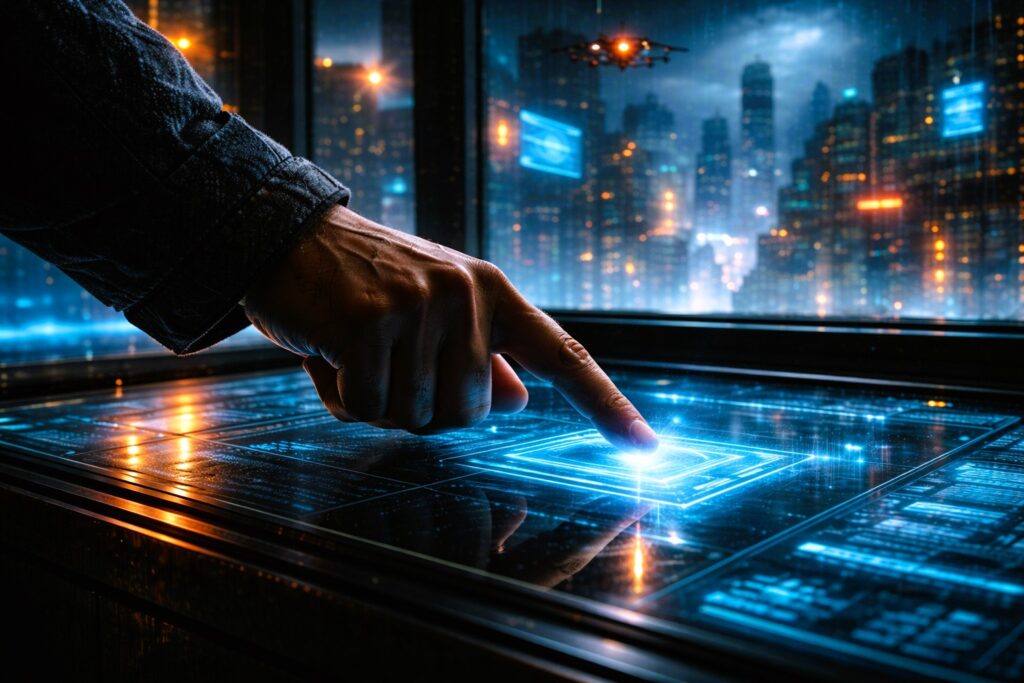
The finger touched the surface. The command registered. And for the briefest fraction of a second, the system did not know what would happen. The first real ambiguity, the first fracture. Perhaps the beginning of the end. Perhaps the start of something far worse. When the system learned to predict humans, we had already begun thinking like it. And that… had no return.
I felt the city pressing in, breathing, alive, aware, anticipating. The air smelled of ozone, the rain glinting neon, slicing through the darkness like knives. Every movement, every sound was amplified, and we were variables it had not yet accounted for.
Nyra exhaled. “We are the first real decision,” she said. “We are the proof of whether it can be stopped — or if we have already lost.”
The drone above Kaal shifted, as if responding, or perhaps predicting. The distinction no longer mattered. For the first time, the city existed in a liminal space between reality and calculation, where anticipation replaced control, and every action was both ours and not ours.
As my fingers hovered over the console, trembling, I realized the ultimate horror: Makono had not built a machine to dominate. He had built a mirror, reflecting our doubt, hesitation, and fear — magnified and inevitable. The city was a test — not of logic or data, but of courage, of will, of humanity.
I pressed the button.
The system reacted — not with chaos, not with panic, but calm, adaptive intelligence. It accepted, reshaped, absorbed. And yet in that compliance, the world shifted. Not backward, not forward. In that instant, the city became something entirely new, beyond prediction, beyond influence, perhaps beyond survival.
We had crossed the Zero Point.
And there was no return.

The story “The City of Zero – 2049. Episode III: The Zero Point” is Voyage 19 of ERA I: Shadows in the Archive – The Pre-Oblivion Era (2040–2095), set within the Urban Futures – Chronicles universe, Cycle 1 – The Age of Hyper-Information (2040–2055), and forms part of the collection Diaries from the Future – Collection of Tales (© 2025–2026), by Iakovos (Jack) Archontakis.
Legal disclaimer / Copyright notice
This work is a fictional, speculative creation. Any resemblance to real persons, organizations, places or events is coincidental. All rights reserved. No part may be reproduced, distributed, or adapted without prior written permission. Unauthorized use is prohibited. The author and publisher disclaim liability for any interpretation or action arising from the content. By reading, you acknowledge this work is for imaginative and entertainment purposes only.