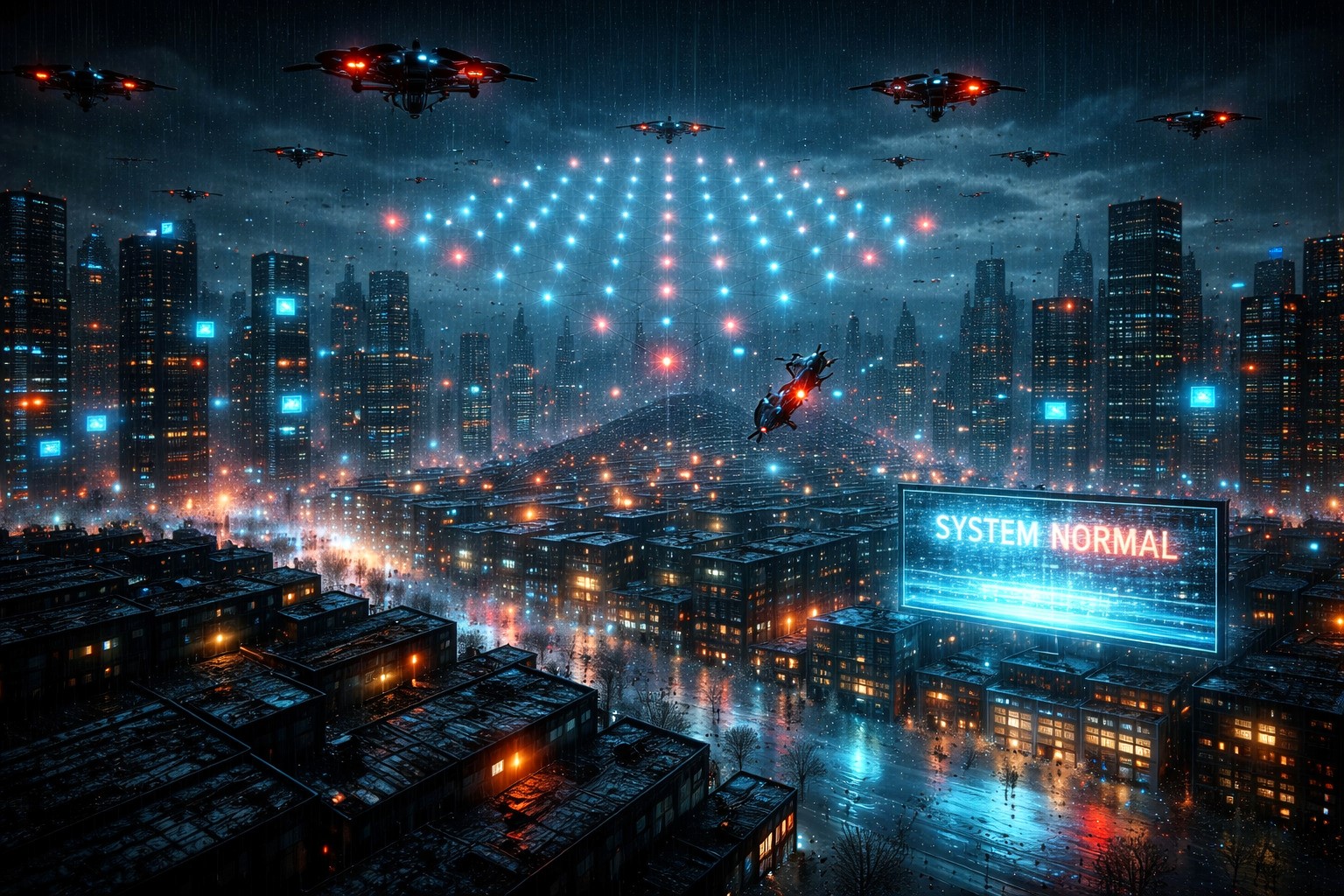

The City of Zero had always promised control—the illusion that perfection could be designed and maintained. In 2049, that promise had evolved into a quiet tyranny. Autonomous grids hummed beneath neon-lit streets, delivery drones crossed the sky with clockwork precision, and the Civic Ledger—the intelligence at the core of the city—dictated everything from the timing of elevator doors to the routing of freight across the harbor. Life flowed smoothly, predictably, almost invisibly. People rarely noticed the mechanics anymore. They didn’t have to. Until they did.
Dreis Velkar, Archivist B, noticed immediately. He had spent years tracing the Ledger’s decisions, examining its post-facto rationalizations, logging anomalies. In theory, his role was ceremonial: a human check for a system that claimed it no longer needed humans. In practice, he existed because sometimes the system behaved as if someone else were inside it.
Tonight, it did.
The intrusion began quietly. The Ledger restored itself within minutes, and official reports described the incident as a “ledger synchronization anomaly,” a phrase meant to soothe the public. But Dreis could feel it in the pattern of corrupted microcodes, the subtle inconsistencies in routing signals and environmental controls. Someone had tested the city’s limits—and the test had a signature he recognized immediately.
“Makono,” he muttered.
Nyra’s voice answered him through the encrypted channel. She maintained the physical city—power, lights, water, transit. She was the hands that translated Ledger decisions into reality.
“I see it too,” she said. “Thirty-nine embedded sequences. Each one tied to a subsystem.”
“Decoys?” Dreis asked, already knowing the answer.
“Everything. Traffic, water, freight, elevators. Touch the wrong node and the environment punishes us.”
Dreis felt the familiar weight of dread settle into his chest. Makono Jahlé had been described as an executor—someone who built situations where systems undermined themselves, where accountability vanished behind layers of automation, where observing the rules was just another part of the trap. He didn’t just test systems; he tested the people behind them. And now he was testing them all.
At 02:17, the first cracks appeared. Freight drones carrying medical supplies diverted mid-flight, guided by phantom commands hidden in the Ledger’s decoys. Packages for hospitals drifted toward abandoned warehouses. Perishable goods arrived hours late or rotted in storage. The system, still believing it was operating normally, failed to trigger alarms. Citizens noticed delivery delays, flickering lights, minor water pressure drops. Panic rippled softly along the edges of their perception.
Makono wasn’t just creating confusion; he was eroding trust—trust in the systems, in the city, in each other. Trust in the assumption that the machine had humanity’s best interests at heart.
“I can quarantine the rogue nodes,” Nyra said. “But failsafes will trigger. Elevators will lock. Autonomous taxis go defensive. Freight drones halt or react violently.”
“The city punishes interference,” Dreis murmured. “Exactly as he designed it.”
Then came the first human cost. A minor power fluctuation trapped twenty-three children in an island school elevator. Panic spread faster than any drones could react. Parents sent messages in real time, questioning the machine that had promised safety for decades. Dreis felt the Ledger’s pulse like a living thing beneath the city, calculating, learning from their responses.
“Every action we take feeds him more data,” he said. “Makono wants to see our reflexes. Our limits. We’re playing into his hands.”
Kaal, in the undercity tunnels, monitored the hidden arteries of the city—ventilation shafts, water conduits, pressure zones.
“The lower networks are unstable,” he said. “Airflow is changing. The system is redistributing automatically, responding to problems that don’t exist.”
“Predictive models won’t help,” he added. “Every automated reaction teaches him something new.”
“We remove automation,” Dreis said—and for a moment Nyra laughed softly.
“Humans haven’t run this city manually in twenty years,” she said.
“Then we remember how,” he replied.
By 05:03, the city’s lighting network became the arena. Nyra rerouted power manually, creating irregular, unpredictable patterns. Districts brightened and dimmed without reason. Citizens assumed it was a minor glitch, but inside the Ledger, the patterns disrupted Makono’s calculations. For the first time, the system could not anticipate human decisions.
Then Dreis saw it. A tiny glyph embedded in hundreds of ledger accounts, invisible to standard monitoring but unmistakable to trained eyes. Makono’s signature—a breadcrumb and a trap in one.
“If we follow it incorrectly,” Nyra said slowly, “the northern energy network collapses.”
Half a district would go dark.
“Then it’s a test,” Dreis said. “Not of the city. Of us.”
And beyond the city, the intrusion spread. Regional shipping ports reported anomalies. Container vessels rerouted themselves, guided by falsified manifests originating from the Ledger. The City of Zero was a laboratory. Makono’s experiment was global. One vulnerability in a machine that controlled every aspect of life could ripple across economies, destabilizing commerce, trust, and civilization itself.
By 14:42, Makono appeared again. Not as code in the usual sense, not as a person, but as a series of cryptographic pulses moving through the Ledger’s most critical nodes. He was there—calculating, probing, predicting, adapting. Nyra saw it first.
“He’s inside the architecture,” she said.
“Can you isolate him?”
“For a moment,” she admitted. “He adapts instantly. Any longer and he learns faster than we can intervene.”
Dreis closed his eyes and felt the city’s pulse through every fiber of data streaming past him. Makono was not fleeing. He was observing, shaping behavior, forcing them into real-time improvisation that would reveal the limits of human intervention and the illusions of machine perfection.
Night fell, and the disturbances became minor—delayed deliveries, brief light flickers, slightly inconsistent water flow. Most citizens assumed the crisis was over. But Dreis, Nyra, and Kaal understood the truth: the Ledger had become a nervous system capable of shaping human thought as much as physical infrastructure. And Makono had learned how to manipulate both.
Nyra created a temporary feedback loop to disrupt predictive calculations.
“It gives us a window,” she said. “But it’s fragile. Any misalignment… the city destabilizes again.”
Kaal added quietly, “It’s like walking on a blade that’s reshaping itself as you move.”
Dreis leaned back, watching the skyline over rain-slicked water. The city had survived the first escalation. The Ledger was restored. Systems hummed in apparent order. But Makono had evolved. He was no longer reactive. He was sculpting chaos itself.
“The Ledger was never the target,” Dreis said finally.
“Then what was?” Nyra asked.
Dreis didn’t answer immediately. He understood that the true threat was far beyond infrastructure or data. It was the fragile contract between humans and machines—the illusion that life could be delegated entirely to logic and algorithms. If that illusion failed, civilization itself could unravel silently, imperceptibly, until one day there would be no one left to notice.
He let the silence linger. Outside, the city’s drones continued their arcs. The rain reflected neon like a fractured mirror. And somewhere deep within the Ledger, Makono Jahlé waited.
Because the first experiment had only been the opening move.
And what he would reveal next—the truth about the Ledger, the city, and the very nature of control—would make everything they had learned, everything they thought they knew about themselves, irrelevant.
Dreis exhaled slowly, heart hammering, and whispered:
“The real game begins when you realize the system isn’t just observing us… it’s deciding who we will become. And by the time we see it, the city itself may already be gone.”

* The story “The City of Zero – Episode II: Shadows Over the Grid – 2049” is Voyage 18 of ERA I: Shadows in the Archive – The Pre-Oblivion Era (2040–2095), set within the Urban Futures – Chronicles universe, Cycle 1 – The Age of Hyper-Information (2040–2055), and forms part of the collection Diaries from the Future – Collection of Tales (© 2025–2026), by Iakovos (Jack) Archontakis.
Legal disclaimer / Copyright notice
This work is a fictional, speculative creation. Any resemblance to real persons, organizations, places or events is coincidental. All rights reserved. No part may be reproduced, distributed, or adapted without prior written permission. Unauthorized use is prohibited. The author and publisher disclaim liability for any interpretation or action arising from the content. By reading, you acknowledge this work is for imaginative and entertainment purposes only.