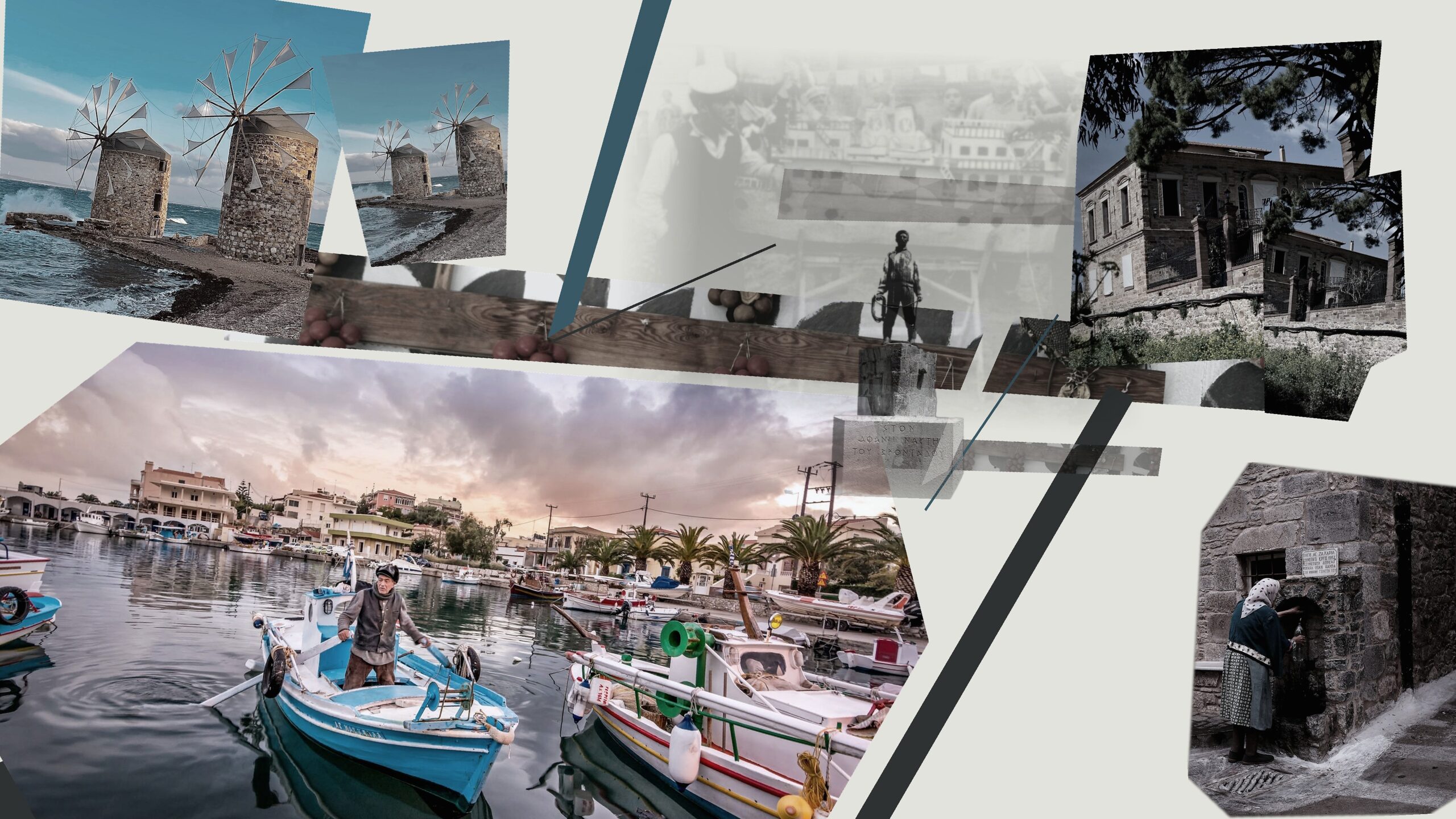

Chios is not merely an island. It is a homeland shaped by sea, history, mastic, people and journeys. A place that does not need to shout to be heard; it only needs to be felt.
For the people of Chios, the island is not simply a destination. It is a root, a memory, an identity.
An island that waits for you
Anyone who grew up in Chios knows that the island has a way of calling you back. You may leave for studies, for work, for voyages to distant seas. Decades may pass. Yet when you see the Castle again, when the first meltemi brushes your face, when you walk through the narrow lanes of Pyrgi, there is a strange sense that time has not forgotten you.
Chios does not wait with nostalgia. It waits with constancy.
For every Chiot who returns, that constancy carries a quiet, unmistakable emotion: the feeling that some places remain part of you regardless of how far you travel.
Where the sea becomes inheritance
Chios is not simply an island with seafarers. It is an island that creates them.
For centuries, its geography pushed its people towards the sea, but geography alone cannot explain what followed. Maritime knowledge became embedded in families and communities. Experience passed from captains and engineers to sons and daughters, from shipowners to younger generations, from the bridge and engine room back to homes on the island.
Vrontados, Kardamyla and Kampos became more than places on the map of Chios. Each in its own way became part of an island culture shaped by maritime enterprise, family networks and connections reaching far beyond the Aegean. They became reservoirs of maritime knowledge, ambition and continuity. The sea entered family conversations, expectations and decisions. A first voyage was rarely an encounter with an unknown world; often, someone in the family had already travelled it.
Over generations, this produced something larger than a tradition of seamanship. It created a maritime ecosystem built on trust, family networks, accumulated experience and a willingness to take commercial risk. Seafarers became captains, captains became shipowners, and family enterprises grew beyond the island into international shipping businesses.
Some of the names rooted in Chios would eventually become part of the story of Greek shipping worldwide. But the deeper achievement was not simply the creation of fleets. It was the creation of continuity: the ability of a small island to reproduce maritime knowledge across generations and carry it into a global industry.
That is why Chios did not become a maritime force by accident. Its people learned to live with the sea, not merely beside it. Seamanship was taught aboard ships and in academies, but its first lessons often began much earlier: at home, at the harbor, through the stories of those who had left and returned.
And every Chiot with a seafarer in the family knows the other inheritance the sea brings: pride mixed with absence, expectation with worry.
The sea gave Chios opportunity. It also taught the island how to wait.
The land that weeps mastic
In the Mastic Villages, the land has its own memory.
The carved bark of the mastic trees, the whitewashed courtyards and the patient rhythm of cultivation reveal another side of the island’s character. Chios does not simply produce a valuable commodity. It has built a culture around something that can grow commercially on this scale nowhere else in the world.
Mastic demands patience. The tree cannot be hurried, and neither can the work surrounding it. Knowledge is passed through families, season after season, much as maritime knowledge travelled through generations elsewhere on the island.
There is something almost symbolic in the way the mastic tree “weeps.” Its resin is collected drop by drop, turning persistence into value.
For a Chiot, it represents more than a product. It is another form of continuity.
Landscapes that do not need to perform
From Anavatos to Nea Moni, from Kardamyla to Pyrgi, Chios has landscapes that rarely seek easy admiration. Their power lies elsewhere: in history, endurance and the lives accumulated within them.
Anavatos stands as a monument to survival and loss. Nea Moni carries centuries of faith, art and history. Pyrgi turns geometry into an everyday language across its façades. Kardamyla looks outward to the sea, carrying a maritime rhythm that has shaped generations.
These places do not make Chios significant because they are picturesque. They matter because they reveal different layers of the same island: agricultural, spiritual, maritime, architectural and historical.
For those who come from Chios, beauty and memory are difficult to separate.
The Chios of today and tomorrow
Chios is not an island that rushes. It persists.
Tourism is growing, but it has not consumed the island’s character. Its economy changes, yet its old foundations remain visible. Shipping still connects Chios to the world. Mastic still ties families to the land. Villages retain identities formed long before the language of destinations and visitor numbers arrived.
Young people leave, as generations before them did. Some leave for education, others for careers or the sea. Not all return permanently.
But departure has always been part of the Chios story.
The more important question is whether connection survives distance: whether knowledge, investment, memory and a sense of belonging continue to travel back to the island.
That may be where Chios’s future lies. Not in resisting change, but in absorbing it without surrendering what made the island distinctive in the first place.
An island with nothing to prove
Chios does not need to win the world.
In a sense, generations of its people have already travelled through much of it. They crossed oceans, built businesses, worked ships, cultivated a unique land and returned carrying stories that became part of the island’s collective memory.
Perhaps that is Chios’s greatest gift.
It teaches you that belonging does not require permanence. You can leave and still carry a place with you. You can cross oceans and still recognise home in a harbor, a village street, the scent of mastic or the first wind coming off the Aegean.
For the people of Chios, the island is not simply where journeys begin or end. It is what travels with them.
Perhaps that is Chios’s greatest gift: the certainty that, no matter how much the world changes or how far life takes you, there is an island that remains — steady, familiar, yours.

Disclaimer
This article reflects solely the personal views of the author and is intended for informational and analytical purposes. It does not constitute an official position or representation of any organization or institution.