

Maps have always been generous to Greece. The country sits between the Suez approaches, the Black Sea, the Balkans and the European interior. Piraeus handles Asian container flows. Thessaloniki faces a natural Balkan hinterland. Alexandroupolis offers access towards Bulgaria, Romania and NATO’s eastern flank. On paper, this looks like strategic abundance.
But ports do not create corridors. Connections do. A container terminal can process millions of boxes without becoming a continental gateway. A railway can exist without carrying enough freight to matter. A corridor begins only when port capacity, rail capacity, border interoperability and predictable services combine into a usable route. Geography supplies the invitation. Infrastructure decides who attends.
That distinction matters because the global transport map is becoming less tolerant of single-route dependence. The World Bank’s 2023 assessment of the Middle Corridor concluded that the right investments and efficiency measures could triple freight volumes and halve travel times by 2030 — reaching roughly 11 million tonnes, a rounding error beside ocean freight. The European Union has been pursuing a Europe–Central Asia connection of 15 days or less, with European and international financial institutions committing €10 billion towards sustainable transport connectivity at the Global Gateway Investors Forum in January 2024. These are not plans to replace Suez. They are investments in optionality. A secondary route does not need to displace the primary one to acquire geopolitical value. It needs to become credible enough that states, carriers and cargo owners possess another option when the main artery becomes expensive, politically exposed or physically constrained.
Türkiye is answering a diagnosis
The World Bank’s Middle Corridor study deliberately excluded Türkiye. Its stated reason was blunt: infrastructure gaps and inefficiencies in Türkiye meant operators were routing across the Black Sea instead, bypassing Turkish territory altogether. A country on the corridor’s most obvious land route was being designed around.
What has happened since reads as a direct answer.
In December 2024 the World Bank approved $660 million towards the Divriği–Kars–Georgian border line — the section its own analysts had identified as the single most capacity-constrained stretch of the entire Middle Corridor by 2023. The project is designed to lift nominal freight capacity from roughly 750,000 tonnes to 20 million tonnes annually. In March 2026 the Bank approved a further $2 billion for the Istanbul North Rail Crossing, anchoring a coordinated $6.75 billion package from six multilateral lenders against a total project cost of around $8.3 billion; AIIB signed the first phase of its own contribution, up to $1.5 billion, in July 2026. That crossing is projected to raise cross-Bosphorus rail freight capacity from around 3 million to as much as 50 million tonnes a year — capacity serving all of Türkiye’s international rail corridors, not the Middle Corridor alone.
The Bank describes this explicitly as a sequence, and the logic is clear: capacity is being expanded at the eastern constraint, while the next major bottleneck, the Bosphorus crossing, is now being attacked at scale. Türkiye is attacking both ends of the same corridor problem.
The anticipation lies in the arithmetic. Türkiye is designing one critical section for 20 million tonnes of annual capacity even though the World Bank’s optimistic scenario puts total Middle Corridor flows at roughly 11 million tonnes by 2030.
It is worth stating what this is not: evidence of Turkish rail strength. Around 95% of Turkish freight still moves by road. Ankara is building from a low base too. The difference is not current performance. It is sequencing, stated targets, and the willingness to fix a bottleneck an international lender had publicly named.
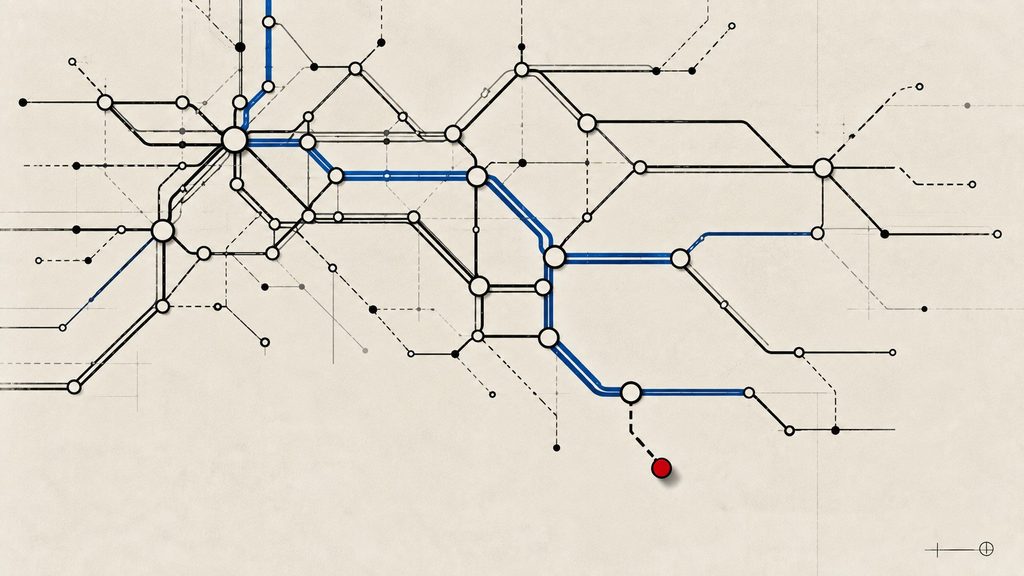
Greece builds from a very small base
Greece presents almost the inverse picture, and the inversion is stranger than it first appears.
Its rail freight sector is exceptionally small. Eurostat recorded Greece below one billion tonne-kilometres in 2024, alongside Estonia, Luxembourg and Ireland at the bottom of the EU table. Per head of population, Greece moved 0.06 tonnes by rail — second-lowest in the Union, ahead only of Ireland.
The recent trajectory carries an unmistakable signature. Greek rail freight performance fell 32.3% in 2023, the year of the Tempi disaster, then posted the largest increase of any EU country in 2024, up 13.5%. In 2025, Greece again recorded the EU’s largest increase, up 9.3%, even as rail freight performance across the Union fell 1.8% for a fourth consecutive year. A collapse followed by two years of growth, visible in the European statistics.
Yet another number makes the picture considerably more interesting. In 2024 Greece recorded the highest international share of rail freight performance in the entire EU: 95.9%.
The comparison that matters is the Netherlands, at 87.8% — and Eurostat explains the Dutch figure directly, attributing it to Rotterdam’s large sea-to-rail transfers of goods dispatched within the EU. In the Netherlands, Eurostat can connect the national pattern to a specific port. In Greece, the national figure is too aggregated to tell us which port, if any, is generating the international rail flow.
The irony is that Greece posts a higher international share than the Netherlands, yet offers far less public visibility into the port-to-rail flows behind it. That paradox changes the question. Greece does not need freight rail principally because of the size of its domestic railway market — its rail freight is barely a domestic market at all. It needs it because its ports sit on maritime networks whose economic value extends northwards only if cargo can cross the hinterland efficiently. Rail corridors are not an accessory to Greek port policy. They determine how much maritime geography converts into continental reach.
Piraeus: a port is not necessarily a gateway
Piraeus Container Terminal describes its facility as directly connected to the national and European rail networks through its own rail ramp, states that the ramp can handle up to ten trains per day, and markets rail services towards Central Europe and the Balkans. Its 2024 sustainability report presents that connectivity as part of the terminal’s intermodal proposition.
That report runs to 55 pages. It discloses total effluent discharge to two decimal places, fifteen environmental spills totalling 898 kilograms, a chief executive pay ratio of 8.56, a gender pay gap of 29.67%, emissions per TEU handled, and a supplier ESG questionnaire response rate of 19%.
It does not disclose how many trains the terminal handled, how many TEU left by rail, or what share of container traffic moved on a railway.
Our review of publicly available PPA, PCT, COSCO and Greek rail-regulatory material identified no consistent port-level indicator showing what proportion of Piraeus container traffic enters or leaves by rail.
That absence proves neither failure nor concealment. It proves something narrower and more useful: publicly available data cannot demonstrate how effectively Piraeus performs as a continental rail gateway. Capacity is disclosed. Connectivity is advertised. Gateway performance is not measurable from outside.
Asked directly, the pattern holds. In December 2025, Naftemporiki put the question to PPA’s president, Han Chao: was COSCO planning new investment in Piraeus’s rail interconnection? His answer described a new infrastructure plan “worth over 50 million euros,” but the figure bundled facility renovation with unspecified new services, no rail-specific number inside it. On rail itself, he said only that “interventions are also being examined that will strengthen the railway interconnection, enhancing intermodality.” No figure, no timeline, no target. Asked point-blank about rail, the president’s answer was that rail was still being looked at.
One detail belongs in the record. PCT’s 2024 report lists Scope 3 emissions as “to be announced,” with calculation beginning in 2025 on 2024 data. Hinterland transport falls squarely within Scope 3. There is a date, in other words, after which some of this may become visible.
When another port measures what Piraeus does not
There is nothing technically exotic about the measurement. Transport for NSW publishes a monthly public dataset showing the number and proportion of TEU moved by rail to and from Port Botany, calculated by dividing rail TEU moved by the port’s three stevedores into total monthly trade volume. NSW Ports separately publishes a long-term goal of moving 3 million TEU by rail by 2045 — roughly 40% of forecast future container volumes — and links specific infrastructure investment to it.
The instructive part is not that Botany measures and Piraeus does not. It is what the measuring revealed.
The NSW Freight and Ports Plan 2018–2023 set a strategic target of lifting Port Botany’s rail share to 28%, or 930,000 TEU, by 2021, against a 2016 baseline of 17.5% and 388,552 TEU. That plan has since expired. In June 2025, the NSW Government endorsed a broader Freight Policy Reform programme. Before the plan expired, New South Wales’ own Auditor-General reviewed Transport for NSW’s data and concluded that the target would not be met.
It was missed. Not merely by inference from raw TEU figures: before the deadline, the state’s own independent auditor, using the state’s own data, had concluded that it would not be met. Transport for NSW continues to publish the rail-share metric publicly.
A closer comparator sits across the Mediterranean, at the port that overtook Piraeus in the EU rankings. Valenciaport publishes rail figures as a routine part of its monthly statistics. In the first half of 2026, containers moved by rail reached 144,803 TEU, up 16.78% year on year, against total throughput of 2.82 million TEU — a rail share of roughly 5%. Rail tonnage grew faster still, up 19.51%. RailFreight.com, doing the same division this article could not do for Piraeus, noted plainly that rail freight still plays a marginal role at Valencia even as it grows. By the end of July the trend had continued: rail tonnage for the year had reached 2.3 million tonnes (+19.31%) and rail containers 172,328 TEU (+17.97%), against 3.28 million TEU handled overall, still close to a 5% share. A year earlier, Valenciaport had reported a similar figure differently: more than 8% of total land traffic, a narrower, gateway-specific denominator based on land traffic rather than total port throughput.
That second figure is the more instructive one. It mirrors the distinction this article has already drawn for Piraeus’s own Pier I: total throughput and gateway cargo are different quantities, and a port that wants to measure its rail performance honestly reports the share of traffic that could plausibly move by rail, not the share of everything that crosses the quay. Valencia publishes both versions. Piraeus publishes neither.
Neither comparison is a league table. Sydney, Valencia and Piraeus serve different markets and different shipping structures. The point concerns governance. A port that publishes a gateway metric can fail against it in public and be held to account. A port that publishes no gateway target cannot be judged publicly against one.
There is a substantial difference between possessing a railway and managing rail corridors against measurable objectives. One is infrastructure. The other is strategy.
Thessaloniki: the natural gateway that must prove itself
Thessaloniki points towards the Balkans rather than the Mediterranean transshipment business that dominates much of Piraeus. Its strategic test is not whether it can emulate Piraeus. It is whether rail can turn proximity to Balkan markets into reliable hinterland reach.
Ownership requires precision, and rewards it.
Thessaloniki Port Authority disclosures show Belterra Investments controlling 72.91% of voting rights as of February 2025, directly and through South Europe Gateway Thessaloniki, which holds 67%. Claims that the port is simply “Russian-controlled” go beyond what those filings establish — and the filings themselves illustrate why. ThPA’s own regulated announcement names Belterra’s controlling ultimate beneficial owner as Nikos Savvidis, while Greek media routinely attribute the holding to Ivan Savvidis.
The structure also resists the tidy division that places Chinese capital in Piraeus and Russian-linked capital in Thessaloniki. SEGT’s other significant shareholder is CMA CGM’s Terminal Link, itself 49% owned by China Merchants Port Holdings, a Chinese state-controlled group. Both of Greece’s principal container ports contain Chinese capital in their ownership ecosystems — but in radically different forms and degrees. In Piraeus, COSCO holds direct operating control. In Thessaloniki, the exposure is an indirect minority stake, several corporate layers removed.
Corporate geography is layered. National labels flatten it. Geopolitics becomes rather silly when adjectives are asked to do the work of shareholder registers. The harder question is connectivity. If Thessaloniki can translate location into dependable northbound freight flows, it becomes a genuine Balkan gateway. If connections remain constrained, geography merely provides an excellent view of an opportunity passing by.
Alexandroupolis belongs to another map
Alexandroupolis should not be forced into the same commercial comparison. In March 2024 the U.S. Army moved roughly 3,000 pieces of equipment through the port, including Abrams tanks and Bradley fighting vehicles, with onward movement by rail and road towards Poland and Bulgaria, as part of a rotational deployment supporting NATO deterrence. That is not port competition. It is military mobility.
Here the investment map becomes intriguing. Under the CEF 2024 call the European Commission allocated €277.2 million to upgrade and double-track the Alexandroupolis–Pythio line near the Turkish and Bulgarian borders, formally handed over in Alexandroupolis during Europe Day in May 2026. A separate, much smaller CEF grant has already funded preliminary studies for the adjoining Pythio–Ormenio section, which would extend the line to the Bulgarian border.
That does not make the project military. Its significance lies in potential dual use: commercial freight, cross-border resilience and military mobility can occupy the same rails. Infrastructure is notoriously indifferent to the uniform of the cargo.
Alexandroupolis shows that commercial scale and strategic value can diverge sharply.
Greece is building more than restoration
This prevents an easy but incorrect verdict that Greece merely repairs old railway infrastructure. Under CEF2 the Commission committed a maximum EU contribution of €154.2 million to a new single-track line between Nea Karvali and Toxotes on the Thessaloniki–Kavala–Alexandroupolis axis, including a branch to Kavala’s new cargo port, against a tendered project budget of around €192.5 million.
The project has become a case study in how a genuine safety finding can still end in institutional gridlock. A European Parliament written question tabled in late 2025 by five Greek MEPs alleged that the project’s environmental approval had failed to account for risks from a nearby natural-gas pipeline and ammonia-storage installations covered by the Seveso III regime. The Commission, answering in February 2026, confirmed the environmental conditions were under review by Greece’s Council of State following an appeal, and that its position on co-financing would depend on the court’s ruling.
The safety finding was real, and it was addressed: revised environmental terms were issued that same month. But the revision changed the project’s physical and economic scope so substantially from what had originally gone out to tender that Greece’s Court of Audit ruled in May 2026 — a separate body that vets major public contracts before signature — that the contract as tendered could no longer be signed. Regional and technical press described the tender as effectively dead. Whether Greece re-tenders the project, on what terms, and what becomes of the €154.2 million in committed EU funding, remained open as of this writing.
So the evidence does not support the comfortable accusation that Greece has no corridor policy. Nor does it support treating infrastructure announcements as functioning corridors — Nea Karvali–Toxotes is now the clearest exhibit for the latter. Rail corridors exist when investments produce reliable flows, border capacity and measurable gateway performance.

Which railway produces which geopolitical Greece?
Three Greek ports reveal three different forms of infrastructure power.
Piraeus asks whether Chinese-backed maritime scale can become continental gateway reach. Thessaloniki asks whether natural Balkan geography can become commercial connectivity. Alexandroupolis asks nothing of the kind — it demonstrates that a port can matter strategically without mattering commercially.
This is where rail corridors cease to be a transport story. They become a question of access. Türkiye is expanding a railway towards the Caucasus, and now across the Bosphorus, because Ankara wants future flows to encounter Turkish infrastructure. Greece is investing too, particularly in its northern network. But the final judgement cannot rest on kilometres built or euros awarded.
It must rest on flows — and on whether anyone is counting them.
Greece has begun building the hardware of corridors. What remains unclear is whether it is also building the traffic, the targets and the accountability that turn infrastructure into strategic reach. Geography has already done its part. The rest must show up in the flows, and someone has to publish them.