
Look at the feeder container market from a distance and it appears straightforward enough. The global containership orderbook has climbed to 12.98 million TEU across 1,592 vessels, with 74% of new orders since July 2025 concentrated in ships below 6,500 TEU. Spot freight rates face persistent downward pressure. By any traditional reading, this is a market in oversupply.
And yet charter rates in the feeder container market remain stubbornly resilient. Forward fixing windows have stretched to six, nine, twelve months. Owners continue ordering at pace. MPC Container Ships entered Q1 2026 reporting 99.1% fleet utilisation, a charter backlog of approximately USD 2 billion, and 99% of its 2026 operating days already covered by contracts. In a market supposedly drowning in capacity, this is not how distress behaves.
So what exactly is happening? The answer lies not in supply and demand as economists draw them, but in access. And access, in this context, is a question of power.
The tonnage squeeze: the disappearance of available ships
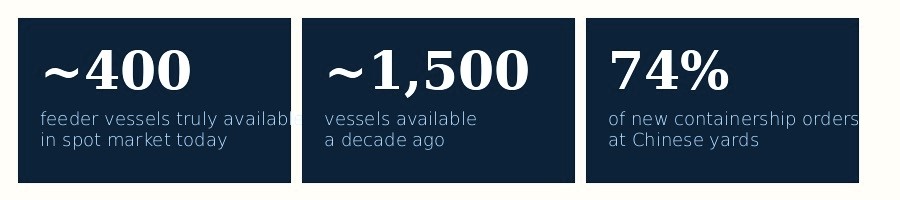
A decade ago, a charterer seeking feeder tonnage could browse a pool of roughly 1,500 available vessels. Today, according to assessments cited across multiple market presentations, that genuinely available pool sits closer to 400. The ships have not vanished. Access to them has.
Forward fixing transformed the feeder container market from a spot transaction into a strategic allocation exercise. Liners now secure tonnage six to twelve months ahead of requirement, effectively locking up availability before it reaches the open market. MPCC reiterated this view in its Q1 2026 results. CEO Constantin Baack noted that “limited availability of modern feeder tonnage and an orderbook concentrated in larger vessels” continued to underpin the segment’s supply-demand balance, with the company’s own Q1 2026 report noting that above 3,000 TEU, charterers were already turning to Q4 2026 positions to secure capacity in advance.
This is the paradox at the heart of the feeder container market: capacity exists, but capacity cannot be obtained. The orderbook is full. The available list is empty. And the gap between the two is where the real market operates.
The feeder container market does not suffer from a shortage of ships. It suffers from a shortage of accessible ships. And in shipping, control over access is often more valuable than ownership itself
The new triangle: owner, liner, shipyard
Traditional market logic held that demand shaped ordering. Freight rates rose, owners ordered ships, supply caught up, rates fell. The cycle was mechanical and, for those who timed it well, profitable. That logic is weakening in the feeder container market in ways that matter beyond the next charter fixture.
A growing share of feeder capacity is now pre-positioned years in advance, structured around a three-way relationship between shipowner, liner operator, and shipyard. The transaction is no longer primarily about freight. It is a capacity-allocation agreement dressed in commercial clothing. MPCC’s $340 million acquisition of four 7,000 TEU vessels announced on 25 June 2026 came with three-year fixed-rate charters to a top-5 liner already in place before the deal closed. The ship was ordered because the charter was secured, not the other way around.
The market no longer sets the price and then fills the slot. The slot is filled first, then the market acknowledges the price. It is a subtle but consequential inversion, and it concentrates leverage in the hands of whoever controls the slots.
Chinese shipyards at full speed
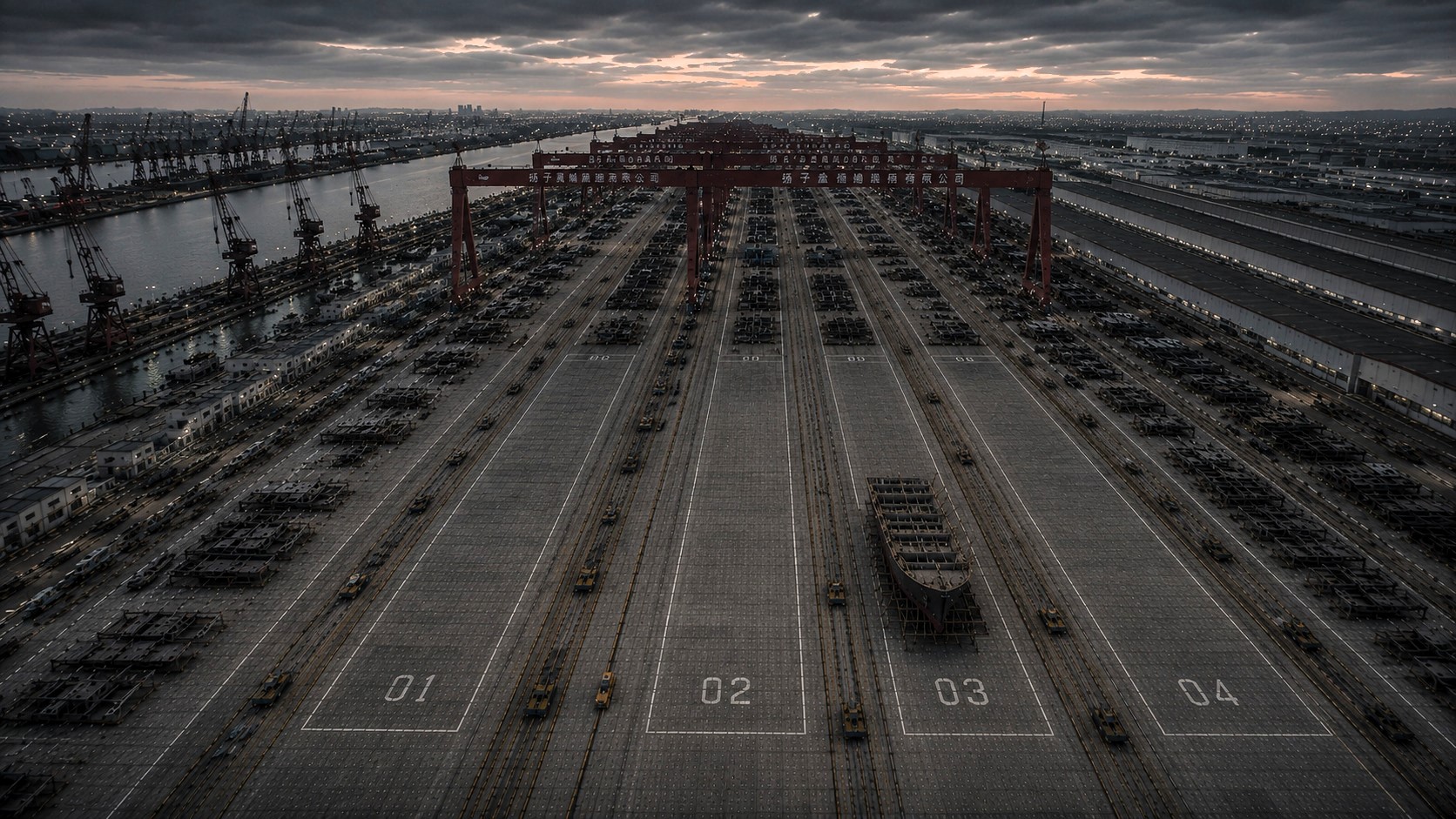
Most of the new feeder container market capacity under construction is being built in China. According to Alphaliner data compiled in June 2026, Chinese shipbuilders hold approximately 74% of the global containership orderbook by TEU, a dominance that has accelerated sharply over the past three years. CSSC’s Huangpu Wenchong and Yangzijiang are the two names appearing most frequently in feeder and mid-size order announcements, with delivery slots committed well into 2029 and beyond.
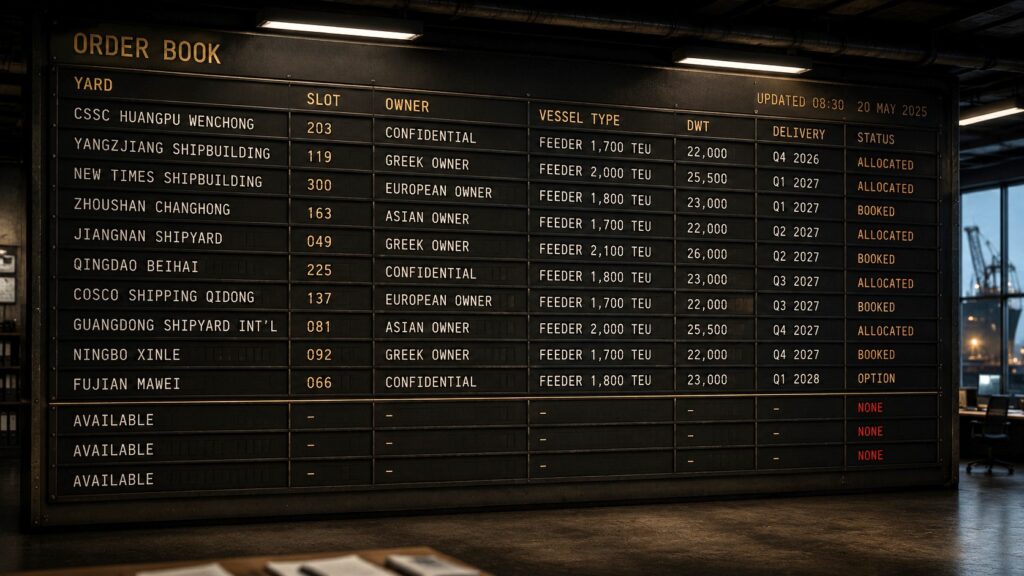
Top-tier Chinese shipyards are booked through 2028, with second-tier yards now absorbing the overflow and delivery waits stretching to three or four years, according to a June 2026 market analysis. Yangzijiang’s Q1 2026 results showed an outstanding orderbook of $22.3 billion across 252 vessels, with clean-energy vessels representing 69% of its backlog value and delivery schedules extending through 2030. The ability to build has become almost as strategically significant as the ability to operate.
Delivery slots are now a commodity in their own right. Shipowners who want modern, fuel-efficient feeder tonnage for 2029 delivery must contract today, at Chinese yards, at prices set by yards operating with full books. The price discovery mechanism has moved from the charter market to the shipbuilding negotiation. The feeder container market is, in this sense, a construction market first.
Erasmus, OceanV, and Greek capital at Chinese yards
Greek shipowners remain among the most active participants in the feeder container market renewal cycle, and a growing proportion of their orders are flowing toward Chinese yards. The pattern is consistent enough to constitute a trend rather than a series of isolated decisions.
| Owner | Vessels | Size | Yard | Source |
|---|---|---|---|---|
| Erasmus Shipinvest | 2 firm + 2 options | 1,800 TEU | CSSC Huangpu Wenchong | Splash247, Apr 2026 |
| OceanV Maritime | 8 (three tranches 2025–2026) | 1,900 TEU | CSSC Huangpu Wenchong | The Loadstar, Jun 2026 |
| Global Ship Lease | 4 firm | 6,200 TEU | CSSC Huangpu Wenchong | Splash247, Jun 2026 |
| Erasmus Shipinvest / CULines | 2 firm + 2 options | 1,900 TEU | CSSC Huangpu Wenchong | Splash247, Jun 2026 |
The significance here extends beyond the commercial. Greek capital is helping finance the industrial infrastructure that will produce a substantial portion of the world’s future feeder container market capacity. A single order package at Huangpu Wenchong announced in June 2026 involved thirteen vessels across Greek, German, and Chinese buyers — a consortium of Western capital and Chinese production that has become the default structure of the feeder renewal cycle.
This is where the discussion begins to leave shipping economics and enters something else.
Piraeus as a strategic hub
Piraeus handled 3.98 million TEU in 2025, making it one of Europe’s largest container gateways. Since COSCO assumed control of Piers II and III in 2009, terminal capacity has grown from 1.5 million to 6.2 million TEU. The port is embedded in China’s Belt and Road framework and features prominently in the country’s 15th Five-Year Plan as a European logistics node. Piraeus is not simply handling containers. It is handling influence.
The connection between Greek capital flowing into Chinese shipyards and Chinese capital operating Greece’s primary container terminal is not coincidental. It reflects the same logic operating at different scales. The feeder container market connects these two flows: vessels ordered at Chinese yards frequently serve liner operators whose transshipment volumes pass through COSCO-managed infrastructure. The capital, the construction, and the connectivity converge on the same axis.
COSCO’s own 2025 annual results reported a 6% decline in Piraeus throughput, from 4.23 million TEU in 2024 to 3.98 million TEU, attributing the drop to weakening Mediterranean transshipment demand. The port’s strategic ambitions remain intact, but the numbers underline a structural vulnerability that no amount of investment resolves without improved regional security.
Tangier Med: the challenger
While Piraeus wrestles with the consequences of Red Sea disruption, Tangier Med handled 11.1 million TEU in 2025, an 8.4% increase on the prior year — growth that sits uncomfortably alongside Piraeus’s simultaneous decline. Morocco’s Nador West Med port is scheduled to open in the fourth quarter of 2026, adding up to 12 million TEU of additional annual capacity.
The competitive threat to Piraeus in the feeder container market context is real and structural. Tangier Med operates under Maersk’s APM Terminals and serves the Western Mediterranean with Strait of Gibraltar proximity that Piraeus simply cannot replicate geographically. The battle is no longer about ports. It is about which network architecture — and ultimately which set of strategic interests — shapes Mediterranean container flows.
Who controls the feeder chain?
The textbook answer is that the feeder container market distributes control across owners, liners, and charterers in a continuous negotiation mediated by rates. That answer was largely adequate when 1,500 vessels were available and the transaction was genuinely competitive. It is substantially less adequate when 400 vessels are available, slots are pre-allocated years in advance, and the industrial capacity to produce new tonnage is concentrated in a single country’s shipyards.
The owner controls the asset. The liner controls the cargo. The shipyard controls the delivery slot. But the actor capable of influencing all three simultaneously — through port ownership, through long-term industrial capacity, through embedded liner relationships — occupies a structural position that no individual shipowner or liner can match. MPCC’s own Q2 2025 earnings call noted that around one quarter of the approximately 4,000 vessels in the 1,000–8,000 TEU segment are above 20 years of age and will require renewal within the next five years — while the orderbook for that same segment remains in single digits as a percentage of the fleet on the water. The replacement cycle that follows will run through Chinese yards, at Chinese prices, on Chinese delivery timelines.
That is where the discussion leaves shipping economics and enters geoeconomics.
The uncomfortable question
Greece is not simply ordering feeder container market vessels from China. It is helping finance part of the industrial ecosystem that underpins China’s global logistics architecture. The capital flows are commercially rational, individually defensible, and collectively significant. Greek owners bring deep operational expertise and access to Western capital markets. Chinese yards offer price, slot availability, and scale that no other supplier can currently match. The transaction makes sense for both parties.
The counterargument deserves a hearing. Greek shipowners are not choosing China out of sentiment or political alignment. They are choosing it because, as a recent OECD analysis of 1,777 ship orders placed between 2020 and 2024 confirmed, Chinese-built containerships are priced consistently below those from other major shipbuilding economies, with the gap reaching double digits in key size segments — and European shipyards have effectively exited the feeder segment entirely. In a market where delivery slots are a strategic commodity, the rational actor orders where the slots exist. This is not dependency by design. It is the consequence of a 30-year industrial retreat by Europe from commercial shipbuilding.
That distinction matters. But it does not dissolve the problem. Whether the concentration of feeder-building capacity in Chinese yards is the result of deliberate strategy or accumulated European neglect, the outcome is structurally identical: the feeder container market in the Eastern Mediterranean connects Greek-flagged tonnage, Chinese-built vessels, COSCO-operated terminal infrastructure, and Belt and Road trade flows into a single interconnected system. How that concentration was created is a historical question. What it enables is a present one.
The question is not who owns the ships. The orderbook for ships under 5,000 TEU represents just 8% of the existing fleet by vessel count, against 35% for larger vessels — a structural underinvestment that guarantees continued tightness in the feeder container market for years. Whoever controls the replacement supply controls the trajectory of the segment. That is a position China’s shipbuilding industry has already secured, and one that Greek capital is, quite literally, helping to fund.
The Brussels question
On 4 March 2026, the European Commission adopted its EU Industrial Maritime Strategy, declaring that “EU shipbuilding and shipping are vital to the Union’s strategic autonomy, trade flows, mobility, defence capabilities.” The Commission acknowledged directly that European yards face “growing dependencies on third-country ship production” and announced an EU Industrial Maritime Value Chain Alliance to coordinate investment. The language is unambiguous. The feeder container market, however, is not mentioned.
The strategy prioritises high-technology vessels: cruise ships, research vessels, icebreakers, offshore wind installation ships. These are segments where European yards retain competitive relevance. The feeder segment — the one responsible for connecting Europe’s secondary ports to its main transshipment hubs — is left to market forces that, as this analysis has demonstrated, now operate almost entirely through Chinese industrial capacity. The Commission is designing a maritime sovereignty framework with a significant gap in its centre.
The port side is equally unresolved. The EU’s Foreign Subsidies Regulation has produced zero forced divestments of COSCO positions as of Q1 2026. Berlin capped COSCO’s Hamburg stake at 24.9%. Piraeus remains at 67% COSCO ownership. Brussels has the regulatory vocabulary of strategic autonomy but has not yet deployed it against the most consequential Chinese maritime position in the EU. Lloyd’s List reported in February 2026 that the EU Ports Strategy would introduce new strategic security criteria on foreign ownership — which would make future Chinese port investments harder, but leaves existing concessions intact for their remaining duration.
The architecture of the problem is therefore layered. European shipyards have withdrawn from feeder construction. European capital — including Greek capital — fills the demand for new vessels through Chinese yards. Chinese state-owned infrastructure operates the primary transshipment hub for the Eastern Mediterranean. And the regulatory framework designed to address these dependencies was adopted too late to affect the dominant positions already secured. The mechanism by which commercial entanglement becomes political constraint is not theoretical. One documented illustration comes from Greece. The Soufan Center cited Greece’s alignment against EU statements on the South China Sea ruling following COSCO’s investment in Piraeus as an example of how port concessions can reshape voting behaviour in multilateral forums (Soufan Center, July 2025). Such strategic shifts rarely begin with dramatic political declarations. They emerge quietly, often without a single headline about shipping. The feeder container market is not where European strategic autonomy will be won or lost.
It is, however, a precise and legible illustration of how strategic exposure accumulates: not through any single dramatic acquisition, but through the compounding of individually rational commercial decisions across shipbuilding, ownership, chartering, and port concessions until the aggregate becomes something that no single actor chose and no single regulation can easily reverse. That is the question the feeder paradox poses to Brussels. Not about containerships. About whether the concept of open strategic autonomy can survive a logistics architecture it did not design and no longer controls.
The feeder market is not a peripheral shipping segment. It is where industrial policy, maritime logistics and geopolitical influence become inseparable — long before the rest of the market notices.
geo-trends.eu · Closing analysis
The feeder container market does not suffer from a shortage of ships. It suffers from a shortage of accessible ships. And in shipping, control over access is often more valuable than ownership itself. That principle applies equally to charter slots, delivery berths, and Mediterranean port infrastructure. The feeder paradox is not a market anomaly. It is a preview of how geoeconomic leverage gets quietly embedded in commercial logistics.