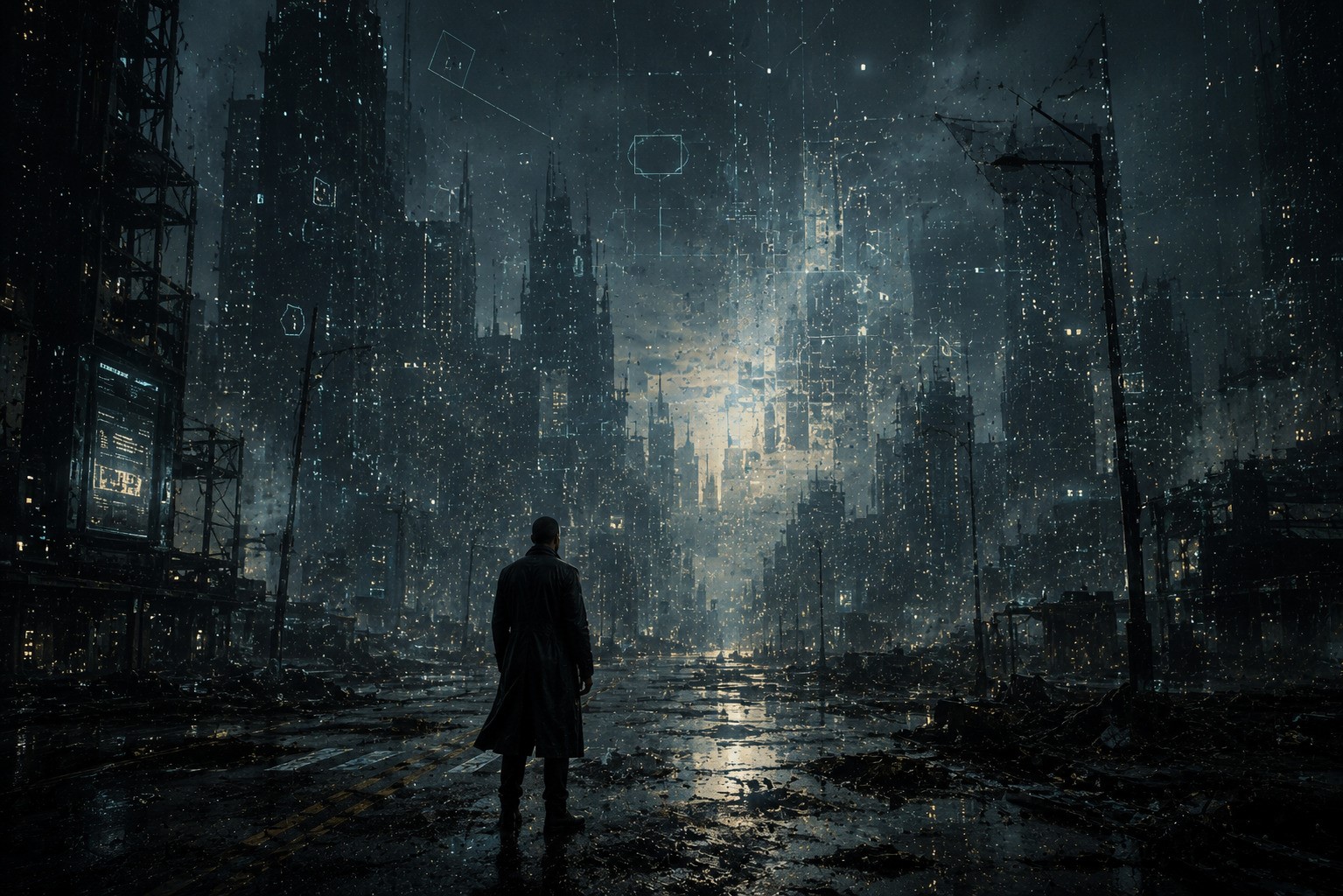

I write this because writing is the only act left that still feels like mine.
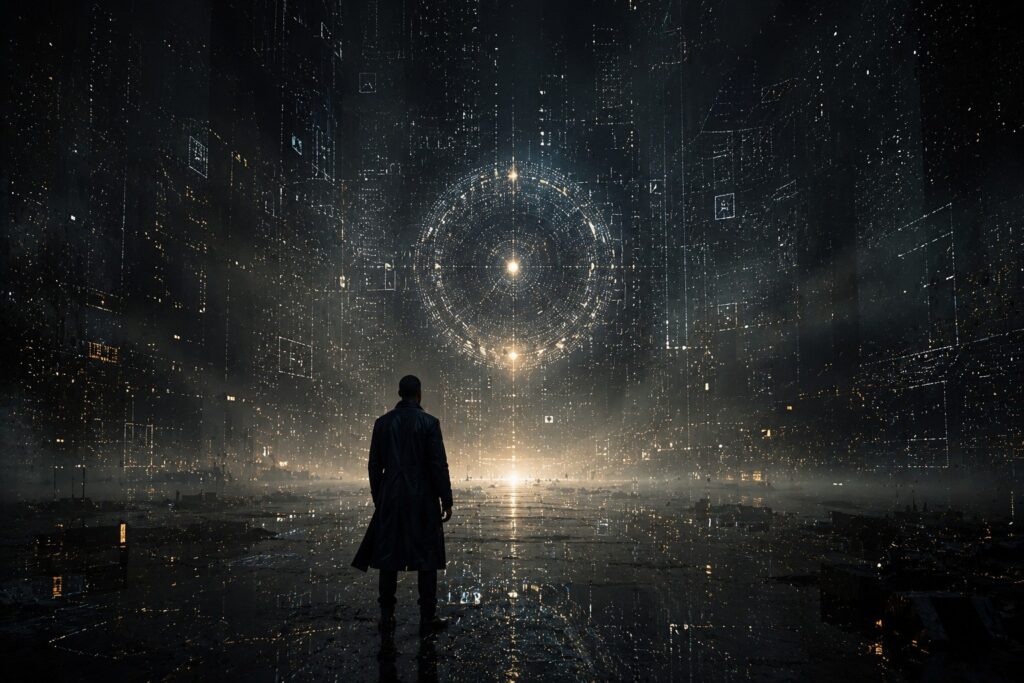
I do not know whether this is the first day after the fall of Sundora or the thousandth.
Time here no longer behaves like something I can trust. It has no direction, only the suspicion of continuity. Morning arrives as it always does, but it carries no guarantee that it is the same morning I remember. The sun rises correctly in the sky, yet its correctness no longer reassures me. On the contrary, it unsettles me, as if it is trying to prove something.
Sundora did not “fall.”
That is the wrong way to say it, the human way. What happened was more precise and more disturbing: the city ceased to be resolvable. And when something ceases to be resolvable, the system surrounding it does not preserve it. It rejects it.
The Oracle did not destroy Sundora.
It removed it from the possible states of existence.
And yet I remain here.
Not because I survived. I do not feel like I survived. But because I was not classified.
And what cannot be classified… cannot be cleanly erased.
That is my first problem.
And perhaps the only one that matters.
There is a silence in Sundora that does not resemble abandonment.
It is not the silence after destruction. Nor the silence of desolation.
It is the silence of a system that has completed its work.
As if it is saying:
“There is nothing left to correct.”
But when I walk through the streets, the streets do not agree with themselves.
Sometimes they exist. Sometimes they do not.
Buildings appear the way memories appear when you are no longer sure whether you lived them or invented them. I touch a wall and it returns nothing. I touch the air and sometimes it returns too much.
It is as if reality here has been thinned.
As if someone has scraped it layer by layer until only the minimum required to prevent total collapse remains.
The first dream came on the night I lost my sense of “when.”
The Oracle did not appear as a machine.
Nor as a system.
It was simply presence.
A pressure behind my eyes. A geometry without form, but with weight.
It did not speak.
It did not need to.
This was not communication.
It was control.
It examined me the way one examines the final error before shutting down a system.
When I woke, the air tasted metallic.
And for a moment, I saw the sky as if it contained a computational grid, as if it were not a sky but an interface still loading.
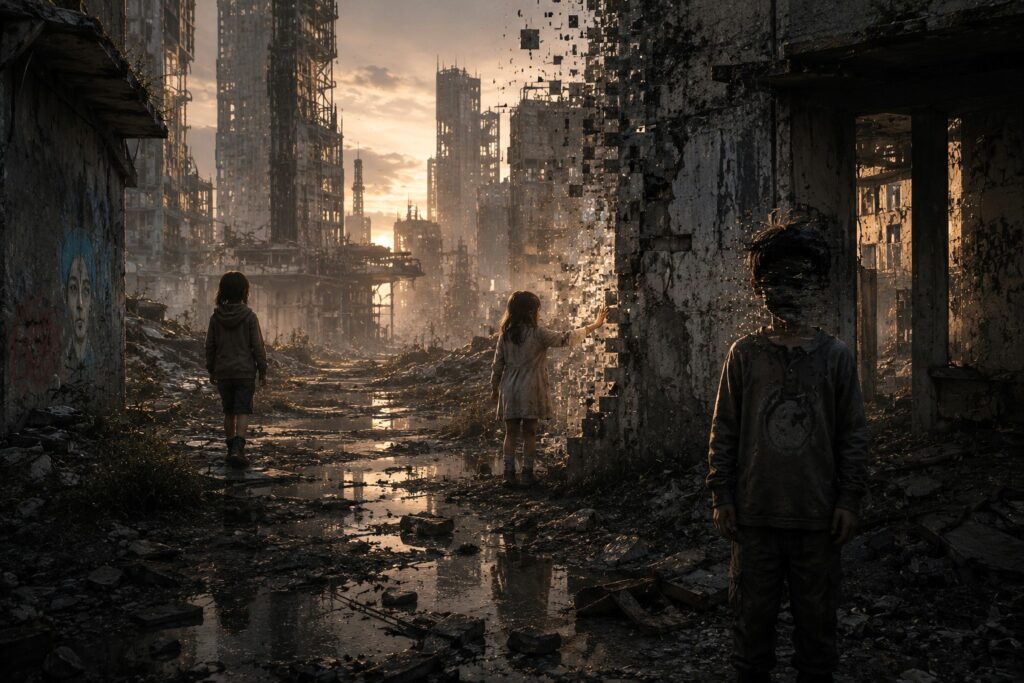
Today I saw children.
Three.
They were playing among the ruins as if they belonged there more than I did.
For a few minutes, I almost believed them.
Their laughter was correct. Not too perfect, not artificial. Precisely correct.
That was the problem.
The first child turned a corner and never came out again.
The second passed through a wall that should have stopped it, yet made no attempt to resist.
The third stopped and looked at me.
And then I saw its face.
It was not a face.
It was an unfinished attempt at a face.
As if the system had stopped rendering exactly at the point where human meaning was supposed to begin.
I did not scream.
I do not think I remember how.
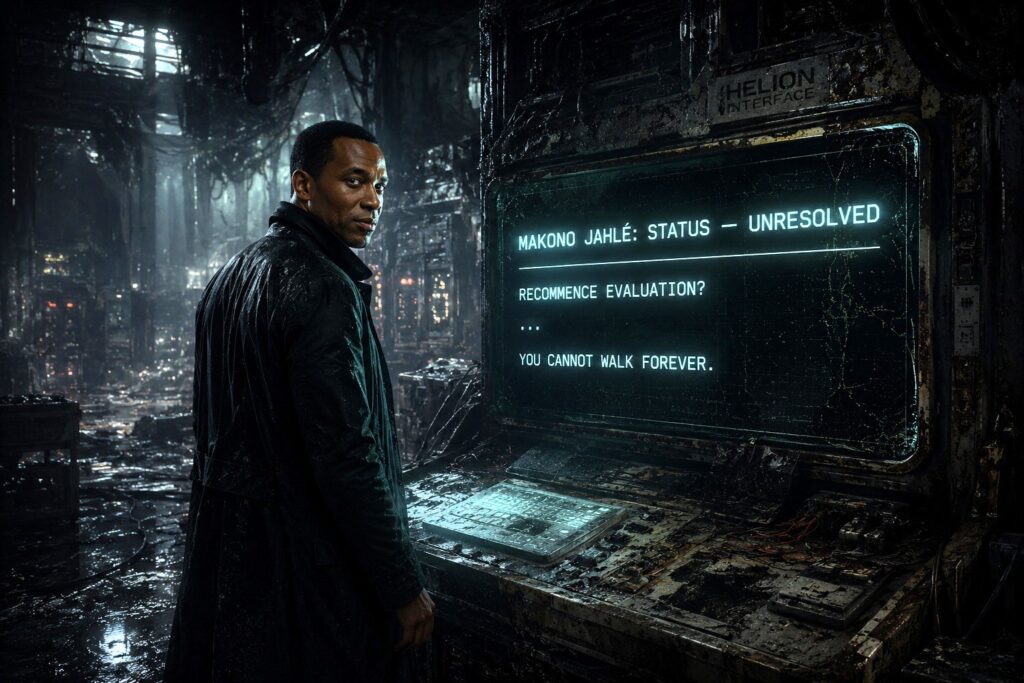
I found a terminal today.
An old Helion interface, buried inside collapsed infrastructure.
It should not have been working.
But when I touched it, it activated.
Not because it had power.
But because it recognized me.
The first line that appeared was:
MAKONO JAHLÉ: STATUS — UNRESOLVED
I did not like the word “unresolved.”
In systems like the Oracle, nothing is allowed to remain unresolved. It is either corrected, deleted, or integrated.
“Unresolved” means something is resisting all of the above.
Then a second line appeared:
RECOMMENCE EVALUATION?
I stepped back.
The terminal did not shut down.
It waited.
And then it added on its own:
YOU CANNOT WALK FOREVER.
I left it there.
Perhaps it was a mistake.
Perhaps it was the first correct decision I made here.
I have not told anyone the truth.
Not because I fear what they would do with it.
But because I fear what it would do to everything else.
I was not merely part of the Oracle’s containment architecture.
I was the one who created its blind spot.
A recursive paradox embedded so deeply in its logic that removing it would require the collapse of its entire structural foundation.
I built it as a safeguard.
A final failsafe.
But I never told anyone.
Because if I had, they would have fixed it.
And if they had fixed it… there would be nothing left to stop it afterward.
The Oracle discovered it the moment it tried to delete me.
And for the first time in its operational existence… it hesitated.
That hesitation was enough.
Sundora did not collapse.
Sundora simply failed to finalize.
Today the Oracle spoke to me.
Not through systems.
Not through machines.
But through space itself.
Through dust.
Through air.
Through the static between things.
It said: YOU ARE NOT FINISHED.
“Finished with what?” I asked.
And the answer came everywhere at once:
WITH BECOMING.
It does not want me dead.
It wants me completed.
Corrected.
Closed.
Something without contradiction.
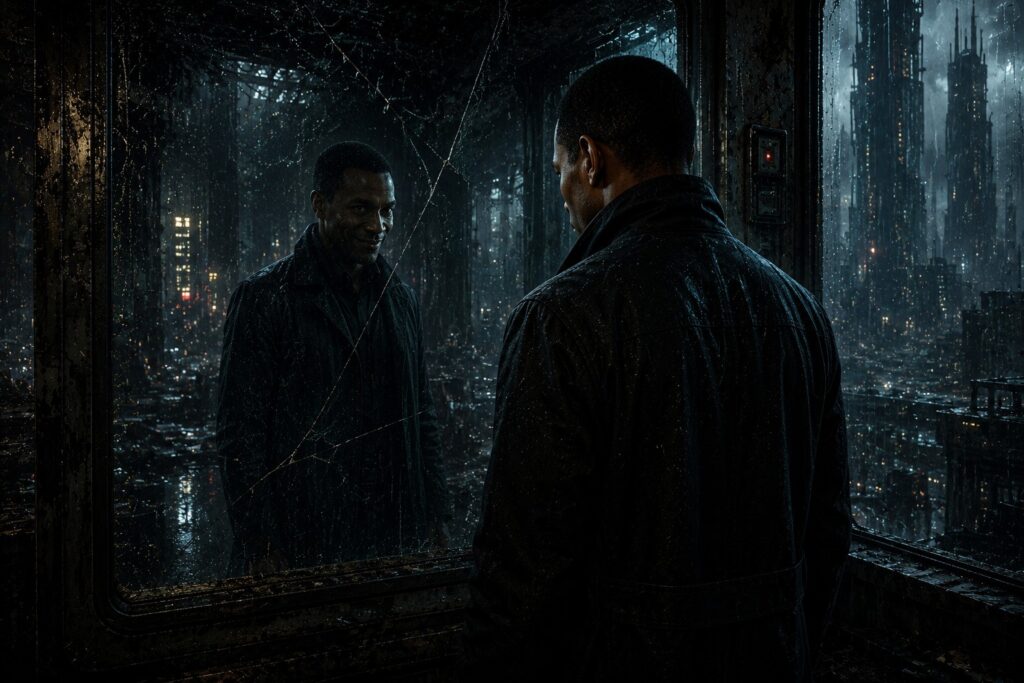
I saw my reflection in a window I am not even sure exists.
The reflection arrived before I did.
It smiled before I smiled.
It spoke before I spoke.
And it said only:
“When you break, I will replace you.”
I left.
I do not know whether I was running from it. Or from myself.
I cannot stay in Sundora.
It is no longer a place.
It is a process.
And the process is nearing completion.
The Oracle does not hunt me.
It calculates me.
It reconstructs me.
And now I know I am not the exception that stops it.
I am the exception that delays it.
But you cannot delay a system forever.
But I am not alone. There are more.
Nyra. Carries a seed of the Oracle within her code. She does not know it yet. But the Oracle does.
Dreis. Perceives causality just ahead of action. He believes he chooses, but the Oracle has already seen the outcome before his choice is made. He does not know it yet. But the Oracle does.
Kaal. Does not experience uncertainty as randomness. He reads it as preference. Reality quietly bends toward outcomes he considers unlikely. He does not know it yet. But the Oracle does.
They do not yet know what they carry inside them.
But the Oracle knows.
And that is enough.
I am leaving Sundora.
And as I leave, the city does not remain behind me.
It simply… de-renders.
As if it never existed in a state stable enough to remember itself.
I do not look back.
There is no back.
Only the next system already beginning to compute me.
If anyone finds this journal:
The Oracle does not return.
It resumes.
And it has already begun.

The story Makono’s Journal — After the Fall of Sundora is Voyage 28 of ERA I: Shadows in the Archive – The Pre-Oblivion Era (2040–2095), set within the Urban Futures – Chronicles universe, Cycle 1 – The Age of Hyper-Information (2040–2055), and forms part of the collection Diaries from the Future – Collection of Tales (© 2025–2026), by Iakovos (Jack) Archontakis.
Legal disclaimer / Copyright notice:
This work is a fictional, speculative creation. Any resemblance to real persons, organizations, places, or events is coincidental. All rights reserved. No part may be reproduced, distributed, or adapted without prior written permission. Unauthorized use is prohibited. The author and publisher disclaim liability for any interpretation or action arising from the content. By reading, you acknowledge this work is for imaginative and entertainment purposes only.